The HyperTexts
Sappho Unveiled: Modern English Translations of Ancient Greek Epigrams, Fragments and Lyric Poems
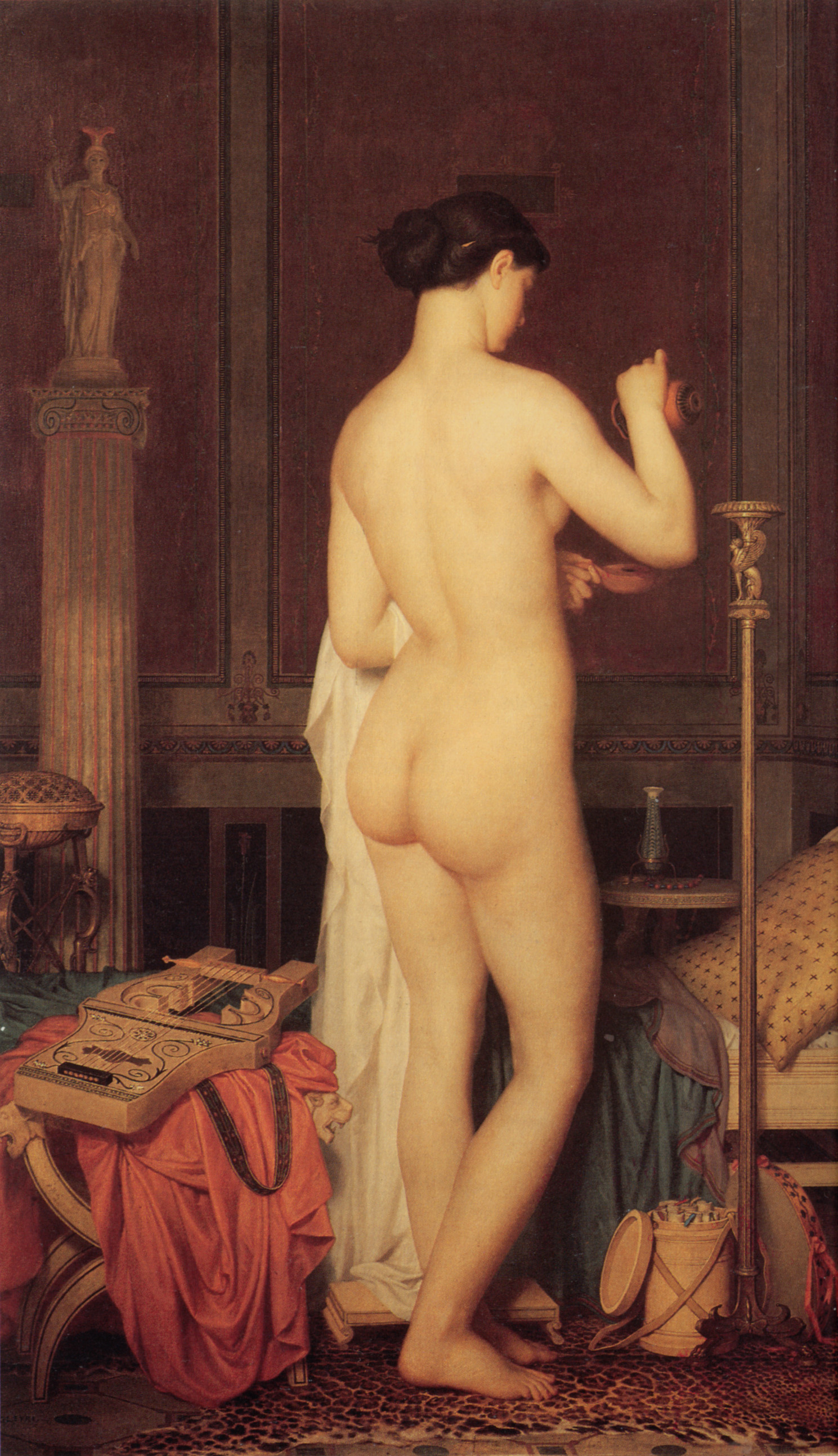
Gleyre Le Coucher de Sappho
by Marc-Charles-Gabriel Gleyre
Introduction by Michael R. Burch
This is my "Complete Sappho" collection. It contains approximately 290 modern English translations of the lyric poems, epigrams, fragments and quotations of
the Immortal Sappho of
Lesbos. Approximately 195 of these translations are either new or revised as of
October 28, 2024 and such translations are tagged "(rev'd)" to make them easier
to spot and find.
Sappho was the first great lyric poet of antiquity. She is known especially for her "Sapphics"―love
poems and songs―some of which are considered to be bisexual in nature, or lesbian (a term derived from the name of her island home, Lesbos).
A short revealing frock?
It's just my luck
your lips were made to mock!
—Sappho, fragment 177,
loose translation/interpretation by Michael R. Burch
But was Sappho just another love poet, or was she the Love Poet?
According to Margaret Reynolds: "Certainly Sappho seems to have been an original
inventor of the language of sexual desire." I believe we can safely call
Sappho the "first Poet of the erotic" with a capital P.
Eros harrows my heart:
wild winds whipping desolate mountains,
uprooting oaks.
—Sappho, fragment 47,
loose translation/interpretation by Michael R. Burch
The poem above is my favorite Sappho epigram. The metaphor of Eros (sexual
desire) harrowing mountain slopes, leveling oaks and leaving them desolate, is
really something―truly powerful and evocative. According to Edwin Marion Cox,
this Sapphic epigram was "quoted by Maximus Tyrius
about 150 BC. He speaks of Socrates exciting Phaedus to madness, when he speaks
of love."
That enticing girl's clinging dresses
leave me trembling, overcome by happiness,
as once, when I saw the Goddess
in my prayers
eclipsing Cyprus.
—Sappho, fragment 22,
loose translation/interpretation by Michael R. Burch
As J. B. Hare, one of her translators, said, "Sappho the poet was an innovator. At the time poetry was principally used in ceremonial
contexts, and to extol the deeds of brave soldiers. Sappho had the audacity to use the first person in poetry and to discuss deep human
emotions, particularly the erotic, in ways that had never been approached by anyone before her. As for the military angle, in one of the
longer fragments (#3) she says: 'Some say that the fairest thing upon the dark earth is a host of horsemen, and some say a host of foot
soldiers, and others again a fleet of ships, but for me it is my beloved.' In the ancient world she was considered to be on an equal
footing with Homer, and was acclaimed as the 'tenth muse.'"
Gongyla, wear, I beg,
that bewitching white dress …
—Sappho, fragment 22,
loose translation/interpretation by Michael R. Burch
(rev'd)
Bed the bride with the beautiful feet,
or bring her to me!
—Sappho, fragment 103b,
loose translation/interpretation by Michael R. Burch
(rev'd)
That hayseed tart
bewitches your heart?
Hell, her most beguiling art's
hiking her dress
to seduce you with her ankles' nakedness!
—Sappho, fragment 57,
loose translation/interpretation by Michael R. Burch
(rev'd)
It is because of the homoerotic nature of some of Sappho's poems that "Lesbian"
and "Sapphic" have their current sexual denotations and connotations. Many of
her poems are about her female companions, but the more erotic ones are
suggestive rather than graphically sexual.
I long helplessly for love. Gazing into your eyes not even Hermione compares.
Who is your equal? I compare you only to goldenhaired Helen among mortal women.
Know your love would free me from every care, and keep me awake nightlong beside
dewy deltas.
—Sappho, fragment 22,
loose translation/interpretation by Michael R. Burch
(rev'd)
Aphrodite, do you not love the windlike dances
of beautiful, apple-cheeked Abanthis?
—Sappho, fragment 301,
loose translation/interpretation by Michael R. Burch
(rev'd)
Unfortunately, the only completely intact poem left by Sappho is her "Ode to
Aphrodite" or "Hymn to Aphrodite." That's an interesting synchronicity since
Sappho is best known as a love poet, Aphrodite was the ancient Greek goddess of
love, and Sappho may have been a priestess dedicated to Aphrodite, although the
latter is uncertain. But at times she does sound
like a priestess in a temple of love.
I am an acolyte
of wile-weaving
Aphrodite.
—Sappho, fragment 12,
loose translation/interpretation by Michael R. Burch
Sing, my sacred tortoiseshell lyre;
come, let my words
accompany your voice.
—Sappho, fragment 118,
loose translation/interpretation by Michael R. Burch
If you prefer to read the longer poems of Sappho first, you can do so via this link:
The Longer Poems of Sappho of Lesbos. However, Sappho is remembered today
primarily for her epigrammatic "fragments" and the efforts of her many
translators to restore them. In some cases a fragment consists of just a word or
two, and the translator/interpreter must either provide the rest or leave a lot
of puzzling "blanks," as Anne Carson elected to do in her translations.
She keeps her scents
in a dressing-case.
And her sense?
In some undiscoverable place.
—Sappho, fragment 156,
loose translation/interpretation by Michael R. Burch
Was Sappho the first great Romantic poet, two millennia before Blake, Burns, Byron,
Coleridge, Wordsworth,
Shelley and Keats? Was she the first modern poet as well? Perhaps even the first
feminist, with competition from
Enheduanna?
Vain woman, foolish thing!
Do you base your worth on a ring?
—Sappho, fragment 36,
loose translation/interpretation by Michael R. Burch
May I lead?
Will you follow?
Foolish man!
Ears so hollow,
minds so shallow,
never can!
—Sappho, fragment 169,
loose translation/interpretation by Michael R. Burch
Perhaps Sappho really was the first modern poet. I think so. Before Sappho, poetry was primarily used for ceremonial, religious and storytelling
purposes. But Sappho used poetry to explore herself and her
relationships with others. She laid herself bare in ways that other poets would
also do―given two thousand years to catch up!
I am weary of all your words and soft, strange ways.
—Sappho, fragment 48, translation by
Charles Algernon Swinburne
Today, when we hear
songwriters like Bob Dylan, Prince, Adele and Taylor Swift baring their souls, we are surely hearing
echoes of the first great lyric poet, Sappho of Lesbos.
With my two small arms,
how can I
think to encircle the sky?
—Sappho, fragment 52,
loose translation/interpretation by Michael R. Burch
(rev'd)
Also, I believe Sappho wrote the first
"make love, not war" poem a mere 2,500 years ahead of her time (see fragment 16:
"Warriors on rearing chargers" in the longer poems section).
The black earth absorbed grief-stricken tears along with the
interred sons of
Atreus.
—Sappho, fragment 297,
loose translation/interpretation by Michael R. Burch
(rev'd)
Menelaus, son of Atreus, lies returned to the black earth, finally beyond agony.
—Sappho, fragment 27,
loose translation/interpretation by Michael R. Burch
(rev'd)
And
Sappho sounds surprisingly modern and
relevant in any number of her poems. Better yet, Sappho never
sounds dated, unless her translators turn her into a Victorian, which I have
attempted not to do myself.
Gold does not rust,
yet my son becomes dust?
—Sappho, fragment 52,
loose translation/interpretation by Michael R. Burch
Atthis, so charming in the bedroom, but otherwise hateful, proud and aloof, her
teeth clicking like castanets.
—Sappho, fragment 87a,
loose translation/interpretation by Michael R. Burch
(rev'd)
Included on this page are translations and tributes by a bevy of contemporary poets and
such highly-regarded writers of the past as Anacreon, Antipater of Sidon, Apollonius, Catullus,
Longinus, Menander, Plato, Ovid, Plutarch,
Sophocles, Sir Philip Sidney,
Ben Jonson, Ambrose Philips, Lord Byron, Percy Bysshe Shelley, Dante Gabriel Rossetti, Charles Algernon Swinburne, Lord Alfred Tennyson, Elizabeth Barrett Browning, A. E. Housman,
Thomas Hardy, Walter Savage Landor, Thomas Moore, William Butler Yeats, T. S. Eliot, Robert
Lowell, Sara Teasdale and William Carlos Williams.
I discovered the Goddess in your body's curves and crevasses.
—attributed to Sappho,
loose translation/interpretation by Michael R. Burch
A note to anthologists, archivists, editors and scholars: This page contains the
authoritative versions of my Sappho translations. Other web pages may have older
versions of translations that have been updated, and hopefully improved, over
the years.
For explanations of how he translates and why he calls his results "loose
translations" and "interpretations" please click here:
Michael R. Burch Translation
Methods and Credits to Other Translators
Sappho Described in Her Own Words
Sappho may have described herself best, in her own words, as parthenon aduphonon, "the sweet-voiced girl." According to Plutarch, Sappho's art was like "sweet-voiced songs
healing love." Today we speak of "sweet singers." Well, Sappho may have
been the first, and she certainly remains one of the very best …
Sappho Biography: A Brief History of the First Major Lyric Poet
One of the best and most famous poets of antiquity was a woman, Sappho, who has been called the Tenth Muse, the Pride of Hellas, the Flower of the
Graces and the Companion of Apollo (the god of Poetry). She was also called
simply The Poetess, just as William Shakespeare is call The Bard (i.e., as if
they have no competition).
Some thoughtlessly proclaim the Muses nine;
A tenth is Lesbian Sappho, maid divine.
—Plato, translated by Lord Neaves
Mnemosyne was stunned into astonishment when she heard honey-tongued Sappho,
wondering how mortal men merited a tenth Muse.
—Antipater of Sidon, translated by Michael R. Burch
O violet-haired, holy, honeysmiling Psapfo!
—Alkaios
O ye who ever twine the three-fold thread,
Ye Fates, why number with the silent dead
That mighty songstress whose unrivalled powers
Weave for the Muse a crown of deathless flowers?
—Antipater of Sidon, translated by Francis Hodgson
When her ancient Greek peers nominated Sappho to be the Tenth Muse, they were
apparently elevating her above all other poets up to their era. By
Plato's time, the poets Sappho leapfrogged would have included Homer, Archilochus, Alcman, Alcaeus, Anacreon, Pindar, Simonides, Sophocles, Aesop,
Euripides and Aristophanes. That's pretty heady company! But who was Sappho, and
was she really that good?
Mere air,
my words' fare,
but intoxicating to hear.
—Sappho, cup inscription,
loose translation/interpretation by Michael R. Burch
Sappho was born around 630 BC on the island of Lesbos and lived there in the
port city of Mytilene. It is believed that she came from a wealthy family and
had three brothers, two of whom are named in her poems. It is also believed that
she was married and had a daughter named Cleis. Sappho was apparently exiled to
Sicily around 600 BC and may have continued to live there until her death
around 570 BC. Not much else is known about her, other than what can be gleaned
from her poems and from what other classical authors wrote about her. However,
Sappho's poems are mostly fragments and much of what was written about her came
long after her own day and may not be accurate. For instance, her father was
given ten different names! We do know, however, that Sappho and her poetry were
highly esteemed.
What cannot be swept
aside
must be wept.
—Sappho, unnumbered fragment,
loose translation/interpretation by Michael R. Burch
My personal theory is that Sappho was the headmistress at a finishing school for
brides-to-be from wealthy, privileged families. Such a school would have taught
prospective brides the arts of singing, dancing, weaving, composing songs,
playing instruments, etc. A finishing school would explain why Sappho complained
about girls she loved leaving her to be married. I imagine the school also
involved religious instruction, explaining poems where Sappho instructs younger
women on matters of worship, such as being sure to wear garlands before
approaching the goddesses. A finishing school would explain a number of things
about Sappho’s poems. For instance, an older woman surrounded by girls in the
flower of their youth and beauty would, of course, feel that she suffered in
comparison. Everything seems to fit. Of course this doesn't mean I'm correct,
but it does seem to make sense. And it seems like as good a theory as any.
Pain
drains
me
to
the
last
drop
.
—Sappho, fragment 37,
loose translation/interpretation by Michael R. Burch
Sappho's
specialty was lyric poetry, so-called because it was either recited or sung to the
accompaniment of the lyre (a harp-like instrument). "She is a mortal marvel"
wrote
Antipater of Sidon, before proceeding to catalog the seven wonders of the
world. Plato numbered her among the wise. Plutarch said the grace of her
poems acted on audiences like an enchantment, so that when he read her poems he
set aside his drinking cup in shame. Strabo called her "something wonderful,"
saying he knew of "no woman who in any, even the least degree, could be compared to
her for poetry." Solon so loved one of her songs that he remarked, "I just
want to learn it and die." Sappho was so highly regarded that her face graced six different ancient coins. But perhaps the
greatest testimony to her talent and enduring fame is the long line of poets
who have paid homage to her over the centuries.
Mother, how can I weave,
so overwhelmed by love?
—Sappho, fragment 102,
loose translation/interpretation by Michael R. Burch
Why do so few complete poems by such a great poet remain today? As J. B. Hare explains, "Sappho's books were burned by Christians in the year
380 AD at the instigation of Pope Gregory Nazianzen. Another book burning in the year 1073 AD by Pope Gregory VII may have wiped out any
remaining trace of her works. It should be remembered that in antiquity books were copied by hand and comparatively rare. There may have only
been a few copies of her complete works. The bonfires of the Church destroyed many things, but among the most tragic of their victims were
the poems of Sappho."
Spartan girls wear short skirts
and are brazen.
—attributed to Sappho, translator unknown
Most of Sappho's poems have been lost, but some have endured through surviving
fragments (a few were found wrapping Egyptian mummies!). Other poets
have sought to "fill in the blanks" because of the known fragments
of her work, twenty contain just one readable word, thirteen have only two, and
fifty-nine have ten or fewer. Because there is no single agreed-upon numbering
system for Sappho's fragments, different poems herein may be assigned the same
number, if the translators used different systems of enumeration. When the
term INCERT. is used, it means Incerti libri, i.e., that the fragments in
question are of uncertain ascription, following Willis Barnstone. When the
original Greek appears herein, it appears above the corresponding translations.
Someone, somewhere
will remember us,
I swear!
—Sappho, fragment 147,
loose translation/interpretation by Michael R. Burch
Of the sad destruction of most of Sappho's work, John Addington Symonds wrote:
"The world has suffered no greater literary loss than the loss of Sappho's
poems. So perfect are the smallest fragments preserved that we muse in a sad
rapture of astonishment to think what the complete poems must have been. Of all
the poets of the world, of all the illustrious artists of all literatures,
Sappho is the one whose every word has a peculiar and unmistakable perfume, a
seal of absolute perfection and illimitable grace. In her art she was unerring."
No droning bee,
nor even the bearer of honey
for me!
—Sappho, fragment 146,
loose translation/interpretation by Michael R. Burch
Some of the less-well-known translators of Sappho who did commendable jobs and
are represented on this page by their best work (in the opinion of this
translator),
include Edwin Arnold, Felicia Dorothea Hemans Browne, Edwin Marion Cox, John
Maxwell (J. M.) Edmonds, Lord Neaves, J. Addington Symonds, Frederick Tennyson and H. T. Wharton.
The moon has long since set;
the Pleiades are gone;
now half the night is spent
yet
here I lie—alone.
—Sappho, fragment 168b,
loose translation/interpretation by Michael R. Burch
Contemporary translators of Sappho include Mary Barnard, Willis Barnstone,
yours truly, D. A. Campbell, Anne Carson, Cid Corman, J. V. Cunningham, Guy Davenport, Julia Dubnoff,
Christina Farella, Anita George, Conor Kelly, A. S. Kline,
Richmond Lattimore, Stanley Lombardo, Thomas McEvilley, Andrew M. Miller, Aaron Poochigian,
Jim Powell, Diane J. Rayor, Kenneth Rexroth and M. L. West. Why are there so many translations of Sappho, despite the fact that most of her poems came down to us in fragments?
Because Sappho blew away her audiences, the way Elvis Presley, Little Richard, the Beatles and Tina Turner blew away audiences during
the early days of rock 'n' roll. And Sappho was also a musician, as her poems were either chanted or sung to the strummings of the lyre,
giving us the term
"lyric" …
Speaking of contemporary translators, I would to like to bring special attention
to the translation of Aaron Poochigian immediately below, which I consider to be
one of the all-time best Sappho translations. I loved Poochigian's wonderfully
evocative translation so much that I did an "after" translation modeled after
it.
Ἦρος ἄγγελος ἰμερόφωνος ἀήδων.
Sappho, fragment 136
by Aaron Poochigian
Nightingale,
All you sing
Is desire;
You are the crier
Of coming spring.
Sappho, fragment 136 (Lobel-Page 136 / Diehl 121 / Cox 37 / Wharton
39 / Barnard
62)
loose translation/interpretation by Michael R. Burch
after Aaron Poochigian
Nightingale,
how handsomely you sing
your desire,
sweet crier
of blossoming spring.
(rev'd)
2.
Nightingale, enticing-songed harbinger of spring. Sing!
(rev'd)
Sappho, fragment 136
by H. T. Wharton
Spring's messenger, the sweet-voiced nightingale.
Sappho, fragment 136
by Ben Jonson, "The Sad Shepherd," Act II
The dear good angel of the spring,
The nightingale.
Sappho, fragment 136
by Charles Algernon Swinburne, "Songs of the Springtides"
The tawny sweetwinged thing
Whose cry was but of Spring.
Sappho, fragment 136
by A. S. Kline
Nightingale, herald of spring
With a voice of longing …
Sappho, fragment 136
by Jim Powell
spring’s messenger, the lovelyvoiced nightingale
"Quoted by the Scholiast on the Electra of Sophocles, 149, 'the nightingale is
the messenger of Zeus, because it is the sign of spring.'"―Edwin
Marion Cox
Sappho, fragment 130
by D. A. Campbell
Once again limb-loosening Love makes me tremble,
the bitter-sweet, irresistible creature.
Sappho, fragment 130
by Jim Powell
Eros limbslackener shakes me again—
that sweet, bitter, impossible creature.
Sappho, fragment 130
by J. Addington Symonds
Lo, Love once more, the limb-dissolving
King,
The bitter-sweet impracticable thing,
Wild-beast-like rends me with fierce quivering.
Sappho, fragment 130 (Lobel-Page 130 / Diehl 137 / Bergk
40 / Barnard 53)
loose translation/interpretation by Michael R. Burch
1.
Eros, the limb-shatterer,
rattles me,
an irresistible
constrictor.
2.
Eros, the limb-loosener,
rattles me,
an irresistible
constrictor.
(rev'd)
Sappho, fragment 10
translation by Julia Dubnoff
I desire
And I crave.
Sappho, fragment 10
loose translation/interpretation by Michael R. Burch
I lust!
I crave!
Fuck me!
Sappho, fragment 93 (Barnard 93)
loose translation/interpretation by Michael R. Burch
Gongyla, wear, I beg,
that revealing white dress
when you come,
so that desire surrounds you,
descending in circling flight as you dance
to the strains of Abanthis's lyre
while I compose hymns to your loveliness,
both of us stirred by your beauty
and that dress!
Wherefore I once prayed to Aphrodite: I want
and she reprimanded me.
(rev'd)
Sappho, fragment 24 (Lobel-Page 24a-d, Voigt 24.2-4)
loose translation/interpretation by Michael R. Burch
1.
Don't you remember, in days bygone,
how
we did such things, being young?
2.
Remember? In our youth
we too did such reckless things.
3.
Remember how we did such things in our youth? Many lovely and beautiful
things in the city of dangerous enticements! We lived face-to-face
with great daring amid those who inflict pain. Daring even
to believe in golden-haired, slender-voiced Love …
(rev'd)
The fragment below seems to be one of the most popular with translators …
Μὴ κίνη χέραδασ.
Sappho, fragment 145 (Lobel-Page 145 / 113D / Cox 108 / Barnard 84)
If you're squeamish, don't prod the beach rubble.―Mary
Barnard
If you dont like trouble dont disturb sand.―Cid
Corman
Don't move piles of pebbles.―Diane J. Rayor
Don't stir the trash.―Guy Davenport
If you're squeamish don't trouble the rubble!―Michael R. Burch
Let sleeping turds lie!―Michael R. Burch
Leave every stone unturned!―Michael R. Burch
Roll no stones, let them all gather moss!―Michael R. Burch
Stir not the pebbles!―Andrew Alexandre Owie
do not move stones―Anne Carson
"From the Scholiast on Apollonius Rhodius. Χεράδεσ were little heaps of stone."―Edwin Marion Cox
Αἴθ᾽ ἔγο χρυσοστέφαν᾽ Ἀφρόδιτα, τόνδε τὸν πάλον λαχόην.
Sappho, fragment 33
by Edwin Marion Cox
May I win this prize, O golden-crowned Aphrodite!
Sappho, fragment 33 (Lobel-Page 33, Diehl 9 /
Bergk 9 / Cox 9 / Wharton 9, Barnard 66)
loose translation/interpretation by Michael R. Burch
Golden-crowned Aphrodite,
don't be a glory-hog!
Share a little of your luck with me!
(rev'd)
"From Apollonius. Sappho invented many beautiful epithets to apply to Aphrodite,
and this fragment contains one of them."―Edwin Marion Cox
καὶ ποθήω καὶ μάομαι …
Sappho, fragment 3
excerpt from "To Constantia, Singing"
by Percy Bysshe Shelley
My brain is wild, my breath comes quick,—
The blood is listening in my frame,
And thronging shadows, fast and thick,
Fall on my overflowing eyes:
My heart is quivering like a flame;
As morning dew, that in the sunbeam dies,
I am dissolved in these consuming ecstasies.
Felicia Hemans and Percy Bysshe Shelley were born a year apart, looked enough
alike to be brother and sister, and were both child prodigies: she was published
at age fourteen; he entered Eton College at age twelve and was said to have only
attended one lecture, preferring to read sixteen hours per day and perform
scientific experiments that earned him the nickname "Mad Shelley." Another thing
they had in common was a taste and appreciation for Sappho …
An Excerpt from "The Last Song of Sappho"
by Felicia Hemans Browne
SOUND on, thou dark unslumbering sea!
My dirge is in thy moan;
My spirit finds response in thee,
To its own ceaseless cry–'Alone, alone!'
Love, from whom the sea is sweet,
from whom the sea is bitterer than death.
— Sara Teasdale, from Helen of Troy & Other Poems; “Sappho,” wr. c. 1928
Sappho, fragment 133 (Wharton 133, Barnard 31)
loose translation/interpretation by Michael R. Burch
1.
Blushing bride, brimful of rose-petaled love,
brightest jewel of the Goddess of Paphos,
come to the bridal bed,
tenderly entice your bridegroom.
May Hesperus lead you starry-eyed
to stand awestruck before the silver throne of Hera,
Goddess of Marriage!
2.
Of all the stars the fairest,
Hesperus,
lead the maiden straight to her bridegroom's bed,
honoring Hera, the goddess of marriage.
3.
The evening star
is of all stars the brightest,
the fairest.
(rev'd)
… Τάδε νῦν ἐταίραισ ταῖσ ἔμαισι τέρπνα κάλωσ ἀείσω.
Sappho, fragment 160
by Julia Dubnoff
Now, I shall sing these songs
Beautifully
for my companions.
Sappho, fragment 160 (Lobel-Page 160 / Diehl 11 / Cox 11 / Barnard 1)
loose translation/interpretation by Michael R. Burch
1.
I shall now sing skillfully
to please my companions.
2.
I shall sing these songs skillfully
to please my companions.
3.
Goddess,
let me sing skillfully
to please my companions.
I have an intuition that my third translation may be the closest to what Sappho
intended, but it's just a hunch.
"Athanaeus quotes this to show that there is not necessarily any reproach in the
word ἐταίραι. Like many others, the fragment is unfortunately too short for
anything but a literal translation. The breathing of the word in question in
Attic Greek would of course be rough."―Edwin Marion Cox
Γλύκεια μᾶτερ, οὔτοι δύναμαι κρέκην τὸν ἴστον,
πόθῳ δάμεισα παῖδος βραδίναν δι’ Ἀφρόδιταν
Sappho, fragment 102
by Walter Savage Landor
Mother, I cannot mind my wheel;
My fingers ache, my lips are dry:
Oh, if you felt the pain I feel!
But oh, whoever felt as I?
Sappho, fragment 102 (Lobel-Page 102 / Diehl 114 / Bergk 90 / Cox 87
/ Barnard 12)
loose translation/interpretation by Michael R. Burch
1.
Mother, how can I weave,
so overwhelmed by love?
2.
Mother, how can I weave,
so overwhelmed by love?
Sly Aphrodite incited me!
(rev'd)
"Quoted by Hephaestion as an example of metre."―Edwin Marion Cox
Sappho, fragment 102 (Lobel-Page 102
/ Barnard 12)
by Mary Barnard
It’s no use
Mother dear, I
can’t finish my
weaving
You may
blame Aphrodite
soft as she is
she has almost
killed me with
love for that boy
Here, I wonder if Barnard has combined two translations because none of the
other translations mentions Aphrodite. But I do like the translation and
consider it one of Barnard's best.
Sappho, fragment 102
by
Frederick Tennyson
Sweet mother, I can spin no more,
Nor ply the loom as heretofore,
For love of him.
Sappho, fragment 130 (Barnard 47)
loose translation/interpretation by Michael R. Burch
1.
May the gods prolong the night
—yes, let it last forever!—
as long as you sleep in my sight.
2.
I prayed that blessed night
might be doubled for us.
(rev'd)
Ἀρτίως μ’ ἀ χρυσοπέδιλλος Αὔως
Sappho, fragment 123 (Lobel-Page 123 / 15D / Wharton 18 / Cox 18 /
Barnard 3)
loose translation/interpretation by Michael R. Burch
Just now I was called,
enthralled,
by golden-sandalled
dawn…
Mary Barnard and I both took minor liberties with this poem. I believe the
fragment reads "just now gold-sandaled Dawn" as in the Anne Carson translation
below. However, I don't think it’s much of a stretch to say Sappho was
"enthralled" by the dawn, as she repeatedly expressed delight in and reverence
for the sun, moon and stars.
Sappho, fragment 123
loose translation/interpretation by Anne Carson
just now goldsandaled Dawn
"This is quoted by Ammonius of Alexandria about A.D. 400 to show Sappho's use of
Ἀρτίωσ."―Edwin Marion Cox
Sappho, fragment 22 (Lobel-Page 22, Barnard 93)
loose translation/interpretation by Michael R. Burch
I bid you, Abanthis, grab your lyre
and sing of Gongyla, while desire
surrounds you. Sing of the lovely one,
how her clinging white dress excited you
as she whirled. Meanwhile, I rejoice
although Aphrodite once chided me
for praying … and yet I still pray to have her.
Sappho, fragment 23 (Lobel-Page 23)
loose translation/interpretation by Michael R. Burch
I long helplessly for love.
Gazing into your eyes not even Hermione compares.
Who is your equal?
I compare you only to goldenhaired Helen among mortal women.
Know your love would free me from every care, and keep me awake nightlong beside
dewy deltas.
(rev'd)
Sappho, fragment 78 (Lobel-Page 78)
loose translation/interpretation by Michael R. Burch
… nor were we without longing together,
as flowers long to delight …
(rev'd)
Sappho, fragment 44 (Lobel-Page 44)
loose translation/interpretation by Michael R. Burch
The Wedding of Andromache and Hector
The herald arrived from Cyprus, Idaios, the fleetfooted Trojan messenger, whose
ringing voice announced the wedding’s immortal fame to all Asia: “Hector and his
companions deliver delightful-eyed delicate Andromache over the salt sea, on
ships from holy Thebes and eternal-shored Plakia, with many gold bracelets,
fragrant purple garments, iridescent adornments, and countless silver cups and
ivory.” As he spoke, Hector’s beloved father sprang joyously to his feet and the
report soon reached Hector's friends throughout the sprawling city. Immediately
the sons of Ilos, Troy's founder, harnessed mules to smooth-wheeled carriages as
throngs of women and slender-ankled virgins climbed aboard. Priam's daughters
came in royal carriages. Elsewhere bachelors harnessed stallions to their chariots. From
far and wide charioteers rode like gods toward the sacred gathering. Everyone of one
accord they set out for Ilion accompanied by the melodies of sweet-voiced
flutes, reed pipes and clacking castanets. The virgins sang sacred songs whose
silvery echoes brightened the heavens. Everywhere in the streets wine bowls and
cups were raised in jubilant toasts. The fragrances of myrrh, cassia and
frankincense mingled together, perfuming the wind. The older women cried
aloud for joy and the men's voices rang forcefully, calling on the archer Paion
Apollo, master of the lyre, as all sang the praises of godlike Hector and
Andromache.
(rev'd)
Sappho, fragment 132 (Lobel-Page 132, Barnard 17)
loose translation/interpretation by Michael R. Burch
1.
I have a delightful daughter
fairer than the fairest flowers, Cleis,
whom I cherish more than all Lydia and lovely Lesbos.
2.
I have a lovely daughter
with a face like the fairest flowers,
my beloved Cleis …
It bears noting that Sappho mentions her daughter and brothers, but not her
husband. We do not know if this means she was unmarried, because so many of her
verses have been lost.
Ὤσ δὲ παῖσ πέδα μάτερα πεπτερύτωμαι.
Sappho, fragment 295 (Lobel-Page 295, INCERT. 25, Cox 36, Barnard 54)
loose translation/interpretation by Michael R. Burch
1.
I fluttered
after you
like a chick
after its mother …
2.
I fluttered
after you
like a chick after its hen …
3.
I flew back like a chick to its hen.
4.
I flew back like a child to its mother.
(rev'd)
From the "Etymologicum Magnum" according to Edwin Marion Cox.
Κὰμ μέν τε τύλαν κασπολέω
Sappho, fragment 30 (Barnard 45)
loose translation/interpretation by Michael R. Burch
Stay!
I will lay
out
a cushion for you
with the plushest pillows …
From Herodian, according to Edwin Marion Cox.
Ἕγω δ᾽ ἐπὶ μαλθάκαν τύλαν σπολέω μέλεα.
Sappho, fragment 46 (Lobel-Page 46 / Cox 46)
loose translation/interpretation by Michael R. Burch
My body descends
and my comfort depends
on your welcoming cushions!
From Herodian, according to Edwin Marion Cox.
Sappho, fragment 140 (Lobel-Page 140, Barnard 11)
loose translation/interpretation by Michael R. Burch
He is dying, Cytherea, the delicate Adonis.
What shall we women do?
Virgins, rend your garments, bare your breasts and abuse them!
While some translators seem to imagine Sappho to have been "anti-male" in her
poems, I don't see it myself. Now, when a man was a rival for someone Sappho had
her eye on, she could express unhappiness! My impression is that Sappho was more
attracted to women, but didn't dislike men in general. In Greek mythology, the
goddess Aphrodite was said to have been born from the sea, emerging on a
seashell at the island of Cythera; thus she was also called Cytherea.
Sappho, fragment 168 (Lobel-Page 168)
loose translation/interpretation by Michael R. Burch
Alas, Adonis!
(rev'd)
Sappho, fragment 26 (Wharton 26)
by Thomas Moore
O Muse, who sitt'st on golden throne,
Full many a hymn of dulcet tone
The Teian sage is taught by thee;
But, goddess, from thy throne of gold,
The sweetest hymn thou'st ever told
He lately learned and sang for me.
Κατθάνοισα δὲ κείσεαι πότα, κωὐ μναμοσύνα σέθεν
ἔσσετ᾽ οὔτε τότ᾽ οὔτ᾽ ύ᾽στερον. οὐ γὰρ πεδέχεισ βρόδοων
τῶν ἐκ Πιερίασ ἀλλ᾽ ἀφάνησ κἠν᾽ ᾽Αῖδα δόμοισ
φοιτάσεισ πεδ᾽ ἀμαύρων νέκυων ἐκπεποταμένα.
Sappho, fragment 55
by
H. T. Wharton
But thou shalt ever lie dead,
nor shall there be any remembrance of thee then or thereafter,
for thou hast not of the roses of Pieria;
but thou shalt wander obscure even in the house of Hades,
flitting among the shadowy dead.
Sappho, fragment 55
by
Thomas Hardy
Dead shalt thou lie; and nought
Be told of thee or thought,
For thou hast plucked not of the Muses' tree:
And even in Hades' halls
Amidst thy fellow-thralls
No friendly shade thy shade shall company!
Sappho, fragment 55 (Lobel-Page 55 / Diehl 58 / Bergk 68
/ Cox 65 / Barnard 82)
loose translation/interpretation by Michael R. Burch
1.
Lady,
soon you'll lie dead, disregarded,
as your worm-eaten corpse like your corpus degrades;
for those who never gathered Pieria's roses
must mutely accept how their memory fades
as they flit
among the obscure, uncelebrated
Hadean shades.
2.
Lady,
soon you'll lie dead, disregarded,
as your worm-eaten corpse like your verse degrades;
for those who never gathered
Pierian roses
must mutely accept how their reputation fades
among the obscure, uncelebrated
Hadean shades.
3.
Lady,
soon you'll lie dead, disregarded;
then imagine how quickly your reputation fades …
when
you who never gathered
the roses of Pieria
mutely assume your place
among the obscure, uncelebrated
Hadean shades.
4.
Death shall rule thee
eternally
now, my Lady,
for see:
your name lies useless, silent and forgotten
here and hereafter;
never again will you gather
the roses of Pieria, but only wander
misbegotten,
rotten
and obscure through Hades
flitting forlornly among the dismal shades.
"Quoted by Stobaeus about A.D. 500 as addressed to a woman of no education.
Plutarch also quotes this fragment, twice in fact, once as if written to a rich
woman, and again when he says that the crown of roses was assigned to the Muses,
for he remembers that Sappho had said these same words to some uneducated
woman."―Edwin Marion Cox
Ἠμιτύβιον σταλάσσον.
Sappho, unnumbered fragment
loose translation/interpretation by Michael R. Burch
All mixed up, I drizzled.
Αστερεσ μέν ἀμφι κάλαν σελάνναν
ἆιψ ἀπυκρύπτοισι φάεννον εἶδοσ,
ὄπποτα πλήθοισα μάλιστα λάμπησ
ἀργυρια γᾶν.
Sappho, fragment 34 (Lobel-Page 34 / Diehl 4 (10?) / Bergk 3 / Cox 4 / Barnard 24)
loose translation/interpretation by Michael R. Burch
1.
Awed by the Moon's splendor,
the stars covered their undistinguished faces.
Even so, we.
2a.
You are,
of all the unapproachable stars,
the fairest.
2b.
You are,
of all the unapproachable stars,
the brightest.
2c.
You are,
of all the unapproachable stars,
by far
the fairest,
the brightest―
possessing the Moon's splendor.
2d.
You are,
compared to every star,
by far
the fairest,
the brightest―
surpassing the Moon's splendor.
3.
The stars lose their luster in the presence of the waxing moon when she graces
the earth with her silver luminescence.
4.
The stars, abashed, hide their faces when the full-orbed moon floods the earth
with her clear silver light.
5a.
Stars surrounding the brilliant moon pale whenever she lights the earth.
5b.
Stars surrounding the brilliant moon pale whenever she silvers the earth.
(rev'd)
"Quoted by Eustathius of Thessalonica in the twelfth century."―Edwin Marion Cox
Sappho, fragment 39
loose translation/interpretation by Michael R. Burch
We're merely mortal women,
it's true;
the Goddesses have no rivals
but You.
Sappho, fragment 5
loose translation/interpretation by Michael R. Burch
We're eclipsed here by your presence—
you outshine all the ladies of Lydia
as the bright-haloed moon outsplendors the stars.
I suspect the fragment above is about Anactoria aka Anaktoria, since Sappho associates
Anactoria with Lydia in fragment 16.
… Ὄττινασ γὰρ εὖ θέω κῆνοί με μάλιστα σίννονται
Sappho, fragment 16 (Lobel-Page 16a:9-11 /Cox 12 / Barnard 77)
loose translation/interpretation by Michael R. Burch
1.
Those I most charm
do me the most harm.
2.
Those I charm the most
do me the most harm.
From the "Etymologicum Magnum," tenth century A.D.
Sappho, fragment 68a (Lobel-Page 68a)
loose translation/interpretation by Michael R. Burch
Apart from me they became like goddesses
in their unrestrained excesses.
Guilty Andromedas. Deceitful Megaras.
(rev'd)
Sappho, fragment 62 (Lobel-Page 62)
loose translation/interpretation by Michael R. Burch
You lay in wait,
beautiful in your garments
beneath a sweet-scented laurel tree,
then ambushed me!
(rev'd)
Sappho, fragment 154 (Lobel-Page 154 / 88D / Cox 49 / Barnard 22)
loose translation/interpretation by Michael R. Burch
1a.
The moon rose and we women
thronged it like an altar.
1b.
As the full moon rose,
we women
thronged it like an altar.
1c.
Women thronged the altar at moonrise.
(rev'd)
2.
All night long
lithe maidens thronged
at the altar of Love.
3.
Maidens throng
at the altar of Love
all night long.
4.
The moon shone, full
as the virgins ringed Love's altar …
Sappho, fragment 2 (Lobel-Page 2.1A)
loose translation/interpretation by Michael R. Burch
Leaving your heavenly summit,
I submit
to the mountain,
then plummet.
Sappho associates her lovers with higher elevations: the moon, stars, mountain
peaks.
Sappho, fragment 129 (Lobel-Page 129 / 146D, 18D / Cox 21, 22, 23 /
Barnard 59)
loose translation/interpretation by Michael R. Burch
1.
You forget me
or you love another more!
It's over.
2.
It's over!
Who can move
a hard heart?
(rev'd)
According to Edwin Marion Cox, Apollonius quoted Sappho to show certain Aeolic
word forms.
αμφὶ δ᾽ ὔδωρ ψῖχρον ὤνεμοσ κελάδει δἰ ὔσδων μαλίνων, αἰθυσσομένων δὲ
φύλλων κῶμα κατάρρει.
Sappho, fragment 5 (Cox 5)
by Edwin Marion Cox
And by the cool stream the breeze murmurs through apple branches and slumber
pours down from quivering leaves.
Sappho, fragment 5
by J. H. Merivale
Through orchard-plots with fragrance crowned
The clear cold fountain murmuring flows;
And forest leaves with rustling sound
Invite to soft repose.
"This beautiful fragment is quoted by Hermogenes about A.D. 170. Demetrius,
about A.D. 150, says that it is part of Sappho's description of the garden of
the nymphs."―Edwin Marion Cox
Οὐκ οἶδ᾽ ὄττι θέω, δύο μοι τὰ νοήματα.
Sappho, fragment 51 (Lobel-Page 51 / 46D / Cox 34, Barnard 69)
loose translation/interpretation by Michael R. Burch
1.
I'm undecided.
My mind? Torn. Divided.
2.
Unsure as a babe new-born,
My mind is divided, torn.
3.
I don't know what to do:
My mind is divided, two.
"Quoted about 220 BC by Chrysippus, the Stoic philosopher."―Edwin
Marion Cox
Sappho, fragment 78 (Lobel-Page 78)
loose translation/interpretation by Michael R. Burch
… nor were we without longing together,
as flowers long to delight …
(rev'd)
Sappho, fragment 68a (Lobel-Page 68a)
loose translation/interpretation by Michael R. Burch
Apart from me they became like goddesses
in their unrestrained excesses.
Guilty Andromedas. Deceitful Megaras.
(rev'd)
Sappho, fragment 23 (Lobel-Page 23)
loose translation/interpretation by Michael R. Burch
I long helplessly for love. Gazing into your eyes not even Hermione compares.
Who is your equal? I compare you only to goldenhaired Helen among mortal women.
Know your love would free me from every care, and keep me awake nightlong beside
dewy deltas.
(rev'd)
Sappho, fragment 62 (Lobel-Page 62)
loose translation/interpretation by Michael R. Burch
You lay in wait,
beautiful in your garments
beneath a sweet-scented laurel tree,
then ambushed me!
(rev'd)
Χαίροισα ηύμφα, χαιρέτω δ᾽ ὀ γάμβροσ.
Sappho, fragment 100
loose translation/interpretation by Michael R. Burch
When the bride comes
let her train rejoice!
(rev'd)
Οὐ γὰρ ἦν ἀτέρα παῖσ, ὦ γάμβρε, τοαύτα
Sappho, fragment 113 (Lobel-Page 113)
loose translation/interpretation by Michael R. Burch
Bridegroom,
was there ever a maid
so like a lovely heirloom?
Sappho, fragment 90
Epithalamium ["Happy Bridegroom"]
by A. E. Housman
Happy bridegroom, Hesper brings
All desired and timely things.
All whom morning sends to roam,
Hesper loves to lead them home.
Home return who him behold,
Child to mother, sheep to fold,
Bird to nest from wandering wide:
Happy bridegroom, seek your bride.
Sappho, fragment 19
loose translation/interpretation by Michael R. Burch
You anoint yourself
with the most exquisite perfume.
Sappho, fragment 120
translation by Anne Carson
But I am not someone who likes to wound,
rather I have a quiet mind …
Sappho, fragment 120 (Lobel-Page 120 / 108D / Cox 69 / Barnard 79)
loose translation/interpretation by Michael R. Burch
1.
I'm no resenter;
I have a childlike heart …
2.
I'm not resentful;
I have a childlike heart …
3.
I'm not spiteful;
I have a childlike heart …
4.
I'm not one who likes to wound,
but have a calm disposition.
(rev'd)
Δαύοις ἀπάλας ἐτάρας
ἐν στήθεσιν …
Sappho, fragment 126
by Willis Barnstone
May you sleep on your tender girlfriend’s breast.
Sappho, fragment 126 (Lobel-Page 126, Barnard 96)
loose translation/interpretation by Michael R. Burch
1.
May you sleep, at rest,
on your tender girlfriend’s breast.
2.
May your head gently rest
on the breast
of the tenderest guest.
3.
May your head gently rest
on the tender breast
of the girl you love best.
Ἦῤ ἔτι παρθενίασ επιβάλλομαι;
Sappho, fragment 107 (Lobel-Page 107 / 53D/ Cox 99)
loose translation/interpretation by Michael R. Burch
1.
Is there any good in maidenhood?
2.
Is there any synergy
in virginity?
(rev'd)
Σὺ δὲ στεφάνοισ, α Δίκα περθέσαθ᾽ ἐράταισ φόβαισιν, ὄρπακασ ἀνήτοιο συν
ῤραισ᾽ ἀπάλαισι χέψιν, ἐγάνθεσιν ἔκ γὰρ πέλεται καὶ χάριτοσ μακαιρᾶν μᾶλλον
προτέρην, ἀστερφανώτοισι δ᾽ ἀπυστερέφονται.
Sappho, fragment 81 (Lobel-Page 81 / Cox 75 / Barnard 19)
loose translation/interpretation by Michael R. Burch
Dica! Do not enter the presence of Goddesses ungarlanded!
First weave sprigs of dill with those delicate hands, if you desire their favor,
for the Blessed Graces disdain bareheaded girls.
(rev'd)
Sappho, fragment 81 (Lobel-Page 81 / Cox 75)
by Edwin Marion Cox
Do thou, O Dica, set garlands upon thy lovely hair,
weaving sprigs of dill with thy delicate hands;
for those who wear fair blossoms may surely stand first,
even in the presence of Goddesses who look without
favour upon those who come ungarlanded.
"Athenaeus quotes this fragment, saying that according to Sappho those who
approach the gods should wear garlands, as beautiful things are acceptable to
them."―Edwin
Marion Cox
While it has been disputed whether Sappho was a priestess, poems like this one
may suggest that Sappho was instructing younger women in matters of religion.
Ἕγω δὲ φίλημ᾽ ἀβροσύναν, καὶ μοι τὸ λάμπρον
ἔροσ ἀελίω καὶ τὸ κάλον λέλογχεν.
Sappho, fragment 76
by H. T. Wharton
I love delicacy, and for me Love has the sun's splendour and beauty.
Sappho, fragment 58 (Lobel-Page 58.25-26 / Cox 76 / Barnard 6)
loose translation/interpretation by Michael R. Burch
1a.
I confess
that I love a gentle caress,
as I love the sun's ecstatic brilliance.
1b.
I confess
that I love her caresses;
for me Love blazes with the sun’s brilliance.
1c.
I love refinement
and for me Eros
blazes with the sun's beauty, brightness and brilliance.
(rev'd)
2.
I love the sensual
as I love the sun's ecstatic brilliance.
3.
I love the sensual
as I love the sun's celestial splendor.
4.
I cherish extravagance,
intoxicated by Love's celestial splendor.
From Athenaeus, according to Edwin Marion Cox.
Sappho, fragment 104
by T. S. Eliot
At the violet hour, the evening hour that strives
Homeward, and brings the sailor home from sea,
The typist home at teatime, clears her breakfast, lights
Her stove, and lays out food in tins.
Δεῦρο δηὖτε Μοῖσαι χρύσιον λίποισαι.
Sappho, fragment 127
(Lobel-Page 127)
loose translation/interpretation by Michael R. Burch
Assemble now, Muses, leaving golden landscapes!
Στᾶθι κἄντα φίλοσ,….
καὶ τὰν ἔπ᾽ ὄσσοισ ἀμπέτασον χάριν.
Sappho, fragment 138 (Lobel-Page 138 / Cox 27, Wharton 29, Barnard
71)
loose translation/interpretation by Michael R. Burch
1.
Darling, let me see your face;
unleash your eyes' grace.
2.
Turn to me, favor me
with your eyes' indulgence.
3.
Look me in the face,
smile,
reveal your eyes' grace …
4.
Turn to me, favor me
with your eyes' acceptance.
5.
Darling, let me see your smiling face;
favor me again with your eyes' grace.
"Athenaeus says that Sappho addressed this poem, of which this is a fragment, to
a man famous for his physical beauty. It has also been suggested that the lines
may have been addressed to Sappho's brother. It need not, however, necessarily
be assumed that any particular person is meant."―Edwin
Marion Cox
Ὄπταις ἄμμε
Sappho, fragment 38
by Diane J. Rayor
you scorch me
Sappho, fragment 38
by Conor Kelly
you sear me
Sappho, fragment 38 (Lobel-Page 38, Cox 109)
loose translation/interpretation by Michael R. Burch
1.
You inflame me!
2.
You ignite and inflame me …
You melt me.
Sappho, fragment 12
loose translation/interpretation by Michael R. Burch
I am an acolyte
of wile-weaving
Aphrodite.
Sappho, fragment 4 (Barnard 4)
loose translation/interpretation by Michael R. Burch
What can Sappho possibly offer
all-blessed Aphrodite?
(rev'd)
Sappho, fragment 104a
by Lord Byron, "Don Juan"
O Hesperus, thou bringest all good things—
Home to the weary, to the hungry cheer,
To the young bird the parent's brooding wings,
The welcome stall to the o'erlaboured steer;
Whate'er of peace about our hearthstone clings,
Whate'er our household gods protect of dear,
Are gathered round us by thy look of rest;
Thou bring'st the child too to its mother's breast.
Sappho, fragment 104a
by Edwin Arnold
Hesperus brings all things back
Which the daylight made us lack,
Brings the sheep and goats to rest,
Brings the baby to the breast.
Sappho, fragment 104a (Lobel-Page 104a / Diehl 120 / Bergk 95 / Cox 92 / Barnard 16)
loose translation/interpretation by Michael R. Burch
Hesperus, herdsman most blessed!,
you herd homeward the wayward guest,
herd sheep and goats back home to their rest,
herd children to snuggle at their mother's breast.
Hesperus is the evening star.
Here I do like the rhymes of “blessed” and “rest” and “mother’s breast.”
Sappho, fragments 54, 94 & 16
by F. T. Palgrave
Sappho loves flowers with a
personal sympathy.
"Cretan girls," she says, "with their soft feet dancing
lay flat the tender bloom of the grass."
She feels for the hyacinth
"which shepherds on the mountain tread under foot,
and the purple flower is on the ground."
She pities the wood-doves
as their "life grows cold and their wings fall"
before the archer.
Sappho, fragment 146
by Elizabeth Barrett Browning
Song of the Rose
If Zeus chose us a king of the flowers in his mirth,
He would call to the Rose and would royally crown it,
For the Rose, ho, the Rose, is the grace of the earth,
Is the light of the plants that are growing upon it.
For the Rose, ho, the Rose, is the eye of the flowers,
Is the blush of the meadows that feel themselves fair—
Is the lightning of beauty that strikes through the
bowers
On pale lovers who sit in the glow unaware.
Ho, the Rose breathes of love! Ho, the Rose lifts the
cup
To the red lips of Cypris invoked for a guest!
Ho, the Rose, having curled its sweet leaves for the
world,
Takes delight in the motion its petals keep up,
As they laugh to the wind as it laughs from the west!
αμφὶ δ᾽ ὔδωρ
ψῖχρον ὤνεμοσ κελάδει δἰ ὔσδων
μαλίνων, αἰθυσσομένων δὲ φύλλων
κῶμα κατάρρει.
Mary Barnard interpreted this poem as being a lament for lost maidenhead.
Sappho, fragment 105
by Dante Gabriel Rossetti
Beauty
I.
Like the sweet apple which reddens upon the topmost
bough,
A-top on the topmost twig,—which the pluckers forgot, somehow,—
Forgot it not, nay, but got it not, for none could get
it till now.
II.
Like the wild hyacinth flower which on the hills is
found,
Which the passing feet of the shepherds for ever tear
and wound,
Until the purple blossom is trodden into the ground.
Sappho, fragment 105
by Stanley Lombardo
Like the sweet apple reddening on the topmost branch,
the topmost apple on the tip of the branch,
and the pickers forgot it,
well, no, they didn’t forget, they just couldn’t reach it.
Sappho, fragment 105 (Lobel-Page 105a,c / Voigt 105a / Diehl 116 / Bergk 93 / Cox 90 / Barnard 34)
loose translation/interpretation by Michael R. Burch
1.
Like the quince-apple ripening on the highest bough,
which the harvesters missed, or forgot—somehow—
or perhaps just couldn't reach, until now.
Like a mountain hyacinth rarely found,
which shepherds' feet trampled into the ground,
leaving purple stains on an unmourned mound.
(rev'd)
2.
You're the sweetest apple reddening on the highest bough,
which the harvesters missed, or forgot—somehow—
or perhaps just couldn't reach, until now.
3.
You're the sweetest apple reddening on the highest bough,
which the harvesters missed … but, no, …
they just couldn't reach that high.
"Quoted by the Scholiast on Hermogenes and elsewhere. The 'sweetapple' to which
Sappho refers was probably the result of a graft of apple on quince."―Edwin Marion Cox
Sappho, fragment 145
loose translation/interpretation by Michael R. Burch
Prometheus the Fire-Bearer
robbed the Gods of their power
and so
brought mankind and himself to woe …
must you repeat his error?
Sappho, fragment 169 (Lobel-Page 169)
loose translation/interpretation by Michael R. Burch
May I lead?
Will you follow?
Foolish man!
Ears so hollow,
minds so shallow,
never can!
Sappho, fragments 156 (Lobel-Page 156, Cox 115)
loose translation/interpretation by Michael R. Burch
1.
Your voice—
a sweeter liar
than the lyre,
more dearly bought
and sold,
than gold.
2.
Your voice?—
more melodious than the lyre,
more dearly bought and sold
than gold.
Ἀμφὶ δ᾽ ἄβροισ λασίοισ εὖ ϝε πύκασσεν
Sappho, fragment 100 (Lobel-Page 100 / Diehl 85 / Cox 86)
loose translation/interpretation by Michael R. Burch
1.
She wrapped herself then in
most delicate linen.
2.
She wrapped herself in
her most delicate linen.
"Pollux says that the line refers to finely woven linen."―Edwin Marion Cox
Τίσ δ᾽ ἀγροιῶτίσ τοι θέλγει νόον,
οὐκ ἐπισταμένα τὰ βράκἐ ἔλκην
ἐπί τῶν σφύρων;
Sappho, fragment 57
by Edwin Marion Cox
What rustic girl bewitches thee who knows not how
to draw her dress about her ankles?
Sappho, fragment 57
by Henry Thornton Walker
What country maiden charms thee,
However fair her face,
Who knows not how to gather
Her dress with artless grace?
Sappho, fragment 57
by Aaron Poochigian
What farm girl, garbed in fashions from the farm
And witless of the way
A hiked hem would display
Her ankles, captivates you with her charm?
Sappho, fragment 57 (Lobel-Page 57 / 61D / Bergk 70 / Cox 67 /
Barnard 74)
loose translation/interpretation by Michael R. Burch
1a.
That country wench bewitches your heart?
Hell, her most beguiling art's
hiking her dress
to seduce you with her ankles' nakedness!
1b.
That country wench bewitches your heart?
Hell, her most beguiling art
is hiking her dress
to reveal her ankles' nakedness!
2.
That hayseed tart
bewitches your heart?
Hell, her most beguiling art's
hiking her dress
to seduce you with her ankles' nakedness!
"Athenaeus and others quote these lines."―Edwin Marion Cox
Sappho, fragment 54 (Lobel-Page 54 / 56D / Cox 61 / Barnard 15)
loose translation/interpretation by Michael R. Burch
1.
Eros
descended from heaven
clad in his imperial purple mantle.
2.
Eros
descends from heaven
wearing his imperial purple mantle.
Mary Bernard has Eros wearing a "soldier's cloak dyed purple" but I think an
imperial purple mantle is more how Sappho saw Eros, as ruling over her.
᾽Αλλ᾽ ἔων φίλοσ ἄμμιν [ἄλλο] λέχοσ ἄρνυσω νεώτερον οὐ γὰρ τλάσομ᾽ ἔγω
ξυνοίκην νεῳ γ᾽ ἔσσα γεραιτερα.
Sappho, fragment 121 (Lobel-Page 121 / Cox 72 / Barnard 72)
loose translation/interpretation by Michael R. Burch
1.
As a friend you're great,
but you need a much younger bedmate.
2.
Although you're very dear to me,
please don't be silly!
You need a much younger filly.
3.
Although you're very dear to me
you need a much younger filly;
I'm far too old for you,
and this old mare's just not that damn silly.
(rev'd)
From the anthology of Stobaeus, according to Edwin Marion Cox.
Sappho, after Anacreon
loose translation/interpretation by Michael R. Burch
Once again I dive into this fathomless ocean,
intoxicated by lust.
Did this epigram perhaps inspire the legend that Sappho leapt into the sea to
her doom, over her despair for her love for the ferryman Phaon?
The Legend of Sappho and Phaon, after Menander
loose translation/interpretation by Michael R. Burch
Some say Sappho was an ardent maiden
goaded by wild emotion
to fling herself from the white-frothed rocks of Leukas
into this raging ocean
for love of Phaon …
but others reject that premise
and say it was Aphrodite, for love of Adonis.
In Menander's play The Leukadia he refers to a legend that Sappho flung
herself from the White Rock of Leukas in pursuit of Phaon. We owe the
preservation of those verses to Strabo, who cited them. Phaon appears in works
by Ovid, Lucian and Aelian. He is also mentioned by Plautus in Miles
Gloriosus as being one of only two men in the whole world, who "ever had
the luck to be so passionately loved by a woman." Alas, not so lucky for Sappho!
Sappho, fragment 140
loose translation/interpretation by
Michael R. Burch
Phaon ferried the Goddess across:
the Goddess of Love, so men say
who crowned him with kingly laurels.
Was he crowned for only a day?
(rev'd)
Οἴαν τὰν ὐάκινθον ἐν οὔρεσι ποίμενεσ ἄνδρεσ.
πόσσι καταστείβοισι, χαμαι δ᾽ ἐπιπορφύρει ἄνθοσ.
Sappho, fragment 105c (Lobel-Page 105c / Voigt 105b / Diehl 117 /
Bergk 93 / Cox 91)
loose translation/interpretation by Michael R. Burch
Shepherds trample the larkspur
whose petals empurple the heath,
foreshadowing shepherds' grief.
Sappho, fragment 91 (Lobel-Page 105c / Cox 91)
by Edwin Marion Cox
O'er the hills the heedless shepherd,
Heavy footed, plods his way;
Crushed behind him lies the larkspur,
Soon empurpling in decay.
"Quoted by Demetrius, who comments on the ornament and beauty of the lines.
Bergk was the first to assign the lines to Sappho. The last three words contain
a picture of a crushed flower decaying on the ground, which would perhaps be
impossible to put in so few words in any language but Greek. The Greek word
ὐάκινθοσ does not mean the flower which at the present day is called 'hyacinth.'
The Greek name was applied to several flowers of which one was almost certainly
the larkspur, and another, as noted elsewhere, the iris."―Edwin Marion Cox
Sappho, fragment 100
loose translation/interpretation by Michael R. Burch
The softest pallors grace
her lovely face.
Sappho, fragment 36 (Lobel-Page 36 / Cox 24-25)
loose translation/interpretation by Michael R. Burch
1.
I yearn for―I burn for―the
one I miss!
2.
While you learn,
I burn.
3.
While you try to discern your will,
I burn still.
According to Edwin Marion Cox, this fragment is from the Etymologicum Magnum.
Sappho, fragment 30 (Lobel-Page 30.2-9)
loose translation/interpretation by Michael R. Burch
Virgins, keeping vigil all night long,
go, make a lovely song,
sing of the love you abide
for the violet-robed bride.
Or better yet―arise, regale!
Go entice the eligible bachelors
so that we shocked elders
can sleep less than the love-plagued nightingales!
(rev'd)
Sappho, fragment 122 (Lobel-Page 122)
loose translation/interpretation by Michael R. Burch
1a.
A willowy girl plucking wildflowers.
1b.
A willowy girl picking wildflowers.
2.
A tender maiden plucking flowers
persuades the knave
to
heroically brave
the world's untender hours.
(rev'd)
Sappho, fragment 125
loose translation/interpretation by Michael R. Burch
Love, bittersweet Dispenser of pain,
Weaver of implausible fictions:
flourishes in prosperity,
weeps for life's perversity,
quails before adversity,
dies haggard, believing she's pretty.
(rev'd)
Sappho, fragment 201 (Lobel-Page 201, Barnard 87)
loose translation/interpretation by Michael R. Burch
1.
Death is evil;
so the Gods decreed
else they would die.
2.
Death is evil; the Gods all agree.
For, had death been good,
the Gods would
be mortal,
like me.
(rev'd)
ARISTOTLE, RHETORIC 1398B
Sappho, fragment 43
loose translation/interpretation by Michael R. Burch
Come, dear ones,
let us cease our singing:
morning dawns.
… κατ᾽ ἔμον στάλαγμον, τὸν δ᾽ ἐπιπλάζοντεσ ἄμοι φέροιεν καὶ
μελεδώναισ.
Sappho, fragment 14 (Lobel-Page 37 / 14D / Wharton 17 / Cox 17)
loose translation/interpretation by Michael R. Burch
1.
Today
may
buffeting winds bear
all
my distress and care
away.
2.
Today
may
buffeting winds bear
away
all my distress and care.
From the Etymologicum Magnum, to show that the Aeolians used ζ in the
place of σσ. Ἄμοι is a guess of Bergk's for ἄνεμοι, 'winds.'
Sappho, fragment 69 (Barnard 57)
loose translation/interpretation by Michael R. Burch
1.
I gladly returned
to soft arms I once spurned.
2.
Into the soft arms of the girl I once spurned,
I gladly returned.
(rev'd)
Sappho, fragment 29
loose translation/interpretation by Michael R. Burch
Since my paps are dry and my barren womb rests,
let me praise lively girls with violet-scented breasts.
Sappho, fragment 22
by J. M. Edmonds
[Persuasion,] Man-beguiling daughter of Aphrodite.
Sappho, fragment 1
loose translation/interpretation by Michael R. Burch
Beautiful swift sparrows
rising on whirring wings
flee the dark earth for the sun-bright air …
Sappho, fragment 10 (Barnard 10)
loose translation/interpretation by Michael R. Burch
1.
Girls ripening for marriage wove flowers into garlands.
2.
Girls of the ripening maidenhead wove garlands.
3.
Girls of the ripening maidenhead wore garlands.
This poem and others make me think Sappho may have run a sort of finishing
school for prospective brides, where girls learned to weave, play musical
instruments, sing, converse, etc.
Sappho, fragment 94 & 98
loose translation/interpretation by Michael R. Burch
Listen, my dear;
by the Goddess I swear
that I, too,
(like you)
had to renounce my false frigidity
and surrender my virginity.
My wedding night was not so bad;
you too have nothing to fear, so be glad!
(But then why do I sometimes still think with dread
of my lost maidenhead?)
Sappho, fragment 114 (Lobel-Page 114 / Barnard 36)
loose translation/interpretation by Michael R. Burch
Maidenhead! Maidenhead!
So swiftly departed!
Why have you left me
forever brokenhearted?
Sappho, fragment 2
loose translation/interpretation by Michael R. Burch, after Sappho and Tennyson
I sip the cup of costly death;
I lose my color, catch my breath
whenever I contemplate your presence,
or absence.
Sappho, fragment 32 (Lobel-Page 32 / Diehl 10 / Bergk 10 / Cox 10 /
Barnard 98 )
loose translation/interpretation by Michael R. Burch
1.
The Muses honored me by gifting me works.
2.
The Muses gave me their gifts and made me famous.
3.
They have been very generous with me,
the violet-strewing Muses of Olympus;
thanks to their gifts
I have become famous.
(rev'd)
Sappho, fragment 3
loose translation/interpretation by Michael R. Burch
Stars ringing the lovely moon
pale to insignificance
when she illuminates the earth
with her magnificence.
Sappho, fragment 49
loose translation/interpretation by Michael R. Burch
You have returned!
You did well to not depart
because I pined for you.
Now you have re-lit the torch
I bear for you in my heart,
this flare of Love.
I bless you and bless you and bless you
because we're no longer apart.
Sappho, fragment 52
loose translation/interpretation by Michael R. Burch
Yesterday,
you came to my house
to sing for me.
Today,
I come to you
to return the favor.
Talk to me. Do.
Sweet talk,
I love the flavor!
Please send away your maids
and let us share a private heaven-
haven.
Sappho, fragment 94 (Lobel-Page 94)
loose translation/interpretation by Michael R. Burch
There was no dance,
no sacred dalliance,
from which we were absent.
… Παντοδάπαισ μεμιγμένα χροίαισιν.
Sappho, fragment 152 (Lobel-Page 152 / 142D / Wharton 20 / Cox 20)
loose translation/interpretation by Michael R. Burch
… shot through
with innumerable hues …
"Quoted by the Scholiast on Apollonius of Rhodes, i, 727. Sappho's reference may
be to the rainbow."―Edwin Marion Cox
Sappho, fragment 46 (Barnard 46)
loose translation/interpretation by Michael R. Burch
You came and did well to come
because I desired you. You made
love blaze in my breast, thus I bless you …
but not the endless hours when you're gone.
Sappho, fragment 153 (Lobel-Page 153)
loose translation/interpretation by Michael R. Burch
They call me the sweet-voiced girl, parthenon aduphonon.
(rev'd)
Sappho, fragment 94 (Lobel-Page 94)
loose translation/interpretation by Michael R. Burch
You anointed yourself
with the most exquisite perfume.
Sappho, fragment 42 (Lobel-Page 42, Wharton 16, Cox 16)
loose translation/interpretation by Michael R. Burch
1.
As their hearts froze,
their feathers molted.
2.
As their hearts grew chill
their wings grew still.
3.
Their hearts quieted,
they alighted.
(rev'd)
In Pindar, Pyth. i. 10, the eagle of Zeus, delighted by music, drops
his wings, and the Scholiast quotes this fragment to show that Sappho says the
same of doves. Thus the third translation may be closest to what Sappho
intended.
Sappho, fragment 134
loose translation/interpretation by Michael R. Burch
Selene came to Endymion in the cave,
made love to him as he slept,
then crept away before the sun could prove
its light and warmth the more adept.
Ἔρος δαὖτ’ ἐτίναξεν ἔμοι φρένας,
ἄνεμος κατ’ ὄρος δρύσιν ἐμπέσων.
Sappho, fragment 47 (Lobel-Page 47 / Diehl 50 / Bergk 42
/ Cox 40 / Wharton 42 / Barnard 44)
loose translation/interpretation by Michael R. Burch
Eros harrows my heart:
wild winds whipping desolate mountains,
uprooting oaks.
(rev'd)
Ἄλλ᾽ ὄνμὴ μαγαλύννεο δακτυλίω πέρι.
Sappho, fragment 36 (Lobel-Page i.a. 5,2 / Diehl 45 / Cox 33 /
Wharton 36 / Barnard 73)
loose translation/interpretation by
Michael R. Burch
Vain woman, foolish thing!
Do you base your worth on a ring?
"Mentioned by Herodian about A.D. 160."―Edwin Marion Cox
Πσαύην δ᾽ οὐ δοκίμοιμ᾽ ὀράνω δύσι πάχεσιν.
Sappho, fragment 52 (Lobel-Page 52 / 47D / Cox 35)
loose translation/interpretation by Michael R. Burch
With my two small arms,
how can I
think to encircle the sky?
Quoted by Herodian, according to Edwin Marion Cox.
Sappho, fragment 137
loose translation/interpretation by Michael R. Burch
Gold does not rust,
yet my son becomes dust?
Sappho, fragment 48 (Lobel-Page 48)
loose translation/interpretation by Michael R. Burch
You did well to come and I yearned for you.
Though I burned with desire, you cooled my fevered mind.
(rev'd)
Sapphic inscription on a long-stemmed cup in an Athens museum
Mere air,
my words' fare,
but intoxicating to hear.
—loose translation/interpretation by Michael R. Burch
The Sapphic epigram above reminds me of William Butler Yeats, the great Irish
poet, who said of his poetry: "I made it out of a mouthful of air."
Sappho, fragment 9 (Barnard 9)
loose translation/interpretation by Michael R. Burch
Mere breath,
words I command
are nevertheless immortal.
No one seems to know where Mary Barnard found the source for her translation.
Mine is an interpretation based on hers.
Ἄγε δὴ χέλυ δῖά μοι φωνάεσσα γένοιο.
Sappho, fragment 118 (Lobel-Page 118 / Cox 42 / Barnard 8)
loose translation/interpretation by Michael R. Burch
Sing, my sacred tortoiseshell lyre;
come, let my words
accompany your voice.
"Quoted by Hermogenes and Eustathius. Sappho is apparently addressing her lyre.
The legend is that Hermes is supposed to have made the first lyre by stretching
the strings across the cavity of a tortoise's shell."―Edwin
Marion Cox
I seem to remember the term "sacred tortoiseshell lyre" appearing in
another translation of Sappho, but I have not been able to find the translation
or translator's name to give proper credit. Cox used the
term "divine shell" in his translation and mentioned the shell belonging to a
tortoise in his notes, so it seems like a reasonable interpretation.―MRB
Sappho, unnumbered fragment
loose translation/interpretation by Michael R. Burch
What cannot be swept
aside
must be wept.
The next translations are of an epigram
attributed to Sappho for which there appears to be no documentation.
My Religion
attributed to Sappho
loose translation/interpretation by Michael R. Burch
1a.
I discovered the Goddess in your body's curves and crevasses.
1b.
I found the Goddess in your body's curves and crevasses.
1c.
I sought the Goddess in your body's curves and crevasses.
2a.
My religion consists of your body's curves and crevasses.
2b.
My religion became your body's curves and crevasses.
2c.
I discovered my religion in your body's curves and
crevasses.
ka;t e[mon ıtavlugmon
Sappho, fragment 37
by Mary Barnard
Pain penetrates
Me drop
by drop
Sappho, fragment 37 (Lobel-Page 37, Barnard 61)
loose translation/interpretation by Michael R. Burch
1.
Pain
drains
me
to
the
last
drop
.
2.
Pain drains me;
may thunderstorms and lightning
strike my condemners.
(rev'd)
Μνάσεσθαί τινά φαμι καὶ ὔστερον ἄμμεων
Sappho, fragment 147
by J. V. Cunningham
Someone, I insist, will remember us!
Sappho, fragment 147
by Edwin Marion Cox
I think men will remember us hereafter.
Sappho, fragment 147 (Lobel-Page 147 / Cox 30, Wharton 32, Barnard
60)
loose translation/interpretation by Michael R. Burch
Someone, somewhere
will remember us,
I swear!
"From Dio Chrysostom, who, writing about A.D. 100, remarks that this is said
'with perfect beauty.'"―Edwin Marion Cox
Μήτ’ ἔμοι μέλι μήτε μέλισσα.
Sappho, fragment 146
loose translation/interpretation by Jim Powell
For me
neither the honey
nor the bee.
Sappho, fragment 146 (Lobel-Page 146 / 52D / Cox 107, Barnard 55)
loose translation/interpretation by Michael R. Burch
1a.
No droning bee,
nor even the bearer of honey
for me!
1b.
No buzzing bee,
nor even the bearer of honey
for me!
2.
Neither the honey
nor the bee
for me!
"This is a proverb quoted by a number of late authors. It is an example of
Sappho's successful use of alliteration."―Edwin Marion Cox
Δέδυκε μεν ἀ σελάννα
καὶ Πληΐαδεσ, μέσαι δὲ
νύκτεσ πάρα δ᾽ ἔρχετ᾽ ὤρα,
ἔγω δὲ μόνα κατεύδω.
Sappho, fragment 168b (Lobel-Page 168b / Diehl 94 / Cox 48 / Barnard 64)
loose translation/interpretation by Michael R. Burch
1a.
Midnight.
The hours drone on
as
I moan here, alone.
1b.
Midnight.
The hours drone.
I moan,
alone.
2a.
The moon has long since set;
the Pleiades are gone;
now half the night is spent
yet
here I lie—alone.
2b.
The moon has long since set;
the Pleiades are gone;
now half the night is spent
yet
here I sleep, alone.
Sappho, fragment 168b
by Diane J. Rayor
The Moon and the Pleiades have set—
half the night is gone.
Time passes.
I sleep alone.
Sappho, fragment 168b
by A. S. Kline
Midnight,
The hours flow on,
I lie, alone.
"This singularly beautiful fragment is quoted by Hephaestion as an example of
metre. With the 'Hymn to Aphrodite' it was the first portion of the Poems of
Sappho to be printed in 1554.―Edwin Marion Cox
Τιμάδος ἅδε κόνις, τὰν δὴ πρὸ γάμοιο θανοῦσαν
δέξατο Φερσεφόνας κυάνεος θάλαμος,
ἇς καὶ ἀποφθιμένας πᾶσαι νεοθᾶγι σιδάρῳ
ἄλικες ἱμερτὰν κρατὸς ἔθεντο κόμαν.
Sappho, fragment 119 (Wharton 119, Diehl 158, Barnard 20)
loose translation/interpretation by Michael R. Burch
1.
We brought the urn aboard the barge, inscribed:
This is the dust of Timas,
whom Persephone received, unwed, into her bedchamber,
for whom her fellowmaidens in mourning
slashed their soft curls with sharpened blades.
2.
This is the dust of Timas, dead, unwed,
whom Persephone took to her dark bed,
for whom her fellowmaidens, mourning,
hacked off their locks like sheep at a shearing.
(rev'd)
Sappho, fragment 21 (Barnard 21)
loose translation/interpretation by Michael R. Burch
A purple scarf shadowed your face—
a cherished gift from Timas,
sent from Phocaea.
(rev'd)
Κρῆσσαί νύ ποτ' ὦδ' ἐμμελέως πόδεσσιν ὠρχεῦντ' ἀπάλοις ἀμφ' ἐρόεντα
βῶμον πόας τέρεν ἄνθος μάλακον μάτεισαι.
Sappho, fragment 290 (Lobel-Page 290, Wharton 54, Barnard 23, 16 INCERT.)
loose translation/interpretation by Michael R. Burch
1.
Dancing rhythmically, with light feet,
the Cretan women thronged the altar,
trampling circles in the fine soft flowering grass.
2.
Dancing rhythmically, with light feet,
to the pulsating beat,
Cretan
women thronged the altar in their mass,
trampling circles in the fine soft flowering grass.
(rev'd)
Δεῦτέ νυν, ἄβραι Χάριτες, καλλίκομοι τε Μοῖσαι.
Sappho, fragment 128 (Lobel-Page 128, Wharton 60, Barnard 25)
loose translation/interpretation by Michael R. Burch
Come join us, tender Graces
and lovely-haired Muses,
in our ecstatic dances!
(rev'd)
Sappho, fragment 93 (Wharton 93 footnote, Barnard 27)
loose translation/interpretation by Michael R. Burch
Our playmates are pink-ankled Graces
and golden Aphrodite!
These lines were quoted by the Scholiast on Hermogenes.
(rev'd)
Βροδοπάχεες ἄγναι Χάριτες, δεῦτε Δίος κόραι.
Sappho, fragment 53 (Lobel-Page 53, Wharton 65, Barnard 28)
loose translation/interpretation by Michael R. Burch
Come, rosy-armed Graces,
Zeus's daughters,
in your perfection!
(rev'd)
Sappho, fragment 111 (Lobel-Page 111, Wharton 91, Barnard 29)
loose translation/interpretation by Michael R. Burch
Raise the rafters, carpenters.
Hoist high the roof-beams!
Hymen Hymenaeus!
Here comes the bridegroom,
statuesque as Ares!
Hymen Hymenaeus!
"The hymenaeus or wedding-song was sung by the bride's attendants as
they led her to the bridegroom's house, addressing Hymen the god of
marriage." — Wharton
(rev'd)
Ὄλβιε γάμβρε, σοὶ μὲν δὴ γάμος, ὠς ἄραο,
ἐκτετέλεστ', ἔχης δὲ πάρθενον, ἂν ἄραο.
Sappho, fragment 112 (Lobel-Page 112, Wharton 99, Barnard 30)
loose translation/interpretation by Michael R. Burch
Lucky bridegroom,
your wedding day has finally arrived
and your alluring bride is your heart’s desire!
(rev'd)
Sappho, fragment 32 (Barnard 32)
loose translation/interpretation by Michael R. Burch
Virginity!
Alas my lost Virginity!
(rev'd)
Ὀφθάλμοις δὲ μέλαις νύκτος ἄωρος.
Sappho, fragment 57 (Wharton 57, Barnard 95)
loose translation/interpretation by Michael R. Burch
Heavy-lidded Slumber, child of Night, claimed them.
From the Etymologicum Magnum, to show that the first letter
of ἄωρος = ὦρος, 'sleep,' was redundant. — Wharton
(rev'd)
Χρυσοφάη θεράπαιναν Ἀφροδίτας.
Sappho, fragment 57a (Wharton 57a, Barnard 35)
loose translation/interpretation by Michael R. Burch
Aphrodite's handmaid, resplendent in gold,
Hecate, Queen of Darkness untold!
(rev'd)
Sappho, fragment 63 (Barnard 63)
loose translation/interpretation by Michael R. Burch
Last night, Cyprian,
you and I clashed (s)words
in my dreams.
(rev'd)
Sappho, fragment 48 (Barnard 48)
loose translation/interpretation by Michael R. Burch
Now I know why Eros,
of all the gods’ offspring,
is most blessed.
(rev'd)
Sappho, fragment 68 (Barnard 68)
loose translation/interpretation by Michael R. Burch
That was then, this is now!
In those days my maidenhead was in full bloom,
then you …
(rev'd)
Sappho, fragment 135 (Wharton 135, Lobel-Page 96, Barnard 65)
loose translation/interpretation by Michael R. Burch
Golden Persuasion,
Aphrodite's daughter,
how you deceive mortals!
(rev'd)
Τί με Πανδίονις ὦ ῎ραννα χελίδων;
Sappho, fragment 88 (Wharton 88, Barnard 67)
loose translation/interpretation by Michael R. Burch
Why, Procne,
delicate swallow, daughter of Pandīon,
why do you weary me with tales of woe?
(rev'd)
Ἤρων ἐξεδίδαξ' εκ Γυάρων τὰν τανυσίδρομον.
Sappho, fragment 287 (Lobel-Page 287, Wharton 71, Barnard 78)
loose translation/interpretation by Michael R. Burch
I once instructed Hero of Gyara, the fleetfooted.
Quoted by Choeroboscus, to show the Aeolic accusative. — Wharton
(rev'd)
Κύ]πρι, κα[ί ϲ]ε πι[κροτέρ]αν ἐπεύρ[οι
µη]δὲ καυχάϲ[α]ιτο τόδ’ ἐννέ[ποιϲα
Δ]ω̣ρίχα τὸ δεύ[τ]ερον ὡϲ πόθε[ννοϲ
ἄψ]ερον ἦλθε.
Sappho, fragment 15 (Lobel-Page 15, Barnard 80)
loose translation/interpretation by Michael R. Burch
Cypris, may she find you a harsh mistress,
Doricha, the slut!
Put an end to her bragging,
nor let her boast that she fooled him twice,
my brother's embezzler!
Doricha was a courtesan who allegedly caused Sappho's brother Charaxus to lose
considerable wealth. Doricha was also known by the pseudonym Rhodopis, which
means "rosy-cheeked."
(rev'd)
Sappho, fragment 7 (Lobel-Page 7)
loose translation/interpretation by Michael R. Burch
Doricha commands arrogantly,
like young men.
(rev'd)
Sappho, fragment 148
loose translation/interpretation by
Michael R. Burch
A vagabond friendship,
a public blessing …
repent Rhodopis!
(rev'd)
Sappho, fragment 138
loose translation/interpretation by
Michael R. Burch
The beautiful courtesan Rhodopis,
lies here entombed, more fair
than when she walked with white lilies
plaited in her dark hair,
but now she's as withered as they:
whose dust is more gray?
πότνιαι Νηρήιδεϲ, ἀβλάβη[ν µοι
τόν καϲίγνητον δ[ό]τε τυίδ’ ἴκεϲθα[ι
…
γ̣νώϲε̣[τ’ ἂψ] ο̣ἶ[ο]ν. ϲὺ [δ]έ,
Κύπ[ρ]ι ϲ[έµ]να, ο̣ὐκ̣ὄν̣ε̣[κτα κατ]θεµ[έν]α κάκαν
Sappho, fragment 5 (Lobel-Page 5)
loose translation/interpretation by Michael R. Burch
Revered Nereids, divine sea-daughters, please grant that my brother may return unharmed,
his heart's desires all fulfilled,
and may he show his sister more honor than in his indifferent past …
But you, O august Kypris, please keep him from unbearable dooms!
(rev'd)
Ὠ πλοῦτος ἄνευ σεῦ γ' ἀρέτα 'στ' οὐκ ἀσίνης πάροικος
[ἤ δ' ἐξ ἀμφοτέρον κρᾶσις εὐδαιμονίας ἔχει τὸ ἄκρον].
Sappho, fragment 148 (Lobel-Page 148, Wharton 81, Barnard 86)
loose translation/interpretation by Michael R. Burch
Wealth unaccompanied by Character
is a dangerous houseguest,
but together they invite happiness.
(rev'd)
Sappho, fragment 148
by
J. H. Merivale
Wealth without virtue is a dangerous guest;
Who holds them mingled is supremely blest.
Διὸς παῖς ὁ χρυσός, κείνον οὐ σης οὐδε κὶς δάπτει,
Sappho, fragment 201 (Lobel-Page 201, Wharton 142, Barnard 88)
loose translation/interpretation by Michael R. Burch
1.
Gold is indestructible.
2.
Gold is God's indestructible Child:
the One neither moth nor worm devours.
(rev'd)
SCHOLIAST ON PINDAR’S PYTHIAN ODES 4.410c (II.153 DRACHMANN)
Ὀ δ' Ἄρευς φαῖσί κεν Ἄφαιστον ἄγην βίᾳ.
Sappho, fragment 66 (Wharton 66, Barnard 89)
loose translation/interpretation by Michael R. Burch
Ares bragged he'd drag forge-master Hephaestus off by sheer force!
From Priscian, late in the fifth century A.D. — Wharton
(rev'd)
Τῷ γριπεῖ Πελάγωνι πατὴρ ἐπέθηκε Μενίσκος
κύρτον καὶ κώπαν, μνάμα κακοζοΐας.
Sappho, fragment 120 (Wharton 120, Diehl 159, Barnard 91)
loose translation/interpretation by Michael R. Burch
Over fisherman Pelagon's grave his father Meniscus left creel and oar, relics
of a luckless life.
(rev'd)
Sappho, fragment 143 (Lobel-Page 143, Barnard 92)
loose translation/interpretation by Michael R. Burch
How golden broom brightens riverbanks!
(rev'd)
Sappho, fragment 94 (Barnard 94)
loose translation/interpretation by Michael R. Burch
You remind me of a little girl
I once assisted picking flowers.
(rev'd)
Sappho, fragment 95 (Lobel-Page 95, Barnard 97)
loose translation/interpretation by Michael R. Burch
Lord Hermes, you guide spirits to their final destination.
Now guide me, for
I am despondent and wish only to die,
to see the lotus-lined shores of Acheron.
(rev'd)
Sappho, fragment 150 (Lobel-Page 150, Barnard 99)
loose translation/interpretation by Michael R. Burch
1
Cleis, daughter, don't cry!
Mourning is unbecoming a poet's household.
2.
For those who serve the Muses,
mourning is unbecoming.
(rev'd)
Sappho, fragment 56 (Lobel-Page 56)
loose translation/interpretation by Michael R. Burch
1.
Will any woman
born under the sun
ever match your art?
2.
No woman
born under the sun
will ever have your wisdom.
(rev'd)
According to SAPPHO OF LESBOS: Her Life and Times by Arthur Weigall,
the Greek poetess Erinna may have written her poem "Distaff" while staying with
Sappho, and Sappho may have written this epigram for her.
Sappho, fragment 135 (Lobel-Page 135)
loose translation/interpretation by Michael R. Burch
Erinna, why does darkwinged Procne, King Pandion's daughter, beckon?
(rev'd)
According to Greek mythology, Procne became either a nightingale or a swallow to
escape her husband Tereus, who was trying to kill her.
Sappho, fragment 17 (Lobel-Page 17)
loose translation/interpretation by Michael R. Burch
Hear me, Queen Hera, as your delightful festival nears,
you to whom the sons of Atreus performed vows,
those dazzling kings who did such amazing things,
first at Troy, then later at sea.
And yet, sailing the sea-road to our island,
those mighty kings still could not attain it
until they had called on you and Zeus,
the god of seekers and beseechers,
and Dionysus, alluring son of Semele.
Now we too perform the ancient rites,
O most holy and most beautiful Goddess,
we throngs of virgins, young women and wives.
Please allow us to arrive safely at the shrine.
(rev'd)
Sappho, fragment 86 (Lobel-Page 86)
loose translation/interpretation by Michael R. Burch
In this quiet moment,
I beg a boon from Zeus,
the bearer of the aegis,
even as I implore, O Aphrodite,
the tenderness of your benevolent heart;
hear my prayer, as once before,
when, departing Cyprus,
you heeded my earnest cry
and chose not to be harsh.
(rev'd)
Sappho, fragment 44a (Lobel-Page 44a)
loose translation/interpretation by Michael R. Burch
Golden-haired Phoebus was sired on Leto by the high-soaring son of Kronos. His
sister, Artemis, swore a great oath to Zeus: “By your crown, I shall always be
an unwed virgin hunting on remote mountaintops. Assent!” The father of the
Blessed Ones nodded his consent. Now gods and mortals call her The Virgin
Huntress and Eros, limb-loosener, dare never approach her!
Zeus was the son of Kronos, and Phoebus Apollo and Artemis were his twin
children by Leto.
(rev'd)
Sappho, fragment 168c (Lobel-Page 168c)
loose translation/interpretation by Michael R. Burch
Gaia, rainbow-crowned, garbs herself in myriad hues.
(rev'd)
Sappho, fragment 101a (Lobel-Page 101a)
loose translation/interpretation by Michael R. Burch
Undaunted by summer ablaze
the cicada emits its high, shrill song.
(rev'd)
Sappho, fragment 103 (Lobel-Page 103)
loose translation/interpretation by Michael R. Burch
Sing of the bride with shapely feet, fair as the violet-robed daughter of Zeus,
Artemis. Let the violet-robed bride calm her bridegroom's anger. Come holy
Graces and Pierian Muses, whose sweet-toned songs soothe the overwrought heart.
Let the annoyed bridegroom complain to his companions as she redoes her hair,
fiddles with her lyre, and tries on dawn-golden sandals!
(rev'd)
Sappho, fragment 103b (Lobel-Page 103b)
loose translation/interpretation by Michael R. Burch
Bed the bride with the beautiful feet,
or bring her to me!
(rev'd)
Sappho, fragment 141 (Lobel-Page 141a,b)
loose translation/interpretation by Michael R. Burch
Hermes mixed ambrosia in a bowl,
then poured it for the gods
who, having lifted their cups, made libations,
then in one voice blessed the bridegroom.
(rev'd)
Sappho, fragment 27 (Lobel-Page 27)
loose translation/interpretation by Michael R. Burch
Because you were once young and loved to dance and sing, come, think favorably
of us and be gracious. You know we're off to a wedding, so quickly as possible
please send the virgins away. And may the gods bless us here since there's no path yet
for men to reach great Olympus.
(rev'd)
Sappho, fragment 115 (Lobel-Page 115)
loose translation/interpretation by Michael R. Burch
Dear groom,
to whom
may I compare you?
To a slender sapling.
(rev'd)
Sappho, fragment 103c (Lobel-Page 103c)
loose translation/interpretation by Michael R. Burch
1.
… remembering delightful Arheanassa,
her laughter lovely as any Lorelei's …
2.
… remembering delightful Arheanassa,
her laughter lovely as any water nymph's …
(rev'd)
Sappho, fragment 76 (Lobel-Page 76)
loose translation/interpretation by Michael R. Burch
Fulfill?
At my age I'm just hanging on!
(rev'd)
Sappho, fragment 45 (Lobel-Page 45)
loose translation/interpretation by Michael R. Burch
1.
As long as you desire, I do!
2.
As long as you command, I obey!
3.
As long as you will, I submit.
4.
As long as you want me, I'm yours.
(rev'd)
Sappho, fragment 50 (Lobel-Page 50)
loose translation/interpretation by Michael R. Burch
A handsome man pleases the eyes
but a good man pleases.
(rev'd)
Sappho, fragment 41 (Lobel-Page 41)
loose translation/interpretation by Michael R. Burch
For you, O my Beautiful Ones,
my mind is unalterable.
(rev'd)
Sappho, fragment 18 (Lobel-Page 18)
loose translation/interpretation by Michael R. Burch
Everyone extols my storytelling:
"better than any man's!"
(rev'd)
Sappho, fragment 88 (Lobel-Page 88)
loose translation/interpretation by Michael R. Burch
Though you prefer not to get carried away
and may imagine someone sweeter to behold,
someone who may yet say "Yes!"
still I will love you as long as there's breath in me,
swallowing the bitter,
ever the faithful lover.
(rev'd)
Sappho, fragment 158 (Lobel-Page 158)
loose translation/interpretation by Michael R. Burch
When anger floods your chest,
best to still a reckless tongue.
(rev'd)
Sappho, fragment 129
loose translation/interpretation by
Michael R. Burch
They say
Sappho's sweetest utterance
Was the hymeneal hymn of Love.
Sappho, fragment 153
loose translation/interpretation by
Michael R. Burch
Queen Dawn,
solemn Dawn,
come!
Sappho, fragment 26 (Lobel-Page 26)
loose translation/interpretation by Michael R. Burch
Why, Mistress Aphrodite,
Dominatrix! Why do you
fill me with such lust? Why
inflict such suffering on me?
When I prayed to you in the past,
you never treated me with such indifference!
(rev'd)
Sappho, fragment 132
loose translation/interpretation by
Michael R. Burch
Love, the child of Aphrodite and heaven;
Sappho, of earth;
Who had the more divine birth?
(rev'd)
In the following 101 short translations the fragment numbers are Lobel-Page
unless otherwise noted. All translations are by Michael R. Burch and should be
so credited if they are used in any way, shape or form.
I now, with all my heart, fully, as much as it is possible for me, blossom to
see your lovely face, touching. (4)
Let's go ogle golden-armed Lady Dawn before our doom. (6b)
It's impossible to be happy and human; yet I still pray a share for myself, of
happiness. (16a)
Even this pressed for time, tonight we can raise a toast to the stars. (18a)
Put on your finery and with any luck we'll make harbor — back to dry land, back
to the black earth. (20)
Though I'm skilled in lament and trembling with wrinkle-skinned age, yet there is the chase.
Strum your lyre and sing to us of violet-robed loveseekers, Abanthis! (21)
Left to our own devices, two pretty young things, we found our way to the
bedroom. (25)
Menelaus, son of Atreus, lies returned to the black earth, finally beyond agony.
(INCERT. 27)
Colorful Lydian sandals covered her feet. So beautiful! (39)
At your altar, unforgiving Mistress, I will sacrifice a white goat and offer
libations. (40)
I and Archeanassa, Gorgo's wife … (42a)
Beauty brings peace when my mind is troubled. Come sit beside me, friends, for
day draws nigh. (43)
Once fleeing, hounded and bitten by gods, you gave me a name, put fame in my mouth.
(58a)
O darkwinged dream you soar on night's drafts to sleep with the gods, and I am
in agony to sense such distant power for I expect to share nothing with the
blessed. I would rather not be left with mere trinkets, yet may I have them all!
(63)
Andromeda may have abandoned you, but I, Aphrodite, Queen of Cyprus, still love
you, Sappho, as the sun illuminates everything, everywhere; even by the dewy
banks of Acheron, I am with you. (65)
I come to join the harmonies of a joyful chorus: sweet-toned, clear-voiced. (70)
Aphrodite, goddess of sweet-sung desires, sits on her throne of blooms in the
beautiful dew. (73)
Aphrodite, sweet-talking goddess of love, sits on her throne of blooms in the
beautiful dew. (73)
Joy? What joy? You gave me nothing: though beautiful, always unsmiling. (77)
She was all hair, otherwise nothing. (80)
Mnasidika is more curvaceous than even our soft Gyrinno. (82a)
Wait here once again, because … I come! (84)
You enrich me, like listening to an old man. (85)
We, having left rumors behind, departed people in a frenzy, tearing out their
hair. (87)
Atthis, so charming in the bedroom, but otherwise hateful, proud and aloof, her
teeth clicking like castanets. (87a)
Though you caused my soul and my heart sorrow, here's a small truth: I will
always say "I love you" with a true heart. (88a)
Persuasion, Aphrodite's fledgling, with her broad, arrogant wings, sped me to
Gyrinno, then to graceful Atthis. (90)
Irana, you're the biggest pain I've ever met! (91)
… saffron-dyed Phrygian purple robes and rugs … (92)
Later Polyanaktidis takes the lyre, strums the chords till they vibrate softly,
and yet the sound pierces bones and melts the marrow. (99a)
Sons of Zeus, come to your rites from wooded Gryneia, here to our oracle! Then
let the ritual songs begin! (99b)
Expensive gifts, these scented purple headscarves Mnasis sent us from Phokaia.
(101)
Gorgo took her many insignificant verses to Cyprus, to be admired by many.
(103a)
Lesbos's singers reign supreme! (106)
Lesbian singers out-sing all others. (106)
… a most beautiful, graceful girl … (108)
The doorkeep’s feet are seven fathoms long, fill five oxhides, and it took ten
cobblers to strap his sandals! (110)
Groom, to whom can I fairly compare you? To a slender sapling. (115)
Rejoice, most honored bride and groom! Rejoice! (116)
May the bride rejoice and her groom rejoice. Rejoice! (117)
The newlyweds appeared at the polished entryway. (117a)
Hesperus, star of the evening! Hymen, god of marriage! Adonis-like groom! (117b)
She stunned us in / wet linen. (119)
I'm talented, it's true, / but you / Calliope, remain unrivaled. (124)
I now wear garlands, who once wove them. (125)
Come again, Muses, leaving the golden heavens. (126)
Andromeda had a fine retort: "Sappho, why did Aphrodite so favor you? Did you
seduce her?" (133)
We once spoke in a dream, Cyprian! (134)
Nightingale, enticing-songed harbinger of spring. Sing! (136)
The gods alone are above tears. (139)
They've all had their fill of Gorgo. (144)
Nightlong celebration wearies their eyes, then closes them. (149)
Our eyes embrace the black sleep of night. (151)
… many colors mingled … (152)
Women thronged the altar at moonrise. (154)
A hearty "Hello!" to the daughter of Polyanax. (155)
Lady Dawn, arise, / flood night's skies / with cerise. (157)
Imperial Aphrodite said: "You and Eros are my vassals. (159)
Imperial Aphrodite! bridegrooms bow down to Her! kings are Her bodyguards and
squires. (161)
You "see" me? With whose eyes? (162)
Oh, my dearest darling, never depart/ or you'll wreck my heart! (163)
Leto summons her son, the Sun. (164)
To himself he seems godly, to us a boor. (165)
Leda, they said, once discovered a hidden, hyacinth-blue egg. (166)
Whiter than eggs, your unsunned breasts. (167)
She's fonder of children than cradlerobber Gello. (168a)
We ran like fawns from the symposium: me, Cleis and reckless Gongyla. (168d)
Destiny is from the Muses, / and thus I was destined to leave him / to become /
Sappho, Mistress of Song. (168e,f)
Unknowing of evil, I was pure innocence. (171)
Eros, pain-inducer, desist! (172)
She grew like a trellis vine. (173)
Mighty Zeus, World-Holder! (180)
Little is learned with an easy passage, much by a hard. (181)
May I go, or must you? (182)
Eros gusting blew my heart to pieces. (183)
I live in danger of too much love. (184)
Men fell in love with my honeyed voice, but I fell for girls. (185)
Sappho: Let me be one of the Muses when I die! Aphrodite: Granted! (187)
Eros, story-weaver, never a happy ending? (188)
I was very wise, except in the ways of love. (190)
That girl grew curvy and curly, like celery. (191)
We raised golden goblets inlaid with ivory and toasted the stars. (192)
I once instructed Hero of Gyara, the fleetfooted runner. (287)
We collapsed, drenched in sweat on both sides. (288)
Dawn spilled down the high mountains. (289)
Trading rosy health for less heartache, I fled my girlish youth. (291)
Such a boy once drove his chariot to Thebes, while Malis spun his fate on her
spindle. (292, Malis was a Lydian war goddess)
"Thorneater?" That doesn't offend irongutted Arcadians! (293)
Hecate, Aphrodite's golden-armored ally, Queen of the Underworld. (294)
Learn from Admetus to love the courageous and avoid cowards, who seldom show
gratitude. (296)
The black earth absorbed grief-stricken tears along with the interred sons of
Atreus. (297)
Nightingale, sing your song and I'll sing along. (298)
Aphrodite, my mind is troubled. I'm still your servant, but Atthis remains a
headstrong child. (299)
As when before your light streamed like honey but I was in darkness still. (300)
She is lovely as before, but where now is Hope? (300a)
Aphrodite, do you not love the windlike dances / of beautiful, apple-cheeked Abanthis?
(301)
Cyprian, how splendid your altar ablaze in blue, silver and gold. Yet you all
the more amazing! (302)
The bride lovely as dawn's unfolding sky, the groom nearly as handsome. (303)
Cyprian, here we come, singing songs and offering libations! (304)
A graceful girl, shy as a fawn and as flighty. (305)
Glorious passions! Passions uproarious! (306)
Sappho, fragment 306a (Lobel-Page 306a)
loose translation/interpretation by Michael R. Burch
O most revered Queen of Heaven,
Golden Aphrodite!
Blessed above all mortal women,
and blessed by them …
Goddess, come!
Aphrodite, most beautiful,
enter with your train of elegant attendants!
Arise now for me,
honeysweet Aphrodite!
Meet me with greetings holy and divine!
Be mine!
What ecstasies, O my Queen,
shall we revel in at midnight?
((rev'd)
THE LONGER POEMS OF SAPPHO
Unfortunately, the only completely intact poem left by Sappho is her "Ode to
Aphrodite" or "Hymn to Aphrodite" (an interesting synchronicity since Sappho is
best known as a love poet and Aphrodite was the ancient Greek goddess of love).
However, "That man is peer of the gods" and the first poem below,
variously titled “The Anactoria Poem,” “Helen’s Eidolon” and “Some People Say
…” are largely intact. Was Sappho the author of the world's first "make love,
not war" poem?
"Some Say"
Sappho, fragment 16 (Lobel-Page 16 / Diehl 27a, 27b / Cox 3 / Barnard 41)
loose translation/interpretation by Michael R. Burch
Warriors on rearing chargers,
columns of infantry,
fleets of warships:
some call these the dark earth's redeeming visions.
But I say—
the one I desire.
Nor am I unique
because she who so vastly surpassed all other mortals in beauty
—Helen—
seduced by Aphrodite, led astray by desire,
departed for distant Troy,
abandoning
her celebrated husband,
deserting her parents and child!
Her story reminds me of Anactoria,
who has also departed,
and whose lively dancing and lovely face
I would rather see than all Lydia's horsemen, war-chariots
and columns of infantry parading in flashing armor.
(rev'd)
Sappho's longer poem below survives "only because the ancient critic
Longinus quoted it as a supreme example of poetic intensity." In On the
Sublime, an ancient work of literary criticism, Longinus spoke with
admiration of Sappho's ability to communicate longing: "Are you not amazed at
how she evokes soul, body, hearing, tongue, sight, skin, as though they were
external and belonged to someone else? And how at one and the same moment she
both freezes and burns, is irrational and sane, is terrified and nearly dead, so
that we observe in her not a single emotion but a whole concourse of emotions?
Such things do, of course, commonly happen to people in love. Sappho’s supreme
excellence lies in the skill with which she selects the most striking and
vehement circumstances of the passions and forges them into a coherent whole."
The poem has been translated—either in whole or in part—into
Latin by Catullus, into French by Jean Racine and Pierre de Ronsard, and into
English by a host of poets including John Addison, Mary Barnard, Willis
Barnstone, Basil Bunting, Michael R. Burch, Lord Byron, Anne Carson, Guy
Davenport, Jeffrey Duban, A. S. Kline, Richmond Lattimore, Robert Lowell,
Ambrose Philips (perhaps the best of the lot), Jim Powell, Diane Rayor, Paul
Roche, Sir Philip Sidney, Tobias Smollett, Alfred Lord Tennyson, Peter Whigham,
William Carlos Williams and Louis & Celia Zukovsky.
Sappho, fragment 31 (Lobel-Page 31 / Gallavotti 2 / Diehl
2 / Bergk 2 / Cox 2 / Barnard 39)
by William Carlos Williams
That man is peer of the gods, who
face to face sits listening
to your sweet speech and lovely
laughter.
It is this that rouses a tumult
in my breast. At mere sight of you
my voice falters, my tongue
is broken.
Straightway, a delicate fire runs in
my limbs; my eyes
are blinded and my ears
thunder.
Sweat pours out: a trembling hunts
me down. I grow
paler than grass and lack little
of dying.
Three Letters to Anaktoria
by Robert Lowell
I set that man above the gods and heroes —
all day, he sits before you face to face,
like a cardplayer. Your elbow brushes his elbow —
if you should speak, he hears.
The touched heart madly stirs,
your laughter is water hurrying over pebbles —
every gesture is a proclamation,
every sound is speech …
Refining fire purifies my flesh!
I hear you: a hollowness in my ears
thunders and stuns me. I cannot speak.
I cannot see.
I shiver. A dead whiteness spreads over
my body, trickling pinpricks of sweat.
I am greener than the greenest green grass —
I die!
Sappho, fragment 31
by Sir Philip Sidney
My muse, what ails this ardour?
My eyes grow dim, my limbs shake,
My voice is hoarse, my throat scorched,
My tongue to its roof cleaves,
My fancy amazed, my thoughts dull’d,
My head doth ache, my life faints
My soul begins to take leave …
Sappho, fragment 31
excerpt from "Fatima"
by Alfred, Lord Tennyson
O Love, Love, Love! O withering might!
O sun, that from thy noonday height
Shudderest when I strain my sight,
Throbbing thro' all thy heat and light,
Lo, falling from my constant mind,
Lo, parch'd and wither'd, deaf and blind,
I whirl like leaves in roaring wind.
Sappho, fragment 31
loose translation/interpretation by
Michael R. Burch
To the brightness of Love
not destroying the sight—
sweet, warm noonday sun
lightening things dun:
whence comes the Night?
A Fragment of Sappho
translation by
Ambrose Philips
BLESS'D as th' immortal gods is he,
The youth who fondly sits by thee,
And hears and sees thee all the while
Softly speak, and sweetly smile.
'Twas this depriv'd my soul of rest,
And rais'd such tumults in my breast,
For while I gaz'd, in transport toss'd,
My breath was gone, my voice was lost.
My bosom glow'd: the subtle flame
Ran quickly through my vital frame;
O'er my dim eyes a darkness hung,
My ears with hollow murmurs rung.
In dewy damps my limbs were chill'd.
My blood with gentle horrors thrill'd.
My feeble pulse forgot to play,
I fainted, sunk, and died away.
Ode to Anactoria
Sappho, fragment 31 (Lobel-Page 31 / Gallavotti 2 / Diehl
2 / Bergk 2 / Cox 2)
loose translation/interpretation by Michael R. Burch
How can I compete with that damned man
who fancies himself one of the gods,
impressing you with his "eloquence" …
when just the thought of basking in your radiant presence,
of hearing your lovely voice and lively laughter,
sets my heart hammering at my breast?
Hell, when I catch just a quick glimpse of you,
I'm left speechless, tongue-tied,
and immediately a blush like a delicate flame reddens my skin.
Then my vision dims with tears,
my ears ring,
I sweat profusely,
and every muscle twitches or trembles.
When the blood finally settles,
I'm paler and wetter than the limpest grass.
Then, in my exhausted madness,
I'm as dull as the dead.
And yet I must risk all, being bereft without you …
Ode to Anactoria
Sappho, fragment 31 (Lobel-Page 31 / Gallavotti 2 / Diehl
2 / Bergk 2 / Cox 2)
loose translation/interpretation by Michael R. Burch
To me that boy seems
blessed by the gods
because he sits beside you,
basking in your brilliant presence.
My heart races at the sound of your voice!
Your laughter?—bright water, dislodging pebbles
in a chaotic vortex. I can't catch my breath!
My heart bucks in my ribs. I can't breathe. I can't speak.
My breasts glow with intense heat;
desire's blush-inducing fires redden my flesh.
My ears seem hollow; they ring emptily.
My tongue is broken and cleaves to its roof.
I sweat profusely. I shiver.
Suddenly, I grow pale
and feel only a second short of dying.
And yet I must endure, somehow,
despite my poverty.
Sappho, fragment 31 (Lobel-Page 31.7)
loose translation/interpretation by Michael R. Burch
… at the sight of you,
words fail me …
Sappho, fragment 31 (Lobel-Page 31)
loose translation/interpretation by Michael R. Burch
Your voice beguiles me.
Your laughter lifts my heart's wings.
If I listen to you, even for a moment, I am left stunned, speechless.
The following are Sappho's poems for Atthis aka Attis aka Athis …
ἠράμαν μὲν ἔγω σέθεν, Ἄτθι, πάλαι ποτά …. σμίκρα μοι πάις ἔμμεν’
ἐφαίνεο κἄχαρις.
Sappho, fragment 49 (Lobel-Page 49 / Gallavotti 43 /
Diehl 40-41 / Bergk 33-34 / Cox 32-33, Wharton 33-34, Barnard 50)
loose translation/interpretation by Michael R. Burch
1.
I loved you, Atthis, long ago …
even when you seemed a
graceless child.
2.
I fell in love with you,
Atthis, long ago …
You seemed immature to me then, and not all that
graceful.
3.
I loved you, little monkey-faced Atthis, long ago …
when you still seemed a
graceless child.
4.
I loved you Atthis, long ago,
when my girlhood was a heyday of flowers
and you seemed but an awkward adolescent.
Mary Barnard and one other translator I was unable to identify have "monkey" in
their translations.
Source: Hephaestion, Plutarch and others.
Ἄτθι, σοὶ δ' ἔμεθεν μὲν ἀπήχθετο φροντίσδην, ἐπὶ δ' Ἀνδρομέδαν πότᾳ
Sappho, fragment 131 (Lobel-Page 131 / Diehl 137 / Voigt 130 / Bergk
41 / Barnard 52 )
loose translation/interpretation by Michael R. Burch
1.
You desert me, Atthis,
as if you find me distasteful,
flitting off to Andromeda …
(rev'd)
2.
Atthis, you forsake me
and flit off to Andromeda …
Ode to Anactoria or Ode
to Atthis or Ode to Gongyla
Sappho, fragment 94 (Lobel-Page 94 / Diehl 96 / Barnard 42)
loose translation/interpretation by Michael R. Burch
So my Atthis has not returned
and thus, let the truth be said,
I wish I were dead …
"Honestly, I just want to die!"
Atthis sighed,
shedding heartfelt tears,
inconsolably sad
when she
left me.
"How deeply we have loved,
we two,
Sappho!
Oh,
I really don't want to go!"
I answered her tenderly,
"Go as you must
and be happy,
trust-
ing your
remembrance of me,
for you know how much
I loved you.
And if you begin to forget,
please try to recall
all
the heavenly emotions we felt
as with many wreathes of violets,
roses and crocuses
you sat beside me
adorning your delicate neck.
Once garlands had been fashioned of many woven flowers,
with much expensive myrrh
we anointed our bodies, like royalty
on soft couches,
then my tender caresses
fulfilled your desire …"
Unfortunately, fragment 94 has several gaps and I have tried to imagine what
Sappho might have been saying.
Sappho, fragment 96 (Lobel-Page 96.21-22 / Voigt 96 / Diehl 98 /
Barnard 40)
loose translation/interpretation by Michael R. Burch
1.
Our beloved Anactoria dwells in distant Sardis, but her thoughts often return to
the life we shared together here, when she saw you
as a goddess incarnate, robed in splendor, and loved
to hear you singing her praises. Now she surpasses all Sardinian women, as,
rising at sunset the rosy-fingered moon outshines the surrounding stars, illuminating
salt seas and flowering meadows alike. Thus the
delicate dew
sparkles, the rose revives, and the tender chervil and sweetclover blossom. Now
oftentimes when our beloved wanders aimlessly, she is
reminded of gentle Atthis; then her heart assaults her tender breast
with painful pangs and she cries aloud for us to console her. Truly, we
understand the distress she feels, because Night, the many-eared,
calls to us from across the dividing sea. But to go there is not easy, nor to
rival a goddess in her loveliness.
(rev'd)
2.
Our beloved Anactoria dwells in distant Sardis, but her thoughts often return here,
to our island, to the life we shared together, and how we honored her like a goddess, and how she loved
to hear us singing her praises. Now she surpasses all Sardinian women, as,
rising at sunset the rosy-fingered moon outshines the surrounding stars, illuminating
salt seas and meadows alike. Thus the dew
sparkles, the rose revives, and the tender chervil and sweetclover blossom. Now
oftentimes when our beloved goes wandering abroad, she is
reminded of gentle Atthis; then her heart assaults her tender breast
with painful pangs and she cries aloud for us to console her. Truly, we
understand all too well the distress she feels, because Night, the many-eared,
calls to us from across the dividing sea. But to go there is not easy, nor to
rival a goddess in her loveliness.
The following translation is based on an
imaginative translation by Willis Barnstone. The source fragment has major gaps.
Sappho, fragment 96 (Lobel-Page 96.21-37)
loose translation/interpretation by Michael R. Burch
How can mortal women rival the goddesses in beauty?
But you may have come closest of all, or second to only Helen! With much love
for you Aphrodite poured nectar from a gold decanter and with gentle hands
Persuasion bade you drink. Now at the Geraistos shrine, of all the women dear to
me, none compares to you.
(rev'd)
Sappho, fragment 92 (Lobel-Page 92 / Barnard 43)
loose translation/interpretation by Michael R. Burch
“Sappho, if you don’t leave your room,
I swear I’ll never love you again!
Get out of bed, rise and shine on us,
take off your Chian nightdress,
then, like a lily floating in a pond,
enter your bath. Cleis will bring you
a violet frock and lovely saffron blouse
from your clothes-chest. Then we’ll adorn
you with a bright purple mantle and crown
your hair with flowers. So come, darling,
with your maddening beauty,
while Praxinoa roasts nuts for our breakfast.
The gods have been good to us,
for today we’re heading at last to Mytilene
with you, Sappho, the loveliest of women,
like a mother among daughters.” Dearest
Atthis, those were fine words,
but now you forget everything!
(rev'd)
Sappho, fragment 98 (Lobel-Page 98a,b / Barnard 83)
loose translation/interpretation by Michael R. Burch
1.
My mother said that in her youth
a purple ribband
was considered an excellent adornment,
but we were dark
and for blondes with hair brighter than torches
it was better to braid garlands of fresh flowers.
2.
My mother said that in her youth
to bind one's hair in back,
gathered together by a purple plaited circlet,
was considered an excellent adornment,
but for blondes with hair brighter than torches
it was better to braid garlands of fresh flowers,
or more recently, to buy colorful headbands from Sardis
and other Ionian cities.
But for you, my dearest Cleis,
I have no iridescent headband
to match your hair's vitality!
(rev'd)
ταὶς κάλαισιν ὔμμι νόημμα τὦμον οὐ διάμειπτον
Sappho, fragment 41 (Lobel-Page 41 / 12D / Wharton 14 )
loose translation/interpretation by Michael R. Burch
For you, fair maidens, my mind does not equivocate.
A Hymn to Venus
from the Greek of Sappho
Ambrose Philips
O Venus, beauty of the skies,
To whom a thousand temples rise,
Gaily false in gentle smiles,
Full of love-perplexing wiles;
O goddess, from my heart remove
The wasting cares and pains of love.
If ever thou hast kindly heard
A song in soft distress preferred,
Propitious to my tuneful vow,
O gentle goddess, hear me now.
Descend, thou bright immortal guest,
In all thy radiant charms confessed.
Thou once didst leave almighty Jove
And all the golden roofs above;
The car thy wanton sparrows drew,
Hovering in air they lightly flew;
As to my bower they winged their way
I saw their quivering pinions play.
The birds dismissed (while you remain)
Bore back their empty car again:
Then you, with looks divinely mild,
In every heavenly feature smiled,
And asked what new complaints I made,
And why I called you to my aid?
What frenzy in my bosom raged,
And by what cure to be assuaged?
What gentle youth I would allure,
Whom in my artful toils secure?
Who does thy tender heart subdue,
Tell me, my Sappho, tell me who?
Though now he shuns thy longing arms,
He soon shall court thy slighted charms;
Though now thy offerings he despise,
He soon to thee shall sacrifice;
Though now he freeze, he soon shall burn,
And be thy victim in his turn.
Celestial visitant, once more
Thy needful presence I implore.
In pity come, and ease my grief,
Bring my distempered soul relief,
Favour thy suppliant's hidden fires,
And give me all my heart desires.
Hymn to Aphrodite (Lobel-Page 1 / Cox 1 / Barnard 38)
by Sappho
loose translation/interpretation by Michael R. Burch
Immortal Aphrodite, throned in splendor!
Wile-weaving daughter of Zeus, enchantress and beguiler!
I implore you, dread mistress, discipline me no longer
with such vigor!
But come to me once again in kindness,
heeding my prayers, as you did so graciously before;
O, come Divine One, descend once more
from heaven's
golden dominions!
Then, with your chariot yoked to love's
white consecrated doves,
their multitudinous pinions aflutter,
you came gliding from heaven's shining heights,
to this dark gutter.
Swiftly they came and vanished, leaving you,
O my Goddess, smiling, your face eternally beautiful,
asking me what unfathomable longing
compelled me
to cry out.
Asking me what I sought in my bewildered desire.
Asking, "Who has harmed you,
why are you so alarmed,
my poor Sappho?
Whom should Persuasion
summon here?"
"Although today she flees love, soon she will pursue you;
spurning love's gifts, soon she shall give them;
tomorrow she will woo you,
however unwillingly!"
Come to me now, O most Holy Aphrodite!
Free me now from my heavy heartache and anguish!
Graciously grant me all I request!
Be once again my
ally and protector!
"Hymn to Aphrodite" is the only poem by Sappho of Lesbos to survive in its
entirety. The poem survived intact because it was quoted in full by Dionysus, a
Roman orator, in his "On Literary Composition," published around 30 BC.
A number of Sappho's poems mention or are addressed to Aphrodite, the Greek
goddess of love. It is believed that Sappho may have belonged to a cult that
worshiped Aphrodite with songs and poetry. If so, "Hymn to Aphrodite" may have
been composed for performance within the cult. However, we have few verifiable
details about the "real" Sappho, and much conjecture based on fragments of her
poetry and what other people said about her, in many cases centuries after her
death. We do know, however, that she was held in very high regard. For instance,
when Sappho visited Syracuse the residents were so honored they erected a statue
to commemorate the occasion! During Sappho's lifetime, coins of Lesbos were
minted with her image. Furthermore, Sappho was called "the Tenth Muse" and the
other nine were goddesses. Here is another translation of the same poem …
Hymn to Aphrodite
by Sappho
loose translation/interpretation by Michael R. Burch
Rainbow-appareled, immortal-throned Aphrodite,
daughter of Zeus, wile-weaver, I beseech you: Hail!
Spare me your reproaches and chastisements.
Do not punish, dire Lady, my penitent soul!
But come now, descend, favor me with your presence.
Please hear my voice now beseeching, however unclear or afar,
your own dear voice, which is Olympus’s essence —
golden, wherever you are …
Begging you to harness your sun-chariot’s chargers —
those swift doves now winging you above the black earth,
till their white pinions whirring bring you down to me from heaven
through earth’s middle air …
Suddenly they arrived, and you, O my Blessed One,
smiling with your immortal countenance,
asked what hurt me, and for what reason
I cried out …
And what did I want to happen most
in my crazed heart? "Whom then shall Persuasion
bring to you, my dearest? Who,
Sappho, hurts you?”
“For if she flees, soon will she follow;
and if she does not accept gifts, soon she will give them;
and if she does not love, soon she will love
despite herself!"
Come to me now, relieve my harsh worries,
free me heart from its anguish,
and once again be
my battle-ally!
Hymn to Aphrodite
by Sappho
loose translation/interpretation by Michael R. Burch
Immortal Aphrodite, throned in splendor!
Wile-weaving daughter of Zeus, enchantress, and beguiler!
I implore you, dread mistress, discipline me no longer
with love's weariness, anguish and distress!
But come to me once again in kindness,
heeding my prayers as you have done before;
O, come Divine One, descend once again
from your Father's golden dominions!
Your chariot yoked to love's consecrated doves,
their multitudinous pinions aflutter,
you once came gliding from heaven's utmost heights,
descending through bright ether to the dark-bosomed earth.
Swiftly they came and vanished, leaving you,
O my Goddess, smiling, your face eternally beautiful,
asking me what unfathomable longing
compelled me to cry out.
Asking me what I sought in my bewildered desire.
Asking, "Who has harmed you,
why are you so alarmed, my poor Sappho?
Whom should Persuasion summon here?"
"Though today she flees love, soon she will pursue you;
spurning love's gifts, soon she shall return them;
tomorrow she will woo you, however unwillingly!"
Come to me now, most Holy Aphrodite!
Release me from my heavy heartache and anguish;
grant me all I request, be once again my ally and protector!
Sappho, fragment 2 (Lobel-Page 2 / Diehl 5-6 / Bergk 4-5 / Barnard 37)
loose translation/interpretation by Michael R. Burch
Come, Cypris, from Crete
to meet me at this holy temple
where a lovely grove of apples awaits our presence
bowering altars
fuming with frankincense.
Here brisk waters babble beneath apple branches,
the grounds are overshadowed by roses,
and through their trembling leaves
deep sleep
descends.
Here the horses will nibble flowers
as we gorge on apples
and the breezes blow
honey-sweet with nectar…
Here, Cypris, we will gather up garlands,
pour the nectar gratefully into golden cups
and with gladness
commence our festivities.
Aphrodite was called Cypris, 'the Cyprian,' because it was mythologically
believed that when she rose from the sea she was first received as a goddess on
the shore of Cyprus (Homeric Hymns, vi.). Sappho seems to be here
figuratively referring to the nectar of love. — Wharton
(rev'd)
The Brothers Poem (Lobel-Page 10)
by Sappho
loose translation/interpretation by Michael R. Burch
… but you’re always prattling about Kharaxos
returning with his ship's hold full. As for that,
Zeus and the gods alone know, so why indulge
idle fantasies?
Rather release me, since I am commending
numerous prayers to mighty Queen Hera,
asking that his undamaged ship might safely return
Kharaxos to us.
Then we will have serenity. As for
everything else, leave it to the gods
because calm seas often follow
sudden squalls
and those whose fortunes the gods transform
from unmitigated disaster
into joy
have received a greater blessing
than prosperity.
Furthermore, if Larikhos raises his head
from this massive depression, we shall
see him become a man,
lift ours and
stand together.
Sappho, fragment 58 (Lobel-Page 58b,c,d / West (2004) / Bergk 79?)
loose translation/interpretation by Michael R. Burch
Virgins, be zealous for the violet-scented Muses' lovely gifts
and those of melodious lyre …
but my once-supple skin sags now;
my arthritic bones creak;
my ravenblack hair's turned white;
my lighthearted heart's grown heavy;
my knees buckle;
my feet, once fleet as fawns, fail the dance.
I often bemoan my fate … but what's the use?
Not to grow old is, of course, not an option.
I am reminded of Tithonus, adored by Dawn with her arms full of roses,
who, overwhelmed by love, carried him off beyond death's dark dominion.
Handsome for a day, but soon withered with age,
he became an object of pity to his ageless wife.
And yet I still love life's finer things and have been granted brilliance,
abundance and beauty.
Sappho, fragment 52 (Lobel-Page 168B / Diehl 94 / Cox 48)
by A. E. Housman
X.
The weeping Pleiads wester,
And the moon is under seas;
From bourn to bourn of midnight
Far sighs the rainy breeze:
It sighs from a lost country
To a land I have not known;
The weeping Pleiads wester,
And I lie down alone.
XI.
The rainy Pleiads wester,
Orion plunges prone;
The stroke of midnight ceases,
And I lie down alone.
The rainy Pleiads wester
And seek beyond the sea
The head that I shall dream of,
And ’twill not dream of me.
And now, in closing, these are poems dedicated by other poets to the Divine Sappho:
Among lovely-locked Lesbian women, Sappho is the crown jewel.
—Antipater of Thessaloniki, The Greek Anthology 9.26,
loose translation/interpretation by Michael R. Burch
O ye who ever twine the three-fold thread,
Ye Fates, why number with the silent dead
That mighty songstress whose unrivalled powers
Weave for the Muse a crown of deathless flowers?
—Antipater of Sidon, translated by Francis Hodgson
Some thoughtlessly proclaim the Muses nine;
A tenth is Lesbian Sappho, maid divine.
—Plato, translated by Lord Neaves
Had Sappho's self not left her word
thus long
For token,
The sea round Lesbos yet in waves of song
Had spoken.
—Charles Algernon Swinburne
Sappho's Rose
loose translation/interpretation by Michael R. Burch
The rose is—
the ornament of the earth,
the glory of nature,
the archetype of the flowers,
the blush of the meadows,
a lightning flash of beauty.
Sappho’s Lullaby
an original poem
by Michael R. Burch
for Jeremy
Hushed yet melodic, the hills and the valleys
sleep unaware of the nightingale's call
as the dew-laden lilies lie
listening,
glistening …
this is their night, the first night of fall.
Son, tonight, a woman awaits you;
she is more vibrant, more lovely than spring.
She'll meet you in moonlight,
soft and warm,
all alone …
then you'll know why the nightingale sings.
Just yesterday the stars were afire;
then how desire flashed through my veins!
But now I am older;
night has come,
I’m alone …
for you I will sing as the nightingale sings.
The following are links to other translations by Michael R. Burch:
Ancient Greek Epigrams and Epitaphs
The Roses of Pieria
Poems about EROS and CUPID
Antipater of Sidon
Meleager
Sappho of Lesbos
The Longer Poems of Sappho of Lesbos
The Best Female Poets of All Time
Enheduanna
The Seafarer
Wulf and Eadwacer
The Love Song of Shu-Sin: The Earth's Oldest Love Poem?
Sweet Rose of Virtue
How Long the Night
Caedmon's Hymn
Anglo-Saxon Riddles and Kennings
Bede's Death Song
The Wife's Lament
Deor's Lament
Lament for the Makaris
Tegner's Drapa
Alexander Pushkin's tender, touching poem "I
Love You" has been translated into English by Michael R. Burch.
Whoso List to Hunt
Basho
Oriental Masters/Haiku
Miklós Radnóti
Rainer Maria Rilke
Marina Tsvetaeva
Renée Vivien
Ono no Komachi
Allama Iqbal
Bertolt Brecht
Ber Horvitz
Paul Celan
Primo Levi
Ahmad Faraz
Sandor Marai
Wladyslaw Szlengel
Saul Tchernichovsky
Robert Burns: Original Poems and Translations
The Seventh Romantic: Robert Burns
Free Love Poems by Michael R. Burch
The HyperTexts