I wrote the villanelle "Because Her Heart is
Tender" for my wife Beth on the first anniversary of 9-11, after I found her
weeping as the names of the fallen were recounted during a memorial service. The
wonderfully moving 9-11 remembrance song "Liturgy for the Drowned"
is by Lonnie Glass and Norman Ball. And please be sure to read the poems by T.
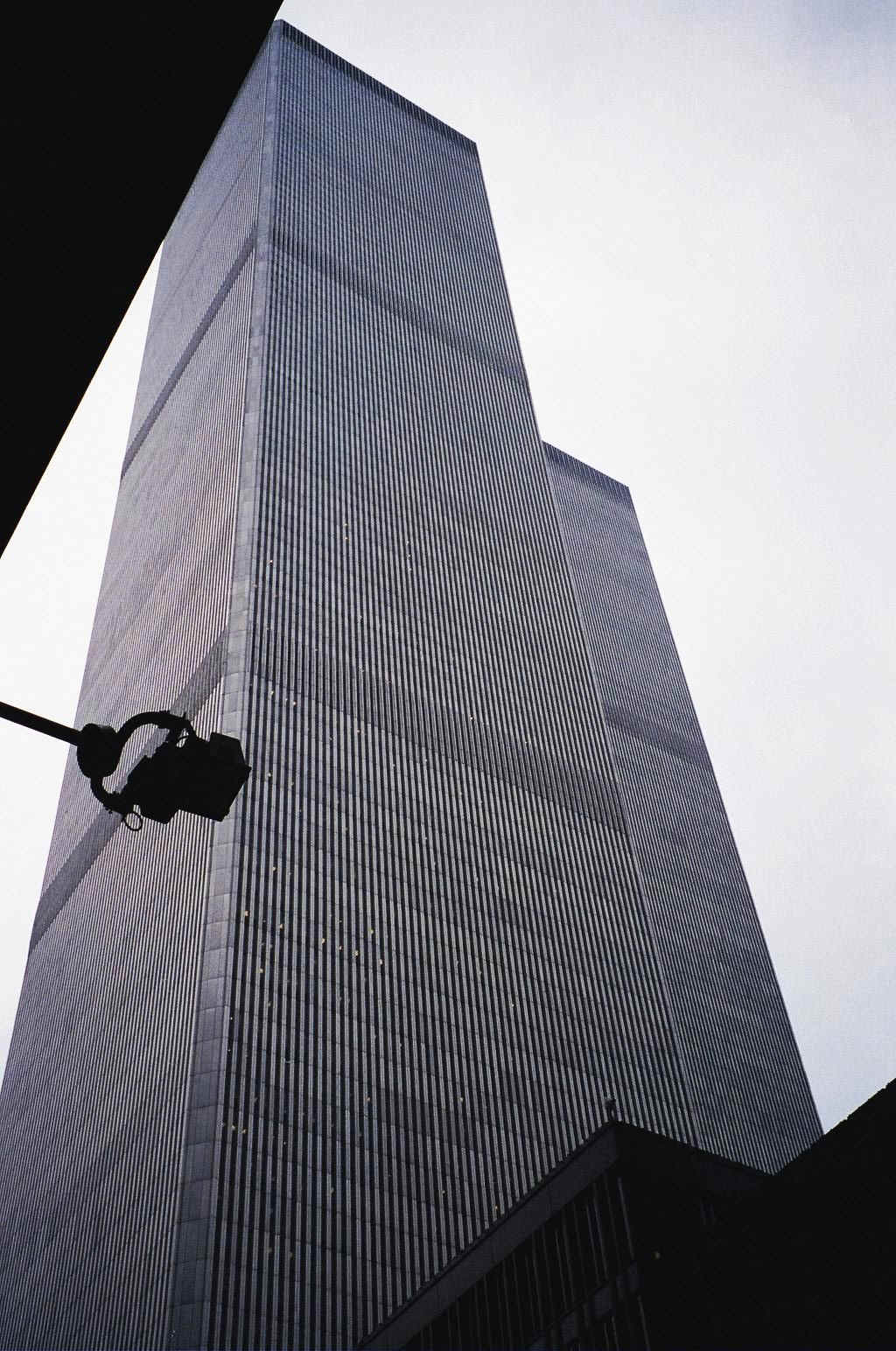
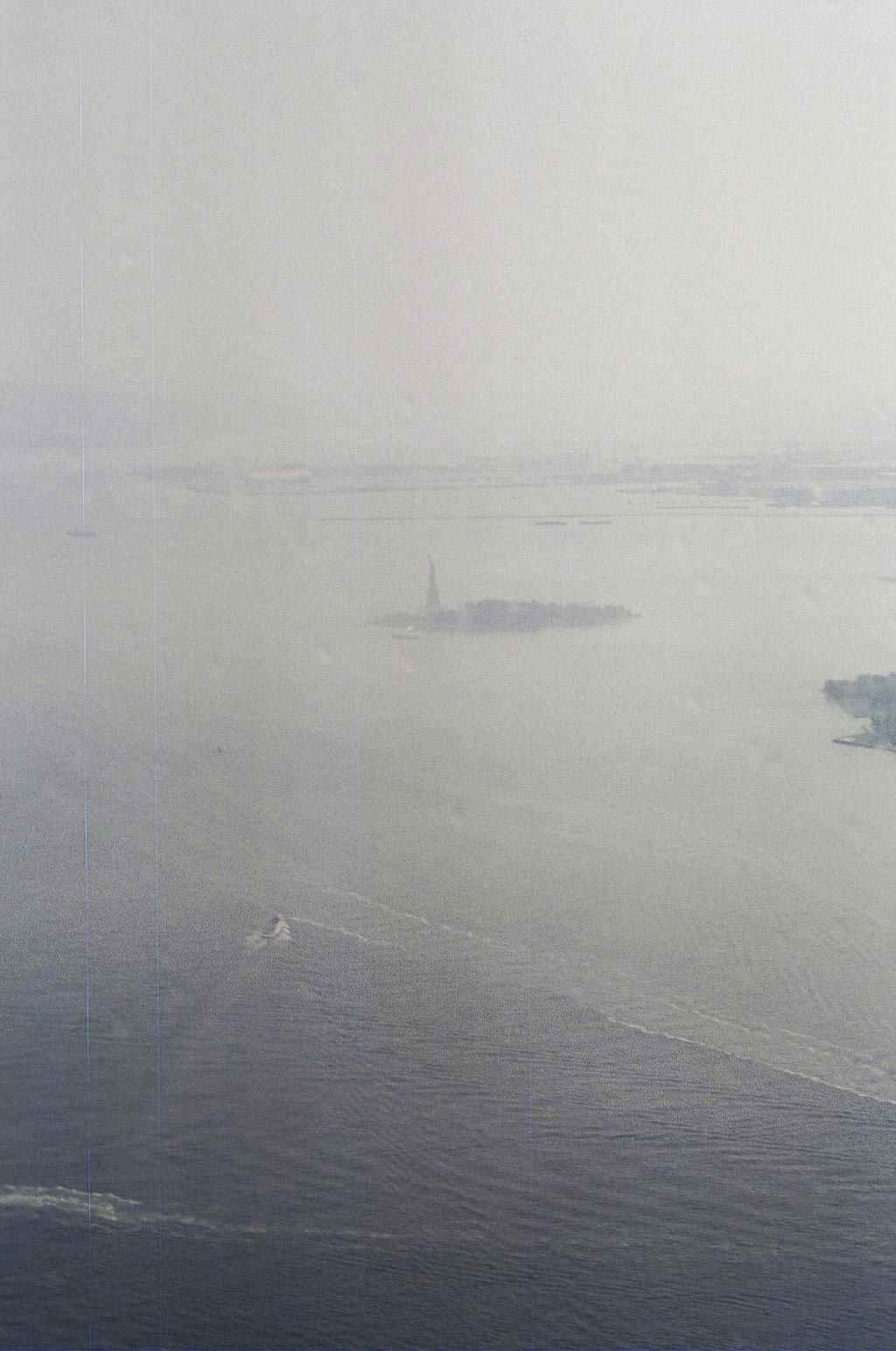
Merrill, who also contributed the photographs on this page, along with an
account of how he came to take them just a few days before the Twin Towers fell.
She scrawled soft words in soap: “Never Forget”
dove-white on her car’s window (though the wren,
because its heart is tender, might regret
it called the sun to wake her).
As I slept,
she heard lost names recounted, one by one.
She wrote in sidewalk chalk: “Never Forget”
and kept her heart’s own counsel. No rain swept
away those words, no tear leaves them undone.
Because her heart is tender with regret,
bruised by razed towers’ glass and steel and stone
that shatter on and on and on and on ...
she stitches in damp linen: “NEVER FORGET”
and listens to her heart’s emphatic song.
(The wren might tilt its head and sing along
because its heart once understood regret
when nestlings fell beyond, beyond, beyond ...
love's reach, and still the boot-heeled world strode on.)
She writes in adamant: “NEVER FORGET!”
because her heart is tender with regret.
Many nights when undrawn to the living,
I have gone to the graveyard instead,
And sought out my truth among ashes,
And for beauty,
Lain down with the dead.
In the stillness of many a midnight,
I have warmed to their wakening sound,
The impassioned, and scorned, and unliving
Who speak to my heart
From the ground.
The villanelle is a French poetic form in which two of the lines are
alternately repeated, then combine to form the closing couplet. The most
famous English villanelle, “Do Not Go Gentle Into That Good Night,”
was written by the Welsh poet Dylan Thomas for his
dying father. (This absolutely stunning poem appears below.) Years later, Robert
Zimmerman took his last name from Dylan Thomas’s first, becoming Bob Dylan. The first song of his that I remember
hearing as a boy was “Blowin’ in the Wind.” The questions raised by
that song still reverberate today, especially in the aftermath of 9-11 and two
trillion-dollar, decade-long wars that have robbed multitudes of people of their
lives, including thousands of American soldiers:
Blowin' in the Wind
by Bob Dylan
How many roads must a man walk down
Before you call him a man?
Yes, 'n' how many seas must a white dove sail
Before she sleeps in the sand?
Yes, 'n' how many times must the cannon balls fly
Before they're forever banned? The answer, my friend, is blowin' in the wind;
The answer is blowin' in the wind ...
How many times must a man look up
Before he can see the sky?
Yes, 'n' how many ears must one man have
Before he can hear people cry?
Yes, 'n' how many deaths will it take till he knows
That too many people have died? The answer, my friend, is blowin' in the wind;
The answer is blowin' in the wind ...
How many years can a mountain exist
Before it's washed to the sea?
Yes, 'n' how many years can some people exist
Before they're allowed to be free?
Yes, 'n' how many times can a man turn his head,
Pretending he just doesn't see? The answer, my friend, is blowin' in the wind;
The answer is blowin' in the wind ...
For the sake of our soldiers—our own children!—we should ask
ourselves, "How many deaths will it take till
we know that too many people have died?" I am
also reminded of thought-inducing epigrams by wise
men like Albert Einstein, Will Rogers and Gandhi:
We can't solve problems by using the same kind of thinking we used when we created them.—Albert
Einstein
I don't know about World War III, but World War IV will be fought with sticks and stones.—Albert
Einstein
Mankind must put an end to war, or war will put an end to mankind.—John F.
Kennedy, Jr.
If there is one thing that we do worse than any other
nation, it is managing somebody else's affairs.―Will Rogers
The clatter of arms drowns out the voice of law.—Michel de Montaigne What difference does it make to the dead, the orphans, and the homeless,
whether the mad destruction is wrought under the name of totalitarianism or in the
holy name of liberty or democracy?—Mohandas Gandhi
Food for thought, indeed. Now here is the most famous villanelle in the English language, and rightly so. It
remains one of the most powerful and moving poems
ever written, in any language. I would like to dedicate it to all the victims
and survivors of 9-11, and their families:
Do Not Go Gentle Into That Good Night
by Dylan Thomas
Do not go gentle into that good
night,
Old age should burn and rave at close of day;
Rage, rage against the dying of the light.
Though wise men at their end
know dark is right,
Because their words had forked no lightning they
Do not go gentle into that good night.
Good men, the last wave by,
crying how bright
Their frail deeds might have danced in a green bay,
Rage, rage against the dying of the light.
Wild men who caught and sang
the sun in flight,
And learn, too late, they grieved it on its way,
Do not go gentle into that good night.
Grave men, near death, who see
with blinding sight
Blind eyes could blaze like meteors and be gay,
Rage, rage against the dying of the light.
And you, my father, there on
the sad height,
Curse, bless me now with your fierce tears, I pray.
Do not go gentle into that good night.
Rage, rage against the dying of the light.
Of course the hardest death to consider, face or bear is the death of a child.
Here's a poem I wrote for a nine-year-old girl, Christian-Taylor-Green, who was born on 9-11 only to be gunned
down by a madman in the politically-motivated Tucson attack on congresswoman Gabrielle Giffords:
Child of 9-11, beloved,
I bring this lily, lay it down
here at your feet, and eiderdown,
and all soft things, for your gentle spirit.
I bring this psalm — I hope you hear it.
Much love I bring — I lay it down
here by your form, which is not you,
but what you left this shell-shocked world
to help us learn what we must do
to save another child like you.
Child of 9-11, I know
you are not here, but watch, afar
from distant stars, where angels rue
the terrible things some mortals do.
I also watch; I also rue.
And so I make this pledge and vow:
though I may weep, I will not rest
nor will my pen fail heaven's test
till guns and wars and hate are banned
from every shore, from every land.
Child of 9-11, I grieve
your tender life, cut short. Bereaved,
what can I do, but pledge my life
to saving lives like yours? Belief
in your sweet worth has led me here ...
I give my all: my pen, this tear,
this lily and this eiderdown,
and all soft things my heart can bear;
I bring them to your final bier,
and leave them with my promise, here.
Gabrielle Giffords continues to recover from her wounds. She wrote my favorite
Tweet (a modern form of the epigram) upon her return to Washington, where she
once again serves her nation as a member of the House of Representatives:
The Capitol looks beautiful
and I am honored
to be at work tonight.
—Gabrielle Giffords
Gabby was shot and nearly killed by an American terrorist. Now, while so many other politicians rage and imagine vain things, I find
her words wonderfully touching and encouraging. Reading her
poetic
Tweet, I can actually see our nation's Capitol lit up at night, shining
like a beacon of hope, and feel her sincerity. How many senators and
congressmen are humble enough to feel honored to work for their country, I
wonder? In any case, I'm glad to have her back, and to know that she's not only
recovering from her injuries, but wants to help her country recover from its own
deep-seated (albeit self-inflicted) wounds. I only hope that other Americans
will exhibit some of her grace under fire. After all, if she pulled through her
harrowing ordeal, so can we as a nation, if only we emulate her courage and
resolve. And as I write this, I am reminded of Gabby's favorite epigram, which
appears on her Facebook page. I have turned it into a poem:
With malice toward none,
with charity for all,
with firmness in the right,
as
God gives us to see the right,
let us strive on to finish the work we are in,
to
bind up the nation's wounds.
—Abraham Lincoln
But of course Christina Taylor-Green did not survive to see her tenth birthday.
What can we do when innocent children
die so senselessly? We must do all we can to prevent the next senseless
murder. This means that adults need to end the wild proliferation of
weapons; politicians spewing lies, hatred and intolerance; and people acting as
if believing the Bible and Constitution gives them the right to abandon reason and go
on the warpath.
If we want all children to live in a safer world, we must
put an end to the bigotry, intolerance and bullying we
see everywhere around us.
But how can we change their world for the better? The same way we ended child
sacrifice, witch hunts and slavery. Human societies decided that such things are
not acceptable. Today we need to decide, as a society, that things which
endanger
children's lives and happiness are not acceptable. This means telling politicians like Sarah
Palin, Michelle Bachmann and Rick Perry to tone down their overheated rhetoric. It means telling the NRA to act
responsibly and not value money above the lives of
children. And it means telling our government that we refuse to send
young people
to die in wars to "secure" foreign oilfields or to support "allies" who
terrorize their neighbors and their own minorities.
If terrorism is wrong for our enemies, how can we as a nation underwrite terrorism practiced
by our "allies"? But American politicians seem to take their marching
orders from Napoleon, who said ironically:
In politics
never retreat,
never retract,
never admit a mistake.
—Napoleon
Bonaparte
And if Americans care about their children they also need to abandon the bizarre fantasy that we were attacked without cause on 9-11.
The root cause of 9-11 was the same as the root cause of two other American
holocausts: Slavery and the Trail of Tears. One of America's wisest men
explained the problem succinctly:
There are many humorous things in the world;
among them,
the white man's notion that he is less savage than the other savages.
—Mark
Twain
American racial injustices against Native Americans led to massacre after
massacre on both sides of the conflict. Today we know that the attempts of a white supremacist
government and a white supremacist press to portray whites as "victims" and Native
Americans as "the problem" were nothing but "spin" ...
What white man can say I ever stole his land or a penny of his money?
Yet they call me a thief.
What white man has ever seen me drunk?
Who has ever come to me hungry and left me unfed?
Who has seen me beat my wives or abuse my children?
What law have I broken?
What white woman, however lonely, was ever held captive or insulted by me?
Yet they call me a bad Indian. —Sitting Bull
American racial injustices against African Americans led to the Civil War, more than
600,000 deaths, and millions of people being maimed, scarred and/or left
homeless. Today we know that the attempts of a white supremacist government and
a white supremacist press to portray whites as "victims" and blacks as "the problem" were nothing but
"spin" ...
I have often sung to drown my sorrow,
but seldom to express my happiness.
Crying for
joy, and singing for joy,
were alike uncommon to me while in the jaws of
slavery.
The singing of a man cast away upon a desolate island
might be as appropriately
be considered evidence of contentment and happiness
as the
singing of a slave;
the songs of the one and of the other are prompted by the
same emotion.
—Frederick Douglass
Now American racial injustices against Palestinians and other Muslims has led to 9-11 and
two terrible wars. If we study history, which often repeats
itself, we should see, know and understand that the attempts
of our government and press to portray Americans and Israeli Jews as the only victims and Muslims as
the only "problem" are also "spin." There are many, many
Muslims who long for peace, and wait anxiously for Americans to open their eyes
to the truth:
The oppressed can but pursue suitable tracks
Learning to heed the lessons of awesome war
But will the mighty listen to reason’s voice
That justice will accomplish the peace of Rome?
Or will conscience’s dictates be inexorably ignored
As war’s clouds hover over culture’s great cradle?
And yet we do not harbor the odium of hatred
But pray that peace can still be humanity’s finest hour. —Khaled Nusseibeh
While American politicians and the American public insist that the United States
is the greatest nation on earth, if we examine the past and the present
honestly, it becomes apparent that white supremacists who claim to be
"Christians" have inflicted incredible suffering on millions of Native
Americans, African Americans and Muslims. How many of them ever did anything to hurt
white Christians, until their loved ones, culture and way of life were under attack? So
if Americans claim to be the only victims, it is obviously a false claim. If we want
peace, justice and security for our own children, we cannot blindly ignore the
fact that our government's policies and actions constantly endanger them, by
constantly endangering the lives and happiness of other men's children.
There are strong and disturbing parallels between what happened to Native Americans and African
Americans in the past, and what is happening to Palestinians today. These
terrible injustices are not only morally wrong, but they undermine everything
America is supposed to stand for. Please consider what Abraham Lincoln said
about slavery, which caused millions of innocents to suffer unjustly:
This declared indifference, but, as I must think, covert, real zeal, for the spread of slavery,
I cannot but hate. I hate it because of the monstrous injustice of slavery itself. I hate it
because it deprives our republican example of its just influence in the
world, enables the enemies of free institutions with plausibility to taunt
us as hypocrites, causes the real friends of freedom to doubt our sincerity,
and especially because it forces so many good men among ourselves into an
open war with the very fundamental principles of civil liberty, criticizing
the Declaration of Independence, and insisting that there is no right
principle of action but self-interest. —Abraham Lincoln
We must recognize that when our government acts out of self-interest today,
ignoring the most fundamental principles of justice and the rights of millions
of completely innocent women and children, we are bound sooner or later to find
ourselves in an open war with the men who love them, and want to protect them.
We may not agree with their tactics, but they do not agree with ours, and in
their minds are fighting fire with fire. At the same time, our friends abroad
doubt the sincerity of our ideals and our enemies taunt us as hypocrites, and
use our hypocrisy to raise funds and enroll recruits to attack us.
The simple truth, I believe after much reading and study, is that we were
attacked on 9-11 because our government constantly interferes in the Middle East
over American “oil interests” (when the oil clearly belongs to the people who
live in the region and would be far less expensive if we simply paid the going
price for it), and because our government has contributed to the suffering of
millions of innocents for more than sixty years, by funding and supporting
this new Holocaust: the Nakba ("Catastrophe") of the
Palestinians. Who the hell are we
as a nation to deny other people's children the freedom and rights we cherish
for our own? If we care about our children, we must also care about other
people's children, because their fates are inextricably linked. Here's a
poem I have dedicated to all Palestinian children who became victims of the
Nakba:
I lived as best I could, and then I died.
Be careful where you step: the grave is wide.
As we remember 9-11 and honor our fallen dead, we must also consider the living
(especially children on both sides of the current conflict) and I believe we should consider three
very important messages found in the poems on this page:
(1) We should value all life, so that we “rage against
the dying of the light” of even a single human being. The basis of
democracy is the value of the
individual and his/her
right to "life, liberty and the pursuit of happiness." On this the
poets agree with Thomas Jefferson, who became a poet himself with these immortal
lines of ringing iambic pentameter:
We hold these truths to be self-evident,
that all men are created equal;
that they are endowed by their Creator
with certain unalienable rights;
that among these are life, liberty
and the pursuit of happiness.
(2) Like Beth, we should allow our hearts to be tender with regret for those who
died so needlessly, honoring their memory. Perhaps the best way to honor their
memory, and not let their deaths be in vain, is to ensure that their children
don’t meet the same terrible end. Here are three of my
favorite epigrams, which together illuminate the path to peace, if only we are
wise enough to seek it, and take it:
The births of all things are weak and tender,
therefore we should have our eyes intent on beginnings. —Michel de Montaigne
If we are to have real peace in the world,
we shall have to begin with the children.
―Mohandas Gandhi
As an Israeli, I have come to understand:
there is no way to love Israel and reject a two-state peace,
no way to love Israel and reject Palestine. —Yael Dayan, daughter of Moshe Dayan, Israel's most famous general
(3) Yes, we should defend
American children, but in order to truly protect our children, we
need to consider how the cannon
balls "may be forever banned," so that they can live in peace without the
ever-present threat of war. To this day, the US government, American politicians and the American
public have never openly and honestly discussed the root cause
of 9-11: the Nakba, which has left millions of Palestinians bereft of freedom,
representative government
and basic human rights. If our government interferes with the ability of other
men's loved ones to enjoy the rights and freedoms we
cherish, then obviously we as a nation are not blameless in their eyes. If we are
blameless in our own, is it because we are willfully blind, or ignorant of the
facts? How many Americans really know and understand what our government has
been doing in the Middle East for more than half a century?
And while it is obviously true that innocent American civilians should
not suffer and die for things they didn't do, more than a billion Muslims would
argue that exactly the same thing should be true for equally innocent
Palestinian women and children. So why does the US government radically favor Jewish babies
over Palestinian babies? Isn't that bigotry? Why should Palestinian babies be
born bereft of freedom and basic human rights? What would American men do if
foreigners tried to strip American babies of their rights, causing
them to grow up as serfs or slaves? Wouldn't the US rain down missiles on
such oppressors, until they
abandoned their Dark Age despotism? In the end, does it really matter whether the "cannon
balls" are cruise missiles or commandeered jets, if innocent women and
children are suffering and dying? Please allow me to repeat a
very pertinent quotation by a great
humanitarian and man of peace:
What difference does it make to the dead, the orphans, and the homeless,
whether the mad destruction is wrought under the name of totalitarianism or the
holy name of liberty or democracy?—Mohandas Gandhi
What our government seems to fail to understand is that mothers and fathers
care more about their children than they do American "ideals." If in its
relentless pursuit of "liberty" and "democracy" for Americans and their favored
friends, millions of less-favored children begin to suffer and die, the men who
have to watch them suffer and die will see this the way American men
saw 9-11. Unfortunately for Americans, the honest truth is that the
terrorism of Jews and Christians against Palestinians happened long before 9-11.
Few Americans are willing to see this, much less admit it and deal with
it. But if it is wrong for American children to suffer and die unjustly, then
it is obviously wrong from the richest, most powerful nation on earth to cause
so much suffering and so many deaths among poor, disadvantaged children.
The solution is not for American men to
keep killing Muslim men, but for Americans to respect the basic human rights of
Muslim women
and children, because this is the only moral solution and the only path to
peace. To paraphrase Dr. Martin Luther King Jr., the governments of Israel and the US sowed the wind, and on 9-11 the American public reaped the
whirlwind. If we want to end acts of terrorism against the US, we will have to
end the terroristic and anti-democratic policies and actions of our government
in the Middle East. If we don't, the cannon balls will continue to fly and
children on both sides will continue to die.
The US State Department and the
Pentagon are fully aware of the real cause of 9-11 and the current wars.
General David Petraeus speaking before the Senate Armed Services
Committee said, “The conflict foments anti-American sentiment due to a
perception of US favoritism for Israel. Arab anger over the Palestinian question
limits the strength and depth of US partnerships with governments and peoples in
[CENTCOM’s area of operations] and weakens the legitimacy of moderate regimes in
the Arab World.” The New York Times reported that in an interview
Petraeus stated, "If you don't achieve progress in a just
and lasting Mideast peace, the extremists are given a stick to beat us with."
As reported by Bloomberg's Jeffrey Goldberg, US Secretary of Defense Roberts
Gates recently said that Israel has done nothing to help the US in its quest for peace,
despite all the US has done to help Israel in the form of advanced weapons,
intelligence sharing and missile defense technology (not to mention billions of
dollars in financial aid).
How is it "wrong" for Americans to ask Israeli Jews to do what Americans did
themselves, when they abandoned Jim Crow laws and kangaroo courts, and did the
right thing by treating people of all races and creeds as equals?
Finding the path to peace may not be easy, but it is essential. Just because an
answer isn’t easy doesn’t mean that it shouldn’t be relentlessly pursued. For
the first time in history, most of the civilized world has stable borders. Just
sixty
years ago, "civilized" nations like Germany, Japan and Italy began blowing up cities by the scores and
killing human beings by the
millions. It has been estimated that 70 million people died as a result of World
War II. Since then, we have made tremendous progress in just a few decades. And
in less
than 150 years, the US has managed to abolish slavery, radically advance
women’s rights, and create a melting pot in which all races and faiths can live
together in peace and equality. Today we're making substantial progress on gay
rights as well. So we shouldn’t assume that global peace is
impossible, because not so very long ago those other things seemed "impossible"
too.
Perhaps
for Americans peace begins with a strong defense and an even stronger value
for human life, equality and justice. As we mourn our fallen dead, let’s also mourn for the children of Iraq
and Afghanistan who died through no fault of their own, and hope that all the
children still living will learn to live in peace, rather than one day hurling atomic bombs at each other.
As Albert Einstein said, if we fight World War III with weapons of mass
destruction, the
next war will be fought with sticks and stones. As John F. Kennedy said, if we
don't end war, war will end us.
I am convinced that the solution that worked
inside the borders of the US (establishing racial equality and justice) will
work outside the borders of the US, if we ever decide as a nation to respect the
rights of Muslims and treat them as equals, with justice. That undoubtedly means that our
government will have to stop telling them how to live and die on their
native soil. But as Will Rogers said, if there is anything we don't do well as a
nation, it is telling other people how to manage their affairs. Isn't it past
time for the US to admit its limitations, and save trillions of dollars and
multitudes of lives, by living up to our stated ideals? If we don't, we risk
more events like 9-11. Here's a poem I wrote about Americans facing a terrible
choice because our government failed to think of the consequences of its
actions:
I held the switch in trembling fingers, asked
why existence felt so small, so purposeless,
like a minnow wriggling feebly in my grasp ...
vibrations of huge engines thrummed my arms
as, glistening with sweat, I nudged the switch
to OFF ... I heard the klaxon's shrill alarms
like vultures’ shriekings ... earthward, in a stall ...
we floated ... earthward ... wings outstretched, aghast
like Icarus ... as through the void we fell ...
till nothing was so beautiful, so blue ...
so vivid as that moment ... and I held
an image of your face, and dreamed I flew
into your arms. The earth rushed up. I knew
such comfort, in that moment, loving you.
The people who died on Flight 93, in the Pentagon, and in the Twin Towers on
9-11 were innocent, but their government and nation were not. When the
governments of Germany, Italy and France ignored the rights of the citizens of
other nations, the world went to war with all Germans, with all
Italians, and with all Japanese. This is a hard truth, and the horror
of war. Yes, we are individuals, but we also have collective identities. If I
was a Palestinian, I would see the nations of Israel and the US as my enemies,
because they chose to ignore the rights of my loved ones and treated them like
serfs, or animals. Like most Germans, most Americans prefer
to ignore their collective responsibility for their
nation's crimes against peace and humanity. According to the average
American, it was reasonable to wage war against all Germans because of the
crimes of Nazi Germany, but it is "terrorism" when other people wage war against
all Americans and Jews for the crimes of the United States and Israel. Being an
American, I understand the deep attachment Americans have to their country. But
having lived in Germany for four years, I also understand how people can live in
denial of their nation's crimes. When I lived in Germany, no German that I ever
met admitted to knowing about the Holocaust, or fighting against the Allies.
Well, in the same way, most Americans and Israeli Jews refuse to admit what
their so-called "democracies" have actually done to millions of completely
innocent Palestinian women and children. If we want to avoid World War III, we
cannot follow in the footsteps of Nazi Germany and people who sang "Deutschland
Uber Alles" while their children died and the world went down in flames ...
There But for the Grace by T. Merrill Tripped by a flash
painting of a silhouetted
square pair twilight-crowned
with fiery sunburst flaring
out over them
like a blast from an open
furnace cleaving cloudmass into dark,
smoky,
billowing wings a vision branded
deep revives, sudden
cable-snap, freefall
in side by side
shafts,
cascades
of dust spilling down,
tombs sealed the way snow
slips off mountains, gravemaking
thaw of steel
or ice,
how a curious
master of heights surveying
the world from a summit late
one summer stepped
so casually, blithely
recording last days, lost sights.
Something inescapable is lost—
lost like a pale vapor curling up into shafts of moonlight,
vanishing in a gust of wind toward an expanse of stars
immeasurable and void.
Something uncapturable is gone—
gone with the spent leaves and illuminations of autumn,
scattered into a haze with the faint rustle of parched grass
and remembrance.
Something unforgettable is past—
blown from a glimmer into nothingness, or less,
and finality has swept into a corner where it lies
in dust and cobwebs and silence.
The bell-rope that gathers God at dawn
Dispatches me as though I dropped down the knell
Of a spent day -- to wander the cathedral lawn
From pit to crucifix, feet chill on steps from hell.
Have you not heard, have you not seen that corps
Of shadows in the tower, whose shoulders sway
Antiphonal carillons launched before
The stars are caught and hived in the sun's ray?
The bells, I say, the bells break down their tower;
And swing I know not where. Their tongues engrave
Membrane through marrow, my long-scattered score
Of broken intervals ... And I, their sexton slave!
Oval encyclicals in canyons heaping
The impasse high with choir. Banked voices slain!
Pagodas campaniles with reveilles out leaping --
O terraced echoes prostrate on the plain! ...
And so it was I entered the broken world
To trace the visionary company of love, its voice
An instant in the wind (I know not whither hurled)
But not for long to hold each desperate choice.
My word I poured. But was it cognate, scored
Of that tribunal monarch of the air
Whose thighs embronzes earth, strikes crystal Word
In wounds pledged once to hope -- cleft to despair?
The steep encroachments of my blood left me
No answer (could blood hold such a lofty tower
As flings the question true?) -- or is it she
Whose sweet mortality stirs latent power? --
And through whose pulse I hear, counting the strokes
My veins recall and add, revived and sure
The angelus of wars my chest evokes:
What I hold healed, original now, and pure ...
And builds, within, a tower that is not stone
(Not stone can jacket heaven) -- but slip
Of pebbles, -- visible wings of silence sown
In azure circles, widening as they dip
The matrix of the heart, lift down the eyes
That shrines the quiet lake and swells a tower ...
The commodious, tall decorum of that sky
Unseals her earth, and lifts love in its shower.
You Who Read No Calm
by T. Merrill
You, who read no calm reportings
Of alien, distant, dire events,
But shriek and keen as loves go down
Beyond all help, to violence;
Whose temple's walls, stormstruck and split
By sizzling bolts collapse around,
While mid the crash of chaos hope
Whirls in a death-spin to the ground;
You, who alone in deep distress
Cry out for help where there is none,
All you whom I shall never know:
I know a portion nonetheless
Of cruel trials you undergo.
Killers in many guises come:
Sudden as electric shock
Or looming ghostly as a shark
Leisurely finning toward its mark.
I who breathless and sweating once
Wrestled a devil to the floor,
And saw him rise again when he
Finished what he began before,
I who re-learned each childhood prayer
Forgotten, to the stars once more
Send up a poor and hopeless plea
For spirit's peace beyond despair.
You who sleep soundly through our bleakest hour,
who hear the meekest cry, and turn away,
who ride the river, blessing it with power
to cancel what we've made day by slow day;
You whom we cannot know nor flee, who hide
behind your countless aliases, who bear
the weapon of your absence like a tide
against our helplessness, and fail to care;
You who stand by while madness picks the lock,
stroke cuts the wires, tumor rigs the mine:
Look how we scour the earth to find--in rock,
in fire, in word--your signature, some sign
of you in thought that quarrels with your will,
and as it quarrels, hungers for you still.
If we strip away all the accouterments of war,
perhaps we'll discover what the heart is for.
After I posted this page, I had two
responses from poets who have been influenced by Bob Dylan's "Blowin' in the
Wind." The first poet told me that he and an impromptu band on
a cruise ship won a shipboard contest by performing "Blowin' in the
Wind." The second poet, Seamus Cassidy, sent me the poem below. Its title was
inspired by the song:
I walk by in back of the strip mall
almost not noticing his dumpster condo next to the junior high school's sports
field.
Wearing a faded baseball cap,
his head propped against
the trunk of a cottonwood tree,
the man moves his lips spasmodically,
but keeps fixing his eyes
on the page he's reading.
...
Sweats dry in lockers
where small jock straps and
training bras hang
on metal hooks.
Boys and girls doze together through last period pre-algebra—
hypnotized by Mrs. 50-Plus,
who paces back and forth
monotoning on
that "both sides of
the equation are equal."
...
He turns another crumpled page
of his paperback and thinks
he now knows why Rome
fell to the "barbarians at the gate."
...
Math blockers understand
they understand nothing
except the looming Hell
of Summer School's repeat failure.
...
Twenty assorted tones of pigeon
share the shade with the homeless
dropout cramming there for finals.
...
Dismissal bell wakes the dozefellows
to the handwriting on the chalkboard—leaving the reader
alone. The battalion passes by
the sentry without noticing
how he's subverted the divine order
of their universe.
Tom Merrill explains how he came to take the photographs that appear on
this page:
Two weeks before 9/11, 200l, at the end of August that all too memorable summer,
I was proudly showing off Manhattan, my birthplace, to a French friend who had
come to the US to spend some time with me and see some sights. We had driven
down from Boston, where I now live most of the time, planning to spend about a
week in the city. One day during our visit—I believe it was August 29th, but I
could be off a day either way—I took him to have a look at the WTC. It
had turned into a foggy, drizzly day, a good time to be indoors, so we decided
to enter the center and see what we could see from the top of the south
twin. Due to the weather, the open air rooftop promenade, which was located
above the tower’s top floor, the 110th, wasn’t open, so we took in the
sights from the observation deck on floor 107. I had brought my camera with me,
and, moving from wet window to wet window, spent maybe half an hour snapping
pictures of the city as it stretched out in various spectacular ways from the
four sides of our since-demolished outlook. At the time I had no idea, of
course, that the pictures I was shooting might ever mean more to anyone than the
usual holiday mementos.
The horrific vision of the explosions, and then the collapse of those two
soaring behemoths, in which so many were trapped in an avalanche of destruction,
has branded itself into the memories of millions. The first section of this
book [in which the poems appeared], especially, "Lost Island Views," is intended as a commemoration
of that tragic watershed moment in our history. Since the city lay under a
blanket of fog at the time all but one of the pictures in this chapter were
taken, and the tower’s windows were blurry, the overall mood of these views
seems somber, the accident of weather having imbued them with an atmosphere that
seems peculiarly fitting to the theme of loss and grief.
The Manhattan series segues into a series of scenes captured further north,
in Quebec. The picture entitled “Spotlight,” which leads off this second
group, was placed at the chapter's beginning because it seemed a kind of visual
metaphor of 9/11, and in fact brought back to my mind the TV coverage,
incredulously witnessed by so many, of the buildings burning. It was that photo,
also, that inspired my poem “There But For The Grace,” which also appears in
this chapter, and which expresses my feeling of personal connection with the
tragedy. Related pages:
Sandy Hook Poems,
Columbine Poems,
Darfur
Poems,
Gaza
Poems,
Haiti Poems, Hiroshima
Poems, Holocaust Poems,
Nakba Poems,
911 Poems,
Trail
of Tears