The HyperTexts
Songs and Poems that Changed the World
The Most Influential Poems of All Time
The Most Influential Songs of All Time
Are there songs and poems that helped change the world for the better? Yes, I am convinced. Singers, songwriters
and poets who helped change the world for the better include the following, with
more detailed accounts of many of the songs and poems and their contexts
following...
compiled by Michael R. Burch
• Pete Seeger: "We Shall Overcome," "We Shall Not Be Moved," "Where Have All the Flowers Gone" and "If I Had a Hammer"
• Woody Guthrie: "This Land Is Your Land," "Tear The Fascists
Down," "Deportee" and "Ain't Got No Home: The Ballad of Old Man Trump" (a song
Guthrie wrote about Donald Trump's father when he rented a New York apartment
from Fred Trump)
• Billie Holiday: "Strange Fruit" a song about lynchings
• Nina Simone: Mississippi Goddam"
• Bob Dylan: "Blowin' in the Wind," "The Times They Are A-Changin'," "Hurricane" and "Masters of War"
• Paul Robeson: "Go Down, Moses" ("Let My People Go") and "The Ballad of Joe Hill"
• Tennessee Ernie Ford: "Sixteen Tons" (written by Merle Travis)
• John Farnham: "You're the Voice" may be the most crowd-stirring and infectious protest song ever performed
• Sam Cooke: "A Change Is Gonna Come"
• James Brown: "Say It Loud: I'm Black and I'm Proud"
• Otis Redding and Aretha Franklin: "Respect"
• Crosby, Stills, Nash and Young: "Ohio" ("Four Dead in Ohio")
• Marvin Gaye: "Mercy Mercy Me" and "What's Goin' On? (The
Ecology)"
• Joni Mitchell: "Big Yellow Taxi" ("They paved paradise and put up a parking
lot.")
• U2: "Sunday Bloody Sunday" and "Pride: In the Name of Love"
• Janis Ian: "Society's Child" and "At Seventeen"
• Billy Joel: "Goodnight Saigon" and "Allentown"
• Bob Marley of the Wailers: "Get Up, Stand Up (for Your Rights)" and "I Shot the Sheriff"
• Stephen Stills of Buffalo Springfield: "For What It's Worth"
• John Fogerty of Creedence Clearwater Revival: "Fortunate Son" and "Run Through
the Jungle"
• Edwin Starr: "War" (What is it good for? Absolutely nothing. Say it again.)
• Barry McGuire: "Eve Of Destruction"
• Rage Against The Machine: “Killing in the Name” (the group's name sounds like
a protest)
• Elvis Presley: "In the Ghetto," "If I Can Dream," and "American Trilogy"
• Paul McCartney and John Lennon: "Revolution," "A Day in the Life"
and "Get Back"
• Paul McCartney: "Blackbird" (written about the Little Rock Nine), "Ebony and Ivory" and “Give Ireland Back to the Irish” (the debut single of Wings)
• John Lennon: "Imagine," "Give Peace a Chance," "Power to the People" and "Happy Xmas/War is Over"
•
George Harrison: "Give Me Love, Give Me Peace on Earth" and "Taxman"
HIGH HONORABLE MENTION: Melanie Safka ("Lay Down"), Jimi Hendrix ("Machine Gun"),
Bruce Springsteen ("Born in the USA"), The Who ("Won’t Get Fooled
Again"), Michael Jackson ("Man in the Mirror"), Cat Stevens ("Peace Train"), Helen Reddy ("I Am Woman"), Lady Gaga ("Born this Way"), Chuck D of Public Enemy ("Fight the Power"), Bob Geldof and Midge Ure ("Do They
Know It's Christmas"), Midnight Oil ("Beds are Burning"), Cranberries
("Zombie"), Gil Scott-Heron ("The Revolution Will Not Be Televised"), Green Day ("American Idiot"), Nirvana ("Smells Like Teen Spirit") and Adam Lambert ("Mad World"
originally by Tears for Fears). Of
course there are many others, but this is a representative list.
Poets who helped change the world for the better include:
• The great anti-war poet Wilfred Owen: "Dulce et Decorum Est" and many similar poems
• The great African-American poet Langston Hughes who most famously wrote "Harlem" aka "A Dream Deferred"
• The first great anti-establishment English poet, William Blake: "Jerusalem," "London" and others
• The first great anti-establishment American poet, Walt Whitman: "Beat! Beat! Drums" and other Civil War poems; also poems
about homosexuality and autoeroticism that were radical for their day
There are many other notable voices among the poets,
going back at least to Sappho of Lesbos, the first great lyric poet we know by
name. Sappho was the first "make love, not war" poet, because
eons ago she wrote a
poem in which she said that other people praised warriors in flashing armor and
fleets of ships, but for her what really mattered was the person she loved. And
long before Sappho there was the first poet we know by name, the Sumerian
poetess-priestess Enheduanna, who around 4,500 years ago wrote the first
anti-war poem, "Lament to the Spirit of War."
W. H. Auden once said that poetry makes nothing happen, but I believe the opposite is
actually true: poems and songs help make everything happen
in the realm of social progress. Why? Because human cultural norms begin with what people believe, and how they
react when they see behavior they approve of (or don't). On
a smaller scale, a student who picks his nose in public is censured with "Gross,
that's disgusting!" On a larger scale, modern societies increasingly say "Gross,
that's disgusting!" when they see bigotry and intolerance. So if a boy wants to
be popular, he needs to stop picking his nose in
public, a girl needs to do the same, and if a nation wants to be admired, it needs
to stop practicing racism and intolerance. Public opinion determines what is
acceptable and what isn't, so poets and songwriters who influence public opinion
play important roles in human social progress.
Take, for example, slavery. In biblical times slavery was socially
acceptable. The god of the Bible, Yahweh (Jehovah) never condemned slavery.
Moses, the first and greatest of the Hebrew prophets, even said that fathers
could sell their own daughters as sex slaves, with the option to buy them back
if they didn't "please" their new masters (Exodus 21). Moses also said that when
prisoners of war were taken only the virgin girls should be kept alive,
obviously as sex slaves (Numbers 31), and that girls who had been raped should be
murdered or sold to their rapists (Deuteronomy 22). None of the other Hebrew prophets ever
clearly denounced slavery. Nor did Jesus, even though according to the Bible he associated with men who owned slaves.
The apostle Paul even returned a
runaway slave to his Christian master, Philemon! According to the Bible, from cover to cover,
slavery was kosher. And yet today Jews and Christians
no longer believe in slavery, except as a terrible evil. Obviously something changed, but what
prompted the change?
The change was prompted largely by poets, songwriters and other artists who despised
racism and persuaded other people to change
their beliefs. We might call these artists "modern prophets" because poets like William Blake (English), Walt Whitman (American), William
Butler Yeats (Irish), Langston Hughes (American) and Robert Burns (Scottish) spoke in radical terms about the need for human societies to reform and embrace
real equality of the races and sexes.
Or take the ideas of nonviolent resistance and peaceful protest. Percy Bysshe
Shelley suggested and described nonviolent resistance in his 1819 poem "Masque
of Anarchy." Shelley's novel idea would influence Henry David Thoreau, who wrote
“Civil Disobedience” to protest the imperialistic Mexican-American War. From
there, the fledgling idea would spread to Leo Tolstoy, Gandhi, MLK, Nelson
Mandela, the Polish Solidarity Movement and, more recently, to Tunisia and Egypt
in what has been called the "Arab Spring." Gandhi quoted lines from "Masque of
Anarchy," so Shelley was apparently an influence on his thinking.
Also, please consider the women's rights movement. Poets and writers like
Sappho (once again WAAAY
ahead of her time), the presumably female writers of the ancient
Anglo-Saxon poems Wulf and
Eadwacer and The
Wife's Lament, Christine de Pizan, Aphra Behn, Robert Burns, William Blake,
Mary Wollstonecraft (an important writer in her own right and the mother of Mary
Shelley), Percy Bysshe Shelley (Mary Shelley's husband), Christina Rossetti,
Sojourner Truth, Sara Teasdale, Gertrude Stein, Elinor Wylie, Edna St. Vincent
Millay, Dorothy Parker, Sylvia Plath and Maya Angelou were powerful and eloquent
voices on this very important front.
Or how about veganism? Percy Bysshe Shelley may have been the first "rock star"
of veganism. His 1813 essay "A Vindication of Natural Diet" was far ahead of its
time. Shelley was an early champion of a natural (meat-free) diet, animal
rights, free love, equality of the sexes, atheism and religious tolerance. He
looked and wrote like an angel ... so who knows? ... perhaps he was right.
Bob Dylan recently won the Nobel Prize for Literature, and deservedly so. These are my top
ten Bob Dylan protest songs: "Blowin' in the Wind," "The Times They Are
a-Changin'," "A Hard Rain's a-Gonna Fall," "Masters of War," "Hurricane,"
"Chimes of Freedom," "Oxford Town," "The Lonesome Death of Hattie Carroll,"
"With God on Our Side," "Maggie's Farm" and "Only a Pawn in Their Game." Well,
that's actually eleven songs, but so be it. Bob Dylan became a voice for
equality and justice. But long before he picked up a guitar, other poets had
taken up the cry―the cry for real equality and social and
economic justice for everyone.
My boyhood introduction to the Prophet Laureate and how I became his Mini-Me
at age eleven
by Michael R. Burch
for Martin Mc Carthy, author of “The Perfect Voice”
Atop a London rooftop
on a rare sunny, smogless day,
between the potted geraniums,
I hear the strange music play ...
Not quite a vintage Victrola,
but maybe a half step up:
late ’69 technology.
I sat up, abrupt.
What the hell was I hearing,
a prophet from days of yore?
Whatever it was, I felt it —
and felt it to the core.
For the times, they are a-changin’ ...
The unspoken answer meandered
on the wings of a light summer breeze,
unfiltered by the geraniums
and the dove in me felt ill at ease.
For the times, they are a-changin’ ...
I was only eleven and far from heaven,
intent on rock music (and lust),
far from God and his holy rod
(seduced by each small budding bust).
For the times, they are a-changin’ ...
Who was this unknown prophet
calling me back to the path
of righteousness through peace?
I felt like I needed a bath!
For the times, they are a-changin’ ...
Needless to say, I was altered.
Perhaps I was altared too.
I became a poet, peace activist,
and now I Am preaching to you!
For the times, they are a-changin’ ...
Get off your duffs, do what you can,
follow the Prophet’s declaiming:
no need to kneel, just even the keel,
For the times, they are a-changin’!
Protest Trivia: The first protest song to reach number one in the United
States was P. F. Sloan's "Eve Of Destruction," performed by Barry McGuire in
1965.
This is my personal list of the top ten protest songs and poems of all time:
•
"The Lie" by Sir Walter Raleigh
• "Jerusalem" and "London" by William Blake
•
"Harlem" ("What happens to a dream deferred?") by Langston Hughes
•
"I Have a Dream" by Dr. Martin Luther King Jr. (a speech/sermon/poem)
•
"Blowin' in the Wind" by Bob Dylan
•
"A Change Is Gonna Come" by Sam Cooke
•
"Imagine" by John Lennon
•
"Dulce et Decorum Est" by Wilfred Owen
•
"The Battle Hymn of the Republic" by Julia Ward Howe and "We Shall Overcome" by
various authors (tie)
•
"Leaves of Grass" by Walt Whitman
•
"The Declaration of Independence" by Thomas Jefferson with the
editorial assistance of Benjamin Franklin
• "i
sing of Olaf glad and big" by e. e. cummings
• "First They Came for the Jews" by Martin Niemöller, the best-known Holocaust
poem
Okay, that's a baker's dozen, but I'm not giving any of them up!
High Honorable Mention: "The Gettysburg Address" by Abraham
Lincoln, "This Land is Your Land" by Woody Guthrie, "Easter Hymn" by A. E. Housman, "His Confession" by the Archpoet, "Beds Are Burning" by Midnight
Oil, "Bread and Roses" by Joan Baez, "I Am Woman" by Helen Reddy, "Independence Day" by Martina McBride, "Wulf
and Eadwacer" (a late Anglo-Saxon or Old English poem), "Postcards" by
the Jewish Holocaust poet Miklós Radnóti, "The Ballad of Reading Gaol" by
Oscar Wilde (who was sentenced to hard labor for the "crime" of being gay),
the protest poems of the great Palestinian poet Mahmoud Darwish, "American Skin"
by Bruce Springsteen, "Fortunate Son" by John Fogerty of Creedence Clearwater
Revival, "I-Feel-Like-I'm-Fixin'-to-Die-Rag" by Country Joe and the Fish, "For
What It's Worth" by Stephen Stills of Buffalo Springfield, "Universal Soldier"
by Buffy Sainte-Marie, "I Ain't Marching Anymore" by Phil Ochs, The
Hebrew prophets, Jesus Christ and the apostles, and the poetic
prose of Mohandas Gandhi, Albert Einstein, Martin Luther King Jr. and
Nelson Mandela.
Protest Trivia: Bob Dylan's song "Only a Pawn in Their Game" debuted at the
rally where Dr. Martin Luther King Jr. gave his famous "I Have a Dream" speech,
in 1963.
Protest Trivia: The oldest protest poem in the English language may be "Wulf
and Eadwacer," an Anglo-Saxon (Old English) poem found in the Exeter Book,
which has been dated to around 990 AD. The poem may have been written by a
female poet who was raped and impregnated, possibly after being captured during
a war or raid. She bitterly renounced the advances of her unwanted suitor,
Eadwacer, which may mean "Heaven-Watcher" and perhaps designates a priest. She concluded her
powerful poem with one of the strongest metaphors in the English language: "One
can easily sever what never was one: our song together."
While some of my choices may seem eclectic, I think they make sense. Sir
Walter Raleigh's "The Lie" is one of first noteworthy poems to mock what we now
call "the establishment." William Blake was an English reformer cut in the
mold of the Hebrew prophets. Langston Hughes spoke eloquently for African
Americans at the time they began to assert their right to real equality. Martin
Luther King's "I Have a Dream" is as much a protest poem as it is a sermon. Bob
Dylan and John Lennon were fans of William Blake and, like Blake, were not afraid
to sock it to the establishment. Sam Cooke wrote his passionate, emotion-charged "A Change is Gonna Come" after
hearing Dylan's "Blowin' in the Wind." Wilfred Owen was, in my opinion, the
greatest of the anti-war poets. Julia Ward Howe's lyrics were sung by many a Union
soldier fighting to end slavery and preserve the Union during the Civil War. "We
Shall Overcome" became an anthem of the American Civil Rights Movement. "Leaves of Grass" was Walt
Whitman's eloquent call for a freer, more tolerant America, including tolerance
for homosexuals―a truly novel idea in his era that is only
now beginning to be realized. Thomas Jefferson and Ben Franklin were accomplished poets who wrote the opening lines of the
Declaration of Independence in ringing iambic pentameter: "We HOLD these TRUTHS
..." and it is a poem that continues to change the world, hopefully for the
better. Abraham Lincoln was another accomplished poet who wrote his own
speeches, including "The Gettysburg Address." Woody Guthrie wrote
"This Land is Your Land" after hearing Irving Berlin's "God Bless America" and finding
it too saccharine for his taste. By the way, Woody Guthrie also wrote
bitter protest songs about Donald Trump's father, Frederick Trump, denouncing
him as a racist! If you're interested, you can get the scoop here:
Is Donald Trump a Fascist?
Guthrie inscribed "This machine kills fascists" on his guitar; will his music
come back to haunt the Trumps?
In the past poets and songwriters lodged protests against the inequitable treatment of women, children and
minorities.
Today artists are lobbying for fully equal rights for LGBTs, so the
struggle continues. The first step
begins when people who are dissatisfied with the status quo
start persuading other people that change is necessary. The people who are the most persuasive are generally the
ones with the
best command of the language. Hence, most social progress begins with the best
speakers, writers and singers, as we shall see when we examine the writings of
people like Thomas Jefferson, Bob Dylan, Joni Mitchell, John Lennon, Abraham Lincoln and Dr. Martin Luther King Jr.
As you read
their stirring words, it will become obvious why they were able to help change the world for the better ...
Thomas Jefferson
Declaration of Independence
We hold these truths to be self-evident:
that all men are created equal,
that
they are endowed by their Creator
with certain inalienable rights;
that among these are life, liberty
and the pursuit of happiness.
This sentence, written in ringing iambic pentameter, is surely the most
influential line of poetry ever written. It signaled the beginning of the end of
the "divine right" of kings, queens and czars to rule
the world. It would eventually deal
the death-blow to slavery. Even today its basic premise—the essential
equality of all human beings, and their right to freedom and justice—continues to undergird modern
democratic civilization.
When the Bible—full of verses that
either command or condone racism, slavery, sexism, homophobia, religious
intolerance, infanticide, matricide, ethnic cleansing and genocide—confronts Jefferson's immortal sentence, human interpretations of the
Bible invariably change, as more and more people have come to believe
that equality, social justice and tolerance constitute the true path to peace and happiness here on
earth.
But was Jefferson a poet? The only surviving poem that has been definitively
attributed to Jefferson was written as he lay dying. On July 2, 1826, just two
days before his death, Jefferson told his daughter Martha Randolph that he'd
composed a farewell in her honor. Following his instructions, she found the
verse in a small box after his death:
"A death-bed Adieu. Th:J to MR."
Life's visions are vanished, its dreams are no more.
Dear friends of my bosom, why bathed in tears?
I go to my fathers; I welcome the shore,
which crowns all my hopes, or which buries my cares.
Then farewell my dear, my lov'd daughter, Adieu!
The last pang in life is in parting from you.
Two Seraphs await me, long shrouded in death;
I will bear them your love on my last parting breath.
I think that qualifies as a good poem.
Jefferson was a lover and student of poetry, so when the time came to
declare why Americans had the right to throw off
the shackles of the British monarchy and its feudalistic colonial system, he
summoned up a ringing anthem which continues to reverberate around the globe.
The
New Colossus
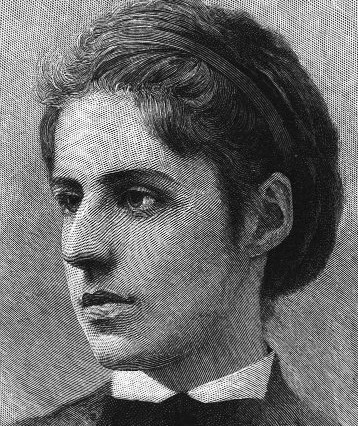
by Emma Lazarus
Not like the brazen giant of Greek fame,
With conquering limbs astride from land to land;
Here at our sea-washed, sunset gates shall stand
A mighty woman with a torch, whose flame
Is the imprisoned lightning, and her name
Mother of Exiles. From her beacon-hand
Glows world-wide welcome; her mild eyes command
The air-bridged harbor that twin cities frame.
"Keep, ancient lands, your storied pomp!" cries she
With silent lips. "Give me your tired, your poor,
Your huddled masses yearning to breathe free,
The wretched refuse of your teeming shore.
Send these, the homeless, tempest-tost to me,
I lift my lamp beside the golden door!"
When the world's possibly most famous sonnet was written in 1883 it barely caused a ripple. When its author died in 1887, the poem wasn't even mentioned in her obituary. And yet today,
most Americans can recite at
least a line. Emma Lazarus's "The New Colossus" did not create much of a stir until it was affixed inside the base of the Statue of Liberty in 1903.
The poem has proven to be so powerful over the years that it has even changed the meaning and purpose of the Statue of Liberty itself. As a gift from the government of France, purchased with coins donated
by French school children, the Statue was meant to be a monument for international republicanism. Today, because of Lazarus's sonnet it is known as a beacon to immigrants and a welcoming to America.
John T. Cunningham wrote that "The Statue of Liberty was not conceived and
sculpted as a symbol of immigration, but it quickly became so as immigrant ships
passed under the statue. However, it was Lazarus's poem that permanently stamped
on Miss Liberty the role of unofficial greeter of incoming immigrants." Paul
Auster said that "Bartholdi's gigantic effigy was originally intended as a
monument to the principles of international republicanism, but 'The New
Colossus' reinvented the statue's purpose, turning Liberty into a welcoming
mother, a symbol of hope to the outcasts and downtrodden of the world."
William Blake
Poems and Art
A little black thing in the snow,
Crying "'weep! 'weep!" in notes of woe!
"Where are thy father and mother? Say!"
"They are both gone up to the church to pray."
William Blake was one of the most influential poets and
artists of all time. He created some of the first graphic depictions of the
horrors and cruelties of slavery. He also wrote tender poems about
the suffering of small children forced to work long, dangerous hours as
chimneysweeps. They were too young to properly pronounce their job
titles, softly moaning: 'weep, 'weep.
Blake preceded the novelist
Charles Dickens, who also wrote about the plight of small children
forced to work long, grueling hours as slaves, or near-slaves. Blake and Dickens appealed to the compassion and
reason of their audiences, and before long England and other western nations
instituted laws that protected children from the abuses of
ruthless businessmen. Blake was the first great poet/artist to lobby strenuously in his
work for children's rights, women's rights, racial equality and free love, while
opposing what Dwight D. Eisenhower would call, a century later, the
"military-industrial complex." Blake had a much more poetic term: "Satanic
mills."
Blake is the forerunner of the modern poet-prophet-reformer. His heirs include
Walt Whitman, Allen Ginsberg, Woody Guthrie, Bob Dylan, Joan Baez, John Lennon,
Pete Seeger, John Fogerty, Neil Young, Bruce Springsteen and Bono ... just to
name a few. If you'd like to learn more about England's greatest
poet-prophet-reformer, please click this link:
BLAKE.
Billie Holiday
Strange Fruit (written by Abel Meeropol)
Southern trees bear strange fruit
Blood on the leaves and blood at the root
Black bodies swinging in the southern breeze
Strange fruit hanging from the popular trees
Pastoral scene of the gallant south
The bulging eyes and the twisted mouth
Scent of magnolias, sweet and fresh,
Then the sudden smell of burning flesh
Here is fruit for the crows to pluck
For the rain to gather, for the wind to suck
For the sun to rot, for the trees to drop
Here is a strange and bitter crop
"Strange Fruit" is a dark, haunting song performed most famously by Billie
Holiday, who released her first recording of it in 1939. Written by Abel
Meeropol [aka Lewis Allan] as a poem, it condemned American racism and the
lynching of African Americans. Meeropol set the poem to music with the help of
his wife and the singer Laura Duncan, and performed it as a protest song in New
York venues, including Madison Square Garden. Meeropol became the adoptive
father of the young sons of Julius and Ethel Rosenberg after their executions
for espionage.
Nina Simone
Mississippi Goddam
Nina Simone wrote "Mississippi Goddam" in one hour in 1964 as a seething
response to the murders of Emmett Till and Medgar Evans in Mississippi and the
16th Street Baptist Church bombing in Birmingham, Alabama.
Alabama's gotten me so upset
Tennessee made me lose my rest
And everybody knows about Mississippi Goddam
...
Hound dogs on my trail
School children sitting in jail
Black cat cross my path
I think every day's gonna be my last
Lord have mercy on this land of mine
We all gonna get it in due time
I don't belong here ...
Walt Whitman
Leaves of Grass
I celebrate myself, and sing myself,
And what I assume you shall assume,
For every atom belonging to me as good belongs to you.
Harold Bloom has suggested that Shakespeare "invented" the
modern human consciousness. Perhaps Walt Whitman created the modern
American consciousness, or at least persuaded it to become more open-minded and
tolerant.
Whitman was a freethinker who believed that autoeroticism, homosexuality and
other things deemed "evil" by church and state were, in fact, merely part of
normal human life, so he invited his readers to be more embracing and love
freely. He was the second major poet of the "make love, not war" school, after
William Blake.
Because Whitman was the first major free verse poet, he was highly influential with
American and English poets to come, and with poets all around the world who
chose to either break the rules of formal verse, or greatly relax
them. No other English language poet with the possible exception of Shakespeare has had
more influence on other poets. Thanks to Whitman, who was
generous in spirit and gregarious in nature, many other poets, songwriters, musicians and artists became more
freethinking and tolerant. He helped change the culture of
modern art.
Wilfred Owen
Dulce et Decorum est
The Unreturning
Anthem for Doomed Youth
Dulce et Decorum est
Bent double, like old beggars under sacks
Knock-kneed, coughing like hags, we cursed through
sludge,
Till on the haunting flares we turned our backs
And towards our distant rest began to trudge.
Men marched asleep. Many had lost their boots
But limped on, blood-shod. All went lame; all blind;
Drunk with fatigue; deaf even to the hoots
Of tired, outstripped Five-Nines that dropped behind.
Gas! GAS! Quick, boys!—An ecstasy of fumbling,
Fitting the clumsy helmets just in time;
But someone still was yelling out and stumbling
And flound'ring like a man in fire or lime...
Dim, through the misty panes and thick green light,
As under a green sea, I saw him drowning.
In all my dreams, before my helpless sight,
He plunges at me, guttering, choking, drowning.
If in some smothering dreams you too could pace
Behind the wagon that we flung him in,
And watch the white eyes writhing in his face,
His hanging face, like a devil's sick of sin;
If you could hear, at every jolt, the blood
Come gargling from the froth-corrupted lungs,
Obscene as cancer, bitter as the cud
Of vile, incurable sores on innocent tongues,—
My friend, you would not tell with such high zest
To children ardent for some desperate glory,
The old Lie: Dulce et decorum est
Pro patria mori.
Note: "Dulce et decorum est pro patria mori" is from
Horace's Odes and means: "It is sweet and fitting to die for one's country."
"Dulce et Decorum est" is one of the most important poems in the English
language, because with it Wilfred Owen challenged the establishment's
claim that it is "sweet and fitting" for boys to die for king, queen and country. Every
anti-war poet and singer-songwriter to follow was probably
influenced to some degree by Owen's poem and its image of soldiers "coughing like hags" from
"froth-corrupted" lungs. This was perhaps the first really vivid poetic image of what
modern warfare was like for the young men being sent to the front lines by
power-mad politicians intent on national "honor" and "glory." Before Owen, poems
about war usually glorified the courage, patriotism and honor of the combatants.
After Owens, there was a gigantic question mark: was war honorable, or were despots sending innocents to
horrific, needless deaths? Wilfred Owen is the greatest of the anti-war poets,
and if enough people heed his voice, we may be able to avoid World War III by
refusing to fight and die in it.
Abraham Lincoln
Gettysburg Address
Four score and seven years ago
our fathers brought forth on this continent, a new nation,
conceived in Liberty, and
dedicated to the proposition
that all men are created equal.
Make no mistake about it: Abraham Lincoln was a true poet, which you can easily
prove to yourself by clicking here:
Abraham Lincoln, Poet.
Lincoln's greatest poem, the Gettysburg Address, contains his two great themes:
that the Union must be preserved, and that the fundamental proposition of that
Union was that all men were created equal and thus were self-evidently entitled
to Liberty (which he capitalized). That slavery was abolished and yet the Union
still remains is a lasting testament to an extraordinary man and a wonderful writer.
Dr. Martin Luther King Jr.
I Have a Dream
I have a dream that one day this nation will rise up and live out the true
meaning of its creed:
"We hold these truths to be self-evident: that all men are created equal."
I have a dream that one day on the red hills of Georgia
the sons of former slaves and the sons of former slave owners
will be able to sit down together at the table of brotherhood.
...
I have a dream that my four little children will one day live in a nation
where they will not be judged by the color of their skin
but by the content of their character ....
I have a dream that one day every valley shall be exalted,
every hill and mountain shall be made low,
the rough places will be made plain,
and the crooked places will be made straight,
and the glory of the Lord shall be revealed,
and all flesh shall see it together.
This is our hope.
Dr. Martin Luther King Jr., like Thomas Jefferson and Abraham Lincoln, resorted
to poetry when everything was on the line. It's ironic that today people on the
far left, such as Al Sharpton, and people on the far right, like Glen Beck, all
want to be aligned with Dr. King and his message of equality. I consider that to
be a very hopeful sign that things are improving, and will continue to improve.
Progress, after all, begins with what we consider the goal to be.
Pete Seeger
Where Have All the Flowers Gone?
If I Had a Hammer
Turn, Turn, Turn
We Shall Overcome (Seeger helped popularize the song)
Waist Deep in the Big Muddy
Bring 'Em Home
Little Boxes (written by Malvina Reynolds)
If I had a hammer
I'd hammer in the morning
I'd hammer in the evening
All over this land
I'd hammer out danger
I'd hammer out a warning
I'd hammer out love between my brothers and my sisters
All over this land
Pete Seeger wrote and performed three of the classic anthems of the peace
movement: "Where Have All the Flowers Gone?", "If I Had a Hammer" and "Turn,
Turn, Turn." He also performed a classic protest song about the cookie-cutter lives and
homes of modern Americans, "Little Boxes," a song written by his friend Malvina
Reynolds. His "Waist Deep in the Big Muddy" has been said to allude to Lyndon
Johnson's leadership as the United States became bogged down in the quagmire of
the Vietnam War. Inspired by Woody Guthrie, whose guitar was labeled "This
machine kills fascists," Seeger's banjo was emblazoned with the motto "This
Machine Surrounds Hate and Forces It to Surrender."
A. E. Housman
XXIII
Crossing alone the nighted ferry
With the one coin for fee,
Whom, on the wharf of Lethe waiting,
Count you to find? Not me.
The brisk fond lackey to fetch and carry,
The true, sick-hearted slave,
Expect him not in the just city
And free land of the grave.
A. E. Housman was one of the greatest writers of protest poems to grace the English
language. He goes beyond other writers who focus primarily on human injustices,
by pointing out the injustices of God (if a Creator exists), nature and life
itself. Here, he seems to be saying that he expects the slavery imposed by life to end
with death, which makes the grave the "just city" and "free land." He also seems
to suggest that people willing to accept the terms of life are lackeys and slaves,
so he may also be protesting being surrounded by religion's lackeys and slaves.
Housman was a homosexual who lived at a time when a great artist like Oscar
Wilde could be sent to prison for "immorality," so it's no surprise that he was
no fan of Christianity and its unjust "God" who didn't know better than to
condemn human beings for being the way he made them. I think anyone with a sense
of justice would be inclined to side with Housman against the Christian
moralists of his day (and ours).
John Lennon
Imagine
Give Peace a Chance
Happy Xmas (War is Over, if You Want it)
Woman is the Nigger of the World
Revolution
Working Class Hero
Power to the People
I Don't Want to Be a Soldier (Mama, I Don't Want to Die)
Imagine there's no countries
It isn't hard to do
Nothing to kill or die for
And no religion too
Imagine all the people
Living life in peace ...
John Lennon's "Imagine" is probably as much a protest song as a utopian dream.
While not everyone who listens to the song will agree with every line, most of
us probably agree about the need to end war, live in peace, and create a
"brotherhood" of man. The song is interesting, I believe, because it has
probably been sung wishfully and hopefully by any number of conservative
Christians who still love their country with passion and continue to believe in heaven.
While one might dismiss parts of the song as simplistic and highly impractical,
I would suggest that the whole song works wonderfully well because Lennon's
longing for a better world connects with his audience's similar longing.
"Imagine" is a highly influential song because the man who wrote it has come to
symbolize so many important things to so many people. And ironically,
the avowed atheist John Lennon seems far more Christlike than most conservative
Christians.
Paul McCartney
Blackbird
Ebony and Ivory
Give Ireland Back to the Irish
"Blackbird" was written about the Little Rock Nine. "Bird" is British slang for
a girl, so a "black bird" is a black girl. "Ebony and Ivory" was performed with
Stevie Wonder. “Give Ireland Back to the Irish” was the debut single of Wings.
Paul McCartney and John Lennon
A Day in the Life
Revolution (mostly Lennon)
George Harrison
Taxman
Give Me Love, Give Me Peace on Earth
Bob Dylan
Blowin' in the Wind
Masters of War
Hurricane
The Times They Are A-Changin'
Oxford Town
With God on Our Side
How many roads must a man walk down
Before you call him a man?
How many seas must a white dove sail
Before she sleeps in the sand?
Yes, 'n' how many times must the cannon balls fly
Before they're forever banned?
The answer, my friend, is blowin' in the wind,
The answer is blowin' in the wind.
Yes, 'n' how many years can a mountain exist
Before it's washed to the sea?
Yes, 'n' how many years can some people exist
Before they're allowed to be free?
Yes, 'n' how many times can a man turn his head,
And pretend that he just doesn't see?
The answer, my friend, is blowin' in the wind,
The answer is blowin' in the wind.
Yes, 'n' how many times must a man look up
Before he can see the sky?
Yes, 'n' how many ears must one man have
Before he can hear people cry?
Yes, 'n' how many deaths will it take till he knows
That too many people have died?
The answer, my friend, is blowin' in the wind,
The answer is blowin' in the wind.
Bob Dylan's peace anthem "Blowin' in the Wind" came early in his career and may
still be his best poem as well as his best song. If John Lennon seems like the second
coming of Jesus Christ, then Bob Dylan seems like the second coming of John the
Baptist, the rough-hewn voice crying in the wilderness, "Make the crooked paths straight."
Dylan's "Oxford Town" denounces racism, while "Masters of War" says the men
who start wars "ain't worth the blood that runs through your veins" and that
"even Jesus would never forgive what you do." His song "With God on Our Side"
questions and ridicules religion-inspired attitudes to war, such as body counts
not mattering if God is "on our side," and the idea that God will stop the next
war despite the fact that he failed to prevent any of the previous ones.
Joan Baez
The Night They Drove Old Dixie Down (written by Robbie Robertson)
We Shall Overcome (written by Charles Albert Tindley)
Joe Hill (written by Alfred Hayes)
In the winter of '65
we were hungry,
just barely alive ...
"The Night They Drove Old Dixie Down" is one of the best anti-war songs of all
time: a very sad, haunting, graphic song about the toll of war on people's
lives. Baez's rendition of "Where Have All the Flowers Gone" is the finest I've
heard. While her one-time singing partner Bob Dylan was only an active protest
singer for a short (but highly influential) period of time, Baez has continually
fought the good fight.
Paul Robeson
Ol' Man River (negro spiritual)
Let My People Go (negro spiritual)
Nobody Knows the Trouble I've Seen (negro spiritual)
Sometimes I Feel Like a Motherless Child (negro spiritual)
Jerusalem (lyrics written by William Blake)
Paul Robeson may be the least-known person on this list today, but he was a
wonderful bass-baritone singer (probably the best bass singer of popular music
in American history to date). The son of a runaway slave, Robeson was the first
major concert singer to popularize negro spirituals. He was also the first black
actor of the 20th century to play Othello on Broadway. He appeared in a number
of films, including one of the all-time best musicals, Show Boat. His
performance in another musical film, The Emperor Jones, has been said
to have been Oscar-worthy. James Earl Jones, Sidney Poitier and Harry Belafonte
have cited Robeson's lead film roles as the first to allow a black actor
dignity. Although Robeson was internationally famous in his day, he was
blacklisted during the Cold War for criticizing the treatment of black Americans
while traveling abroad, and for supporting socialism. In 1951 he presented the
United Nations a charge of genocide against the United States for allowing
lynchings and mob executions of blacks. In addition to working for equal rights
for black Americans, Robeson also spoke publicly for the rights of the Maori and
Australian Aborigines.
Wallace Willis
Swing Low, Sweet Chariot (negro spiritual)
Wallace Willis (c. 1820-1880) was a slave who worked in Oklahoma cotton fields
in the mid 1800s. A composer of "plantation songs," Willis is credited with
writing "Swing Low, Sweet Chariot" which would be first recorded by the Fisk
Jubilee Singers. "Uncle Wallace" and his wife "Aunt Minerva" Willis would
perform their songs while working in the fields and later in the evening to
entertain school children. The spirituals became popular and were brought to the
attention of the Fisk singers around 1871. The rest, as they say, is history.
A. E. Housman
XXXI
Because I liked you better
Than suits a man to say,
It irked you, and I promised
To throw the thought away.
To put the world between us
We parted, stiff and dry;
'Good-bye,' said you, 'forget me.'
'I will, no fear', said I.
If here, where clover whitens
The dead man's knoll, you pass,
And no tall flower to meet you
Starts in the trefoiled grass,
Halt by the headstone naming
The heart no longer stirred,
And say the lad that loved you
Was one that kept his word.
A. E. Housman was one of the first public voices to discuss, albeit in somewhat
ambiguous terms, the "unspeakable sin" of homosexuality. The poem above was
written by Housman for the man he loved. Whether he was rejected because the
other man was "straight," or because he refused to come "out of the closet," or
for some other reason, I'm not sure. Housman's poem suggests that the
reason was that it wasn't "suitable" for him to profess his
attraction for the other man. In any case, the poem conveys the dismay Housman
felt when he promised to keep his word by throwing the thought away.
Marvin Gaye
Mercy, Mercy Me (The Ecology)
What's Goin' On?
Oil wasted on the oceans and upon our seas
Fish full of mercury
Oh, mercy mercy me
Marvin Gaye had two of the all-time great protest songs on the same album in
1971. "Mercy, Mercy Me" laments the effects of pollution on the earth. "What's Goin' On" is an anti-war song with the lines: "Father, father / We don't need to
escalate / You see, war is not the answer / For only love can conquer hate / You
know we've got to find a way / To bring some lovin' here today." Ironically,
Gaye was shot and killed by his father.
Joni Mitchell
Big Yellow Taxi
Saigon Bride
Birmingham Sunday
The Fiddle and the Drum
They paved paradise
and put up a parking lot.
"Big Yellow Taxi" is one of the first (and best) songs of protest about man's
overbuilding and abuse of the environment. Joni Mitchell is one of the pioneers
of protest as an art form, and a career.
Janis Ian
Society's Child
At Seventeen
Now I could understand your tears and your shame,
She called you "boy" instead of your name.
Janis Ian wrote two highly influential protest songs: "Society's Child" (about a
girl who rejects a black boyfriend because her parents and teachers refuse to
accept the relationship) and "At Seventeen" (about a girl who suffers because
her face is "ravaged" rather than pretty and pleasing to others).
Beatles
Revolution
You say you want a revolution
Well, you know
We all want to change the world
You tell me that it's evolution
Well, you know
We all want to change the world
But when you talk about destruction
Don't you know that you can count me out
Don't you know it's gonna be all right
all right, all right ...
"Revolution" is an important song because the Beatles were so influential in
their heyday, and because the song clearly informs their audience that the
"revolution" they supported would not be based on violence, destruction and hate. Led by
John Lennon, the Beatles would insist that love, tolerance, sexual freedom, and
other positive things constituted the right kind of "revolution." The Beatles were
fervently anti-war and anti-establishment (when the establishment resorted to
mindless tyranny) in the tradition of poets like William Blake and Wilfred Owen.
A. E. Housman
XXXVI
Here dead we lie we because we did not choose
To live and shame the land from which we sprung.
Life, to be sure, is nothing much to lose;
But young men think it is, and we were young.
This is one of the great protest poems, written in two perfect sentences which
wonderfully illustrate the terrible situation we put our children in, when we
tell them that "honor" requires them to forfeit their lives for the sake of
their fatherland.
John Fogerty/Creedence Clearwater Revival
Fortunate Son
Run Through the Jungle
Bad Moon Rising
Who'll Stop the Rain
Have You Ever Seen the Rain
Some folks are born made to wave the flag,
ooh, they're red, white and blue.
And when the band plays "Hail To The Chief"
oh, they point the cannon at you!
Lord, it ain't me, it ain't me,
I ain't no senator's son;
It ain't me, it ain't me;
I ain't no fortunate one, no.
John Fogerty wrote some of the very best protest songs about the Vietnam War.
Like Wilfred Owen, he questioned the highly dubious "wisdom" of poor boys dying
for the sake of rich, powerful, tyrannical elderly men. While some have
questioned whether "Who'll Stop the Rain" was actually a protest song, in an
interview with Rolling Stone magazine, Fogerty said: "Certainly, I
was talking about Washington when I wrote the song, but I remember bringing the
master version of the song home and playing it. My son Josh was four years old
at the time, and after he heard it, he said, 'Daddy stop the rain.' And my wife
and I looked at each other and said, 'Well, not quite.'" It may not be an
accident that "reign" can be substituted for "rain."
Mark Twain
"All right, then, I'll go to hell!" (from Huckleberry
Finn)
This is
an important passage in American literature because the most famous American
writer makes the point that if our religion teaches us to discriminate against
our fellowmen, something is fundamentally wrong with our beliefs.
Huckleberry Finn is one of the most-read books by an American writer, and
hopefully has helped convince many people to follow the example of Huckleberry
Finn, by choosing friendship, compassion and tolerance over the highly dubious "morality" preached by
narrow-minded religious types.
e. e. cummings
i sing of Olaf glad and big
the Cambridge ladies
and other poems
i sing of Olaf glad and big
whose warmest heart recoiled at war:
a conscientious object-or
his wellbelovéd colonel(trig
westpointer most succinctly bred)
took erring Olaf soon in hand;
but—though an host of overjoyed
noncoms(first knocking on the head
him)do through icy waters roll
that helplessness which others stroke
with brushes recently employed
anent this muddy toiletbowl,
while kindred intellects evoke
allegiance per blunt instruments—
Olaf(being to all intents
a corpse and wanting any rag
upon what God unto him gave)
responds,without getting annoyed
"I will not kiss your fucking flag"
straightway the silver bird looked grave
(departing hurriedly to shave)
but—though all kinds of officers
(a yearning nation's blueeyed pride)
their passive prey did kick and curse
until for wear their clarion
voices and boots were much the worse,
and egged the firstclassprivates on
his rectum wickedly to tease
by means of skilfully applied
bayonets roasted hot with heat—
Olaf(upon what were once knees)
does almost ceaselessly repeat
"there is some shit I will not eat"
our president,being of which
assertions duly notified
threw the yellowsonofabitch
into a dungeon,where he died
Christ(of His mercy infinite)
i pray to see;and Olaf,too
preponderatingly because
unless statistics lie he was
more brave than me:more blond than you.
"i sing of Olaf glad and big" speaks for itself, by denouncing the excesses of what
William Blake called the "Satanic Mills" and Dwight D. Eisenhower called the
"military-industrial complex." The poem makes a compelling case for the warmongers to
be punished, rather than the conscientious objectors.
A. E. Housman
XL
Farewell to a name and a number
Recalled again
To darkness and silence and slumber
In blood and pain.
So ceases and turns to the thing
He was born to be
A soldier cheap to the King
And dear to me;
So smothers in blood the burning
And flaming flight
Of valour and truth returning
To dust and night.
Housman continues his litany of protests by pointing out that soldiers are
"cheap to the King" but dear to him (and hopefully to us). He laments the "valor
and truth" of a human soul returning to "dust and night."
A. E. Housman
XLVII (For My Funeral)
O thou that from thy mansion
Through time and place to roam,
Dost send abroad thy children,
And then dost call them home,
That men and tribes and nations
And all thy hand hath made
May shelter them from sunshine
In thine eternal shade:
We now to peace and darkness
And earth and thee restore
Thy creature that thou madest
And wilt cast forth no more.
In this protest poem, Housman seems to be comparing God to an earthly king to
whom the lives of soldiers are "cheap." This poem may be as close as Housman comes to being
hopeful: his hope being that once a creature has died, God will cast it "forth no
more" (i.e., will not inflict life on it again).
A. E. Housman
I (Easter Hymn)
If in that Syrian garden, ages slain,
You sleep, and know not you are dead in vain,
Nor even in dreams behold how dark and bright
Ascends in smoke and fire by day and night
The hate you died to quench and could but fan,
Sleep well and see no morning, son of man.
But if, the grave rent and the stone rolled by,
At the right hand of majesty on high
You sit, and sitting so remember yet
Your tears, your agony and bloody sweat,
Your cross and passion and the life you gave,
Bow hither out of heaven and see and save.
Here, Housman protests the messiah-hood of Jesus Christ, pointing out that after
his death hatred and violence only increased. In the second stanza, Housman the
atheist proves himself a better Christian than most orthodox Christians, as he asks Jesus
to save everyone he sees, if he is able, not just the "chosen few."
U2
Sunday, Bloody Sunday
New Year's Day
Pride (in the Name of Love)
Bullet the Blue Sky
I can't believe the news today
Oh, I can't close my eyes
and make it go away ...
"Sunday, Bloody Sunday" is one of U2's most overtly political songs. Its lyrics
describe the horror felt by an observer of "the Troubles" in Northern Ireland,
mainly focusing on the "Bloody Sunday" incident in which 26 unarmed civil rights
marchers were shot and killed by British troops. "New Year's Day" is a song of
solidarity with the people of Poland; it expresses a longing for the people in
both camps to be one even though "we're told this is the golden age / and gold
is the reason for the wars we wage." The song "Pride (in the Name of Love)" is
about the assassination of Dr. Martin Luther King Jr. All three songs are ranked
in the Rolling Stone 500 Greatest Songs of All Time, making U2 perhaps the
most popular protest act with critics. "Bullet the Sky" is a less-played song
that is harshly critical of Ronald Reagan and the United States for intervening
militarily in the El Salvador civil war.
William Butler Yeats
An Irish Airman Foresees His Death
I know that I shall meet my fate
Somewhere among the clouds above;
Those that I fight I do not hate,
Those that I guard I do not love;
My country is Kiltartan Cross,
My countrymen Kiltartan's poor,
No likely end could bring them loss
Or leave them happier than before.
Nor law, nor duty bade me fight,
Nor public men, nor cheering crowds,
A lonely impulse of delight
Drove to this tumult in the clouds;
I balanced all, brought all to mind,
The years to come seemed waste of breath,
A waste of breath the years behind
In balance with this life, this death.
William Butler Yeats captures the irony of war for so many soldiers: his Irish
airman does not hate the Germans he fights or the Englishmen he defends.
The poor people he springs from will likely remain poor regardless of which
rich, powerful nation "wins" the war. When did the poor ever benefit from a war,
really?
Otis Redding/Aretha Franklin
Respect (written by Otis Redding,
performed by Aretha Franklin)
R-E-S-P-E-C-T
Find out what it means to me.
"Respect" became the best-known and signature song of Aretha Franklin, and a
rallying cry for the women's right movement.
Midnight Oil
Beds Are Burning
The time has come
To say fair's fair
To pay the rent
To pay our share
The time has come
A fact's a fact:
It belongs to them
Let's give it back
"Beds Are Burning" is a political song about giving native Australian lands back
to the Pintupi tribe, who were among the very last people to come in from the
desert.
Crosby, Stills, Nash and Young
(Four Dead in) Ohio
Find the Cost of Freedom
For What It's Worth
Southern Man
Wooden Ships
Cortez the Killer
Tin soldiers and Nixon coming
We're finally on our own
This summer I hear the drumming
Four dead in Ohio
Gotta get down to it
Soldiers are gunning us down
Should have been done long ago
What if you knew her
And found her dead on the ground
How can you run when you know?
"(Four Dead in) Ohio" was written by Neil Young about the Kent State shootings
of May 4, 1970. It was released as a single, backed with Stephen Stills' "Find
the Cost of Freedom" (an ode to the war dead), peaking at #14 on the Billboard
Hot 100. "For What It's Worth" is a protest song written by Stills and
originally recorded by Buffalo Springfield in 1967. "Southern Man" is a protest
song written by Neil Young about racism in the south. "Wooden Ships" was written
by Stills, David Crosby and Paul Kantner (of Jefferson Airplane) about the
possibility of an apocalypse brought on by a nuclear war between the USSR and
United States. "Cortez the Killer" is a song written by Neil Young
The Archpoet
His Confession
Pardon, pray you, good my lord,
Master of discretion,
But this death I die is sweet,
Most delicious poison.
Wounded to the quick am I
By a young girl's beauty:
She's beyond my touching? Well,
Can't the mind do duty?
The Archpoet's wonderfully ironic "Confession" may not
be influential in the sense that many people have read it, but perhaps it is
influential in the sense that anyone who ever questioned the value of
moralistic, pleasure-denying, guilt-inducing religion, then chose to remain free
in some sense is the Archpoet. Reading the Archpoet is almost to discover
oneself living hundreds of years ago, thumbing one's nose at the moralists and
waiting for the day when the tables will finally be turned ... but are they,
yet?
Robert Frost
Forgive, O Lord
Directive
Forgive, O Lord, my little jokes on Thee
And I'll forgive the great big one on me.
Should God forgive man, or beg man's forgiveness? In two wonderfully ironic
lines, Robert Frost upsets the applecarts of orthodoxy. His poem "Directive" is
one of the scariest poems in the English language. It illustrates the darkness
children grow up with when they are told that some human beings are predestined
for hell, and that God deliberately prevents them from from being saved, as the
gospel of Mark teaches. (According to Mark, Jesus used parables to mislead the
common folk, revealing his true teachings about salvation only to his inner circle of
disciples.)
Cat Stevens
Where Do the Children Play
Peace Train
O Very Young
I know we've come a long way,
We're changing day to day,
But tell me, where do the children play?
Cat Stevens has long been one of my favorite singer-songwriters. He converted to
Islam and changed his name to Yusuf Islam. Two of his "protest" songs listed
above are more along the lines of pointing out how vulnerable children are, than
attacks on the status quo. His "Peace Train" is one of the more positive peace
movement songs, and a damn good one.
Various Artists
Protest Songs
"Go Down Moses"
"Oh Freedom"
"We Shall Overcome"
"When Johnny Comes Marching Home"
"Song of the Abolitionist"
"No More Auction Block for Me"
Related page:
The Best Singers of All
Time
A Brief History of American Protest, Peace and Freedom Songs (excerpted
from Wikipedia)
Sociologist R. Serge Denisoff saw the protest song
tradition originating in the "psalms" or songs of grass-roots Protestant
religious revival movement.
Denisoff classified protest songs as either "magnetic"
or "rhetorical". Magnetic protest songs attracted people to a movement and
promoted group solidarity and commitment (for instance, "We Shall Overcome").
Rhetorical protest songs are characterized by individual indignation and
straightforward messages designed to change human opinion (for instance,
"Blowin' in the Wind").
Ron Ayerman and Andrew Jamison, in Music and Social Movements: Mobilizing
Tradition in the Twentieth Century, point out that some of the most effective
protest songs gain power through their appropriation of tunes that are bearers
of strong cultural traditions. They note that: "Music, and song ... can maintain
a movement even when it no longer has a visible presence in the form of
organizations, leaders, and demonstrations, and can be a vital force in
preparing the emergence of a new movement. Here the role and place of music
needs to be interpreted through a broader framework in which tradition and
ritual are understood as processes of identity and identification, as encoded
and embodied forms of collective meaning and memory."
Dr. Martin Luther King, Jr. described the freedom songs
this way: "They invigorate the movement in a most significant way [...] these
freedom songs serve to give unity to a movement."
19th-century protest songs dealt primarily with three
key issues: War (such as "When Johnny
Comes Marching Home Again"); The abolition of slavery (such as "Song of the
Abolitionist" and "No More Auction Block for Me") and women's suffrage.
Perhaps the most famous voices of protest at the time,
at least in America, were the Hutchinson Family Singers. From 1839, the
Hutchinson Family Singers became well-known for their songs supporting
abolition. They sang at the White House for President John Tyler, and befriended
Abraham Lincoln. Their songs most often touched on relevant social issues such
as abolition, the temperance movement, politics, war and women's suffrage. Much
of their music focused on idealism, social reform, equal rights, moral
improvement, community activism and patriotism. They are considered to be the
forerunners of the protest singers-songwriters and folk groups of the
1950s and 60s such as Woody Guthrie and Bob Dylan, and are often referred to as
America's first protest band.
Many Negro spirituals have been interpreted as
thinly-veiled expressions of protest against slavery and oppression. For
example, "Oh, Freedom" and "Go Down Moses" draw implicit comparisons between the
plight of enslaved African Americans and that of enslaved Hebrews in the Bible.
These spiritual songs antedated the Civil War. The first collection of
African-American spirituals appeared in Thomas Wentworth Higginson's
book Army Life in a Black Regiment, which was published in 1870, but
collected in 1862-64 while Higginson was serving as a colonel of the First South
Carolina Volunteers, the first regiment recruited from former slaves.
A fervent abolitionist, Transcendentalist critic, and
poetry lover, who was a friend and champion of the American poet Emily
Dickinson, Higginson had been deeply impressed by the beauty of the devotional
songs he heard the soldiers singing around the regiment's campfires. Higginson
wrote down the texts, in dialect, as he heard them, but failed to provide tunes.
The second influential book about African-American spirituals was the 1872
collection Jubilee Songs as Sung by the Jubilee Singers of Fisk University, by
Thomas F. Steward.
One of the best-known African-American
spirituals is the anthem "Lift Every Voice and Sing." Originally written as a
poem by noted African-American novelist and composer James Weldon Johnson, it was set to music in 1900 by his brother John Rosamond Johnson
and first performed in Jacksonville, Florida as part of a
celebration of Lincoln's Birthday on February 12, 1900 by a choir of 500
schoolchildren at the segregated Stanton School, where James Weldon Johnson was
principal. In 1919, the NAACP adopted the song as "The Negro National Anthem."
By the 1920s,
copies of "Lift Every Voice and Sing" could be found in black churches across
the country, often pasted into the hymnals by the congregation members.
A topical parlor song that is arguably a precursor of environmental movement is
an 1837 musical setting of "Woodman, Spare That Tree!" The text is from a poem
by George Pope Morris, founder of the New York Mirror and published in that
paper, set to music composed by British-born composer Henry Russell. Verses
include: "That old familiar tree,/Whose glory and renown/Are spread o'er land
and sea/And wouldst thou hack it down?/Woodman, forbear thy stroke!/Cut not its
earth, bound ties;/Oh! spare that ag-ed oak/Now towering to the skies!"
In the 20th century the union movement, the Great Depression, the Civil
Rights movement, and the Vietnam War all inspired
protest songs.
Much American protest music from the first half of the
20th century was based on the struggle for fair wages and working hours for the
working class, and on the attempt to unionize the American workforce towards
those ends. The Industrial Workers of the World (IWW) was founded in Chicago in
June 1905 and from the start used music as a powerful form of protest. One of
the most famous of the "Wobblies" was Joe Hill, an IWW activist who traveled
widely, organizing workers and writing and singing political songs. He coined
the phrase "pie in the sky," which appeared in his most famous protest song "The
Preacher and the Slave" (1911). Other notable protest
songs written by Hill include "The Tramp," "There Is Power in a Union," "Rebel
Girl," and "Casey Jones—Union Scab."
Another one of the best-known songs of this period was
"Bread and Roses" by James Oppenheim and Caroline Kohlsaat, which was sung in
protest en masse at a textile strike in Lawrence, Massachusetts during
January–March 1912 (now often referred to as the "Bread and Roses strike").
The advent of The Great War (1914–1918) resulted in many protest songs. One of the most successful was “I Didn’t
Raise My Boy to Be a Soldier” (1915) by lyricist Alfred Bryan and composer Al Piantadosi.
Another was "War Babies," with music composed by James F. Hanley and
lyrics by Ballard MacDonald. "Hello Central! Give Me No Man's Land" (1918), is
about a young boy trying to call his father in No Man's Land on the telephone
(then a recent invention), unaware that he has been killed in combat.
The 1920s and 30s saw the continuing growth of the
union and labor movements, as well as widespread poverty due to the Great Depression.
Folk singer Aunt
Molly Jackson wrote protest songs such as "Hungry Ragged Blues" and "Poor Miner's
Farewell," which depicted the struggle for social justice in a
Depression-ravaged America. Marc Blitzstein's The Cradle Will Rock, a pro-union musical directed by Orson Welles, was produced
in 1937, but it was so controversial that it was shut down for
fear of social unrest. Undeterred, the IWW increasingly used music to protest
dismal working conditions and to recruit new members.
The 1920s and 30s also saw a number of songs which protested against racial discrimination, such as Louis
Armstrong's "(What Did I Do to Be So) Black and Blue" in 1929, and the
anti-lynching song, "Strange Fruit" written by Lewis Allan and performed by
Billie Holliday, which contains the lyrics
"Southern trees bear strange fruit / Blood on the leaves and blood at the root /
Black bodies swinging in the southern breeze." African American blues singers were
also being
heard on a larger scale. Perhaps the most
famous blues protest song is Leadbelly's "The Bourgeois
Blues" with the lines "The home of the Brave / The land of the Free / I
don't wanna be mistreated by no bourgeoisie."
The 1940s
and 1950s continued the tradition, but the movement and its protest singers faced
increasing opposition from McCarthyism. One of the most notable pro-union
protest singers was Woody Guthrie ("This Land Is Your Land",
"Deportee", "Dust Bowl Blues," "Tom Joad"), whose guitar bore a sticker which
read "This Machine Kills Fascists." Guthrie was also an occasional member of
the hugely influential labor-movement band The Almanac Singers, founded by
Millard Lampell, Lee Hays and Pete Seeger. Their first
release in May 1941, an album called Songs For John Doe, urged non-intervention in World War II
and opposed the peacetime draft and unequal treatment of African-American
draftees. A month after it was issued, Hitler invaded the Soviet Union and
President Roosevelt issued an order banning racial and religious discrimination in defense
hiring. The Almanacs immediately switched to a pro-war position and the album was withdrawn and all copies destroyed. Their second album,
Talking Union, was a collection of labor songs which contained "Talking Union", sung by Woody
Guthrie, who had joined the group in July. After the Japanese bombed Pearl Harbor in December of that
year, the Almanacs issued a strongly pro-war, pro-Roosevelt album, Dear Mr.
President, that included Woody Guthrie's "Reuben James" (1942), and band
members enlisted in the Army (Seeger) or Merchant Marine (Woody Guthrie and Cisco
Houston). The Almanacs were widely criticized in the press for switching
positions.
In 1948 Hays and Seeger organized a quartet initially known as the No Name
Quartet; by 1950 it was enjoying great popular success as The Weavers. Several
of the Weavers' most popular songs, such as "If I Had a Hammer," were protest
songs, although the political content was not explicit. But because of
its New Deal and popular front associations, folk music itself came under a dark cloud
as potentially subversive, regardless of content, and disappeared from the mass
media. The Weavers had their recording contract canceled by Decca Records, but returned
to sing before a rapturous crowd in a reunion concert at Carnegie Hall
in 1955. The album documenting this concert, The Weavers at
Carnegie Hall, became a highly influential best-selling album. A second
Weavers LP, Folk Songs Around the World, was limited to
traditional songs and spirituals.
Paul Robeson, a black singer, actor, athlete, and civil rights activist, was called before the House
Un-American Activities Committee (HUAC) for his outspoken political views. The
State Department denied Robeson a passport and issued a "stop notice" at all
ports, effectively confining him to the United States. In a symbolic act of
defiance against the travel ban, labor unions in the U.S. and Canada organized a
concert at the International Peace Arch on the border between Washington state
and the Canadian province of British Columbia on May 18, 1952. Robeson
stood on the back of a flat bed truck on the American side of the
border and performed a concert for a crowd on the Canadian side,
estimated at 20,000 to 40,000 people.
In the 1940s, one of the leading musical voices of
protest from the African American community in America was Josh White, one of
the first musicians to make a name singing political blues. White
established a close relationship with Franklin and
Eleanor Roosevelt. His highly controversial album Joshua
White & His Carolinians: Chain Gang included
the song "Trouble" with the lines "Well, I always been in trouble, 'cause I’m a black-skinned
man." The album caused such a furor that it
reached the desk of President Roosevelt. On December 20, 1940, White
and the Golden Gate Quartet, sponsored by Eleanor Roosevelt, performed at the Library of Congress's Coolidge
Auditorium to celebrate the 75th Anniversary of the Thirteenth Amendment, which abolished slavery. In January 1941,
White performed at the Presidential Inauguration, and two months later he released
another highly controversial record album, Southern Exposure, which included six
anti-segregationist songs with liner notes written by the
controversial African-American writer Richard Wright, with the subtitle "An
Album of Jim Crow Blues." White later became the
first African American artist to give a White House Command Performance, in
1941.
The atomic bombings of Hiroshima and Nagasaki in 1945 resulted in many protest songs,
such as Vern Partlow's "Old
Man Atom." Other anti-nuclear protest songs of the immediate post-war period
included "Atom and Evil" (1946) by the Golden Gate Quartet, ("If Atom and Evil
should ever be wed, / Lord, then darn if all of us are going to be dead.") and
"Atomic Sermon" (1953) by Billy Hughes and his Rhythm Buckeroos.
The 1960s were a fertile era for the genre, especially
with the rise of the Civil Rights movement, the ascendency of counterculture
groups such as the "hippies" and the New Left, and the escalation of the
Vietnam War. The protest songs of the period differed from those of earlier leftist
movements, which had been more oriented towards labor activism; the new songs
adopted
a broader definition of political activism, commonly called "social activism,"
which incorporated notions of equal rights and peace.
One of the key figures of the 1960s protest movement was
Bob Dylan, who produced a number of landmark protest songs such as "Blowin' in
the Wind" (1962), "Masters of War" (1963), "Talking World War III Blues" (1963),
and "The Times They Are A-Changin'" (1964). While Dylan is often thought of as a
protest singer, his protest period was relatively brief: approximately 20 months, from January 1962 to November 1963.
During this period, "Influenced
by American radical traditions (the Wobblies, the Popular Front of the thirties
and forties, the Beat anarchists of the fifties) and above all by the political
ferment touched off among young people by the civil rights and ban the bomb
movements, he engaged in his songs with the terror of the nuclear arms race,
with poverty, racism and prison, jingoism and war."
Dylan often sang against injustice, such as the murder
of African American civil rights activist Medgar Evers in "Only A Pawn In their
Game." By 1963, Dylan and his partner Joan Baez
had become prominent in the civil rights movement, singing together at rallies
including the March on Washington where Martin Luther King, Jr. delivered his
famous "I have a dream" speech. Dylan, glancing towards the Capitol, is
reported to have asked, cynically: "“Think they’re listening?” He is
reported to have answered: “No, they ain’t listening at all.”
Pete Seeger was a major influence on Dylan and his contemporaries, and
continued to be a strong voice of protest in the 1960s, when he composed "Where
Have All the Flowers Gone" (written with Joe Hickerson) and "Turn, Turn, Turn." Seeger's "If I Had a Hammer" rose to Top Ten popularity in 1962 when
it was covered by Peter, Paul and Mary, and it went on to become one of the
major anthems of the American Civil Rights movement. "We Shall Overcome,"
Seeger's adaptation of an American gospel song, continues to be used by labor
rights and peace movements. Seeger was also one of the leading singers to
protest President Lyndon Johnson's policies and actions, especially regarding
the Vietnam War.
Phil Ochs, another leading protest singer, performed at many political
events, including anti-Vietnam War and civil rights rallies, student events, and
organized labor events. Other notable voices of protest included Joan Baez, Buffy
Sainte-Marie and Tom Paxton. The first protest song to reach number one in the
United States was P. F. Sloan's "Eve Of Destruction," performed by Barry McGuire
in 1965.
The American Civil Rights Movement of the 1950s and 1960s often used Negro
spirituals as a source of protest, changing the religious lyrics to suit the
political mood of the time. The use of religious music helped to emphasize the
peaceful nature of the protest; it also proved easy to adapt, with many
improvised call-and-response songs being created during marches and sit-ins.
Some imprisoned protesters used their incarceration as an opportunity to write
protest songs. These songs were carried across the country by Freedom Riders,
and many of these became Civil Rights anthems. Soul singers of the period wrote and performed songs which
demanded equal rights for African Americans. Mahalia Jackson, the "Queen of
Gospel," performed the hymn "How I Got Over" at the historic March on Washington
for Jobs and Freedom in 1963, before a crowd of 250,000. Sam Cooke wrote his
magnificent, soulful "A Change Is Gonna Come" in 1964 after being turned away by
a whites-only motel. Nina Simone wrote her smoldering "Mississippi Goddam" the
same year. The Staple Singers recorded "Freedom Highway" in 1965. Otis Redding
and Aretha Franklin combined on "Respect" in 1967. James Brown released the funk
song "Say It Loud ― I'm Black and I'm Proud" in 1968.
Janis Ian's "Society's Child (Baby I've Been Thinking)," a
song about an interracial romance forbidden by a white girl's mother and frowned
upon by her peers and teachers, demonstrated that white singer-songwriters were
also rebelling against the racist status quo.
In the 1960s and early 1970s many protest songs condemned the Vietnam War, most notably "Simple Song of
Freedom" by Bobby Darin (1969), "I Ain't Marching Anymore" by Phil Ochs (1965),
"Lyndon Johnson Told The Nation" by Tom Paxton (1965), "Bring Them Home" by Pete
Seeger (1966), "Saigon
Bride" by Joan Baez (1967), "Waist Deep in the Big Muddy" by Pete Seeger (1967),
"The "Fish" Cheer / I-Feel-Like-I'm-Fixin'-To-Die Rag"
by Country Joe and the Fish (1968), "The Unknown Soldier" by The
Doors (1968), "One Tin Soldier" by Original Caste (1969), "Volunteers" by
Jefferson Airplane (1969), and "Fortunate Son" by Creedence Clearwater Revival
(1969). Woody Guthrie's son Arlo Guthrie also wrote one of the decade's most
famous anti-war songs,
"Alice's Restaurant."
The Kent State shootings of May 4, 1970 amplified
anti-war sentiment, which had been aggravated by the U.S. invasion of Cambodia.
Anti-war songs included Chicago's "It Better
End Soon" (1970), "War" (1969) by Edwin Starr, and "Ohio" (1970) by Crosby,
Stills, Nash, and Young (a song about the Kent State shootings).
Stevie Wonder blasted Richard Nixon's Vietnam policies in his
1974 song "You Haven't Done Nothin'." Joan Baez
dedicated the entire B side of her album Where Are You Now, My Son?
(1973) to recordings she had made of bombings while in Hanoi. Steely Dan's "King
of the World" (1973) protested nuclear war.
While war continued to dominate the protest songs of the
early 70s, other issues were also being addressed. Helen
Reddy's feminist hit "I Am Woman" (1972) became an anthem for the women’s
liberation movement. Bob Dylan made a brief return to the genre with "Hurricane" (1976), which protested the imprisonment of
Rubin "Hurricane" Carter as a result of racism and profiling, which according to Dylan led to a false trial and
conviction.
In Jamaica, the ravages of poverty and racism and the birth of reggae music
led to Bob Marley's famous "Redemption Song," recorded shortly before his
death. The last song Marley played on stage was "Get Up Stand Up." Marvin Gaye's seminal 1971 protest album What's Going On included "Inner City Blues," "Mercy Mercy Me (The Ecology)" and the
title track.
The Reagan administration was also attacked for its
policies, in Bruce Springsteen's "Born in the U.S.A." (1984), and "My Brain
Is Hanging Upside Down" by The Ramones. Reagan's involvement in the Iran-Contra Affair, in which his
administration sold arms to Iran's radical Islamic regime, using
the proceeds to illegally fund the Contras, a Nicaraguan guerilla/terrorist
group, led to Don Henley's
"All She Wants to Do Is Dance" (1984). Billy Joel's "Allentown" protested the
decline of the rust belt, and represented people coping with the demise of the
American manufacturing industry.
The 1980s also saw the rise of rap and hip-hop, with
Grandmaster Flash and the Furious Five ("The Message"), Boogie Down
Productions ("Stop the Violence"), "N.W.A ("Fuck tha Police") and
Public Enemy ("Fight the Power") vehemently protesting the racial discrimination
and poverty the black community faced in America, in particular focusing on
police discrimination and violence. Folk singer-songwriter Tracy Chapman chimed
in with "Talkin' 'bout a Revolution."
Punk music continued to be a strong voice of protest in
the 1980s, led by Patti Smith's 1988 recording "People
Have the Power."
Rage Against the Machine, formed in 1991, railed
against corporate America ("No Shelter", "Bullet in the Head"), government
oppression ("Killing in the Name"), and Imperialism ("Sleep Now in the Fire",
"Bulls on Parade"). The band used its music as a vehicle for social activism
because, as lead singer Zack de la Rocha said, "Music has the power to cross
borders, to break military sieges and to establish real dialogue."
The '90s also saw a third-wave feminism
movement, with Ani DiFranco at the forefront, protesting sexism,
sexual abuse, homophobia, racism, poverty, and
war. Her "Lost Woman Song" (1990) asserts that a woman has a right to choose
an abortion without being judged. The
underground feminist punk Riot Grrrl movement included
protest bands such as Bikini Kill, Bratmobile, Jack Off Jill, Excuse 17, Heavens
to Betsy, Huggy Bear, Sleater-Kinney, and lesbian queercore bands such as
Team Dresch. Sonic Youth's "Swimsuit Issue" (1992) protested the way women are
objectified and shilled by the media. Tupac Shakur added his voice with his 1998
song "Changes."
After the '90s, the protest song found renewed
popularity around the world as a result of the Afghanistan and
Iraq wars, with George W. Bush
facing much of the criticism. Famous protest singers of the past,
such as Neil Young, Patti Smith, Tom Waits, and Bruce Springsteen returned
to the public eye with new anti-war songs. Young sang "Let's Impeach the President," a stinging rebuke of Bush. "Final Straw" (2003)
by R.E.M. also protests the U.S. government's actions in
the Iraq War.
Patti Smith wrote songs indicting American and Israeli foreign policy: "Qana," about the Israeli
airstrike on the Lebanese village of Qana, and "Without Chains," about the U.S.
detention center at Guantanamo Bay. Tom Waits in his "Road To Peace" also deals
explicitly with the Israeli-Palestinian conflict and the Middle East in general.
In "The Day After Tomorrow,"
Waits adopts the persona of a soldier writing home that he is disillusioned with
war and thankful to be leaving. Waits describes the
song as something of an "elliptical" protest song about the Iraqi invasion. Thom Jurek
describes "The Day After Tomorrow" as "one of the most insightful and
understated anti-war songs to have been written in decades. It contains not a
hint of banality or sentiment in its folksy articulation."
Bruce Springsteen has also been vocal in his
condemnation of the Bush government, among other issues of social commentary. In
2000 he released "American Skin (41 Shots)" about tensions between immigrants
and
American police forces, and of the police shooting of Amadou Diallo in
particular.
In the aftermath of 9/11 Springsteen released The Rising, which
exhibited his reflections on the tragedy and America's reaction to it. In 2006
he released We Shall Overcome: The Seeger Sessions, a collection of 13
covers of protest songs. His
2007 album Magic continues Springsteen's tradition of protest
song-writing, with "Last to Die" asking "Who'll be
the last to die for a mistake ... Whose blood will spill, whose heart will
break?" The song is believed to have been inspired by John Kerry's 1971
testimony to the US Senate, in which he asked "How do you ask a man to be the
last man to die in Vietnam? How do you ask a man to be the last man to die for a
mistake?"
Conor Oberst, lead singer/songwriter of the band Bright
Eyes, wrote the anti-Bush protest song "When the President Talks to God," which was hailed by the Portland, Oregon, alternative paper
Willamette Week as
"this young century's most powerful protest song." In 2003 Lenny Kravitz recorded "We Want Peace" with Iraqi pop star Kadim Al
Sahir, Arab-Israeli strings musician Simon Shaheen and Lebanese percussionist
Jamey Hadded. According to Kravitz the song "is about more than Iraq. It is
about our role as people in the world and that we all should cherish freedom and
peace." The Decemberists, while not normally known for writing political
songs (or songs set in the present day, for that matter), contributed to the
genre in 2005 with their understated but scathing song "16 Military Wives",
which singer Colin Meloy described this way: "It's kind of a protest song, ...
My objective is to make sense of foreign policy decisions taken by the current
Bush administration and showing how they resemble solipsistic bullying." Pearl
Jam also included two anti-Bush songs ("World Wide Suicide", "Marker In The
Sand") in their 2006 album Pearl Jam. Prince recorded the song "United States of Division," in which he sings, "Why should I sing 'God
Bless America'/ but not the rest of the world?"
The hip-hop group Beastie Boys in "It Takes Time To
Build" and "Right Right Now Now" attacked the Bush administration
and its policies.
Arcade Fire's 2007 Neon Bible contains many oblique
protests against the paranoia of a contemporary America "under attack by
terrorism." The album also contains two more overtly political protest songs: "Windowsill," in which Win Butler sings "I don't want to live in
America no more," and "Intervention", which contains the line "Don't want to
fight, don't want to die," and criticizes religious fanaticism in general.
The protest album that achieved the most mainstream success in the first
decade of the 21st century has been Green Day's "American Idiot", which was
awarded a Grammy for "Best Rock Album" in 2005, despite its strong criticism of
current American foreign policy and George Bush. The title track from the album
has been described by the band as their public statement about American pop culture since 9/11.
Rapper Eminem has encountered controversy
over protest songs directed towards George W. Bush. Songs such as "Mosh," "White
America" and "We As Americans" have targeted Bush or the U.S. government in
general.
John Mayer's single "Waiting on the World to
Change" is critical of the desensitizing of politics in youths. He goes
on to say in "Belief," "What puts a hundred thousand children in the sand?
Belief can. What puts the folded flag inside his mother's hand? Belief can."
Folk singer Dar Williams's song "Empire" from her 2005 album My Better Self
accuses the Bush administration of building a new empire based on the fear of
terror, as well as protesting the administration's policy on torture: "We'll
kill the terrorizers and a million of their races, but when our people torture
you that's a few random cases."
Punk rock remains a formidable force. Artists such as Anti-Flag, Bad
Religion, NOFX, Rise Against and Authority Zero are noted for
their political activism. The political campaign Punkvoter, which
started the project Rock Against Bush, created a collection of punk
songs called "Rock Against Bush, Vol. 1." Punk rockers like Fat
Mike of NOFX, Henry Rollins of Black Flag, and Jello Biafra of The
Dead Kennedys are noted for their political activism. In 2009, Conor Oberst and the Mystic Valley Band released Roosevelt Room, which protests the perils of America's wealth gap.
Kendrick Lamar provided an update on "A Change Is Gonna Come" with his 2015 song
"Alright." The following year he and Beyonce combined forces on "Freedom."
Childish Gambino recorded "This is America" in 2018 and Lil' Baby released "The
Bigger Picture" in 2020.
While country music has offered vocal
support of war in Toby Keith's "Courtesy of the Red,
White, & Blue (The Angry American)," Darryl Worley's "Have You Forgotten?" and
songs by Charlie Daniels, other established country artists have released strongly
critical anti-war songs; for instance, Willie Nelson, Merle Haggard, Emmylou
Harris, the Dixie Chicks and Nanci Griffith.
English Protest Songs
English folk songs from the late medieval and early
modern period reflect the social upheavals of their day. A. L. Lloyd claimed that the "Cutty Wren" song constituted a coded
anthem against feudal oppression and dated back to the English
peasants' revolt of 1381, making it the oldest extant European protest song.
He offered no evidence for his assertion, however and no trace of the song has
been found before the 18th century. Despite Lloyd's dubious claim about its
origins, "Cutty Wren" was revived and used as a protest song in the 1950s folk
revival. However the rhyme "When Adam delved and Eve span, / Who was then the
gentleman?" has been said to authentically date back to the 1381 peasant revolt,
though no tune associated with it has survived. Ballads celebrating social
bandits like Robin Hood, dating from the 14th century onwards, can be seen as
expressions of a desire for social justice, although social criticism is implied
and there is no overt questioning of the status quo.
The era of civil and religious wars of the 17th century
in Britain gave rise to the radical communist millenarian Levellers' and Diggers'
movements and their associated ballads and hymns such as, "The Diggers' Song" with this incendiary verse:
But the Gentry must come down,
and the poor shall wear the crown.
Stand up now, Diggers all!
The Digger movement was violently crushed, so it is
not surprising that few protest songs associated with it have survived. From
roughly the same period, however, songs protesting the suffering caused by wars abound, though such song do not generally explicitly condemn the
wars or the leaders who wage them: for example, "The Maunding Souldier" and "The
Fruits of Warre is Beggery." Such songs may be considered complaints
rather than protests, since they offer no hint of rebellion against the
status quo.
The advent of industrialization in the eighteenth and
early 19th centuries was accompanied by a series of protest movements and a
corresponding increase in the number of topical social protest songs and
ballads. An important example is ‘The Triumph of General Ludd,’ which built a
fictional persona for the alleged leader of the early 19th century
anti-technological Luddite movement in the cloth industry of the northern midlands,
and which made explicit reference to the Robin Hood tradition. A surprising
English folk hero immortalized in song is Napoleon Bonaparte, the military
figure most often the subject of popular ballads, many of them treating him as
the champion of the common working man in songs such as the "Bonny Bunch of
Roses" and "Napoleon’s Dream." As labour became more organized, songs were used
as anthems and propaganda: for miners with songs like "The Black Leg Miner", and
for factory workers with songs like "The Factory Bell." (In the 1980s the anarchist rock band Chumbawamba
recorded several versions of traditional English protest songs as English Rebel
Songs 1381-1914.)
Colin Irwin, a journalist for The Guardian, believes the
modern British protest movement started in 1958 when the Campaign for Nuclear
Disarmament (CND) organized a 53-mile march from Trafalgar Square to Aldermaston, to protest Britain's participation in the arms race and
testing of the H-bomb. A song composed for the march, "The H-Bomb's Thunder," set the words of a
poem by novelist John Brunner to the tune of "Miner's Lifeguard":
Men and women, stand together
Do not heed the men of war
Make your minds up now or never
Ban the bomb for evermore.
As their fame and prestige increased in the 1960s,
The Beatles—John Lennon in particular—added their voices to the
anti-war movement. The song "Revolution" (1968) commemorated worldwide student uprisings. In 1969,
when Lennon and Yoko Ono were married, they staged a week-long “bed-in for
peace” in the Amsterdam Hilton, attracting worldwide media coverage. At the
second "Bed-in" in Montreal, in June 1969, they recorded "Give Peace a Chance"
in their hotel room. The song was sung by over half a million demonstrators in
Washington, D.C. at the second Vietnam Moratorium Day, on October 15, 1969.
The 1970s saw a number notable songs by British acts that protested against war,
including "Peace Train" by Cat Stevens (1971) and "War Pigs" by Black Sabbath
(1970). Sabbath also protested environmental destruction, describing people
leaving a ruined Earth in "Into the Void." The Rolling Stones sang against police
brutality in "Doo Doo Doo Doo Doo (Heartbreaker)" (1973).
As the 1970s progressed, the louder, more aggressive punk movement became the
strongest voice of protest in the UK, featuring anti-war, anti-state, and
anti-capitalist themes. The punk culture stressed individual freedom, often
incorporating concepts of individualism, free thought and even anarchism.
The most significant punk protest songs included "God Save the Queen" (1977) by the Sex Pistols, "If the Kids
are United" by Sham 69, and "Career Opportunities" (1977) and "White Riot" (1977) by The Clash.
War remained the prevalent theme of British protest
songs of the 1980s such as Kate Bush's "Army Dreamers" (1980). However, as the
1980s progressed, British prime minister Margaret Thatcher drew strong criticism from protest singers, for her
opposition to trade unions and especially for her handling of the UK
miners' strike (1984–1985). The leading voice of protest in Thatcherite
Britain in the 1980s was Billy Bragg, whose style of protest song and
grass-roots political activism was reminiscent of Woody Guthrie.
Britain's involvement in Iraq and Afghanistan
also garnered criticism, such as George Michael's
anti-Tony Blair single "Shoot the Dog" (2002) and Sinéad O'Connor's "Illegal Attacks"
(2007): "So what the fuck is this UK/ Gunning with this US of A / in Iraq and Iran
and in Afghanistan? / These are illegal attacks / So bring the soldiers back."
Ex-Smiths frontman Morrissey has also attacked both sides of the Atlantic with
"America is Not the World" and "Irish Blood, English Heart" from his 2004 album
You
Are the Quarry.
Irish rebel music is a sub genre of Irish folk music,
played on typically Irish instruments (such as the Fiddle, tin whistle, Uilleann
pipes, accordion, bodhrán etc.) and acoustic guitars. The lyrics deal with the
fight for Irish freedom, people who were involved in liberation movements, the
persecution and violence during Northern Ireland's Troubles and the history of
Ireland's numerous rebellions. Music of
this genre has often courted controversy, and some of the more outwardly
anti-British songs have been effectively banned from the airwaves in both
England and the Republic of Ireland.
Paul McCartney made a contribution to the genre
with his 1972 single "Give Ireland Back to the Irish," which he wrote as a
reaction to Bloody Sunday in Northern Ireland on January 30, 1972. The song
faced an all-out ban in the UK, and has never been re-released or appeared on
any Paul McCartney or Wings best-of compilations. His former colleague John Lennon wrote a
song called "Sunday Bloody Sunday" in 1972 shortly after the massacre of Irish
civil rights activists; this song differs from U2's 1983 version of Bloody
Sunday in that it directly supports the Irish Republican cause and does not call
for peace. The same year John Lennon released another protest song concerning
the hardships of war-torn Northern Ireland, "The Luck Of The Irish."
The Wolfe Tones have become legendary in Ireland for their contribution to the
Irish rebel genre. The band has been recording since 1963 and has attracted
worldwide fame and attention through their renditions of traditional Irish songs
and originals, dealing with the former conflict in Northern Ireland. In 2002 the
Wolfe Tones' version of "A Nation Once Again," a nationalist song from the 19th
century, was voted the greatest song in the world in a poll conducted by the BBC
World Service.
Christy Moore is another famous figure in Irish rebel
music, and together with his original band Planxty he recorded traditional music
during the 1970s. Following his departure from the band in 1975 he embarked on a
solo career, lending his support to a wide variety of left-wing causes. Until
1987 the Provisional IRA was among the groups he supported; however this came to
an end following the Enniskillen bombing. During his career he has sung about
human rights in El Salvador, republican volunteers from the Spanish Civil War,
South African anti-apartheid activist and martyr Steven Biko, the murdered
Chilean singer, songwriter, poet, playwright and activist Victor Jara, and the late
Palestinian solidarity peace activist Rachel Corrie (who was murdered by an
Israeli military bulldozer; her family is currently suing Israel and Caterpillar
has suspended shipment of militarized bulldozers to the government of Israel).
An Irish alternative rock/post punk band from Dublin, U2
broke with the rebel musical tradition when they wrote their song "Sunday Bloody
Sunday" in 1983. The song makes reference to two separate massacres of Irish
civilians by British forces (Bloody Sunday 1920 and Bloody Sunday
1972); however, unlike other songs dealing with those events, the song calls
for peace rather than revenge.
The song "Zombie" by the Irish band The Cranberries (written in 1994 in response to the Warrington Bomb Attacks of 1993) protests
the cycle of violence and retribution in Northern Ireland and the pain and
suffering it has caused to both communities.
Israeli and Palestinian Protest Songs
Israel's protest music has often become associated with
different political factions.
During the 1967 war, Naomi Shemer wrote "Jerusalem of
Gold" about the recapturing of Jerusalem after 2000
years. Later that year a very different point of view was
introduced by the folk singer Meir Ariel, who recorded an anti-war version of
the song and named it "Jerusalem of Iron."
Gush Emunim supporters have taken a repertoire of old
religious songs and invested them with political meaning. An example is the song
"Utsu Etsu VeTufar" (They gave counsel but their counsel was violated). The song
signifies the ultimate rightness of those steadfast in their beliefs, suggesting
the rightness of Gush Emunim's struggle against anti-settlement policy by the
Israeli government.
Minutes before Israeli Prime Minister Yitzhak Rabin was murdered
at a political rally in November 1995, Israeli folk singer Miri Aloni sang the
Israeli pop song "Shir Lashalom" (Song for Peace). This song, originally written
in 1969 and performed extensively at the time by an Israeli military performing
group, has become one of the anthems of the Israeli peace camp.
During the Arab uprising known as the First Intifada,
Israeli singer Si Heyman sang "Yorim VeBokhim" (Shoot and Weep), written by Shalom
Hanoch, to protest Israeli government policies and actions in the occupied
Palestinian territories. This song was banned from
the radio for a certain period of time on charges of subversiveness. Pink
Floyd's "Another Brick in the Wall" is often used as a protest song by many
opponents of Israel's barrier wall in the West Bank. The lyrics have been
adapted to: "We don't need no occupation. We don't need no racist wall."
Since the onset of the Oslo Process and, more recently,
Israel's unilateral disengagement plan, protest songs have become a major avenue for
opposition activists to express sentiments. Songs protesting Israeli government policies were
written and performed by Israeli musicians such as Ariel Zilber, Shalom Flisser,
Aharon Razel, Eli Bar-Yahalom, Yuri Lipmanovich, Ari Ben-Yam, and many
others.
Palestinian music deals with the conflict with Israel, the longing for peace, and the love of
Palestinians for their land. A typical example of such a song is "Biladi, Biladi" (My
Country, My Country), which has become the unofficial Palestinian national
anthem.
Another example is the song "Al Kuds (Jerusalem) our
Land", with words by Sharif Sabri. The song, sung by Amar Diab from Port Said,
Egypt, won first prize in 2003 in a contest in Egypt for video clips produced in
the West Bank and Gaza. DAM is an Arabic hip-hop group, rapping in Arabic
and Hebrew about the problems faced by Palestinians under occupation and calling
for change. Kamilya Joubran's song "Ghareeba," a setting of a poem by Khalil
Gibran, deals with a sense of isolation and loneliness felt by the Palestinian
woman.
Unlike during the Anti-Apartheid era, international
artists have largely avoided the Israeli-Palestinian conflict.
However, since 2000 this has been changing, with Electronic Intifada cofounder Nigel
Parry's 2001 album, This Side of Paradise. The increasing number of lyrics dealing with the
conflict is primarily noted in the hip hop community, particularly from
underground artists such as Immortal Technique and Invincible.
Korean Protest Songs
Commonly, protest songs in South Korea are known as Min-oong Ga-yo (Korean: literally, "people's song"), and the genre of
protest songs is called Norae Undong (literally. "song movement").
Chinese Protest Songs
Chinese-Korean Cui Jian’s 1986 song "Nothing to My Name"
was popular with protesters in Tiananmen Square. After the crackdown, he
frequently played in public wearing a symbolic red blindfold when playing "A
Piece of Red Cloth," a practice which led to censorship officials canceling
concerts.
Australian Protest Songs
Indigenous issues feature prominently in politically
inspired Australian music and include the topics of land rights and aboriginal
suffering and deaths. One of the most prominent Australian bands to confront these
issues is Yothu Yindi. Other Australian bands to have confronted indigenous
issues include Tiddas, Kev Carmody, Archie Roach, Christine Anu, Neil Murray,
Blue King Brown, the John Butler Trio, Midnight Oil, Warumpi Band, Powderfinger
and Xavier Rudd.
In addition to Indigenous issues, many Australian
protest singers have sung about the futility of war. Notable anti-war songs
include "And The Band Played Waltzing Matilda" (1972) by Eric Bogle, and "A Walk
in the Light Green" (1983) by Redgum, most often remembered by its chorus: "I
was only nineteen."
Other notable themes in politically inspired Australian
music include racism (for example, The Herd) and the environment (for example,
Midnight Oil). In recent years increasing numbers of protest songs have emerged
in support of imprisoned Australian Schapelle Corby.
Related pages:
Best Singers of All Time,
Best Singer-Songwriters,
Best Female Singer/Songwriters,
Best Songs of All Time,
Best Sad Songs,
Best Protest Songs and Poems,
Rock Jukebox: the Poetry of Rock Lyrics,
Best Female Poets,
Best Sappho Translations,
Best Metaphors and Similes,
The Worst Song Lyrics of All Time,
Best Lines from Songs and Poems
The HyperTexts