The HyperTexts
Wladyslaw Szlengel
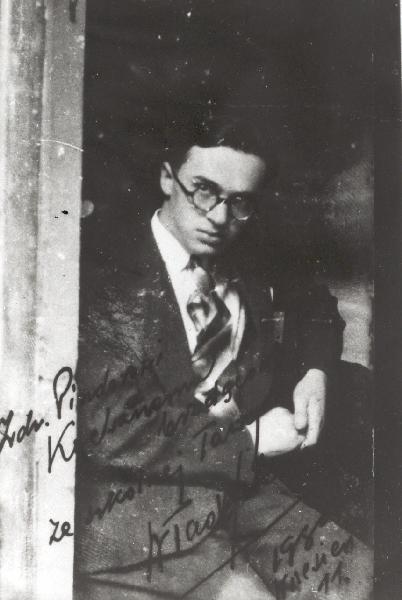
Wladyslaw Szlengel
was born in 1914, in Warsaw. His father, an artist, supported his family
by painting movie posters. While still in school, young Wladyslaw wrote poems and
short stories. A number of them were published in various small magazines.
Later, his works continued to appear, mainly in Warsaw publications. He was also
a songwriter who produced texts for cabarets and he wrote satirical poems for
the press and stage.
Szlengel's writings were firmly grounded in reality. After the creation of the Warsaw
ghetto, they
acquired a singular depth. A good example is this poem he wrote about a
courageous friend of his who watched over and comforted children the Nazis were
sending to their deaths,
Janusz Korczak:
Excerpts from "A Page from the Deportation Diary"
by Wladyslaw Szlengel
a loose translation/interpretation by Michael R. Burch
I saw Janusz Korczak walking today,
leading the children, at the head of the line.
They were dressed in their best clothes—immaculate, if gray.
Some say the weather wasn’t dismal, but fine.
They were in their best jumpers and laughing (not loud),
but if they’d been soiled, tell me—who could complain?
They walked like calm heroes through the haunted crowd,
five by five, in a whipping rain.
The pallid, the trembling, watched high overhead,
through barely cracked windows—pale, transfixed with dread.
And now and then, from the high, tolling bell
a strange moan escaped, like a sea gull’s torn cry.
Their “superiors” looked on, their eyes hard as stone.
So let us not flinch, as they march on, to die.
Footfall . . . then silence . . . the cadence of feet . . .
O, who can console them, their last mile so drear?
The church bells peal on, over shocked Leszno Street.
Will Jesus Christ save them? The high bells career.
No, God will not save them. Nor you, friend, nor I.
But let us not flinch, as they march on, to die.
No one will offer the price of their freedom.
No one will proffer a single word.
His eyes hard as gavels, the silent policeman
agrees with the priest and his terrible Lord:
“Give them the Sword!”
At the town square there is no intervention.
No one tugs Schmerling’s sleeve. No one cries
“Rescue the children!” The air, thick with tension,
reeks with the odor of vodka, and lies.
How calmly he walks, with a child in each arm:
Gut Doktor Korczak, please keep them from harm!
A fool rushes up with a reprieve in hand:
“Look Janusz Korczak—please look, you’ve been spared!”
No use for that. One resolute man,
uncomprehending that no one else cared
enough to defend them,
his choice is to end with them.
Emanuel
Ringelblum reported that Szlengel's poems "were highly popular in the
ghetto and reflected its moods." They passed from hand to hand and were
recited at meetings. Szlengel also composed works of prose and poetry for Sztuka
(Art), one of the clubs for the emerging elite and the few people of means in
the ghetto. Szlengel's became one of the foremost voices of one of the largest
European Jewish communities, as these lines from "A Cry in the Night"
attest ...
These poems were written between the first
And second upheavals,
In the last dying days of agony
Of the largest Jewish community in Europe ...
Szlengel succeeded in conveying in his writings of that period his views on the
occupiers and his misgivings about the running of the ghetto's institutions.
When the deportations from the Warsaw
ghetto were launched, Szlengel's mood changed. From then on his works
emphasized the terror felt in the ghetto and the bitter settling of accounts
between men and God. One of his poems is entitled "An Account with
God" ...
Do You still expect that
The day after tomorrow like in the Testament
When going to the Prussian gas
I shall still say "Amen" to You?
In the ghetto, each prayer became an "immense plea for mercy, a
miracle" as in the poem "Kol Nidre" ...
I've never understood the content and the words,
Only the melody of the prayer.
While my eyes I close, I see again
Reminisces from my childhood
The yellow grayish glow of candle light,
Sad movements of arms and beards,
I hear a cry, wailing
An immense plea for mercy, a miracle ...
Whipping of the chest, clasping hands —
The glory of old books,
Fear of verdicts unknown and dark.
That night I'll never tear off my heart,
A menacing mysterious night,
And the grieved prayer Kol Nidre —
In the poem "Telephone, " Szlengel complains that no one
is left whom he can call in the Polish side of the city. In his last poems,
which he wrote when he was working in a broom workshop, Szlengel records
the decline of the ghetto and its final days. One such poem is "The Little Station:
Treblinka"
(translation by Yala Korwin):
On the Tluszcz-Warsaw line,
from the Warsaw-East station,
you leave by rail
and ride straight on …
The journey lasts, sometimes
five hours & 45 minutes,
but sometimes it lasts
a lifetime until death.
The station is tiny.
Three fir trees grow there.
The sign is ordinary:
it’s the Treblinka station.
No cashier’s window,
No porter in view,
No return tickets,
Not even for a million.
There, no one is waiting,
no one waves a kerchief,
and only silence hovers,
deaf emptiness greets you.
Silent the flagpole,
silent the fir trees,
silent the black sign:
it’s the Treblinka station.
Only an old poster
with fading letters
advises:
“Cook with gas.”
Szlengel was
apparently a ghetto policeman for a time, but he resigned, since he was
incapable of taking part in the roundups of ghetto inhabitants conducted by the
ghetto police during the deportations. Even in the final stages of that period,
Szlengel continued to recite his poems before small groups in clandestine
gatherings. In poems like "Five
Minutes to Twelve," Szlengel bids farewell to life, expresses his admiration for those offering resistance
with weapons in their hands, and calls for revenge:
Hear, O God of the Germans,
the Jews praying amid the barbarians,
an iron rod or a grenade in their hands.
Give us, O God, a bloody fight
and let us die a swift death!
Szlengel took part in the September of 1939 campaign against the German
invaders. The only Jewish writer who was still alive in the ghetto, he became
its chronicler. According to surviving evidence, Szlengel was a close friend of Janusz
Korczak.
Szlengel was killed in April 1943. He is known to have been in a bunker during the Warsaw
ghetto uprising, but the circumstances and the exact date of his death are
not known.
The Nazis destroyed the Jewish people and their literary works with equal
fanatical zeal.
Therefore, not much remains of Szlengel’s output. Only part of his poetry and prose writings
has been preserved. A
collection of his writings in Polish was published under the title Co
Czytalem Umarlym (What I Read to The Dead). This slender volume was published in 1977 by Warsaw Publishing
Institute. It begins with an introductory essay of the same title, followed by three one-page
essays, and around forty poems. The introductory essay is a
heart-wrenching account of the ghetto experience. It ends thus:
Do Read it.
This is our history.
This is what I read to the dead …
To read the entire essay, click here.
Our sincere thanks to Yala Korwin for the following translations of full-lengths poems
by Wladyslaw Szlengel:
New Holiday
Jews must have holidays,
Jews must remember
what Passover and what Purim mean;
that hamantash is because of Haman,
matzo because of Egypt,
colorful flags because of Torah;
lulav and sukkah and Hanukkah candles
remind of a deed, a miracle, a period.
This horrible war, that rends the Jews asunder,
to lumps, to tatters, to quarters, will pass.
Jews will survive.
One morning they will somehow resurface
and transmit greetings from Death.
Jews must have holidays,
Jews must remember
that miracle saved them again.
New holiday, similar to Sukkot,
though no booths, but cellars and garrets.
On Deliverance Day all will descend
to creep-holes, dark hiding places.
There, they will feast on prayers,
their hearts will fill with joy and with faith.
Spade, pickaxe, and sledgehammer
will become symbols of cult.
They will fast, as in shelters,
the old one will weep and the young listen
how it was when an Action…
how it was when a blockade…
The old one will recount
how they lived in their hovels
without air and for months…
In pitch dark they waited and waited
for the first breeze of wind,
for freedom, for sun…
The old ones will assent and applaud.
The young ones will scoff, saying
that the old grandpa embroiders.
…let him tell what he wants, but
it must be enlarged as the story
of the Red Sea and Moses.
They will leave their hideouts at dusk
to where all is peace and calm,
to the world prettier, better, and new.
In the safety of light, for the holiday dinner
they will serve swastikas with honey.
Published in Jewish Currents
Two Gentlemen in the Snow
Snow is falling, angry, pervasive,
trimming my collar with white wool.
We’re together in the empty street,
a Jewish slave-worker and a soldier.
I am homeless, and so are you.
Time’s boulder is crushing our lives.
So much divides us … just think of it …
but now the snow unites us.
Because of you I can’t budge.
You too — you have no choice.
Which one of us is holding whom?
It’s a third one who holds us both.
Your uniform is dashing, I admit.
I wouldn’t dare compare with you,
though the snow can’t tell us apart
the Jew and the handsome soldier.
Snow falls equally on me and on you.
It sheds so much white peace …
We both stare through the white veil
at the faraway light in the dusk.
Look, what am I up to? What are you up to?
What for? And who needs it?
Listen, my buddy, it snows and snows,
let’s split, and let’s go home.
Translation by Yala Korwin
Leave Me Alone
Stop, my friend,
if you intend to tell me
what my lot will be.
Leave me alone.
I don’t want to know,
I’m not curious!
Don’t bring me news
from underground papers,
and especially,
do not bring me such
from the men made of rubber,
wearing slippery coats.
Not from those who know,
from those who perceive,
not from those who heard
what they say in the workshop.
Don’t give me dates,
don’t whisper in asides,
I ’m not curious,
leave me alone!
What are you after?
What are you deploring?
What do you wish
still to achieve, to add?
Your zest for life
is not yet weakened?
Are you afraid that
they’ll send us to the devil?
Who are you? A Jew.
10 million Jews
drink whisky every day
and lick ice cream sodas
in the USA.
They drink grapefruit juice
before lunch, for breakfast.
You’re sorry for Jews?
They’ll last!
Not the frightened Jews,
not the sick, shivery Jews,
but the stadium Jews,
the singing Jews —
Leave me alone,
stop the pointless whispers.
This one — an optimist,
the other one — a skeptic.
Why the arguments?
Whom do we mean?
Lies — gentlemen —
keep your heads up.
Thomas Mann is writing another novel;
Chaplin is maneuvering, will be first again;
Tuwim [*] in his solitude, in Rio,
prepares a volume of poems;
Huberman is tuning his fiddle,
and with disdainfully puffed up lips,
is practicing a sonatina
non troppo and largo;
Einstein, in safety,
is silently mulling over
his theory of relativity.
Feuchtwanger, yes — in his Jewish heart
he shares our concerns,
but he will survive, gentlemen,
and will have The Jewish War
republished.
Lopek Krukowski [**] — Mlinczyk’s cousin,
is in the USA.
Just think about it, gentlemen — in short: Wells
and I ———————————
Who are you sorry for?
The 100 Jewish militiamen?
The fellows of the Council?
What kind of brains they have?
Nothing to regret.
Al Capone is alive,
and will replace them.
Think about it for a while,
and realize
what the world will lose,
and what it will gain.
You are wasting your nights,
sucking on your dry tongue,
searching in the columns
for some new hope.
Rumpling in your hand
yet another paper,
you ruminate, like a cow,
the news bulletins.
Just think for a while:
at this same hour,
Tolek Slonimski [***] is sitting in London.
Why do you worry about
What is happening
on the eastern front,
Algiers and Tunisia,
Toulon — Morocco —
all this I have —
you know where.
I find my comfort
in the genius saved.
Walt Disney’s films
“aere perennius.”
Don’t report anything,
don’t grab my sleeve,
whisper into my ear.
Do not read me that
on the first of the …
again Treblinka.
Vodka is good,
and girls are warm.
If your life now seems
too short to you,
come to me, my friend,
take me out for a vodka.
And bring your wife,
or someone else’s.
Let our glasses double
and even triple.
I will offer you
a bulletin, splendid,
all interwoven
with rimes and rhythms.
Let us drink
To Julian Tuwim.
It’s good that in Rio …
he will endure.
Let’s drink to Wells and to Lopek,
then leave me alone.
That’s it.
[*] Julian Tuwim was a Jew and a famous Polish poet.
[**] Lopek Krukowski was a Jew and a famous Warsaw actor and entertainer.
[***] Tolek Slonimski was a famous Polish–Jewish poet.
Translation by Yala Korwin
Christmas Legends
1. Jesus in Krupp's Factory
In the factory of Krupp & Co.,
among jumbles of iron and steel,
in the plant’s blazing hall,
on Christmas Eve, a child was found
near the bullets and bombs.
In Essen’s cradle of death,
those on the evening shift
discovered in a corner
a tiny creature, forgotten or lost.
The first star appeared,
just as in Bethlehem.
Its glow strayed in a tangle
of bombs, bullets, grenades.
And the child was lying
on the heap of grimy clothes,
and everyone wondered …
Someone whispered: “like Jesus …”
Awe took hold of the flock,
and shivers — as in a hot spell.
All production stopped
for a while.
Silence as huge as a bomb
hung over their heads.
All the chimneys hushed,
all gears, bellows, and mills,
motors, foundries, and forges.
The news of the miracle,
like a strange manifesto,
struck people with fright
Crowds gathered in the hall,
the child saw the people,
and they beheld the marvel.
They implored mercy,
genuflected, beat their breasts,
and cried …
Suddenly news arrived
and reached the human throng.
Toward Essen, toward Krupp’s factory,
three kings were approaching.
Christmas, twilight,
the star’s silvery brightness,
and the kings on their way ...
A miracle, as in Bethlehem.
The dense crowd staggered
like waves against a ridge.
The central loudspeaker
suddenly broke the silence.
The three kings were coming,
according to the speaker,
to the death-making cradle,
for they needed wares.
All the shifts back to work!
The Holiday postponed!
The kings needed bombs,
mines, cartridges, and guns.
The crowd moved swiftly
to the halls, the huts, and the bombs.
All the shifts were at work
at Krupp & Co.
the tapes of steel crackled,
flames of fire rose,
the heat of blood …
Jesus, at the plant of Krupp &Co,
was forgotten.
2. Miracle in the Trenches
Fearful Europe was waiting,
what are those in the trenches going to do? …
All those in the trenches
had tired feet, weary bones, eyes, and blood.
They had stopped counting offensives,
stopped counting days…
The general staff was drawing red lines,
shouting into the field telephones,
while someone bellowed into a broken handset.
Attention! All is ready …
In the
trenches — stooped backs,
all watches —
fearfully ticking,
something
flashed at the turn in the road,
tension grew
in the lines.
Veins swelled in all temples,
maps were red hot in palms,
eyes blinked with fury,
pulses quivered and throbbed,
and blood was impatient
for the final outcry: ”Hurrah!” …
A watch
revealed
hopelessness
and gloom,
in the blink
of a flashlight
disclosed the
time was ripe ...
The attack — soon. Soon they’ll set out
with bayonets, move forward,
soon both enemy lines
will leap toward each other,
sink their teeth into each other,
engage, pry edges into furrows,
eyes will go blind with blood.
Soon butt-ends, blades, and fingers
will crunch into each other,
soon two human waves
will clash in a dark battle.
One army is ready,
the other — still waiting
for the sign.
Human lines — two sides.
Close to nightfall now.
Look — a star shone forth —
for it was Christmas Eve.
Hard fingers were on triggers,
nerves — greyhounds loosed,
hearts — crash and pursuit,
Eyes — bloodshot circles —
Let them scream! Let them go!
Human dogs running forward
toward smiting and pricking,
bloody sowing and thrashing …
Trrrr — the telephone signal,
a shot drove them from their trenches.
The signal imbedded in their hearts,
they set out toward death …
Both foes —
running, running,
for a meeting
mid-way.
All rushing
and burning,
Palms on
butt-ends and triggers,
but on that
Christmas Eve
a miracle
occurred on the front.
When they were mid-way,
the human dogs — human foes —
stopped all of a sudden.
Their thrust restrained by someone,
they looked and contemplated …
Someone dropped the gun from his hand …
When they reached each other,
with the last of their initial drive
they broke, with each other,
Christmas wafers [*] rather than lives.
They shook each other’s hands,
cried in each other’s arms,
spoke, like brothers or sons,
of each other’s homes.
A call came from the general staff:
Again we broke in with a wedge …
[*] The Christmas wafer is a Polish tradition.
Translation by Yala Korwin
To read more English translations of several of Szlengel's poems, click here
and here and here.
Sources:
"Encyclopedia of the Holocaust"
©1990 Macmillan Publishing Company
New York, NY 10022
Yala Korwin
Museum of Tolerance
We Remember
Poetry on the Shoah
The HyperTexts