The HyperTexts
Yala Korwin (1933-2014): Obituary, Biography, Tribute and Memorial
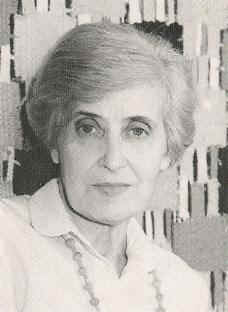
"I escaped to be a witness."
Yala Helen Korwin, a Holocaust survivor, was born on February 7, 1933 in Lvov, Poland and died May 30, 2014 in New York
City. She was a poet, artist, author, essayist, librarian and teacher. She created over 400 paintings
and sculptures, some of which are on display in the Holocaust
Museum in Washington, D.C.
Korwin was a precocious child artist who received
spankings for scribbling on the walls of her parents' apartment. Her father,
Salomon
Nachmani Meisels, was a poet and editor. As a high school
student, she excelled at writing imaginative stories
for her Polish Language classes. But the outbreak of World War II brought drastic changes to her life.
Having survived a labor camp in the heart of Germany, and having no place to
return to, she let the winds carry her to France, where she lived as a refugee
for ten years. The urge to write never left her, but after years away from her native country, the Polish tongue didn't
seem like the right tool anymore. French, though greatly admired, remained a
stranger.
A breakthrough came after she emigrated to the United States in 1956 with her
husband Paul Korwin and their two children, Danielle and Robert. In 1965 she
enrolled at Queens College, where she majored in French Literature with a minor
in Art. As a senior, she took an honors course in Creative Writing, and
discovered the new trends in poetry. Glad that rhymes, quite scary for the
foreign-born, were no longer essential, she handed in assignments written in
free verse, and completed the course with an A-minus. She eventually earned her
BA degree Magna Cum Laude, then a Masters degree Summa Cum Laude. She went on to
author six books.
Korwin's first published work was a library tool, the two-volume Index to
Two-Dimensional Art Works in Books, published in 1981 by Scarecrow Press. Her
first collection of poems, To Tell the Story: Poems of the Holocaust, was published in 1987 by the
Holocaust Library. Her poetry has also been published in literary journals,
anthologies, textbooks, and has been set
to classical music.
Korwin considered herself to be a more traditional poet and especially favored the sonnet, which,
she said, allows the poet to say all one needs in just fourteen lines, without
unnecessary verbosity. Her books are available through amazon.com,
barnesandnoble.com, and other major book retailers.
A poem she hoped to be remembered by, which appears immediately below, is " The Little Boy with His
Hands Up." It has been included in the documentary film produced in
Finland; discussed in an essay by M. Hirsch in Acts of Memory, published by
Dartmouth College; used by Prof. R. Raskin of Denmark in his
scholarly study of the famous photograph; and included in the curriculum unit
created by the Westchester Holocaust Education Center.
Rhina Espaillat in a letter to Michael R. Burch, the editor of The HyperTexts,
said: "I want to tell you again what a joy
it is to see Yala Korwin's work posted on your site, attracting the readers she
deserves. Her poetry gives the lie to the remark by Paul Celan that she uses as
an epigraph to one of her poems, about the impossibility of telling one's own
truth in a language that is not one's first. Yala's work is so passionate and
wise about her truth—the truth of her personal experience and that of her
generation—that it would somehow make itself understood if she stammered it in
Chinese! Thank you for giving a forum to those of us who try to defy Celan's
observation by doing our "telling"—our singing—in the language of
the Other."
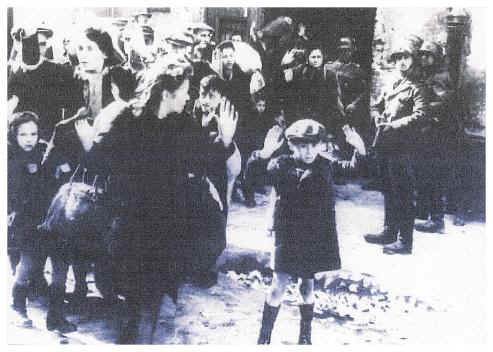
The Little Boy with His Hands Up
Your open palms raised in the air
like two white doves
frame your meager face,
your face contorted with fear,
grown old with knowledge beyond your years.
Not yet ten. Eight? Seven?
Not yet compelled to mark
with a blue star on white badge
your Jewishness.
No need to brand the very young.
They will meekly follow their mothers.
You are standing apart
Against the flock of women and their brood
With blank, resigned stares.
All the torments of this harassed crowd
Are written on your face.
In your dark eyes—a vision of horror.
You have seen Death already
On the ghetto streets, haven't you?
Do you recognize it in the emblems
Of the SS-man facing you with his camera?
Like a lost lamb you are standing
Apart and forlorn beholding your own fate.
Where is your mother, little boy?
Is she the woman glancing over her shoulder
At the gunmen at the bunker's entrance?
Is it she who lovingly, though in haste,
Buttoned your coat, straightened your cap,
Pulled up your socks?
Is it her dreams of you, her dreams
Of a future Einstein, a Spinoza,
Another Heine or Halévy
They will murder soon?
Or are you orphaned already?
But even if you still have a mother,
She won't be allowed to comfort you
In her arms.
Her tired arms loaded with useless bundles
Must remain up in submission.
Alone you will march
Among other lonely wretches
Toward your martyrdom.
Your image will remain with us
And grow and grow
To immense proportions,
To haunt the callous world,
To accuse it, with ever stronger voice,
In the name of the million youngsters
Who lie, pitiful rag-dolls,
Their eyes forever closed.
From To Tell the Story - Poems Of the Holocaust
Also published in Blood to Remember, ed. Charles Fishman, publ. Texas Tech Univ. Press
Also published in A Child at Gunpoint by Richard Raskin, click here
for more information, or to order.
Passover Night 1942
not a crumb of leavened
or unleavened bread
and no manna fell
no water sprang out
of the bunker’s wall
the last potato was gone
we sat and we munched
chunks of potato-peels
more bitter than herbs
we didn’t dare to sing
and open the door
for Elijah
we huddled and prayed
while pillars of clouds
massed above our heads
and pillars of fire
loomed like blazing traps
Ecce Homo
The lives of great men are like legends—
difficult, but beautiful.
—Hirsh Goldszmit (Janusz Korczak)
His life was difficult but beautiful.
"Old Doctor"—gifted penman, teacher, sage,
a Polish Jew with childlike soul so full
of tenderness for those of tender age,
a father to the orphans in his care.
The wings of children, still so weak, should be
not clipped, but groomed by love, to cleave the air—
his favorite maxim and his constant plea.
Then Hitler's war. The orphans' lot was cast.
He went with them, a supreme sacrifice.
This noble lesson was to be his last:
All life is dear, but not at any price.
How hard to find the proper words that can
convey his life...Just this: Behold the Man.
His Words
Don't hold me back, my friend, let me sail.
I won't be going far:
Only to the other shore.
—Primo Levy
The mystery still veiled, much left untold . . .
What made him drop the task, give up the quest
for purpose, meaning, truth? What force, what tide
propelled his boat to shores so dark and cold?
Scholar of matter, what made him feel so pressed
to cross, by willful act, the great divide?
Matter was silent. Was it injured pride
over defeat that gave his mind no rest?
In zinc and carbon he would find no clue.
Wary of spirit, where else to seek and test
the divine secret? Gesture grave and bold:
he gave up the gift. Yet spirit rose and grew.
His words became his life. What can undo
their iron strength, the glamour of their gold?
Published in Midstream
O Israel
O Israel, you stubborn ancient tribe!
Your fathers all banned human sacrifice:
young rams for sons, said prophet, sage, and scribe.
The lust for blood unleashed, you paid the price
of banishment. Landless, among your hosts,
you thrived, refused to change your faith, forget
your customs, give in, fade away like ghosts.
You clung to Sabbath and to alphabet.
You’re back. Your home—ransomed by blood and ash,
Old promise salvaged from a dusty shelf,
a chip of land. Your destiny—the clash
with foes who would uproot you. Save yourself
this time again, to stay where you belong.
O Israel, be merciful, but strong.
Published in Midstream
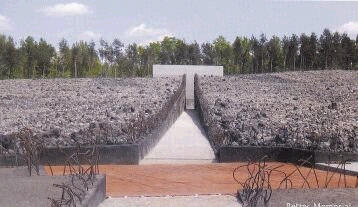
The Unveiling of Belzec Monument
Earth, do not cover my blood.
Let there be no resting place for my outcry.
—Job 16:18
These ash-clad acres imbued with charred remains
of women, men, and children, young and old,
induced with lie and ruse to board the trains
that brought here all their stories left untold...
O, mother, father, sister, teacher, friend...
O, countless strangers, and my murdered youth...
Here have I come, striving to comprehend
your silence, your bequest of final truth.
As I descend the narrow ditch that cuts
that grisly field, I breathe your breaths and feel
your dread, constrained to die your many deaths.
Your stone—embedded deeply, like a seal.
I light my candle, pray, and bless each name,
then turn to what can never be the same.
Published in Midstream
From a Widow's Diary— 9/11/01
This morning's news: in shock I watch on screen
two giants tumble like a house of cards.
And I, alone to view the fatal scene
of life and steel becoming shreds and shards.
Wrapped up in grief, as in a hellish dream,
I think, the towers were like you and me—
two units, yet a true united team—
a heap of shattered hopes, become debris.
But time, in passing, tends and heals each wound.
Twin towers nevermore will reach the sky,
but life renews itself on hallowed ground.
Though I will not allow our link to die,
rebuilding must go on. And so, I, too,
will join the builders. This I promise you.
Published in BEREAVEMENT - A Magazine for Hope and Healing
To Bruno Schulz
One of Bruno Schulz's secrets of creativity lies in
the symbiosis of authentic and mythical elements.
—Jerzy Ficowski
O Master, you cajoled what's plain to grace.
Your pen obeyed your visions' magic wand,
and forced all clocks to stop, or curb their pace.
That god-forsaken town you loved—your bond
to life of lone pursuits and pregnant dreams.
You ventured boldly to where wonders live,
you traveled deeply where pure insight teems.
The silence of your room was thought's live sieve.
The Nazi's hand, that cut
your fated time,
did not avert the fame of your mean street
and modest house. It was a heinous crime
that stopped your breath. It still was not defeat.
Though time has passed, though many years are gone,
your name delights all shores, your art lives on.
Widows
They congregate like birds, two, three, or more,
wearing masks of mirth, cover for grief,
applaud an actor, admire a design,
feast on green salad, fresh salmon, but before,
order a carafe—Bordeaux—for the brief
drowning of misery in a glass of wine.
They sip some gossip, gentle or malign,
go promenading in the park, but if
lovers stroll by, they grow serene. A goad
piercing sad hearts. A gasp, a sniff,
a burst of glee relieving an old sore.
Day ends. They part. Another episode—
each to her cold nest, with her secret load,
where no one waits, where silence has the floor.
How Lucky . . .
I am connected to life only by a single thread,
and this single thread is my cognition, nothing else.
—Imre Kertesz
How lucky those who breathe but do not think!
The oak and spruce, that birch, the elm and plane...
They live their lives not knowing loss or gain,
Do not invent or strive, don't look, don't blink.
How blessed the rose, how blessed the plainest bloom!
They thrive on gifts (The givers: earth and sun).
They fade with grace; give up what's just begun.
No cringe, regret, no grief, no fear of doom.
But I do need the touch and smell of rain.
My fate is lightning, so intense and terse.
Yet I, endowed with matter known as brain,
Am grateful for what seems to be a curse.
Although I suffer, grieve, and twist with pain,
I also love and dream, and pen a verse.
"Old Shoes" by Van Gogh & "Stardust Shoes" by Warhol
Like a pair of patient dogs they gravely sit,
soiled, battered, scuffed, as if they had been dropped
from someone's tired feet, and thudding, hit
the floor. They sit inert, and time seems stopped
letting us sense the odor of their sweat.
Whose toil, whose pains, what agony they must
have witnessed! Vincent's own despair? And yet,
there is hope, for sweat transcends the dust.
Another age, another kind of vision
Picks up the theme: a pair of shoes. New-laced,
no feet have worn them. Here,
no earthly scope.
They float in space. Drawn with great precision,
what force has styled them so, without a trace
of human presence, no one here to hope?
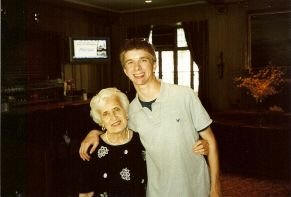
Yala Korwin with Brian Coleman, an American student who reached out to and
befriended a number of Holocaust survivors.
In addition to this page of her poetry, we also have pages of Yala Korwin's Holocaust poetry
and visual art. Yala Korwin and her family were victims of
racism, ethnic cleansing and genocide.
If you are a student, teacher, educator, peace
activist or just someone who cares and wants to help, please read two very
important articles:
What Was
the Holocaust and Why Did It Happen?
and
How Can We End Ethnic Cleansing and Genocide Forever?
The HyperTexts