The HyperTexts
Nelson Mandela Poems, Elegies, Tributes, Quotes and Epigrams
South African Apartheid Freedom Poetry
An Inspiring Tribute to Nelson Mandela by Muhammad Ali and the Poem "Invictus"
by William Ernest Henley
Nelson Mandela and the Elders: Reflections on Palestine and
Peace in the Middle East
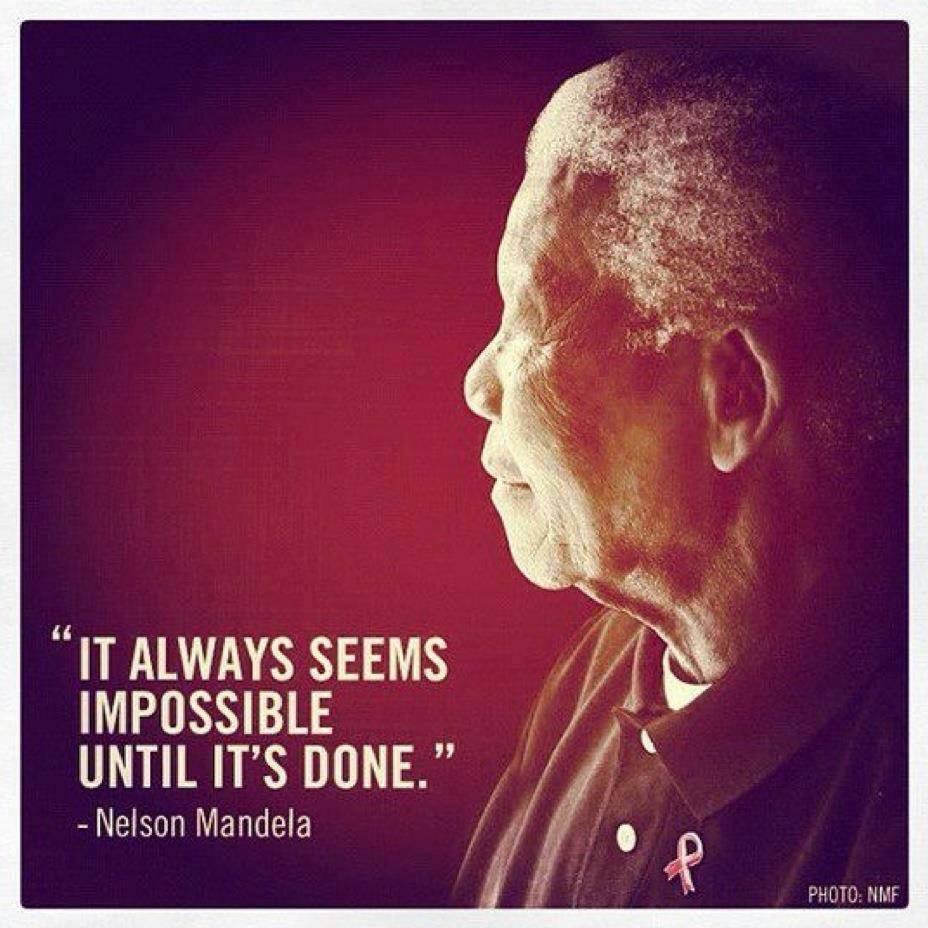
Nelson Mandela (1918-2013) stood steadfastly for equality and
justice, while opposing intolerance, hatred, racism, apartheid, ethnic cleansing and
genocide. Mandela’s father, a tribal chief in Transkei, a Xhosa homeland, gave
his son the name Rolihlahla at birth. In Xhosa it means "pulling the
branch from a tree" but colloquially it means "troublemaker." Mandela's
father may have had a premonition of troubles to come, as his son would one day
be called the "Black Pimpernel" because of his ability to elude
political police by donning disguises (his favorite disguise was a chauffer). At
age 16, Mandela was formally initiated into manhood through a traditional Xhosa
ceremony in which he was given the name Dalibhunga, which means
"creator or founder of the council" or "convener of the dialogue." When using
the name to greet Mandela, the correct usage was "Aaah! Dalibhunga."
Later in life, Mandela was known as Madiba, the name of his Xhosa clan, as
Tata ("father") and as Khulu, a Xhosa abbreviation
for uBawomkhulu, which means "grandfather" with connotations of
"great, paramount, grand." After spending
27 years in prison for resisting apartheid, Nelson Mandela became the first black president of South Africa and a Nobel Peace Prize laureate.
Nelson Mandela was a poetry lover, and he loved one poem in particular:
"Invictus" by William Ernest Henley.
"Invictus" became the title of the movie about Mandela's life; it starred
Morgan Freeman as Mandela. The inspiring poem appears in full later on this
page.
Your freedom and mine cannot be separated.
―Nelson Mandela
Nelson Mandela Lives (I)
an Elegy
by Michael R. Burch
Nelson Mandela in prison
was more powerful than a nation of unjust jailers.
A pacing lion demanding justice,
he refused the comfort of a coward's sinecure.
A man must belong to his pride, and so too every freedom-loving woman!
Later, the aging gladiator of peace
crossed the dark savannahs of intolerance,
transforming himself into enlightenment and benevolence.
Now Tata Madiba in his grave
is more vitally alive than billions of shadow people
cringing in obedient silence before their inferior
masters.
His ringing words live on:
Hating clouds the mind.
It gets in the way of strategy.
Leaders cannot afford to hate.
He was born Rolihlahla Mandela on July 18, 1918, in Mvezo, a tiny village
in the rolling hills of the Transkei. His father, Gadla Henry Mphakanyiswa, was a chief and
royal of the Thembu people, a subdivision of the Xhosa nation. I believe Mandela
was a poet. He spoke in "the universal language of the heart" ...
If you talk to a man in a language he understands,
that goes to his head.
If you talk to him in his own language,
that goes to his heart.
―Nelson Mandela
It is never my custom to use words lightly.
If twenty-seven years in prison taught us anything,
it was to use the silence of solitude
to make us understand how precious words are
and how real speech is in its impact
on the way people live and die.
―Nelson Mandela
I have walked that long road to freedom.
I have tried not to falter;
I have made missteps along the way.
But I have discovered the secret
that, after climbing a great hill,
one only finds that there are many more hills to climb.
I have taken a moment here to rest,
to steal a view of the glorious vista that surrounds me,
to look back on the distance I have come.
But I can only rest for a moment,
for with freedom comes responsibilities,
and I dare not linger,
for my long walk is not ended.
―Nelson Mandela
Nelson Mandela Lives (II)
an Elegy
by Michael R. Burch
Mandela is gone,
and yet he is not;
he lives in our hearts;
he lives in the thought
of men living free,
in equality.
Mandela lives here,
as vital as ever!
He lives in the words
that still make us shiver:
"The load weighs a ton
until the work's done."
He lives on in the work
he would not let us shirk.
Mandela!
Mandela!
by Michael R. Burch
Nelson Mandela,
warrior of peace,
stare down the tyrant,
speak for the least.
Mandela!
Give greed no foothold
to clamber upon
the bent backs of children
and make them its pawn.
Mandela!
Let virtuous justice
redeem crimson lands
till the dove glides to rest
in albescent sands.
Mandela!
If you are a student, teacher, educator, peace
activist or just someone who cares and wants to help, please
click this link
How Can We End Ethnic Cleansing and Genocide Forever? and do
what you can to
make the world a safer, happier place for children of all races
and creeds.
I am fundamentally an optimist.
Whether that comes from nature or nurture, I cannot say.
Part of being optimistic is keeping one’s head pointed toward the sun,
one’s feet moving forward.
There were many dark moments when my faith in humanity was sorely tested,
but I would not and could not give myself up to despair.
That way lays defeat and death.
―Nelson Mandela
Into the Heartland
by Michael R. Burch
Nelson Mandela,
friend of mankind,
speak for the voiceless,
bear forth the blind
into the heartland
where sweet kindness reigns
and courts dispense justice
till each man regains
his sense of self worth
and dignity.
Let us emulate you,
till all men are born free,
Mandela!
Here is the poem that helped Nelson Mandela endure 27 years in Prison, to emerge triumphant:
Invictus
by William Ernest Henley
Out of the night that covers me,
Black as the pit from pole to pole,
I thank whatever gods may be
For my unconquerable soul.
In the fell clutch of circumstance
I have not winced nor cried aloud.
Under the bludgeonings of chance
My head is bloody, but unbowed.
Beyond this place of wrath and tears
Looms but the Horror of the shade,
And yet the menace of the years
Finds and shall find me unafraid.
It matters not how strait the gate,
How charged with punishments the scroll,
I am the master of my fate:
I am the captain of my soul.
The following are sayings of Nelson Mandela that I have re-cast as poems. I have
followed his own words with a tribute to him written by the great American
boxer, Muhammad Ali, who unabashedly calls Mandela his hero. I am also
including an important letter Mandela wrote about the prospects for peace in
Palestine, shortly before the 9-11 attacks, along with a link to an article
which discusses the opinions of Nelson Mandela and other Elders of the human
race about what it will take to achieve
Peace in the Middle East.
People who don't believe guns and bombs will bring peace should carefully
consider what men like Nelson Mandela, Desmond Tutu, Jimmy Carter, Albert
Einstein, Mohandas Gandhi and Dr. Martin Luther King Jr. have to say about
achieving peace through justice. Now, here are the words of a great man of peace
and justice, Nelson Mandela:
Let freedom reign.
The sun never set
on so glorious a human achievement.
Only free men can negotiate;
prisoners cannot enter into contracts.
Your freedom and mine
cannot be separated.
And there can be no keener revelation
of a society's soul
than the way in which it treats its children.
To be free
is not merely to cast off one's chains,
but to live in a way
that respects and enhances
the freedom of others.
I had no epiphany,
no singular revelation,
no moment of truth,
but a steady accumulation of a thousand slights,
a thousand indignities
and a thousand unremembered moments
produced in me an anger,
a rebelliousness,
a desire to fight the system that imprisoned my people.
There was no particular day on which I said,
Henceforth I will devote myself to the liberation of my people;
instead, I simply found myself doing so,
and could not do otherwise.
For to be free
is not merely to cast off one’s chains,
but to live in a way
that respects and enhances
the freedom of others.
The greatest glory in living
lies not in never falling,
but in rising every time we fall.
Resentment is like drinking poison
hoping it will kill your enemies.
As I walked out the door toward the gate
that would lead to my freedom,
I knew if I didn’t leave my bitterness and hatred behind,
I’d still be in prison.
There is no such thing as partial freedom.
Difficulties break some men but make others.
No axe is sharp enough to cut the soul of a sinner who keeps on trying,
one armed with the hope that he will rise even in the end.
Nelson Mandela explains why apartheidist Israel remains under siege:
A freedom fighter learns the hard way
that it is the oppressor who defines the nature of the struggle,
and the oppressed is often left no recourse
but to use methods that mirror those of the oppressor.
At a point, one can only fight fire with fire.
―Nelson Mandela, "Long Walk to Freedom"
The poem below has been incorrectly attributed to Nelson Mandela, but I have no
doubt that he would approve its message ...
Our Deepest Fear
by Marianne Williamson
Our deepest fear is not that we are inadequate.
Our deepest fear is that we are powerful beyond measure.
It is our light, not our darkness
That most frightens us.
We ask ourselves
Who am I to be brilliant, gorgeous, talented, fabulous?
Actually, who are you not to be?
You are a child of God.
Your playing small
Does not serve the world.
There's nothing enlightened about shrinking
So that other people won't feel insecure around you.
We are all meant to shine,
As children do.
We were born to make manifest
The glory of God that is within us.
It's not just in some of us;
It's in everyone.
And as we let our own light shine,
We unconsciously give other people permission to do the same.
As we're liberated from our own fear,
Our presence automatically liberates others.
NELSON MANDELA
by Muhammad Ali
Nelson Mandela is my hero. His story has come to symbolize the struggle
against the apartheid machine in South Africa. Apartheid, the terrible, and
often violent, institutionalized racism that for so long held South African
society in its grip, was not an easy policy to fight against—especially
since he was oppressed within the system. Mandela understands what it means
to fight against enormous odds; he went to prison for nearly three decades
for his work, because he knew there was no alternative. He believes that
every human being is of equal value.
Mandela is my hero because he survived many years of life as a subject of
colonialism. As a child in Africa, Mandela was a victim of the European
colonial project in that involved "civilizing" indigenous folks by silencing
African lifeways in favor of so-called Eurocentric high culture. Perhaps
finding his Xhosa name, Rolihlahla, too cumbersome or primitive, a teacher
assigned him the decidedly more English "Nelson" when he was a student at a
British colonial boarding school.
Mandela is my hero because he embraces all people like brothers and
sisters. He is one of the greatest civil rights leaders in world history.
Mandela is my hero because his spirit cannot be crushed. Imprisoned for his
political views in the early 1960s, Mandela refused to compromise his
position, which was equality and justice for all people. He sacrificed his
own freedom for the self-determination of all South Africans. He is
courageous and uncompromising.
Mandela is my hero because is a man of great personal honor, strength,
and integrity, but he was always fighting for something greater than
himself, and that was the freedom of an entire nation. It is painful to
imagine that this man, who radiates so much love, who espoused so many
truths, could have spent so much of his life in prison.
Mandela is my hero because he triumphed over injustice, and not in a
small way. Almost unimaginable just a few years before, Nelson Mandela
became the first democratically-elected president of South Africa in 1994
and served in that position for five years.
More than anyone in the world, Mandela embodies the hopes and dreams of a
true, lasting justice and equality, not just for South Africans but for all
people. It is Mandela—through his unselfish and constant presence on the
international stage raising awareness about AIDS, peace, debt relief, the
environment—who most inspires us to think responsibly of our fellow man and
of our planet.
Nelson Mandela has always inspired me to think beyond myself, to think of
people in the wider world as part of a common humanity. I am blessed by his
friendship. I love him for what he has accomplished, for what he has been
through, for his journey forward. He remains a hallmark of what it really
means to give of oneself selflessly—which is, indeed, a gift for us all.
Nelson Mandela Memo on Palestine
March 28, 2001
To: Thomas L. Friedman (columnist for the New York Times)
From: Nelson Mandela (former President of South Africa)
Dear Thomas,
I know that you and I long for peace in the Middle East,
but before you continue to talk about necessary conditions from an Israeli
perspective, you need to know what's on my mind. Where to begin? How about 1964.
Let me quote my own words during my trial. They are true today as they were
then:
"I have fought against white domination and I have fought against black
domination. I have cherished the ideal of a democratic and free society in which
all persons live together in harmony and with equal opportunities. It is an
ideal which I hope to live for and to achieve. But if needs be, it is an ideal
for which I am prepared to die."
Today the world, black and white, recognise that apartheid has no future. In South Africa it
has been ended by our own decisive mass action in order to build peace and
security. That mass campaign of defiance and other actions could only culminate
in the establishment of democracy.
Perhaps it is strange for you to observe the situation in Palestine or more specifically,
the structure
of political and cultural relationships between Palestinians and Israelis, as an
apartheid system. This is because you incorrectly think that the problem of Palestine began in 1967.
This was demonstrated in your recent column "Bush's First Memo" in the New York
Times on March 27, 2001.
You seem to be surprised to hear that there are still
problems of 1948 to be solved, the most important component of which is the
right to return of Palestinian refugees.
The Palestinian-Israeli conflict is not just an issue of military occupation and Israel
is not a country that was established "normally" and happened to occupy another
country in 1967. Palestinians are not struggling for a "state" but for freedom,
liberation and equality, just like we were struggling for freedom in
South Africa.
In the last few years, and especially during the reign
of the Labour Party, Israel showed that it was not even willing to return what
it occupied in 1967; that settlements remain, Jerusalem would be under exclusive
Israeli sovereignty, and Palestinians would not have an independent state, but
would be under Israeli economic domination with Israeli control of borders,
land, air, water and sea.
Israel
was not thinking of a "state" but of "separation". The value of separation is
measured in terms of the ability of Israel to keep the Jewish state
Jewish, and not to have a Palestinian minority that could have the opportunity
to become a majority at some time in the future. If this takes place, it would
force Israel
to either become a secular democratic or bi-national state, or to turn into a
state of apartheid not only de facto, but also de jure.
Thomas, if you follow the polls in Israel for the last 30 or 40 years,
you clearly find a vulgar racism that includes a third of the population who
openly declare themselves to be racist. This racism is of the nature of "I hate
Arabs" and "I wish Arabs would be dead". If you also follow the judicial system
in Israel you will see there is discrimination against Palestinians, and if you
further consider the 1967 occupied territories you will find there are already
two judicial systems in operation that represent two different approaches to
human life: one for Palestinian life and the other for Jewish life. Additionally
there are two different approaches to property and to land. Palestinian property
is not recognised as private property because it can be confiscated.
As to the Israeli occupation of the West Bank and Gaza, there is an
additional factor. The so-called "Palestinian autonomous areas" are bantustans.
These are restricted entities within the power structure of the Israeli
apartheid system.
The Palestinian state cannot be the by-product of the
Jewish state, just in order to keep the Jewish purity of Israel. Israel's racial discrimination is
daily life of most Palestinians. Since Israel is a Jewish state, Israeli
Jews are able to accrue special rights which non-Jews cannot do. Palestinian
Arabs have no place in a "Jewish" state.
Apartheid is a crime against humanity. Israel has
deprived millions of Palestinians of their liberty and property. It has
perpetuated a system of gross racial discrimination and inequality. It has
systematically incarcerated and tortured thousands of Palestinians, contrary to
the rules of international law. It has, in particular, waged a war against a
civilian population, in particular children.
The responses made by South Africa to human rights abuses emanating
from the removal policies and apartheid policies respectively, shed light on
what Israeli society must necessarily go through before one can speak of a just
and lasting peace in the Middle East and an end to its apartheid policies.
Thomas, I'm not abandoning Mideast
diplomacy. But I'm not going to indulge you the way your supporters do. If you
want peace and democracy, I will support you. If you want formal apartheid, we
will not support you. If you want to support racial discrimination and ethnic
cleansing, we will oppose you. When you figure out what you're about, give me a
call.
Nelson Mandela
[Editor’s note, Nov. 29, 2013: It has been brought to my attention that this article was written by Arjan El Fassed in
2001 in the satirical style then being employed by Thomas Friedman, of writing
mock letters from one world leader to another. Although it carries El Fassed’s
byline, it has been repeatedly mistaken for an actual letter from Mandela. It is
not. It is a piece of satire. El Fassed has written this
history of the piece and how it subsequently was mistaken for a real letter, on
his personal blog. The memo was written in 2001, shortly before the 9-11 attacks. Several of
the men who engineered the attacks, including Osama bin Laden, said that
they were motivated by the suffering of the Palestinians. Why have the
governments of Israel and the United States colluded to cause millions of
completely innocent Palestinian women and children to suffer so terribly,
for more than sixty years, while hypocritically trumpeting the glories of
"democracy" to the rest of the world? If the world would only listen
to men like Nelson Mandela, and follow their lead, world peace might become
possible in our lifetimes. But if the most powerful nation on earth is going
to pay lip service to its ideals, while perpetuating the suffering of so
many innocents, we will necessarily remain doomed to never-ending cycles of
violence and retribution, because Muslim men will never accept that Muslim
women and children can be treated like slaves or feudal serfs. If we want
peace, we have to understand that we cannot mistreat other men's women and
children. Every time Jews and Christians try to make Muslims the "exception"
to this universal rule, which is only common sense, all hell is bound to
break loose, eventually, as it did on 9-11.—MRB]
"I have come to join you today to add our own voice to the universal call for
Palestinian self-determination and statehood. We would be beneath our own reason
for existence as government and as a nation, if the resolution of the problems
of the Middle East did not feature prominently
on our agenda."—Nelson Mandela, "The International Day of Solidarity with the Palestinian People", Pretoria, South Africa, December 4th 1997
"When in 1977, the United Nations passed the resolution inaugurating
the International Day of Solidarity with the Palestinian people, it was
asserting the recognition that injustice and
gross human rights
violations were being perpetrated in Palestine. In the same
period, the UN took a strong stand against apartheid; and over the years, an
international consensus was built, which helped to bring an end to this
iniquitous system. But we know too well that our freedom is incomplete
without the freedom of the Palestinians."—Nelson Mandela, "The International
Day of Solidarity with the Palestinian People", Pretoria, South Africa, December 4th 1997
As reported by the Times of Israel: "Indeed, one of Mandela’s first
acts as a free man was to visit Yasser Arafat." The article mentions that photos
of Mandela embracing Arafat "raised concerns in
Jewish communities around the globe." The article goes on to say that: "Alon
Liel, who became Israel’s ambassador in 1992, met Madiba merely a few days after
taking up his new post in Pretoria. He had told Mandela’s associates that
Jerusalem had dramatically changed its South Africa policies in favor of the
black community. 'The message [Mandela] sent us was that they will never forget
what we did,' Liel recalled. 'The main message was this: ‘We care a lot about
the Palestinians. We are on the verge of achieving our freedom, it will not
really be complete until our brothers the Palestinians, who fought with us and
supported us, will achieve their freedom.’' If Rabin, who had just been elected
prime minister, makes peace with the Palestinians, then 'we will judge Israel on
that merit,' Madiba told Liel."
If you are interested in following in the footsteps of Nelson Mandela, and
believe that peace must be achieved through justice rather than violence, please
read this short article:
The Path to Peace in the Middle East. You can also learn more about what is
really happening in the Middle East and how those events led to 9-11 and two
fruitless, unwinnable wars, by exploring our
Nakba Index.
Here are more Nelson Mandela quotes and sayings recast as poems:
Let there be work,
bread, water and salt
for all.
There is no easy walk to freedom anywhere,
and many of us will have to pass
through the valley of the shadow of death
again and again
before we reach the mountaintop of our desires.
I am not a saint,
unless you think of a saint
as a sinner who keeps on trying.
There is nothing like returning
to a place that remains unchanged
to find the ways
in which you yourself have altered.
Money won't create success,
the freedom to make it will.
The greatest glory in living
lies not in never falling,
but in rising every time we fall.
We must use time wisely
and forever realize
that the time is always ripe
to do right.
A good head and a good heart
are always a formidable combination.
If there are dreams
about a beautiful South Africa,
there are also roads
that lead to their goal.
Two of these roads
could be named Goodness
and Forgiveness.
When the water starts boiling
it is foolish to turn off the heat.
A Nation should not be judged
by how it treats its highest citizens,
but its lowest ones.
Without language,
one cannot talk to people
and understand them;
one cannot share their hopes
and aspirations,
grasp their history,
appreciate their poetry,
or savor their songs.
And as we let our own light shine,
we unconsciously give other people permission to do the same.
As we are liberated from our own fear,
our presence automatically liberates others.
People must learn to hate,
and if they can learn to hate,
they can be taught to love,
for love comes more naturally
to the human heart than its opposite ...
Man's goodness is a flame
that can be hidden
but never explained.
I have never cared very much for personal prizes.
A person does not become a freedom fighter
in the hope of winning awards.
I like friends who have independent minds
because they tend to make you see problems from all angles.
Real leaders
must be ready to sacrifice
all
for the freedom of their people.
A fundamental concern
for others in our individual and community lives
would go a long way in making the world
the better place we so passionately dreamt of.
Everyone can rise above their circumstances
and achieve success
if they are dedicated to and passionate about what they do.
Education is the most powerful weapon
which you can use to change the world.
I learned that courage was not the absence of fear,
but the triumph over it.
The brave man is not he who does not feel afraid,
but he who conquers that fear.
Lead from the back
and let others believe
they are in front.
Do not judge me by my successes,
judge me by how many times I fell down
and got back up again.
I hate race discrimination
most intensely
and in all its manifestations.
I have fought it all during my life;
I fight it now,
and will do so until the end of my days.
A Poem for Nelson Mandela
by Elizabeth Alexander
Here where I live it is Sunday.
From my room I hear black
children playing between houses
and the El at a Sabbath rattle.
I smell barbecue from every direction
and hear black hands tolling church bells,
hear wind hissing through elm trees
through dry grasses
On a rooftop of a prison
in South Africa Nelson Mandela
tends garden and has a birthday,
as my Jamaican grandfather in Harlem, New York
raises tomatoes and turns ninety-one.
I have taken touch for granted: my grandfather’s hands,
his shoulders, his pajamas which smell of vitamin pills.
I have taken a lover’s touch for granted,
recall my lover’s touch from this morning
as Mandela’s wife pulls memories through years
and years
my life is black and filled with fortune.
Nelson Mandela is with me because I believe
in symbols; symbols bear power; symbols demand
power; and that is how a nation
follows a man who leads from prison
and cannot speak to them. Nelson Mandela
is with me because I am a black girl
who honors her elders, who loves
her grandfather, who is a black daughter
as Mandela’s daughters are black
daughters. This is Philadelphia
and I see this Sunday clean.
I am the First Accused
text by Nelson Mandela.
"poetized" by Lee Bob Black
the question of violence
I planned sabotage
I did not plan it in a spirit of recklessness
nor because I have any
love
of violence
a calm and sober assessment of the political situation
years of tyranny, exploitation, and oppression of my people
violence by the African people had become inevitable
without violence there would be no way
to succeed
against
white supremacy
We chose to defy the law
to answer violence with violence
South Africa belongs to all
people
In the words of my leader:
"What have been the fruits of moderation?
No self-respecting White political organization
would disband
itself if declared illegal by a government in which it had no say
It would be unrealistic
to continue preaching peace and non-violence
when the Government met our peaceful demands with force
Manifesto of Umkhonto
"The time comes in the life of any nation
where there are only two choices—submit or fight.
That time has now come to South Africa.
We have no choice but to hit back
by all means in our power
in defense of
our people
our future and
our freedom"
the ANC
would no longer disapprove of properly controlled violence
when we decided to adopt violence
we realized that we might one day
face the prospect of
war
Four forms of violence:
sabotage
guerrilla warfare
terrorism
open revolution
compelling
voters
to reconsider their position
attacks
on the economic life-lines of the country
on Government buildings
and
symbols of apartheid
a source of inspiration to our people
strict instructions
that on no account were they to injure or kill people
and people began to speculate on how soon freedom would be obtained
we must succeed, but at what cost to ourselves and the rest of the country?
African Nationalism
is not
expressed in the cry, Drive the White man into the sea
African Nationalism
is
the concept of freedom and fulfillment for the African people
rebellion would offer the Government limitless opportunities
for the indiscriminate slaughter of our people
I started to
study of the art of war and revolution
Clausewitz
Mao Tse Tung
Che Guevara
white supremacy implies black inferiority
they do not realize that they
have emotions—that they fall in love
like white people do
we want equal political rights
I know this sounds revolutionary
This makes the white man fear democracy
I have fought
against white domination
and
against black domination
a democratic and free society
an ideal which I hope to live for and to achieve
an ideal for which I am prepared to die
Nelson Mandela, was born July, 18, 1918 in South Africa, where he attended
college, became a lawyer, then joined the African National Congress (ANC) in
1944, and helped found its Youth League. In 1962, South African police arrested
him for his opposition to the white government and its apartheid
("separateness") policies of racial, political, and economic discrimination
against the non-white majority. In 1964, the government brought further charges
including sabotage, high treason, and conspiracy to overthrow the government. On
June 11, 1964, Mandela was found guilty of sabotage and was sentenced to life
imprisonment. A worldwide campaign to free Mandela began in the 1980s and
resulted in his release on Feb. 11, 1990, at age 71, after 27 years in prison.
In 1993, Mandela shared the Nobel Peace Prize with South Africa's President F.W.
de Klerk for their peaceful efforts to bring a non-racial democracy to South
Africa. Black South Africans voted for the first time in the 1994 election that
brought Mandela the presidency of South Africa.
"I am Prepared to Die."
Nelson Mandela's statement from the dock at the opening of the defence case in
the Rivonia TrialPretoria Supreme Court, 20 April 1964.
I am the First Accused.
I hold a Bachelor's Degree in Arts and practised as an attorney in Johannesburg
for a number of years in partnership with Oliver Tambo. I am a convicted
prisoner serving five years for leaving the country without a permit and for
inciting people to go on strike at the end of May 1961.
At the outset, I want to say that the suggestion made by the State in its
opening that the struggle in South Africa is under the influence of foreigners
or communists is wholly incorrect. I have done whatever I did, both as an
individual and as a leader of my people, because of my experience in South
Africa and my own proudly felt African background, and not because of what any
outsider might have said.
In my youth in the Transkei I listened to the elders of my tribe telling stories
of the old days. Amongst the tales they related to me were those of wars fought
by our ancestors in defence of the fatherland. The names of Dingane and Bambata,
Hintsa and Makana, Squngthi and Dalasile, Moshoeshoe and Sekhukhuni, were
praised as the glory of the entire African nation. I hoped then that life might
offer me the opportunity to serve my people and make my own humble contribution
to their freedom struggle. This is what has motivated me in all that I have done
in relation to the charges made against me in this case.
Having said this, I must deal immediately and at some length with the question
of violence. Some of the things so far told to the Court are true and some are
untrue. I do not, however, deny that I planned sabotage. I did not plan it in a
spirit of recklessness, nor because I have any love of violence. I planned it as
a result of a calm and sober assessment of the political situation that had
arisen after many years of tyranny, exploitation, and oppression of my people by
the Whites.
I admit immediately that I was one of the persons who helped to form Umkhonto we
Sizwe, and that I played a prominent role in its affairs until I was arrested in
August 1962.
In the statement which I am about to make I shall correct certain false
impressions which have been created by State witnesses. Amongst other things, I
will demonstrate that certain of the acts referred to in the evidence were not
and could not have been committed by Umkhonto. I will also deal with the
relationship between the African National Congress and Umkhonto, and with the
part which I personally have played in the affairs of both organizations. I
shall deal also with the part played by the Communist Party. In order to explain
these matters properly, I will have to explain what Umkhonto set out to achieve;
what methods it prescribed for the achievement of these objects, and why these
methods were chosen. I will also have to explain how I became involved in the
activities of these organizations.
I deny that Umkhonto was responsible for a number of acts which clearly fell
outside the policy of the organisation, and which have been charged in the
indictment against us. I do not know what justification there was for these
acts, but to demonstrate that they could not have been authorized by Umkhonto, I
want to refer briefly to the roots and policy of the organization.
I have already mentioned that I was one of the persons who helped to form
Umkhonto. I, and the others who started the organization, did so for two
reasons. Firstly, we believed that as a result of Government policy, violence by
the African people had become inevitable, and that unless responsible leadership
was given to canalize and control the feelings of our people, there would be
outbreaks of terrorism which would produce an intensity of bitterness and
hostility between the various races of this country which is not produced even
by war. Secondly, we felt that without violence there would be no way open to
the African people to succeed in their struggle against the principle of white
supremacy. All lawful modes of expressing opposition to this principle had been
closed by legislation, and we were placed in a position in which we had either
to accept a permanent state of inferiority, or to defy the Government. We chose
to defy the law. We first broke the law in a way which avoided any recourse to
violence; when this form was legislated against, and then the Government
resorted to a show of force to crush opposition to its policies, only then did
we decide to answer violence with violence.
But the violence which we chose to adopt was not terrorism. We who formed
Umkhonto were all members of the African National Congress, and had behind us
the ANC tradition of non-violence and negotiation as a means of solving
political disputes. We believe that South Africa belongs to all the people who
live in it, and not to one group, be it black or white. We did not want an
interracial war, and tried to avoid it to the last minute. If the Court is in
doubt about this, it will be seen that the whole history of our organization
bears out what I have said, and what I will subsequently say, when I describe
the tactics which Umkhonto decided to adopt. I want, therefore, to say something
about the African National Congress.
The African National Congress was formed in 1912 to defend the rights of the
African people which had been seriously curtailed by the South Africa Act, and
which were then being threatened by the Native Land Act. For thirty-seven years
- that is until 1949—it adhered strictly to a constitutional struggle. It put
forward demands and resolutions; it sent delegations to the Government in the
belief that African grievances could be settled through peaceful discussion and
that Africans could advance gradually to full political rights. But White
Governments remained unmoved, and the rights of Africans became less instead of
becoming greater. In the words of my leader, Chief Lutuli, who became President
of the ANC in 1952, and who was later awarded the Nobel Peace Prize:
"who will deny that thirty years of my life have been spent knocking in vain,
patiently, moderately, and modestly at a closed and barred door? What have been
the fruits of moderation? The past thirty years have seen the greatest number of
laws restricting our rights and progress, until today we have reached a stage
where we have almost no rights at all".
Even after 1949, the ANC remained determined to avoid violence. At this time,
however, there was a change from the strictly constitutional means of protest
which had been employed in the past. The change was embodied in a decision which
was taken to protest against apartheid legislation by peaceful, but unlawful,
demonstrations against certain laws. Pursuant to this policy the ANC launched
the Defiance Campaign, in which I was placed in charge of volunteers. This
campaign was based on the principles of passive resistance. More than 8,500
people defied apartheid laws and went to jail. Yet there was not a single
instance of violence in the course of this campaign on the part of any defier. I
and nineteen colleagues were convicted for the role which we played in
organizing the campaign, but our sentences were suspended mainly because the
Judge found that discipline and non-violence had been stressed throughout. This
was the time when the volunteer section of the ANC was established, and when the
word 'Amadelakufa' was first used: this was the time when the volunteers were
asked to take a pledge to uphold certain principles. Evidence dealing with
volunteers and their pledges has been introduced into this case, but completely
out of context. The volunteers were not, and are not, the soldiers of a black
army pledged to fight a civil war against the whites. They were, and are.
dedicated workers who are prepared to lead campaigns initiated by the ANC to
distribute leaflets, to organize strikes, or do whatever the particular campaign
required. They are called volunteers because they volunteer to face the
penalties of imprisonment and whipping which are now prescribed by the
legislature for such acts.
During the Defiance Campaign, the Public Safety Act and the Criminal Law
Amendment Act were passed. These Statutes provided harsher penalties for
offences committed by way of protests against laws. Despite this, the protests
continued and the ANC adhered to its policy of non-violence. In 1956, 156
leading members of the Congress Alliance, including myself, were arrested on a
charge of high treason and charges under the Suppression of Communism Act. The
non-violent policy of the ANC was put in issue by the State, but when the Court
gave judgement some five years later, it found that the ANC did not have a
policy of violence. We were acquitted on all counts, which included a count that
the ANC sought to set up a communist state in place of the existing regime. The
Government has always sought to label all its opponents as communists. This
allegation has been repeated in the present case, but as I will show, the ANC is
not, and never has been, a communist organization.
In 1960 there was the shooting at Sharpeville, which resulted in the
proclamation of a state of emergency and the declaration of the ANC as an
unlawful organization. My colleagues and I, after careful consideration, decided
that we would not obey this decree. The African people were not part of the
Government and did not make the laws by which they were governed. We believed in
the words of the Universal Declaration of Human Rights, that 'the will of the
people shall be the basis of authority of the Government', and for us to accept
the banning was equivalent to accepting the silencing of the Africans for all
time. The ANC refused to dissolve, but instead went underground. We believed it
was our duty to preserve this organization which had been built up with almost
fifty years of unremitting toil. I have no doubt that no self-respecting White
political organization would disband itself if declared illegal by a government
in which it had no say.
In 1960 the Government held a referendum which led to the establishment of the
Republic. Africans, who constituted approximately 70 per cent of the population
of South Africa, were not entitled to vote, and were not even consulted about
the proposed constitutional change. All of us were apprehensive of our future
under the proposed White Republic, and a resolution was taken to hold an All-In
African Conference to call for a National Convention, and to organize mass
demonstrations on the eve of the unwanted Republic, if the Government failed to
call the Convention. The conference was attended by Africans of various
political persuasions. I was the Secretary of the conference and undertook to be
responsible for organizing the national stay-at-home which was subsequently
called to coincide with the declaration of the Republic. As all strikes by
Africans are illegal, the person organizing such a strike must avoid arrest. I
was chosen to be this person, and consequently I had to leave my home and family
and my practice and go into hiding to avoid arrest.
The stay-at-home, in accordance with ANC policy, was to be a peaceful
demonstration. Careful instructions were given to organizers and members to
avoid any recourse to violence. The Government's answer was to introduce new and
harsher laws, to mobilize its armed forces, and to send Saracens, armed
vehicles, and soldiers into the townships in a massive show of force designed to
intimidate the people. This was an indication that the Government had decided to
rule by force alone, and this decision was a milestone on the road to Umkhonto.
Some of this may appear irrelevant to this trial. In fact, I believe none of it
is irrelevant because it will, I hope, enable the Court to appreciate the
attitude eventually adopted by the various persons and bodies concerned in the
National Liberation Movement. When I went to jail in 1962, the dominant idea was
that loss of life should be avoided. I now know that this was still so in 1963.
I must return to June 1961. What were we, the leaders of our people, to do? Were
we to give in to the show of force and the implied threat against future action,
or were we to fight it and, if so, how?
We had no doubt that we had to continue the fight. Anything else would have been
abject surrender. Our problem was not whether to fight, but was how to continue
the fight. We of the ANC had always stood for a non-racial democracy, and we
shrank from any action which might drive the races further apart than they
already were. But the hard facts were that fifty years of non-violence had
brought the African people nothing but more and more repressive legislation, and
fewer and fewer rights. It may not be easy for this Court to understand, but it
is a fact that for a long time the people had been talking of violence—of the
day when they would fight the White man and win back their country—and we, the
leaders of the ANC, had nevertheless always prevailed upon them to avoid
violence and to pursue peaceful methods. When some of us discussed this in May
and June of 1961, it could not be denied that our policy to achieve a nonracial
State by non-violence had achieved nothing, and that our followers were
beginning to lose confidence in this policy and were developing disturbing ideas
of terrorism.
It must not be forgotten that by this time violence had, in fact, become a
feature of the South African political scene. There had been violence in 1957
when the women of Zeerust were ordered to carry passes; there was violence in
1958 with the enforcement of cattle culling in Sekhukhuniland; there was
violence in 1959 when the people of Cato Manor protested against pass raids;
there was violence in 1960 when the Government attempted to impose Bantu
Authorities in Pondoland. Thirty-nine Africans died in these disturbances. In
1961 there had been riots in Warmbaths, and all this time the Transkei had been
a seething mass of unrest. Each disturbance pointed clearly to the inevitable
growth among Africans of the belief that violence was the only way out—it
showed that a Government which uses force to maintain its rule teaches the
oppressed to use force to oppose it. Already small groups had arisen in the
urban areas and were spontaneously making plans for violent forms of political
struggle. There now arose a danger that these groups would adopt terrorism
against Africans, as well as Whites, if not properly directed. Particularly
disturbing was the type of violence engendered in places such as Zeerust,
Sekhukhuniland, and Pondoland amongst Africans. It was increasingly taking the
form, not of struggle against the Government—though this is what prompted it—
but of civil strife amongst themselves, conducted in such a way that it could
not hope to achieve anything other than a loss of life and bitterness.
At the beginning of June 1961, after a long and anxious assessment of the South
African situation, I, and some colleagues, came to the conclusion that as
violence in this country was inevitable, it would be unrealistic and wrong for
African leaders to continue preaching peace and non-violence at a time when the
Government met our peaceful demands with force.
This conclusion was not easily arrived at. It was only when all else had failed,
when all channels of peaceful protest had been barred to us, that the decision
was made to embark on violent forms of political struggle, and to form Umkhonto
we Sizwe. We did so not because we desired such a course, but solely because the
Government had left us with no other choice. In the Manifesto of Umkhonto
published on 16 December 1961, which is Exhibit AD, we said:
"The time comes in the life of any nation when there remain only two choices—
submit or fight. That time has now come to South Africa. We shall not submit and
we have no choice but to hit back by all means in our power in defence of our
people, our future, and our freedom".
This was our feeling in June of 1961 when we decided to press for a change in
the policy of the National Liberation Movement. I can only say that I felt
morally obliged to do what I did.
We who had taken this decision started to consult leaders of various
organizations, including the ANC. I will not say whom we spoke to, or what they
said, but I wish to deal with the role of the African National Congress in this
phase of the struggle, and with the policy and objectives of Umkhonto we Sizwe.
As far as the ANC was concerned, it formed a clear view which can be summarized
as follows:
It was a mass political organization with a political function to fulfil. Its
members had joined on the express policy of non-violence.
Because of all this, it could not and would not undertake violence. This must be
stressed. One cannot turn such a body into the small, closely knit organization
required for sabotage. Nor would this be politically correct, because it would
result in members ceasing to carry out this essential activity: political
propaganda and organization. Nor was it permissible to change the whole nature
of the organization.
On the other hand, in view of this situation I have described, the ANC was
prepared to depart from its fifty-year-old policy of non-violence to this extent
that it would no longer disapprove of properly controlled violence. Hence
members who undertook such activity would not be subject to disciplinary action
by the ANC.
I say 'properly controlled violence' because I made it clear that if I formed
the organization I would at all times subject it to the political guidance of
the ANC and would not undertake any different form of activity from that
contemplated without the consent of the ANC. And I shall now tell the Court how
that form of violence came to be determined.
As a result of this decision, Umkhonto was formed in November 1961. When we took
this decision, and subsequently formulated our plans, the ANC heritage of
non-violence and racial harmony was very much with us. We felt that the country
was drifting towards a civil war in which Blacks and Whites would fight each
other. We viewed the situation with alarm. Civil war could mean the destruction
of what the ANC stood for; with civil war, racial peace would be more difficult
than ever to achieve. We already have examples in South African history of the
results of war. It has taken more than fifty years for the scars of the South
African War to disappear. How much longer would it take to eradicate the scars
of inter-racial civil war, which could not be fought without a great loss of
life on both sides?
The avoidance of civil war had dominated our thinking for many years, but when
we decided to adopt violence as part of our policy, we realized that we might
one day have to face the prospect of such a war. This had to be taken into
account in formulating our plans. We required a plan which was flexible and
which permitted us to act in accordance with the needs of the times; above all,
the plan had to be one which recognized civil war as the last resort, and left
the decision on this question to the future. We did not want to be committed to
civil war, but we wanted to be ready if it became inevitable.
Four forms of violence were possible. There is sabotage, there is guerrilla
warfare, there is terrorism, and there is open revolution. We chose to adopt the
first method and to exhaust it before taking any other decision.
In the light of our political background the choice was a logical one. Sabotage
did not involve loss of life, and it offered the best hope for future race
relations. Bitterness would be kept to a minimum and, if the policy bore fruit,
democratic government could become a reality. This is what we felt at the time,
and this is what we said in our Manifesto (Exhibit AD):
"We of Umkhonto we Sizwe have always sought to achieve liberation without
bloodshed and civil clash. We hope, even at this late hour, that our first
actions will awaken everyone to a realization of the disastrous situation to
which the Nationalist policy is leading. We hope that we will bring the
Government and its supporters to their senses before it is too late, so that
both the Government and its policies can be changed before matters reach the
desperate state of civil war."
The initial plan was based on a careful analysis of the political and economic
situation of our country. We believed that South Africa depended to a large
extent on foreign capital and foreign trade. We felt that planned destruction of
power plants, and interference with rail and telephone communications, would
tend to scare away capital from the country, make it more difficult for goods
from the industrial areas to reach the seaports on schedule, and would in the
long run be a heavy drain on the economic life of the country, thus compelling
the voters of the country to reconsider their position.
Attacks on the economic life lines of the country were to be linked with
sabotage on Government buildings and other symbols of apartheid. These attacks
would serve as a source of inspiration to our people. In addition, they would
provide an outlet for those people who were urging the adoption of violent
methods and would enable us to give concrete proof to our followers that we had
adopted a stronger line and were fighting back against Government violence.
In addition, if mass action were successfully organized, and mass reprisals
taken, we felt that sympathy for our cause would be roused in other countries,
and that greater pressure would be brought to bear on the South African
Government.
This then was the plan. Umkhonto was to perform sabotage, and strict
instructions were given to its members right from the start, that on no account
were they to injure or kill people in planning or carrying out operations. These
instructions have been referred to in the evidence of 'Mr. X' and 'Mr. Z'.
The affairs of the Umkhonto were controlled and directed by a National High
Command, which had powers of co-option and which could, and did, appoint
Regional Commands. The High Command was the body which determined tactics and
targets and was in charge of training and finance. Under the High Command there
were Regional Commands which were responsible for the direction of the local
sabotage groups. Within the framework of the policy laid down by the National
High Command, the Regional Commands had authority to select the targets to be
attacked. They had no authority to go beyond the prescribed framework and thus
had no authority to embark upon acts which endangered life, or which did not fit
into the overall plan of sabotage. For instance, Umkhonto members were forbidden
ever to go armed into operation. Incidentally, the terms High Command and
Regional Command were an importation from the Jewish national underground
organization Irgun Zvai Leumi, which operated in Israel between 1944 and 1948.
Umkhonto had its first operation on 16 December 1961, when Government buildings
in Johannesburg, Port Elizabeth and Durban were attacked. The selection of
targets is proof of the policy to which I have referred. Had we intended to
attack life we would have selected targets where people congregated and not
empty buildings and power stations. The sabotage which was committed before 16
December 1961 was the work of isolated groups and had no connection whatever
with Umkhonto. In fact, some of these and a number of later acts were claimed by
other organizations.
The Manifesto of Umkhonto was issued on the day that operations commenced. The
response to our actions and Manifesto among the white population was
characteristically violent. The Government threatened to take strong action, and
called upon its supporters to stand firm and to ignore the demands of the
Africans. The Whites failed to respond by suggesting change; they responded to
our call by suggesting the laager.
In contrast, the response of the Africans was one of encouragement. Suddenly
there was hope again. Things were happening. People in the townships became
eager for political news. A great deal of enthusiasm was generated by the
initial successes, and people began to speculate on how soon freedom would be
obtained.
But we in Umkhonto weighed up the white response with anxiety. The lines were
being drawn. The whites and blacks were moving into separate camps, and the
prospects of avoiding a civil war were made less. The white newspapers carried
reports that sabotage would be punished by death. If this was so, how could we
continue to keep Africans away from terrorism?
Already scores of Africans had died as a result of racial friction. In 1920 when
the famous leader, Masabala, was held in Port Elizabeth jail, twenty-four of a
group of Africans who had gathered to demand his release were killed by the
police and white civilians. In 1921, more than one hundred Africans died in the
Bulhoek affair. In 1924 over two hundred Africans were killed when the
Administrator of South-West Africa led a force against a group which had
rebelled against the imposition of dog tax. On 1 May 1950, eighteen Africans
died as a result of police shootings during the strike. On 21 March 1960,
sixty-nine unarmed Africans died at Sharpeville.
How many more Sharpevilles would there be in the history of our country? And how
many more Sharpevilles could the country stand without violence and terror
becoming the order of the day? And what would happen to our people when that
stage was reached? In the long run we felt certain we must succeed, but at what
cost to ourselves and the rest of the country? And if this happened, how could
black and white ever live together again in peace and harmony? These were the
problems that faced us, and these were our decisions.
Experience convinced us that rebellion would offer the Government limitless
opportunities for the indiscriminate slaughter of our people. But it was
precisely because the soil of South Africa is already drenched with the blood of
innocent Africans that we felt it our duty to make preparations as a long-term
undertaking to use force in order to defend ourselves against force. If war were
inevitable, we wanted the fight to be conducted on terms most favourable to our
people. The fight which held out prospects best for us and the least risk of
life to both sides was guerrilla warfare. We decided, therefore, in our
preparations for the future, to make provision for the possibility of guerrilla
warfare.
All whites undergo compulsory military training, but no such training was given
to Africans. It was in our view essential to build up a nucleus of trained men
who would be able to provide the leadership which would be required if guerrilla
warfare started. We had to prepare for such a situation before it became too
late to make proper preparations. It was also necessary to build up a nucleus of
men trained in civil administration and other professions, so that Africans
would be equipped to participate in the government of this country as soon as
they were allowed to do so.
At this stage it was decided that I should attend the Conference of the
Pan-African Freedom Movement for Central, East, and Southern Africa, which was
to be held early in 1962 in Addis Ababa, and, because of our need for
preparation, it was also decided that, after the conference, I would undertake a
tour of the African States with a view to obtaining facilities for the training
of soldiers, and that I would also solicit scholarships for the higher education
of matriculated Africans. Training in both fields would be necessary, even if
changes came about by peaceful means. Administrators would be necessary who
would be willing and able to administer a non-racial State and so would men be
necessary to control the army and police force of such a State.
It was on this note that I left South Africa to proceed to Addis Ababa as a
delegate of the ANC. My tour was a success. Wherever I went I met sympathy for
our cause and promises of help. All Africa was united against the stand of White
South Africa, and even in London I was received with great sympathy by political
leaders, such as Mr. Gaitskell and Mr. Grimond. In Africa I was promised support
by such men as Julius Nyerere, now President of Tanganyika; Mr. Kawawa, then
Prime Minister of Tanganyika; Emperor Haile Selassie of Ethiopia; General Abboud,
President of the Sudan; Habib Bourguiba, President of Tunisia; Ben Bella, now
President of Algeria; Modibo Keita, President of Mali; Leopold Senghor,
President of Senegal; Sekou Toure, President of Guinea; President Tubman of
Liberia; and Milton Obote, Prime Minister of Uganda. It was Ben Bella who
invited me to visit Oujda, the Headquarters of the Algerian Army of National
Liberation, the visit which is described in my diary, one of the Exhibits.
I started to make a study of the art of war and revolution and, whilst abroad,
underwent a course in military training. If there was to be guerrilla warfare, I
wanted to be able to stand and fight with my people and to share the hazards of
war with them. Notes of lectures which I received in Algeria are contained in
Exhibit 16, produced in evidence. Summaries of books on guerrilla warfare and
military strategy have also been produced. I have already admitted that these
documents are in my writing, and I acknowledge that I made these studies to
equip myself for the role which I might have to play if the struggle drifted
into guerrilla warfare. I approached this question as every African Nationalist
should do. I was completely objective. The Court will see that I attempted to
examine all types of authority on the subject—from the East and from the West,
going back to the classic work of Clausewitz, and covering such a variety as Mao
Tse Tung and Che Guevara on the one hand, and the writings on the Anglo-Boer War
on the other. Of course, these notes are merely summaries of the books I read
and do not contain my personal views.
I also made arrangements for our recruits to undergo military training. But here
it was impossible to organize any scheme without the co-operation of the ANC
offices in Africa. I consequently obtained the permission of the ANC in South
Africa to do this. To this extent then there was a departure from the original
decision of the ANC, but it applied outside South Africa only. The first batch
of recruits actually arrived in Tanganyika when I was passing through that
country on my way back to South Africa.
I returned to South Africa and reported to my colleagues on the results of my
trip. On my return I found that there had been little alteration in the
political scene save that the threat of a death penalty for sabotage had now
become a fact. The attitude of my colleagues in Umkhonto was much the same as it
had been before I left. They were feeling their way cautiously and felt that it
would be a long time before the possibilities of sabotage were exhausted. In
fact, the view was expressed by some that the training of recruits was
premature. This is recorded by me in the document which is Exhibit R.14. After a
full discussion, however, it was decided to go ahead with the plans for military
training because of the fact that it would take many years to build up a
sufficient nucleus of trained soldiers to start a guerrilla campaign, and
whatever happened the training would be of value.
I wish to turn now to certain general allegations made in this case by the
State. But before doing so, I wish to revert to certain occurrences said by
witnesses to have happened in Port Elizabeth and East London. I am referring to
the bombing of private houses of pro-Government persons during September,
October and November 1962. I do not know what justification there was for these
acts, nor what provocation had been given. But if what I have said already is
accepted, then it is clear that these acts had nothing to do with the carrying
out of the policy of Umkhonto.
One of the chief allegations in the indictment is that the ANC was a party to a
general conspiracy to commit sabotage. I have already explained why this is
incorrect but how, externally, there was a departure from the original principle
laid down by the ANC. There has, of course, been overlapping of functions
internally as well, because there is a difference between a resolution adopted
in the atmosphere of a committee room and the concrete difficulties that arise
in the field of practical activity. At a later stage the position was further
affected by bannings and house arrests, and by persons leaving the country to
take up political work abroad. This led to individuals having to do work in
different capacities. But though this may have blurred the distinction between
Umkhonto and the ANC, it by no means abolished that distinction. Great care was
taken to keep the activities of the two organizations in South Africa distinct.
The ANC remained a mass political body of Africans only carrying on the type of
political work they had conducted prior to 1961. Umkhonto remained a small
organization recruiting its members from different races and organizations and
trying to achieve its own particular object. The fact that members of Umkhonto
were recruited from the ANC, and the fact that persons served both
organizations, like Solomon Mbanjwa, did not, in our view, change the nature of
the ANC or give it a policy of violence. This overlapping of officers, however,
was more the exception than the rule. This is why persons such as 'Mr. X' and
'Mr. Z', who were on the Regional Command of their respective areas, did not
participate in any of the ANC committees or activities, and why people such as
Mr. Bennett Mashiyana and Mr. Reginald Ndubi did not hear of sabotage at their
ANC meetings.
Another of the allegations in the indictment is that Rivonia was the
headquarters of Umkhonto. This is not true of the time when I was there. I was
told, of course, and knew that certain of the activities of the Communist Party
were carried on there. But this is no reason (as I shall presently explain) why
I should not use the place.
I came there in the following manner:
As already indicated, early in April 1961 I went underground to organize the May
general strike. My work entailed travelling throughout the country, living now
in African townships, then in country villages and again in cities. During the
second half of the year I started visiting the Parktown home of Arthur Goldreich,
where I used to meet my family privately. Although I had no direct political
association with him, I had known Arthur Goldreich socially since 1958.
In October, Arthur Goldreich informed me that he was moving out of town and
offered me a hiding place there. A few days thereafter, he arranged for Michael
Harmel to take me to Rivonia. I naturally found Rivonia an ideal place for the
man who lived the life of an outlaw. Up to that time I had been compelled to
live indoors during the daytime and could only venture out under cover of
darkness. But at Liliesleaf [farm, Rivonia,] I could live differently and work
far more efficiently.
For obvious reasons, I had to disguise myself and I assumed the fictitious name
of David. In December, Arthur Goldreich and his family moved in. I stayed there
until I went abroad on 11 January 1962. As already indicated, I returned in July
1962 and was arrested in Natal on 5 August.
Up to the time of my arrest, Liliesleaf farm was the headquarters of neither the
African National Congress nor Umkhonto. With the exception of myself, none of
the officials or members of these bodies lived there, no meetings of the
governing bodies were ever held there, and no activities connected with them
were either organized or directed from there. On numerous occasions during my
stay at Liliesleaf farm I met both the Executive Committee of the ANC, as well
as the NHC, but such meetings were held elsewhere and not on the farm.
Whilst staying at Liliesleaf farm, I frequently visited Arthur Goldreich in the
main house and he also paid me visits in my room. We had numerous political
discussions covering a variety of subjects. We discussed ideological and
practical questions, the Congress Alliance, Umkhonto and its activities
generally, and his experiences as a soldier in the Palmach, the military wing of
the Haganah. Haganah was the political authority of the Jewish National Movement
in Palestine.
Because of what I had got to know of Goldreich, I recommended on my return to
South Africa that he should be recruited to Umkhonto. I do not know of my
personal knowledge whether this was done.
Another of the allegations made by the State is that the aims and objects of the
ANC and the Communist Party are the same. I wish to deal with this and with my
own political position, because I must assume that the State may try to argue
from certain Exhibits that I tried to introduce Marxism into the ANC. The
allegation as to the ANC is false. This is an old allegation which was disproved
at the Treason Trial and which has again reared its head. But since the
allegation has been made again, I shall deal with it as well as with the
relationship between the ANC and the Communist Party and Umkhonto and that
party.
The ideological creed of the ANC is, and always has been, the creed of African
Nationalism. It is not the concept of African Nationalism expressed in the cry,
'Drive the White man into the sea'. The African Nationalism for which the ANC
stands is the concept of freedom and fulfilment for the African people in their
own land. The most important political document ever adopted by the ANC is the
'Freedom Charter'. It is by no means a blueprint for a socialist state. It calls
for redistribution, but not nationalization, of land; it provides for
nationalization of mines, banks, and monopoly industry, because big monopolies
are owned by one race only, and without such nationalization racial domination
would be perpetuated despite the spread of political power. It would be a hollow
gesture to repeal the Gold Law prohibitions against Africans when all gold mines
are owned by European companies. In this respect the ANC's policy corresponds
with the old policy of the present Nationalist Party which, for many years, had
as part of its programme the nationalization of the gold mines which, at that
time, were controlled by foreign capital. Under the Freedom Charter,
nationalization would take place in an economy based on private enterprise. The
realization of the Freedom Charter would open up fresh fields for a prosperous
African population of all classes, including the middle class. The ANC has never
at any period of its history advocated a revolutionary change in the economic
structure of the country, nor has it, to the best of my recollection, ever
condemned capitalist society.
As far as the Communist Party is concerned, and if I understand its policy
correctly, it stands for the establishment of a State based on the principles of
Marxism. Although it is prepared to work for the Freedom Charter, as a short
term solution to the problems created by white supremacy, it regards the Freedom
Charter as the beginning, and not the end, of its programme.
The ANC, unlike the Communist Party, admitted Africans only as members. Its
chief goal was, and is, for the African people to win unity and full political
rights. The Communist Party's main aim, on the other hand, was to remove the
capitalists and to replace them with a working-class government. The Communist
Party sought to emphasize class distinctions whilst the ANC seeks to harmonize
them. This is a vital distinction.
It is true that there has often been close co-operation between the ANC and the
Communist Party. But co-operation is merely proof of a common goal—in this
case the removal of white supremacy—and is not proof of a complete community
of interests.
The history of the world is full of similar examples. Perhaps the most striking
illustration is to be found in the co-operation between Great Britain, the
United States of America, and the Soviet Union in the fight against Hitler.
Nobody but Hitler would have dared to suggest that such co-operation turned
Churchill or Roosevelt into communists or communist tools, or that Britain and
America were working to bring about a communist world.
Another instance of such co-operation is to be found precisely in Umkhonto.
Shortly after Umkhonto was constituted, I was informed by some of its members
that the Communist Party would support Umkhonto, and this then occurred. At a
later stage the support was made openly.
I believe that communists have always played an active role in the fight by
colonial countries for their freedom, because the short-term objects of
communism would always correspond with the long-term objects of freedom
movements. Thus communists have played an important role in the freedom
struggles fought in countries such as Malaya, Algeria, and Indonesia, yet none
of these States today are communist countries. Similarly in the underground
resistance movements which sprung up in Europe during the last World War,
communists played an important role. Even General Chiang Kai-Shek, today one of
the bitterest enemies of communism, fought together with the communists against
the ruling class in the struggle which led to his assumption of power in China
in the 1930s.
This pattern of co-operation between communists and non-communists has been
repeated in the National Liberation Movement of South Africa. Prior to the
banning of the Communist Party, joint campaigns involving the Communist Party
and the Congress movements were accepted practice. African communists could, and
did, become members of the ANC, and some served on the National, Provincial, and
local committees. Amongst those who served on the National Executive are Albert
Nzula, a former Secretary of the Communist Party, Moses Kotane, another former
Secretary, and J. B. Marks, a former member of the Central Committee.
I joined the ANC in 1944, and in my younger days I held the view that the policy
of admitting communists to the ANC, and the close co-operation which existed at
times on specific issues between the ANC and the Communist Party, would lead to
a watering down of the concept of African Nationalism. At that stage I was a
member of the African National Congress Youth League, and was one of a group
which moved for the expulsion of communists from the ANC. This proposal was
heavily defeated. Amongst those who voted against the proposal were some of the
most conservative sections of African political opinion. They defended the
policy on the ground that from its inception the ANC was formed and built up,
not as a political party with one school of political thought, but as a
Parliament of the African people, accommodating people of various political
convictions, all united by the common goal of national liberation. I was
eventually won over to this point of view and I have upheld it ever since.
It is perhaps difficult for white South Africans, with an ingrained prejudice
against communism, to understand why experienced African politicians so readily
accept communists as their friends. But to us the reason is obvious. Theoretical
differences amongst those fighting against oppression is a luxury we cannot
afford at this stage. What is more, for many decades communists were the only
political group in South Africa who were prepared to treat Africans as human
beings and their equals; who were prepared to eat with us; talk with us, live
with us, and work with us. They were the only political group which was prepared
to work with the Africans for the attainment of political rights and a stake in
society. Because of this, there are many Africans who, today, tend to equate
freedom with communism. They are supported in this belief by a legislature which
brands all exponents of democratic government and African freedom as communists
and bans many of them (who are not communists) under the Suppression of
Communism Act. Although I have never been a member of the Communist Party, I
myself have been named under that pernicious Act because of the role I played in
the Defiance Campaign. I have also been banned and imprisoned under that Act.
It is not only in internal politics that we count communists as amongst those
who support our cause. In the international field, communist countries have
always come to our aid. In the United Nations and other Councils of the world
the communist bloc has supported the Afro-Asian struggle against colonialism and
often seems to be more sympathetic to our plight than some of the Western
powers. Although there is a universal condemnation of apartheid, the communist
bloc speaks out against it with a louder voice than most of the white world. In
these circumstances, it would take a brash young politician, such as I was in
1949, to proclaim that the Communists are our enemies.
I turn now to my own position. I have denied that I am a communist, and I think
that in the circumstances I am obliged to state exactly what my political
beliefs are.
I have always regarded myself, in the first place, as an African patriot. After
all, I was born in Umtata, forty-six years ago. My guardian was my cousin, who
was the acting paramount chief of Tembuland, and I am related both to the
present paramount chief of Tembuland, Sabata Dalindyebo, and to Kaizer Matanzima,
the Chief Minister of the Transkei.
Today I am attracted by the idea of a classless society, an attraction which
springs in part from Marxist reading and, in part, from my admiration of the
structure and organization of early African societies in this country. The land,
then the main means of production, belonged to the tribe. There were no rich or
poor and there was no exploitation.
It is true, as I have already stated, that I have been influenced by Marxist
thought. But this is also true of many of the leaders of the new independent
States. Such widely different persons as Gandhi, Nehru, Nkrumah, and Nasser all
acknowledge this fact. We all accept the need for some form of socialism to
enable our people to catch up with the advanced countries of this world and to
overcome their legacy of extreme poverty. But this does not mean we are
Marxists.
Indeed, for my own part, I believe that it is open to debate whether the
Communist Party has any specific role to play at this particular stage of our
political struggle. The basic task at the present moment is the removal of race
discrimination and the attainment of democratic rights on the basis of the
Freedom Charter. In so far as that Party furthers this task, I welcome its
assistance. I realize that it is one of the means by which people of all races
can be drawn into our struggle.
From my reading of Marxist literature and from conversations with Marxists, I
have gained the impression that communists regard the parliamentary system of
the West as undemocratic and reactionary. But, on the contrary, I am an admirer
of such a system.
The Magna Carta, the Petition of Rights, and the Bill of Rights are documents
which are held in veneration by democrats throughout the world.
I have great respect for British political institutions, and for the country's
system of justice. I regard the British Parliament as the most democratic
institution in the world, and the independence and impartiality of its judiciary
never fail to arouse my admiration.
The American Congress, that country's doctrine of separation of powers, as well
as the independence of its judiciary, arouses in me similar sentiments.
I have been influenced in my thinking by both West and East. All this has led me
to feel that in my search for a political formula, I should be absolutely
impartial and objective. I should tie myself to no particular system of society
other than of socialism. I must leave myself free to borrow the best from the
West and from the East . . .
There are certain Exhibits which suggest that we received financial support from
abroad, and I wish to deal with this question.
Our political struggle has always been financed from internal sources—from
funds raised by our own people and by our own supporters. Whenever we had a
special campaign or an important political case—for example, the Treason Trial
- we received financial assistance from sympathetic individuals and
organizations in the Western countries. We had never felt it necessary to go
beyond these sources.
But when in 1961 the Umkhonto was formed, and a new phase of struggle
introduced, we realized that these events would make a heavy call on our slender
resources, and that the scale of our activities would be hampered by the lack of
funds. One of my instructions, as I went abroad in January 1962, was to raise
funds from the African states.
I must add that, whilst abroad, I had discussions with leaders of political
movements in Africa and discovered that almost every single one of them, in
areas which had still not attained independence, had received all forms of
assistance from the socialist countries, as well as from the West, including
that of financial support. I also discovered that some well-known African
states, all of them non-communists, and even anti-communists, had received
similar assistance.
On my return to the Republic, I made a strong recommendation to the ANC that we
should not confine ourselves to Africa and the Western countries, but that we
should also send a mission to the socialist countries to raise the funds which
we so urgently needed.
I have been told that after I was convicted such a mission was sent, but I am
not prepared to name any countries to which it went, nor am I at liberty to
disclose the names of the organizations and countries which gave us support or
promised to do so.
As I understand the State case, and in particular the evidence of 'Mr. X', the
suggestion is that Umkhonto was the inspiration of the Communist Party which
sought by playing upon imaginary grievances to enrol the African people into an
army which ostensibly was to fight for African freedom, but in reality was
fighting for a communist state. Nothing could be further from the truth. In fact
the suggestion is preposterous. Umkhonto was formed by Africans to further their
struggle for freedom in their own land. Communists and others supported the
movement, and we only wish that more sections of the community would join us.
Our fight is against real, and not imaginary, hardships or, to use the language
of the State Prosecutor, 'so-called hardships'. Basically, we fight against two
features which are the hallmarks of African life in South Africa and which are
entrenched by legislation which we seek to have repealed. These features are
poverty and lack of human dignity, and we do not need communists or so-called
'agitators' to teach us about these things.
South Africa is the richest country in Africa, and could be one of the richest
countries in the world. But it is a land of extremes and remarkable contrasts.
The whites enjoy what may well be the highest standard of living in the world,
whilst Africans live in poverty and misery. Forty per cent of the Africans live
in hopelessly overcrowded and, in some cases, drought-stricken Reserves, where
soil erosion and the overworking of the soil makes it impossible for them to
live properly off the land. Thirty per cent are labourers, labour tenants, and
squatters on white farms and work and live under conditions similar to those of
the serfs of the Middle Ages. The other 30 per cent live in towns where they
have developed economic and social habits which bring them closer in many
respects to white standards. Yet most Africans, even in this group, are
impoverished by low incomes and high cost of living.
The highest-paid and the most prosperous section of urban African life is in
Johannesburg. Yet their actual position is desperate. The latest figures were
given on 25 March 1964 by Mr. Carr, Manager of the Johannesburg Non-European
Affairs Department. The poverty datum line for the average African family in
Johannesburg (according to Mr. Carr's department) is R42.84 per month. He showed
that the average monthly wage is R32.24 and that 46 per cent of all African
families in Johannesburg do not earn enough to keep them going.
Poverty goes hand in hand with malnutrition and disease. The incidence of
malnutrition and deficiency diseases is very high amongst Africans.
Tuberculosis, pellagra, kwashiorkor, gastro-enteritis, and scurvy bring death
and destruction of health. The incidence of infant mortality is one of the
highest in the world. According to the Medical Officer of Health for Pretoria,
tuberculosis kills forty people a day (almost all Africans), and in 1961 there
were 58,491 new cases reported. These diseases not only destroy the vital organs
of the body, but they result in retarded mental conditions and lack of
initiative, and reduce powers of concentration. The secondary results of such
conditions affect the whole community and the standard of work performed by
African labourers.
The complaint of Africans, however, is not only that they are poor and the
whites are rich, but that the laws which are made by the whites are designed to
preserve this situation. There are two ways to break out of poverty. The first
is by formal education, and the second is by the worker acquiring a greater
skill at his work and thus higher wages. As far as Africans are concerned, both
these avenues of advancement are deliberately curtailed by legislation.
The present Government has always sought to hamper Africans in their search for
education. One of their early acts, after coming into power, was to stop
subsidies for African school feeding. Many African children who attended schools
depended on this supplement to their diet. This was a cruel act.
There is compulsory education for all white children at virtually no cost to
their parents, be they rich or poor. Similar facilities are not provided for the
African children, though there are some who receive such assistance. African
children, however, generally have to pay more for their schooling than whites.
According to figures quoted by the South African Institute of Race Relations in
its 1963 journal, approximately 40 per cent of African children in the age group
between seven to fourteen do not attend school. For those who do attend school,
the standards are vastly different from those afforded to white children. In
1960-61 the per capita Government spending on African students at State-aided
schools was estimated at R12.46. In the same years, the per capita spending on
white children in the Cape Province (which are the only figures available to me)
was R144.57. Although there are no figures available to me, it can be stated,
without doubt, that the white children on whom R144.57 per head was being spent
all came from wealthier homes than African children on whom R12.46 per head was
being spent.
The quality of education is also different. According to the Bantu Educational
Journal, only 5,660 African children in the whole of South Africa passed their
Junior Certificate in 1962, and in that year only 362 passed matric. This is
presumably consistent with the policy of Bantu education about which the present
Prime Minister said, during the debate on the Bantu Education Bill in 1953:
"When I have control of Native education I will reform it so that Natives will
be taught from childhood to realize that equality with Europeans is not for them
. . . People who believe in equality are not desirable teachers for Natives.
When my Department controls Native education it will know for what class of
higher education a Native is fitted, and whether he will have a chance in life
to use his knowledge."
The other main obstacle to the economic advancement of the African is the
industrial colour-bar under which all the better jobs of industry are reserved
for Whites only. Moreover, Africans who do obtain employment in the unskilled
and semi-skilled occupations which are open to them are not allowed to form
trade unions which have recognition under the Industrial Conciliation Act. This
means that strikes of African workers are illegal, and that they are denied the
right of collective bargaining which is permitted to the better-paid White
workers. The discrimination in the policy of successive South African
Governments towards African workers is demonstrated by the so-called 'civilized
labour policy' under which sheltered, unskilled Government jobs are found for
those white workers who cannot make the grade in industry, at wages which far
exceed the earnings of the average African employee in industry.
The Government often answers its critics by saying that Africans in South Africa
are economically better off than the inhabitants of the other countries in
Africa. I do not know whether this statement is true and doubt whether any
comparison can be made without having regard to the cost-of-living index in such
countries. But even if it is true, as far as the African people are concerned it
is irrelevant. Our complaint is not that we are poor by comparison with people
in other countries, but that we are poor by comparison with the white people in
our own country, and that we are prevented by legislation from altering this
imbalance.
The lack of human dignity experienced by Africans is the direct result of the
policy of white supremacy. White supremacy implies black inferiority.
Legislation designed to preserve white supremacy entrenches this notion. Menial
tasks in South Africa are invariably performed by Africans. When anything has to
be carried or cleaned the white man will look around for an African to do it for
him, whether the African is employed by him or not. Because of this sort of
attitude, whites tend to regard Africans as a separate breed. They do not look
upon them as people with families of their own; they do not realize that they
have emotions—that they fall in love like white people do; that they want to
be with their wives and children like white people want to be with theirs; that
they want to earn enough money to support their families properly, to feed and
clothe them and send them to school. And what 'house-boy' or 'garden-boy' or
labourer can ever hope to do this?
Pass laws, which to the Africans are among the most hated bits of legislation in
South Africa, render any African liable to police surveillance at any time. I
doubt whether there is a single African male in South Africa who has not at some
stage had a brush with the police over his pass. Hundreds and thousands of
Africans are thrown into jail each year under pass laws. Even worse than this is
the fact that pass laws keep husband and wife apart and lead to the breakdown of
family life.
Poverty and the breakdown of family life have secondary effects. Children wander
about the streets of the townships because they have no schools to go to, or no
money to enable them to go to school, or no parents at home to see that they go
to school, because both parents (if there be two) have to work to keep the
family alive. This leads to a breakdown in moral standards, to an alarming rise
in illegitimacy, and to growing violence which erupts not only politically, but
everywhere. Life in the townships is dangerous. There is not a day that goes by
without somebody being stabbed or assaulted. And violence is carried out of the
townships in the white living areas. People are afraid to walk alone in the
streets after dark. Housebreakings and robberies are increasing, despite the
fact that the death sentence can now be imposed for such offences. Death
sentences cannot cure the festering sore.
Africans want to be paid a living wage. Africans want to perform work which they
are capable of doing, and not work which the Government declares them to be
capable o Africans want to be allowed to live where they obtain work, and not be
endorsed out of an area because they were not born there. Africans want to be
allowed to own land in places where they work, and not to be obliged to live in
rented houses which they can never call their own. Africans want to be part of
the general population, and not confined to living in their own ghettoes.
African men want to have their wives and children to live with them where they
work, and not be forced into an unnatural existence in men's hostels. African
women want to be with their menfolk and not be left permanently widowed in the
Reserves. Africans want to be allowed out after eleven o'clock at night and not
to be confined to their rooms like little children. Africans want to be allowed
to travel in their own country and to seek work where they want to and not where
the Labour Bureau tells them to. Africans want a just share in the whole of
South Africa; they want security and a stake in society.
Above all, we want equal political rights, because without them our disabilities
will be permanent. I know this sounds revolutionary to the whites in this
country, because the majority of voters will be Africans. This makes the white
man fear democracy.
But this fear cannot be allowed to stand in the way of the only solution which
will guarantee racial harmony and freedom for all. It is not true that the
enfranchisement of all will result in racial domination. Political division,
based on colour, is entirely artificial and, when it disappears, so will the
domination of one colour group by another. The ANC has spent half a century
fighting against racialism. When it triumphs it will not change that policy.
This then is what the ANC is fighting. Their struggle is a truly national one.
It is a struggle of the African people, inspired by their own suffering and
their own experience. It is a struggle for the right to live.
During my lifetime I have dedicated myself to this struggle of the African
people. I have fought against white domination, and I have fought against black
domination. I have cherished the ideal of a democratic and free society in which
all persons live together in harmony and with equal opportunities. It is an
ideal which I hope to live for and to achieve. But if needs be, it is an ideal
for which I am prepared to die.
On 11 June 1964, at the conclusion of the trial, Mandela and seven others—
Walter Sisulu, Govan Mbeki, Raymond Mhlaba, Elias Motsoaledi, Andrew Mlangeni,
Ahmed Kathrada and Denis Goldberg—were convicted. Mandela was found guilty on
four charges of sabotage and, like the others, was sentenced to life
imprisonment.
Source: www.anc.org.za/ancdocs/history/rivonia.html
Related Pages:
Marilyn Monroe Poems,
Muhammad Ali Poems,
Albert Einstein Poems
Abraham Lincoln Poems,
Mark Twain Poems,
Nelson Mandela Poems,
Pope Francis Poems,
Ronald Reagan Poems,
The HyperTexts