The HyperTexts
Alfred Dorn (1929-2014)
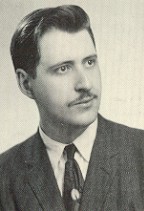
Dr.
Alfred Dom (1929-2014) was an American poet, critic, scholar, educator,
performer, raconteur and art historian. He garnered more than seventy awards,
was featured on New York radio stations, and authored six books: Flamenco Dancer
(1959), Wine in Stone (1959), From Cells to Mindspace (1997), Voices from Rooms
(1997),
Claire and the Christmas Village (2003), and the e-book Visions and Vistas.
He also edited and published a collection of Joseph Tusiani's translations of
Renaissance Italian poets, From Marino to Marinetti (1974). His poems and articles appeared in more than sixty journals,
including The
Hudson Review, The Formalist, Light Quarterly, The Lyric, Hellas, Pivot, Orbis
and Sparrow. After earning a doctorate from
New York University, where he was Penfield Fellow and also taught, Dorn served as a Vice President of
the Poetry Society of America and as the Director of the World Order of
Narrative and Formalist Poets. He also taught at Rider College and the City
University of New York, and directed writing workshops for the Poetry Society of
America, the Brooklyn Poetry Circle, and literary organizations in Texas,
Arkansas, and Indiana. Dorn is considered to have been one of the leading and guiding lights of the poetic school
known as New Formalism. Over the years he and his wife, the poet Anita Lorenz
Dorn, hosted many parties in which the arts were congenially toasted and
celebrated. In 2008, in his eighth decade, Dorn founded a publishing company,
Prospero's World Press. He also established the Anita Dorn Memorial Award for
Poetry, in his wife's honor after her death. As one admirer put it, "He was most generous with
his time and support, never refusing a request to comment on a colleague's
poetry or to attend a reading. His devotion to his craft was an inspiration to
his students, and other poets."
"The poems of Alfred Dom seem to me vigorous, imaginative and original, graced
with elegant formalities when the occasion warrants, manumitted and free when the spirit
moves. His gifts, instincts and actual procedures are all admirable. "—Anthony Hecht
"Alfred Dom is a master of ballades, rondeaus, sonnets, epigrams and other forms. Like most serious poets, he writes about other people as well as himself, and his
creation of types reveals him as a sturdy ally of human nature, a critic with a heart."—Felix Stefanile
"Throughout years of faithfully standing out in thunderstorms, Alfred Dom has been
struck a surprising number of times by lightning bolts directly from the Muse. His
new collection is among the more satisfying books of verse I have seen in a long time."—X.J. Kennedy
"In Alfred Dom's Voices from Rooms I was impressed by the breadth of his
scope and the clarity of his vision. Alfred Dom's best poems—highly original,
sharply observed, forcefully expressed—deserve a wide and appreciative audience."—Frederick Morgan
"The carefully crafted poems of Alfred Dom's Voices from Rooms are serious, often startling,
reflections on the voids and isolations of human existence—life in a universe where each and every room has a
provocative tale to tell."—William Baer
"Alfred Dom' s poems in different modes and moods are united by an appealing
sympathy for their subjects and by a sensibility robustly receptive to human experience.
"—Timothy Steele
You can read Michael R. Burch's tribute poem for Alfred Dorn by clicking here: "Gallant
Knight"
Travelers
For Anita
Hadrian built at Tivoli, near Rome,
a dream in marble and water, a paradise
that gave a second life to the art he’d seen
in regions continents remote from home.
We too combed lands beneath exotic skies,
and what we are contains where we have been.
We purchased little, though. (Why go encumbered?)
Our Tivoli is everything remembered.
Stalked by the hour which cancels every tour,
we glimpse that dark room where all travels end.
Though there’s much planet we could not explore,
much no life’s large enough to comprehend,
each packed a thousand years into three score.
Looking back, we find little we’d amend.
In Simultaneous Rooms
How many doors open, how many close
while your eye skims this "moment's monument"?
Holed up in a slum lord's apartment house,
an old man dies, alone, irrelevant.
Another life is pincered out of the womb,
from tropic sleep into our arctic day.
In a deluxe hotel's Edwardian room
a widow fiercely hugs a rose bouquet
sent by a charmer half her age, with card
warbling silk words that curtain his design.
In the Sahara of a hospital ward
a bed explodes with pain like a land mine.
And meanwhile the galaxy, that spiral ear
carrying us through darkness, does not hear.
Variations on a Theme
I.
Denying and denied, he scowled away
All women from his fern-protected tower.
He stood, an icy monolith of gray,
And saw the darkness hung with grapes—all sour.
II.
She sought in other women her reflection,
And wished the hated tribe of men would vanish.
Only her mirror loved her to perfection.
She raged and aged—and grew each year more mannish.
III.
A girl went driving in a low-cut gown.
A lecher stared as though she were Godiva,
Gave chase, and ran some ten pedestrians down.
And afterwards he blamed “that woman drivah!”
IV.
While chauvinists of either sex deride
The other with invective barbed and venomy,
The crown of fig leaves falls to neither side.
There’s too much fraternizing with the enemy.
From Wine In Stone (1959)
Tightrope Walker: Madison Square Garden
He strides the air, a litheness nerved with power,
His body chainless as a glimpsed ideal,
Untensioned as the opening of a flower,
But coiled in muscle hard as spiral steel.
Whittled beyond the fears of bone, he dares
The void that holds no net between his wire
And dust’s wide floor. The breathless monster stares
With all its twenty-thousand eyes afire.
Dense eyes, now triggered by an appetite
For safe-seen peril, merge into his will.
They soar a moment into weightless height,
Fused with his hush, made whole by grace of skill—
Then tumble from a dream of equipoise
Into themselves. Outside the circus door,
Autos and busses wait like heavy toys …
The tightwire plummets to an asphalt floor.
From Wine In Stone (1959)
Executors
The white-haired bachelor left less than they wanted.
After the coroner, the locusts came,
Spearheaded by a cousin in ninth degree,
Well flanked by wives, ex-wives, and office wives—
Battalions of smiles, all reconciled
With a cold memory that no longer argued.
“Sift all with care … Each scrap of paper matters,”
Whispered high wardens of the family name,
And spread the banquet of certificates.
Juggling a turret of papers, they betrayed
His arcane journal bound in flaming vellum.
“… Her hair is a harp of black perfumes, her body
A barge of orchids, cool in the Nile-green night …”
There were too many entrances and entries …
Squinting, the wardens of the family name
Dispatched warm memory into the nearest flame.
From Wine In Stone (1959)
Jove
Olympus shook. The marble halls and pillars
Turned light as spindrift, changed to a pearl-spume palace
By laughter huge as the sky. The king of gods
Basked on a couch of roses, feeding fruit
To his pet eagle. White as a waterfall,
His beard foamed over his breast, and his smooth flesh
Glowed warm as ivory tinged with dawn. Cool wine,
Red, white, and amber, geysered from a cloud,
While gods drained beakers to the jests of Jove.
Pillowed on storms, he made the world with laughter,
Strummed air with fire, quicksilvered earth with song.
He housed his cunning in the bones and hide
Of a young bull. Locked in his hoofs, Europa
Heard the loud bloodbeat of the hidden god
Above the surge and drumming of brute veins.
The thighs of Leda drank immortal seed
When the great swan swept down, a white monsoon,
Wrapping her in the wide lust of his plumes.
Danaë in her guarded turret bathed
In rainfall plashing through the bars like sparks,
And the whole earth rose lush like her own breasts
To mingle with warm rain that veiled the god.
The world grows old. The dumb beasts go their way,
Bereft; and men stare blank with un-Greek eyes
At Calvary, not Olympus, nor can hear
The god’s white laughter rolling cloud on cloud.
From Flamenco Dancer (1959)
War Phantoms
The earth is mute no longer, nor asleep.
Now buried eyes and hands of our accusers
Lift from the cratered hills in angry bloom.
Through tidal whispers of new wheat we hear
A throb of fire. The wind is a lash of voices—
Voices of deaths too young for epitaphs.
In ocean caves where drowned men change to coral,
The coil of brittle sleep is cut by dreams
That raise long tentacles. Death cannot bind
The dead and bleach their memory like their bones.
Still tethered to the pulse of earth they move
As strangers in the continent of silence.
The sky flamed red with sudden immolations.
There men who shamed the eagle’s flight have torn
The eyeball of the sun with steel and bone,
And left the burning shrapnel of their dreams
In the wide wounds of sunset and of dawn.
Through soil and wind and water seethes the curse
Of lips that cannot rest beneath the rock,
Of phantoms bidding the carrion nations taste
The vitriol of their blood in harvest gold.
From Wine In Stone (1959)
Synesthesia
Adagios from the lips of horns disclose
The touch of Midas and Apollo’s hair;
The syrup-gold of slumber-heavy stars;
October hills in leopard-soft repose.
Flutes bring flakes of laughter from a stream
Where bathers flash like sunlight turned to flesh.
Fifes are glittering blades of cold that carve
The year’s first snow to palaces of cream.
Harps are tidal as the sun-flecked foam
Breaking in spiralled whispers on a shell;
And cellos drowsily brush the mind like bees
And drop their dreams as in a honeycomb.
Wreathing violins are redolent
With moonflowers blowing on Titania’s tomb,
As all the strings combine and music flows
To colors, and each color flows to scent.
Melody builds a prism with perfumes
Of roses, lips, and breasts. The moment soars
On phoenix feathers wrought of musk and fire,
And rich beyond the rainbow’s pomp of plumes.
From Flamenco Dancer (1959)
From Bengal
A monarch walks in stripes of gold and black,
pacing the floor where he must live and die.
He lunges at the bars that hurl him back.
Around his cage the popcorn eaters pack;
they hoot and howl but fail to catch his eye.
A monarch walks in stripes of gold and black,
glaring at me, legs tensed for an attack.
(How could he know that I am his ally?)
He lunges at the bars that hurl him back.
Attendants clean his cage. He does not lack
raw meat, yet hungers for another sky.
A monarch walks in stripes of gold and black
I'd swipe the jailer's key, I'd blowtorch, hack
or saw through steel to let the prisoner fly.
He lunges at the bars that hurl him back
and roars. The echo shakes the zodiac.
I clamp my ears in shame to mute his cry .
A monarch walks in stripes of gold and black
He lunges at the bars that hurl him back.
First Encounter
They've dressed him up in black from shoes to tie,
a straight-backed, stiff-lipped gentleman aged six.
They tell him everybody has to die.
He sees his aunt, a big-boned redhead, lie
in a pine box, clenching a crucifix.
They've dressed him up in black from shoes to tie
to hear the organ shudder and sob and sigh,
to hear the preacher, nasal and prolix.
They tell him everybody has to die.
He thinks: She's fast asleep. Not breathing. Why? . . .
She bakes great cherry pies for our picnics . . .
They've dressed him up in black from shoes to tie
to stand near a hungry ditch and say goodbye.
Gravediggers lean upon their spades and picks;
they tell him everybody has to die.
But how can buried people reach the sky?
Are they alone or do they meet and mix ?
They've dressed him up.
In black, from shoes to tie,
they tell him everybody has to die.
Requiem for a Nose
She paid high fees to get herself defaced—
"to look more like my friends." Why did she do it?
What nose could match the one that she erased?
Aquiline as a Roman arch, it graced
her Tuscan profile. (Several artists drew it. )
She paid high fees. To get herself defaced,
she overruled sage counsel and good taste.
Her nose was nature's bounty—but she blew it.
What nose could match the one that she erased
to purchase fools' approval? In blind haste
she chucked Roman for pug, and she will rue it
She paid high fees to get herself defaced.
My requiem honors what she replaced
with an anonymous lump. May boyfriends boo it!
What nose could match the one that she erased?
But since the new one is not made of paste
or putty like a clown's, none can unglue it.
She paid high fees to get herself defaced.
What nose could match the one that she erased?
Ballade of Migraine
It wants your head, demands the space
that houses thought. You groan, you roar,
though Stoic-schooled. Your gargoyle face
panics the caller from your door.
You chew the carpet on the floor
like John at Runnymede, in vain.
Your thumbscrewed head becomes one sore.
Something must hate the human brain.
When men wore tricorn, wig, and lace,
Pope, a crippled midget, bore
"this long disease," his life, with grace.
When critics skewered him to the core,
they brought on migraine, skewering more—
though he stung back, deflecting pain
with hornet phrase and metaphor.
Something must hate the human brain.
Given another person, place,
and time, what triggered Pope to pour
rage into couplets might erase
foes with a gun—or start a war.
When migraine's voodoo needles gore
a pate as brittle as porcelain,
the truth's too blatant to ignore:
something must hate the human brain.
Envoy
Friend, have you known the visitor
grinding one's noodle to chow mein?
Head-hunter, Grand Inquisitor—
something must hate the human brain.
The HyperTexts