The HyperTexts
Terese Coe
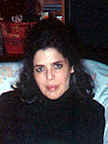
Terese Coe's poems, translations, and prose appear in over 100 Anglophone
journals, inc. Able Muse, Agenda, Alabama Lit. Rv, Alaska Quarterly Rv,
Apogee, Cincinnati Rv, The Classical Outlook, Crannog, Cyphers, Hopkins Rv,
Measure, Metamorphoses, The Moth, New American Writing, New Writing Scotland,
Orbis, Ploughshares, Poetry, Poetry Rv, Stinging Fly, Threepenny Rv, the TLS,
Warwick Rv, Xavier Rv, and in various anthologies. Giorno Poetry Systems
awarded her poetry grants in 2001 and 2002, and her collection Shot Silk
was listed for the 2017 Poets Prize. Agenda UK published a number of her Rilke
and Borges translations and adaptations in their 2007 *A Special Consideration
of Rilke* Issue. Her biographical comedy about Harry Smith, Harry Smith at
the Chelsea Hotel, based on her decades-long friendship with Mahagonny’s
filmmaker-artist-wit, was read aloud by Equity Actors at Dixon Place, NYC, in
2019 to a full house and was taped both there and at another reading.
She won first prize in the 2008 Schaible Sonnet Award, and publishes several
genres of poems, inc. metrical and free verse. Copies of her poem "More" were
heli-dropped across London as part of the 2012 London Olympics' Poetry
Parnassus.
Also see https://en.wikipedia.org/wiki/Terese_Coe.
"It's clear to me that she knows what she's doing, she's doing what she wants to do, and she does it
well."—Hayden Carruth
"She domesticates and humanizes the exotic without robbing it of its strangeness, just as she reveals
the inherent strangeness in everything looked at closely, however much we persuade
ourselves that we already know it intimately."—Rhina P. Espaillat
"Intensely curious, and even more intensely observant, Coe uses wry good humor and considerable formal
dexterity to keep the reader turning the pages of her album."—R. S. Gwynn
"The most recent issue of our magazine, no. 25, opens with the poem 'Remorse' by
Jorge Luis Borges, translated by Terese Coe. The first stanza is: 'I have
committed the vilest of any crime / a man can commit. I have not been happy. /
Let the ruthless glaciers of forgetfulness / come wrench me out and lose me.' No
king is shoved beneath the bed. But there's a backlit melodrama of light and
shadow figures that's our idea of a good time in language."—Paul Hoover, editor
of New American Writing
Way of the World
Translated from Heinrich Heine’s German
He who has will soon have more,
much more than he has today.
What he with only a little has,
that little is taken away.
But you who have nothing whatever,
go dig yourself a grave–
for the right to live, you wretches,
is only for those who have.
Terese Coe, translator
First Published in The Alabama Literary Review
The Bison
After Jorge Luis Borges' Spanish
Like the mountains, steaming, indecipherable,
red as the coal that glares before it dies,
he moves his slow and monumental size
across the solitude of indefatigable
Plains. He lifts his horns, his armored head.
In the sleeping fury of the ancient beast
I see Comanche, Sioux, the mounted red
man, all the men whom Altamira lost.
Then I think he is unaware of human time,
whose phantom mirror is the memory.
Neither time nor history can touch his journey,
so long and so unsettled, and so hollow.
Out of time, out of number, zero,
he is the last of the bison, and the primal.
Terese Coe, translator
First published in Evansville
Review
Café Noir
He turned her bedroom into a garage,
just ripped a hole in the wall and gutted it.
He never could hold on to a parking space,
you said. That month we suffered a barrage
of demolition noise; Annette had split.
Then one day he pulled up in a beat-up Lexus
with inanition chiseled on his face.
He said Annette was somewhere in West Texas.
I dreamt I wrote this living in a canyon
outside Malibu. Pacific waves
sent salt in through the trees; a massive banyan
stood near a fresh-dug grave.
At breakfast we were drinking café noir.
You said we wouldn’t always need a car.
Terese Coe
First published in The Threepenny
Review
Apollo and Daphne
She runs again, shouts to her father,
The hound is Apollo, he’ll take me!
Beauty is only a curse to me—
destroy me or unmake me!
Apollo leaps for her loosened hair
but her flesh becomes bark as she flies.
Her feet sink into the ground as roots—
the laurel he clutches has eyes.
Pounding the trunk, he hears the beat
of Daphne’s sealed-in heart.
In a fury, the god rips out her leaves
for his wreath to war and art.
Terese Coe
First published in The Alabama Literary
Review
Consider the Egg
Translated from Pierre de Ronsard’s French
Consider the egg. The egg is like the sky,
enclosing in its arms the earth entire,
caprices of the sea, the air and fire,
never known, but knowing what and why.
Its case recalls the air; the white, when raw,
is ocean, making all things sprout and shoot;
the yolk, like fire, can quicken and transmute;
the shell I hold, like ample Earth, in awe.
Both sky and egg are coverings of white.
In giving you an egg, I give creation:
a promise in a wrapping blank and bright
though next to this divine configuration
your own perfection rises without peer,
as only gods are worthy to make clear.
Terese Coe
First published in Iambs &
Trochees
Tooth and Claw
With stones and sharpened sticks, with tooth and claw,
with blade and bow and cities burnt to cinder,
with truncheon, boulder, catapult and bluster,
with visions of a father or a river,
With boiling oil, with poisoned food and water,
with jealous kings still licking ancient wounds,
with armies made of boys and bones and blunder,
in frenzies called religion and revenge,
For envy, power, greed, for shackled slaves,
for access to the sea and concubines,
for cattle herds and horses, beaver skins,
for fox and fur, for flesh and diamond mines,
For minerals and lies, for land and timber,
corpse and battle, battle, corpse, and plunder.
Terese Coe
First published in Stone Canoe
Manhattan Schist
October 2001
The list of Missing swells;
a flotilla of ash and mote
is one with the air we breathe.
There is no antidote.
Scrawled above the encampment
and vigil in Union Square
is Love, the most somber graffito,
alive and stark and spare.
Terese Coe
First published in Blue Unicorn
Notes from a Tenement Downtown
The more original it is, the more
enigmatic. That could be said
of this apartment, which is
133 years old. Alexander Cockburn
was here to talk about a mutual friend’s
suicide. Drag comedian Jackie Curtis
in his 70s heyday acting out his fantasy of
“Three Girls at a Bus Stop” on an audio
tape. Up the block Eddie Condon and Phyllis before
they gave over their Washington Square apartment
to their daughter Maggie, Eddie in his
chenille bathrobe, Phyllis finally understanding
when I said their younger daughter was
alienated. That put it into perspective for
Phyllis, a 1940s intellectual. Don Barthelme
climbed three flights of stairs to pick up
his daughter from a play date. I wasn't
reading fiction at the time and had the indifference or
the temerity to say so. He was inscrutable, bright-
eyed as we picked our way through wooden blocks
and railroad bridges to the toddlers with
Botticelli in their eyes. Ron Rosenbaum fell by
the night of the ’77 Blackout, more than
enough temptation for an all-night walk
downtown, the only light a cop car’s
spotlights swirling red on tunnels of brick
facades. We took those images in the mind.
Terese Coe
First published in
Alaska Quarterly Review
On the Choice of his Burial Ground (De l’Election de son sepulchre)
Translated from Pierre de Ronsard’s Middle French
Caves, and you fountains
in cliffs and mountains
cascading in flights
from shimmering heights
and you rivers and trees
amid vagabond leas,
and you woods and creeks:
hear me speak.
When time and the sky
decree I must die
and they snatch me away
from the light of day,
I forbid you to cut
blocks of marble.
What use is room
in a grandiose tomb?
Instead make my shrine
in the shade of a pine
or an evergreen tree.
Let the marble be.
Let my body give birth
to ivy, let earth
enfold and entwine
my body in vines.
Let the vines abound
and flourish around,
casting blue shade
where my body is laid.
And shepherds each year
will gather here
on the day of my feast
with their flocks increased.
Let sacrifice be made
in the deep of the shade.
May they pause for a while
and say to the isle:
How deep is the grace
of this resting-place
for a poet sung
by the old and the young.
He never burned
with envy nor yearned
for honors and awards
from barons and lords
nor would he use
a magician’s ruse,
nor the mysteries of
old potions of love.
But he brought to our leas
the Pierides,
who danced along
to the sounds of his songs
trampling the grass
to circle and pass
to the grace of his chords
and praying words:
Let dew be my shawl,
let sweet manna fall
forever down,
and May be my crown.
Let the green grass grow
on leas high and low,
and let rivers and rills
run for aye in these hills
every day to proclaim
the renown of his name
in homage to the man
and honor to Pan.
So the shepherds will say
as they pause on that day,
mingling blood of a lamb
with the milk of a dam
to pour over me.
Just then I will be
in the home of the blest,
my spirit at rest.
Neither snow nor hail
is seen in that vale,
and lightning’s glare
does not strike there,
where the undulant sea
of eternity
is forever seen
as spring’s new green.
The afflictions that cling
to the mind of a king
do not trouble those sprites
without appetites.
Instead they pursue
the trades they knew
from their fathers and mothers.
They live like brothers.
There, there will I hear
Alcaeus’ clear
lyre, the light strings
when Sappho sings.
And the spirits who longed
for her music and song
will hear and rejoice
at the sound of her voice,
their torment supplanted,
the boulder enchanted,
and even the thirst
of Tantalus reversed.
The lyre alone
has the sweetness of tone
to unburden the mind
and give ease to mankind.
Terese Coe, translator
This is a link to the original Middle French poem:
https://www.bartleby.com/lit-hub/the-oxford-book-of-french-verse/68-odes/
The Enigmas
After Jorge Luis Borges' Spanish
I who am the one who sings this song now
tomorrow will be the mysterious dead,
the inhabitant of a magical and deserted
world without before or after or when.
So the mystics say. I believe I am
myself unworthy of either hell or glory,
with nothing to predict. Our winding history
shifts and tilts like the shapes of Proteus.
What vagrant labyrinth, what blinding whiteness
will come to be my fate when I am delivered
into the final fragment of this adventure,
the curious experience of death?
I long to drink its clear oblivion,
always to be, but never to have been.
Where to Now?
Translated from Heinrich Heine’s “Jetzt Wohin?”
Where to now? To Germany,
my dumb feet want to say—
but shaking no, my head says
Let’s go the other way:
They say the war is over now,
but martial law’s a fright;
they say your writing’s reckless,
and Germans shoot on sight.
Quite true, quite true, and firing squads
are dirty, smug and rank.
I couldn’t bear the guillotine,
not even for a prank.
I’d gladly cross to England
if it weren't for the damp—
and then the smells alone suffice
to make my stomach cramp—
Perhaps an ocean voyage
to America, where I’d
see daring freedom fighters
and their feats of homicide.
It’s just that countries frighten me
where cowboys take a chaw,
they bowl without a kingpin,
and spittoons are not the law.
Then there’s Russia, Czarist Russia!
Just the place to skip.
It’s doubtful I’d survive
the year-long winter and the whip.
I look up to the heavens
where a billion stars are bright,
but where’s my constellation?
Obscured by too much light.
In the labyrinth of starlight
it’s mislaid itself, as I
have mislaid myself in tumult.
So on Earth as in the sky.
Rain
After Jorge Luis Borges' Spanish
Suddenly afternoon turns clear as rain,
already falling, falls, meticulous rain.
It is falling or it fell. Rain is a thing
that doubtless occurs in a time already gone.
Whoever hears it fall recovers an era
when circumstance and luck revealed a flower
someone named the rose, and a peculiar
blood-red color.
In lost suburban towns this rain that turns
the windows blind will plump the blue-black grapes
on a vine in a certain yard no longer there.
At night the drenching brings his voice inside,
the longed-for voice of my father
who has now come back again, and who never died.
First published in
New American Writing
Imitation of Martial
Translated from the French of Pierre de Ronsard
You want me to perform as slave
in every service you require,
to clear the path of gnome and knave
when you parade in silk attire,
to grovel every time you twitch
and burst with pride if you should snort,
to bitch and backstab when you bitch—
enough! I do not care to court
your trifling whims, nor do I owe
a duty to your odd pursuits.
Your menials rushing to and fro
can't hope to match my attributes.
Chanson
Translated from the French of Pierre de Ronsard
Spring has not the flowers
nor autumn such a squall
nor summer heat the power
nor winter cold the pall—
nor Beauce the cornucopia,
nor all the seas the fish,
Bretagne no utopia,
Auvergne no springs like this—
nor has the night the torches,
nor have the woodlands trees,
as I, the scars and scorches
you've burned there by degrees.
First published by
Leviathan Quarterly (UK)
And This Is What We Have
And this is what we have:
a rakish slated rooftop,
the aging tambourine,
a page of eggshell foolscap,
a flap of barkentine.
And this is what we lack:
a penny saved for madness,
a penny saved for pain,
a measure for our gladness,
a box to fill with rain.
And this is what we know:
a summer birth will flourish,
Orion's stars will shift,
the love of love will nourish,
the scent of death will drift.
And this is what we don't know:
the reason for our living,
the price we pay for chance,
the sacredness of giving,
the grace of our own dance.
Will O’ the Wisp
Translated from the German of Rainer Maria Rilke
We have an ancient dealing
with those lights out on the moors.
They seem to me great-aunts, revealing …
things I fathom more and more:
We share the kind of family quirk
no power can suppress—
a bounce, a bow, a swing, a jerk
the others don’t possess.
I too am there, where no roads go,
where clouds put men to rout;
and I have seen myself below
my eyelids, going out.
First published in Orbis (UK)
Reviews of Terese Coe's Work
The
Cincinnati Review
Jacket
Magazine
New
Pages
The HyperTexts