The HyperTexts
Sandra Jane Burch: A Voice Beyond
by Michael R. Burch, her nephew
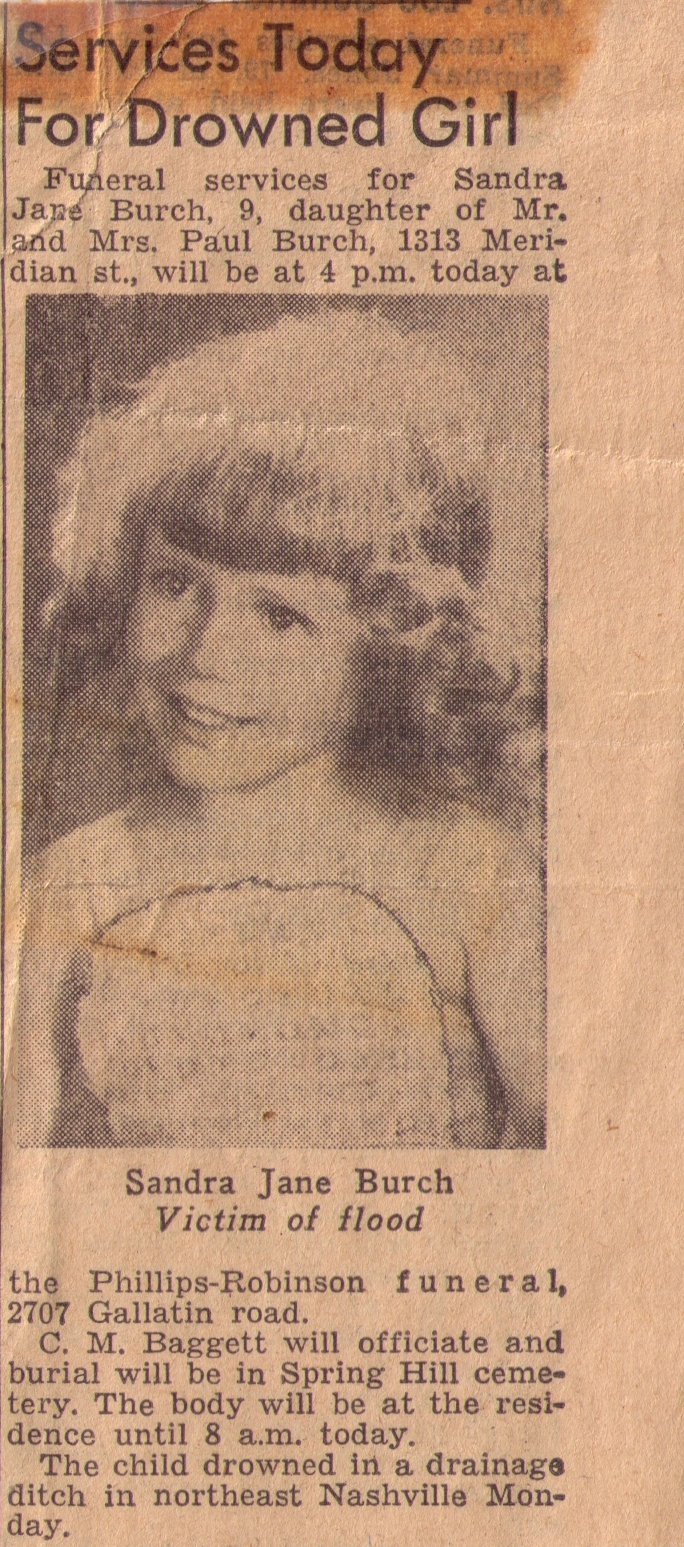
Sandra Jane Burch is the name of the elder of my two sisters (I'm the oldest of three siblings); she
inherited it from our aunt of the same name, who died in 1955, three years
before I was born. Since my sister goes by Sandra, I will call our aunt of the
same name Jane, in order to avoid confusion. Until very recently, all I knew about Jane was that she
had died in a flood as a young girl. But recently I came across a folder containing
her schoolwork and certain other of her personal effects, and to my surprise and
delight I discovered that she was a poet, as I and my sisters are. Jane was the
daughter of my grandfather, Paul Ray Burch Sr., and his second wife, Darkis Mary
Stepp Burch, also known as Dottie. Here is a picture of Jane's grave in
Nashville's Spring Hill Cemetery:
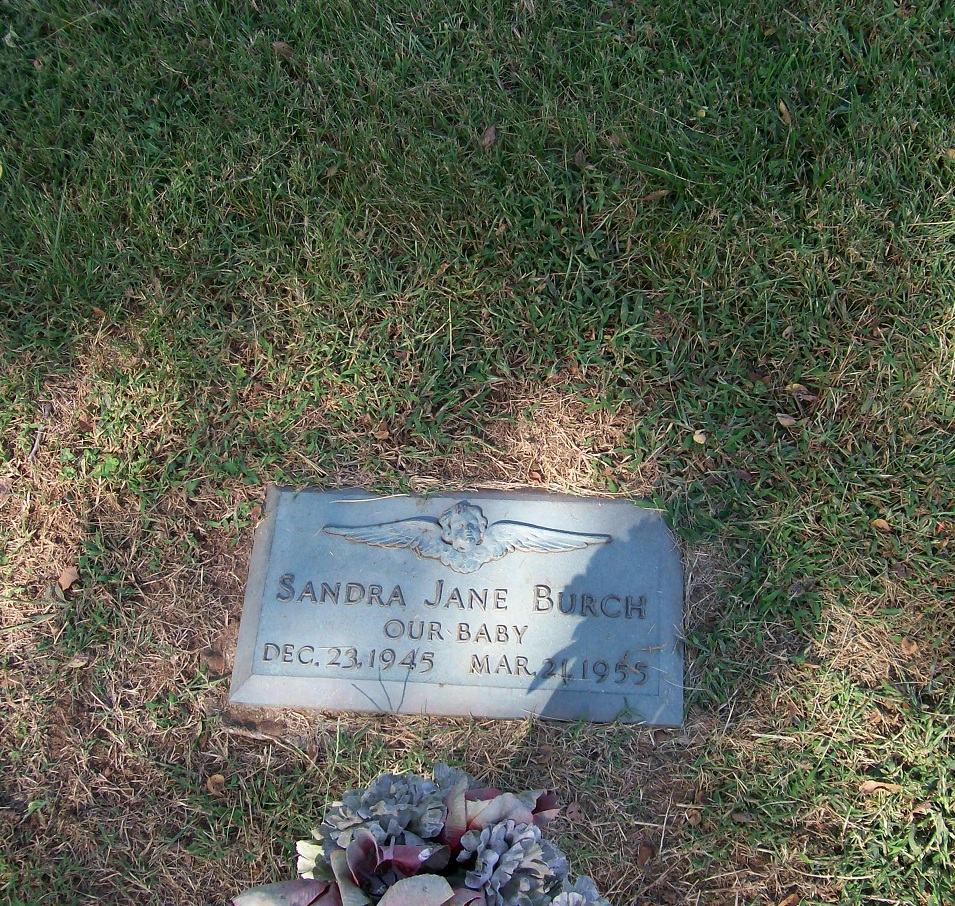
Jane was born on December 23, 1945 (a Christmas baby!) and she died on March 21,
1955 at age nine, the victim of a flood. Her brother was my father,
Paul Ray
Burch Jr. He was born on July 27, 1933 and died on the evening of March 20, 2013
at age 79. So he died just a few hours short of the anniversary of Jane's death.
And when he died, his sister's picture was on the wall at the foot of his bed,
so hers may have been the last face he saw in this world.
At the time of her death, Jane was survived by her parents, my father, and her
other brother, Clint Beavers of Cleveland, Tennessee. She was also survived by
her grandparents, Mr. and Mrs. W. H. Stepp, also of Cleveland, Tennessee.
This account was provided by a childhood friend, Ted Stewart Price, who knew
Sandra Jane Burch when she lived in Hartsville, Tennessee. These are his
memories: "The memory of two kids playing in my grandmother's yard. Ironically
it had a culvert that went under the street then ran besides my grandmothers
yard. I have a memory of Sandra and myself playing around the small stream. It
is just a memory ... not remembering exactly what we did at the branch or even
playing in the yard. This was etched in my memory when I was told she died in
the flooded culvert. Paul and his wife were nice people, as my grandmother and
rest of the family spoke well of them. My mom passed last March 2016 (18 days
from being 102). She had an excellent memory. Every one else has passed. I have
one cousin that I will check with about his memory. This was the first photo to
see what was reported in the paper. Sandra was beautiful. I was born 7/24/44 and
was older. Being that age, I remember what a nice playmate she was, rather than
her beauty. All the rest of my life have I have remembered her and sadly what
happened. That was the first loss for me to think about in my life. I have told
some friends over time. But she was etched in my memory. My uncle was
secretary/treasurer of CB Ragland. They would have to been acquainted (because
Paul Burch Sr. worked for CB Ragland). My Stewart family was related to Hugh or
maybe James Stewart in your research. They were my folks mentioned in you
research. Well done. Thank you for filling in the rest of the story. Sandra was
as nice as she was beautiful."
To avoid confusion, here's a picture of my sister Sandra Jane Burch, when she
was a young girl:
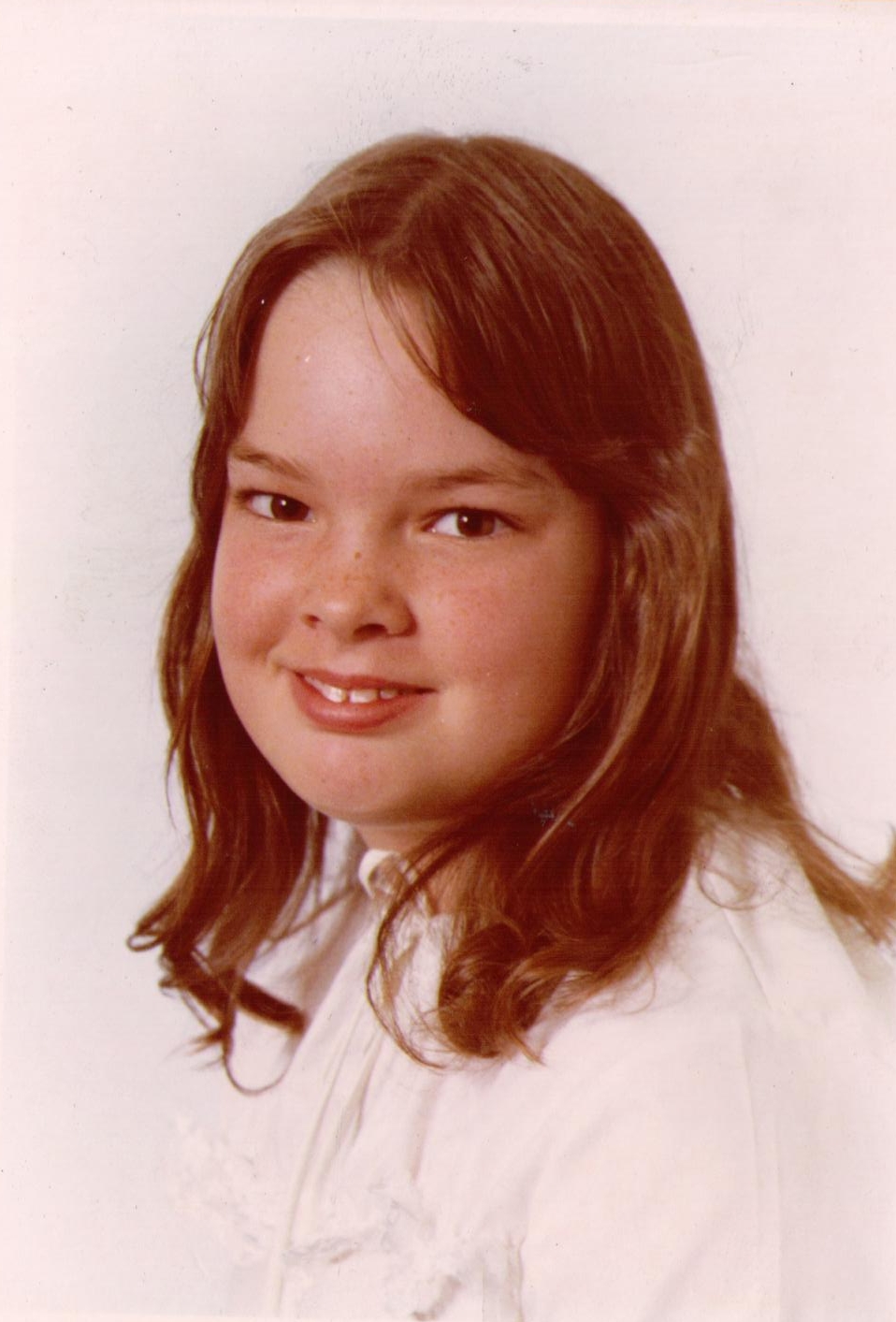
The picture above is of my sister, Sandra Jane Burch (now Boyte), at perhaps around the same age as my aunt Jane when she died. I'm
not good at guessing ages, so I could be wrong about my sister's age in the
picture above. My sister has the most "Cherokee" of the three siblings, which
she gets from our grandmother on my father's side, Lillian McAdams, who became
Lillian Burch when she married my grandfather, Paul Ray Burch Sr., and then
Lillian Lee when she later married Eric Lee, whom we called "Pappy" to avoid
confusion with our other grandfathers. Lillian's
grandmother, at according to legend, was a full-blooded Cherokee princess, and on
our English side we are supposed to be related to the royal Stuarts and Bonnie
Prince Charlie, so perhaps we have a smidgen or two of highly diluted royal
blood running in our veins! In any case, I think Jane's poem is a very nice one for the age at which she wrote it:
Cherrys are red;
Christmas is white,
Stars are yellow,
Snow is white.
The second poem is a prayer-poem which I have seen attributed to one of my
favorite poets of recent years, Robert Frost. I'm not sure if Frost actually
wrote it. In fact, I rather doubt it. But the lines are nice ones, and so I must
congratulate Jane on having a poet's ear for good poetry:
God, we thank you for this food,
for rest and home and all things good;
for wind and rain and sun above,
but most of all for those we love.
Something prompted me to begin work on this page: on the night of December 2,
2007, I was reading lines from Shelley, when suddenly this line struck me—"For
our belovèd Jane alone." Although I had only
recently become acquainted with Jane, I had already come to think of her as "one
of our own," as part of our family. And so I wrote the lines below, starting
with Shelley's line:
For our belovèd Jane alone,
we bid the welcome Spirit, come!
With us, she'll always have a home.
Still one of us, we hold her near,
with welcomeness and goodly cheer.
What she might say, we long to hear.
For our belovèd Jane alone,
we bid the welcome Spirit, come!
With us, she'll always have a home.
About this time, the wind chimes on our deck began to tinkle a lovely, musical
song. They hadn't been there for long, or if they had, I don't remember having
heard them chime before. I suppose my wife Beth had put them out on the deck
only recently, or perhaps they had chimed in the past and I simply hadn't heard
them. In any case, it seemed like a mystical moment, and I felt encouraged to continue.
Jane's folder contained a primer titled WORD MASTERY Spelling Progress Book,
which seemed promising. And the first word written in the primer was "teach."
In Jane's folder I found a paper graded "100" with the very date, December 2nd,
that I had begun my project! And so I wrote these lines:
At this time of the year
we seek Grace—
the appearance of,
radiant with Love,
an Angel's face.
December 2nd, 1954,
exactly 53 years ago,
to this day,
you got an A!
A perfect 100, in fact!
And perhaps now, tonight,
we have made a most excellent pact ...
I felt that I had both a pact and a project: to tell the world about Jane, a
little girl who died far too young, but who had become, in my mind and my heart,
A Voice Beyond.
Because, as far as I can tell, she had written only a single poem, I decided to
write poems with her, using her Spelling Lists to provide me with her words. And
even those words— Spelling List—seemed mystical, as I considered them, as they
might mean a "catalogues of spell." Of course poems are white magic, the good
kind. Some of my favorite poems are chants and incantations. One page in Jane's
folder says SUPREME CLASS SCHEDULE and below that she had written SPELL. She had
also drawn four trees. On the adjacent page she had drawn what appears to be a
headstone in the shape of a cross, with flowers, sprigs, and what appear to be a
diamond (or star) and rays of light. The word "Merry Christmas" appear on a
scroll at the bottom of the drawing, which is very well done. The other side of
the page is dated December 9, 1954.
The paper dated December 2nd, 1954, was a list of four items:
1. The pupils' book was their favorite.
2. The tree groups' pictures and stories were in it.
3. The twins' poems were in it too.
4. Other teachers' classes would come to see it.
Now, this seemed very interesting! Were Jane and I together the "pupils" and was
the book not to be ours, together? The second sentence was hard to read, but I
kept seeing "tree groups'" and because our last name is Burch, this sentence
seemed to make sense. Could it be prophetic? And what about the "twins' poems"?
Well, I had been thinking about offering to publish some of my sister Sandra's
poems, even before I began this new project. My mother had mentioned that Sandra
might be interested in publishing her work. Their names are the same, making
them "twins." And what of the fourth sentence? Might others read the book and
learn from it, even teachers and their classes?
Very interesting! First the folder appeared unbidden (I hadn't even known of its
existence); then the chimes; and now this.
As I continued to ponder the idea of writing poems with, and for, my Aunt Jane,
it occurred to me that my father was her brother. My father and I have never
been especially close, and because mystical, magical things seemed to be
happening, I penned these lines:
And now for your Brother,
my Father,
I ask—
Love in abundance,
a worthy
task,
not to condemn him,
not abruptly
to change,
but, perhaps, the stars
—slightly—
to rearrange.
And so I had written a prayer-poem of my own. By now is was beginning to seem a
very magical night, and so I chose to continue. I picked up where I had left off
earlier, reading Shelley's "to Jane" poem, and his lines (below) led me to
wonder: "Just suppose that a young girl who died in a flood had a chance to be
reborn. Would she choose to live again?" ...
When you die, the silent Moon,
In her interstellar swoon,
Is not sadder in her cell
Than deserted Ariel.
When you live again on earth,
Like an unseen star of birth,
Ariel guides you o'er the sea
Of life in your nativity.
And so I wrote these lines, pondering, wondering ...
Jane,
Do you wish to be reborn,
to feel the pleasant blush of morn
light on your skin, or does the thorn
still sting, that barbed the fairest rose?
See how the rose, remembered, glows!
Speak to me Jane, now, and disclose:
Dear, do you wish to live again,
to dream in poetry, the pen
sharp in your grasp, and speak to men?
It was now sometime after midnight, meaning the date had changed to December 3,
2007. Reading Shelley again, I came upon these lines ...
And now, alas!, the poor sprite is
Imprisoned, for some fault of his,
In a body like the grave;—
From you he only dares to crave
For his service and his sorrow,
A smile today, a song tomorrow.
... which, after having read, I wrote ...
A smile today, a song tomorrow,
small debt to pay—for a little sorrow,
a pleasant service, and your presence.
But think how strange this world of men is!
O, could you wish to live again?
To write, with magic in your pen,
or music, thunder, worlds of wonder?
Come, write, perhaps the world we'll plunder!
But think awhile—to make me smile,
now that would be a Veritable Wonder!
If it was possible for a poet whose life ended tragically early to write
again, what method might she choose? Might she choose to be reborn, only to
suffer and die again? Might she choose to write posthumously, as it were, by
being channeled through another poet's pen? Or might she choose to remain
silent, either biding her time for awhile, or forever? These are seemingly
unanswerable questions. There are artists who claim to have channeled other
artists. And I remember watching a documentary recently about a man called "John
of God" who claims to channel Dom Inácio and other
healing entities, with what seems like remarkable success. And of course Edgar
Cayce was renowned for being able to heal people by going into a trance and
receiving information "from beyond." Can a poet speak from Beyond?
If nothing else happens from all this, at least I will have come to know a
family member better, and to keep her memory and words alive. And it will still
be interesting to write poems for her, if not exactly "with" her. But who knows
...
I'd like to close the first "installment" of this story with more lines from
Shelley ...
All this it knows, but will not tell
to those who cannot question well
the Spirit that inhabits it ...
... It keeps its highest, holiest tone
for our belovèd Jane alone.
And 'tis her we welcome home.
Michael R. Burch
December 2-3, 2007

In the picture above, the handsome gentleman fourth from
the right is my Grandfather, Paul Ray Burch Sr. (I get my middle name from him
and my father, Paul Ray Burch, Jr.). Granddad worked for C. B. Ragland, in
Nashville, Tennessee, as a truck driver. He is reputed to have once lifted the
back end of his truck one day, so that a tire could be changed.
A spelling list of Jane's had a red
star attached. The first three words created something of a reverie for me,
while the last four bade me remember my first summer job, which I remember not
all that well, nor in any way fondly ...
Red Star
by Sandra Jane Burch and Michael Ray Burch
Awhile
almost
tonight,
as to the
labor
of words I bend,
I nearly remember the first summer
I worked
(was it hard?),
and did I earn a Red Star?
From reading through Jane's folder, I believe I see several "family
resemblances." First, she seems to have been an "A" student, which I was in my
day. School was usually easy for me: sometimes too easy. Second, she seems to
have had a rebellious streak, which is perhaps my major failing, if
rebelliousness is a failing. (I like to think it isn't.) Jane seems to have been
made to write the same words over and over again on more than one occasion,
presumably as punishment. I got in rather more trouble than that, but then I had
more time to evolve. Third, her handwriting reminds me of my own. And fourth,
and most importantly, she was a poet. I'm quite glad to be related to her! But
her heavy-handed teacher has gotten me more than a little perturbed:
Another Red Star,
my Scholar,
but here and there
the Collar
of a heavy-handed
Teacher—
Great Heaps of Repeated Words,
Redundancies Absurd!
Never mind,
Spectacular Creature—
you'll be the Bright Star
of my Feature!
It's a bit strange to think of Jane as my aunt, because in the pictures I have
of her, and in her single poem, and in her schoolwork, she is a very young girl,
a fourth-grader. Trying to imagine her looking at me now, as my aunt, with me
being so many years her elder, led me to write the following lines:
Jane,
I imagine your eyes
upon me,
and I imagine
having an American aunt
to hug, hold and dote upon me,
as my English "aunties" did,
and I imagine there is nothing hidden
between us,
because we are both poets,
and clever,
rebellious students,
and curious, skeptical scholars,
like Shelley
(have you met him,
in some heavenly realm;
does he sing there like an Angel,
some glorious unlikely hymn
to the consternation of the Christians?).
And I imagine you
smiling indulgently
at my conniptions.
I've just spotted another "family resemblance"—this one between Jane and my son,
Jeremy, who has been known to "fudge" on multiplication problems by adding
recursively instead ...
Family Affair
I see you cheated
at multiplication
(or was it "improvised"?).
Your "twelve times four"
answer
was obfuscated,
then you wrote
four "twelves"
with a "plus" beside
and added them up
(just as Jeremy, your nephew, my son,
has likewise done!).
Of course after so many years there are mysteries. In Jane's folder there are a
number of small blank squares of paper. What did she cut them out for, and why
did they remain blank? ...
Your little caper
with beige construction paper
escapes me,
and the small white squares
and the aquamarine,
what do they mean?
I suspect they were
houses,
or boxes (for gnomes?).
Or perhaps
prosaic squares
for elegantly cursive poems?
Another clue that Jane was a poet ...
On February 9th, 1955,
ten days and three years
short of the date of my birth,
you wrote:
"10. beautiful—Pleasing to the senses, especially to the ear."
Why, I wonder, "especially to the ear"?
Was it because you're a poet? That's the spirit!
(But was there a scale of one to ten
back then,
long before Dudley Moore and Bo Derek?)
Michael R. Burch
December 3-4, 2007
The HyperTexts