The HyperTexts
Robert W. Crawford
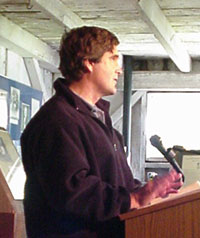
Robert W. Crawford is an American poet who was born in 1958 in Philadelphia. He graduated from Colby College in 1980 and earned an MA in National Security Policy
Studies at The George Washington University in 1985. From 1983 to 1994 he worked in and around the Pentagon. He now lives with his family in
Chester, New Hampshire, where he directs the information technology department and teaches poetry at Chester College. His poems have appeared
in The Formalist, First Things, The Dark Horse, Iambs & Trochees, Light and other journals. His first book of poetry, Too
Much Explanation Can Ruin a Man was published in March 2005 and is now available on Amazon, Barnes
and Noble, and direct from the publisher David
Robert Books.
For more information, please visit his website: www.robertwcrawford.com.
Editor's Note: The poetry of Pope John Paul II was featured on THT at the same time we published Robert's poetry. Robert pointed out another
of those "harmonic convergences" that seem to happen so often with THT these days: "The odd thing (and very humbling) is that
when my poem, 'Olber's Paradox,' was in First Things, that particular issue also featured a review of Pope John Paul II's poetry by
Joseph Bottum."—MRB
Scattered
The change is so complete, who doesn’t feel
October is a dream, November real?
One week, and we’ve forgotten paradise,
Accepted, as more probable, the facts
Of winter wind and ice: the proper price
The brilliant excess of the fall exacts.
We say we won’t forget those days—the hue
Of maples that resemble fire. We do.
Stripped like trees in a slight, inconstant breeze,
We come to lose our grip on what we know,
Content ourselves with scattered memories:
Odd oak leaves left to crab across the snow,
The sound of children running out the door,
The things that disappear and are no more.
Published in Pivot, Summer 2002
French Braids
While one hand is content to touch, admire
A balanced, careful weave—preserve for viewing
The beauty and the boundaries of desire—
The other hand is busy at undoing.
The quiet hand counsels restraint; afraid
To wreck the composition of composure,
It’s wary of destruction just for fun.
The other wants to slip between each braid,
To tease apart the strands, let run, spill over,
Release, unbind, what was so neatly done.
Your urgent kiss decides which hand is played.
A gentle pull brings argument to closure.
Surprised, my hands attempt to catch your hair:
It falls the way the rain lets go the air.
Published in The Cumberland Poetry Review, Fall 2001
Salisbury Cathedral
I know my eye is drawn to be inspired
By flight on flight of arched and buttressed stone,
And though the height meets what the eye required,
The heart is not impressed by this alone.
The place their lord gave them to build this church
Was bottomland, a home for fowl and fog,
And not, by all rights, firm enough to perch
The tons of marble resting on this bog.
Defying calculation and good sense,
The mass and burden of the task appalls.
While I could understand if it relents,
I feel in me for earth to hold these walls:
The single spire celebrates above,
Their faith the ground could bear this weight of love.
Published in The Lyric, Summer 2001
Olber’s Paradox
The heavens hold more stars than earth has grains
Of sand, and, given time, each tiny sun
Combined should make a world where starlight stains
The sky bright white and dark would be undone.
And yet the night remains. The dim stars gleam
Their separate ways, and constellations drawn
Connect their dots, while under them we dream
And sleep, then wake to such a thing as dawn.
The universe, expanding since its birth,
Is larger, older than its light; sublime,
The force that keeps this constant day from earth—
The same that measures out our years—is time:
The limitation that provides us night
And saves us all from unremitting light.
Published in First Things, May 2004
At the Top of the Stairs
You, stopping, laugh and whisper, “War and Peace
Can wait.” You place my hand where it can run
Against your jeans, near skin untouched by sun,
And kiss me—any thoughts of reading cease.
My fingers concentrate in fold and crease:
The buttons on your jeans each come undone,
A fumble here and there, but, one by one,
Each one worked free—resistance and release.
Open at last, a dark blue denim vee
Still trembles on your hips and hesitates;
It needs a gentle push, a helpful hand,
To slip along your thigh, fall past your knee.
Across the hall, a turned down bed awaits;
The jeans can stay till morning where they land.
Published in Iambs & Trochees, Spring 2004
Town Roads
At each town line the old town roads change names
To take the name of where you’re coming from:
The Chester Road will bring you into Derry,
Derry Road ends at the Chester green.
Confusion wasn’t built in by design—
The roads were laid like spokes on wagon wheels
To serve the farms that long ago moved west—
But this arrangement’s hard on travelers
Who simply want to get from place to place.
What these towns need is a Copernicus
To tell them that the center lies without,
And agencies to legislate that roads
That run between them share a common name.
And yet, when sitting on the bench behind
Two cannons and a monument to boys
Who went, when asked, to save that wider world,
But never came back down these wrong-named roads,
I see the possibility: perhaps
The towns were right. All roads don’t lead to Rome;
They do, however, radiate from home.
Published in The Dark Horse, Summer 2002
When Boston Wins the Series
The throngs along the Esplanade;
The Charles crowded with light.
We’ll be convinced there is a God—
This time, the world set right.
We’ll feel the city roar in bliss
As we pass the Elliot bar:
Enough relief and happiness
To raise the evening star.
We’ll find a place to rest our feet
Upon a Fenway stair.
You’ll take my hand on Lansdowne Street,
Kiss me in Kenmore Square:
We’ll see replayed that winning run
This patient town deserves,
And find, again, the sacred in
The geometry of curves.
Published in Iambs & Trochees, Spring 2003
The HyperTexts