The HyperTexts
Robert Mezey
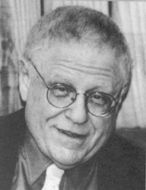
Robert Mezey (1935-) is an American poet, translator, critic and academic. He was educated at Kenyon, Iowa, and Stanford, and has taught at Western Reserve, Fresno State, the University of Utah, Franklin
& Marshall, and elsewhere; from 1976 to 1999, he was professor and poet-in-residence at Pomona College, and taught from time to time at
the Claremont Graduate School.
His poems, prose, and translations have appeared in many journals, including New York Review of Books, Hudson Review, The
New Republic, Raritan, Kenyon Review, Partisan Review, Yale Review, The New Yorker, Harper's, Paris Review, Poetry, and others. His poems can be found in many anthologies and textbooks, and some have been translated and published in
Bosnia, Spain, Italy, Israel, Japan and Greece.
His books of verse include The Lovemaker, White Blossoms, A Book of Dying, The Mercy of Sorrow, The Door Standing Open: New & Selected
Poems, Couplets, Small Song, Selected Translations, Evening Wind, Natural Selection and Collected Poems 1952-1999. He has edited a
number of books, including Thomas Hardy: Selected Poems [Penguin Classics], The Poetry of E. A. Robinson [Modern Library], An
Everyman Book, Poems of the American West, Poems from the Hebrew, and others. With Donald Justice he co-edited The Collected Poems of
Henri Coulette. He has also published a scholarly translation of César Vallejo's Social-realist Novel, Tungsteno, and with Dick Barnes
translated all of Jorge Luis Borges’ poetry—many of those poems have appeared in literary journals and magazines.
His awards include the Robert Frost Prize; the Lamont (for The Lovemaker); an award from the American Academy of Arts and Letters; the
Bassine Citation and a PEN prize (for Evening Wind); the Poets' Prize (for Collected Poems); fellowships from the Ingram Merrill
Foundation and Guggenheim Foundation and from the National Endowment for the
Arts; and an honorary doctorate from the World Congress of Poets.
He has given many readings and lectures over the last four decades at such schools as Yale, Oberlin, UCLA, Bucknell,
Dartmouth, Vassar, Duke, Princeton, Brown, Penn, Columbia, and many others, as well as universities in England and Spain; at poetry centers and conventions; at
museums and libraries; at Squaw Valley and other conferences; and at festivals celebrating the poetry
of Hardy, Robinson, Weldon Kees, and James Wright.
Mezey has labored to master the craft of the English language long and deep. Now the fury and anguish of his person have fused with his always
wild imagination to produce that almost impossible thing: a poetry that is fierce just because it is so full of love and kindness ... Mezey's
Small Song contains only twenty poems. Only? In our era of poetic inflation, twenty poems, real poems, are precious. Taken with the
poems in Mezey's Couplets, they form a substantial value. They are among the most moving achievements of the past decade.—James
Wright
The line, the melodic line of Couplets, moving from measure to measure, chorus to chorus, is so clean—I mean the 'meaning,'
which is everything, song, feeling, idea image. It is a line, but in the old sense, no arbitrary tone row, but consecutive, infinitely
variable phrasings linked together, a flow, improvised and always new, but out of the established, utterly known ground.—Hayden Carruth
What I look for—hope for— in poems, and what I find in Robert Mezey's new work is the effort to bring into words that ultimate
tenderness toward existence which is the dream of great poems.—Galway Kinnell
I think Robert Mezey's new book, Evening Wind, is especially fine. At a time when erotic poetry has come back into fashion and
every writer, male and female, of free verse doggerel takes a crack at it, Mezey writes in the Great Tradition. He mentions Catullus—as
well he might—these are Catullan poems, but without quite the heartbreak and bitterness.—Kenneth Rexroth
In whatever formal more he has worked, from free verse to the most limited schematic patterns, Mezey has always revealed a mastery of the
relation between deep and surface rhythms of language and thought, and an unyielding poetic integrity that is itself like a beacon against a
darkening literary horizon.—JohnHollander
Robert Mezey has long been one of my favorite poets. Some of these new poems are absolute classics of calm and beauty.—Donald Justice
The Lovemaker
I see you in her bed,
Dark, rootless epicene,
Where a lone ghost is laid
And other ghosts convene;
And hear you moan at last
Your pleasure in the deep
Haven of her who kissed
Your blind mouth into sleep.
But body, once enthralled,
Wakes in the chains it wore,
Dishevelled, stupid, cold,
And famished as before,
And hears its paragon
Breathe in the ghostly air,
Anonymous carrion
Ravished by despair.
Lovemaker, I have felt
Desire take my part,
But lacked your constant fault
And something of your art,
And would not bend my knees
To the unmantled pride
That left you in that place,
Forever unsatisfied.
N. W.
On a certain street there is a certain door,
Unyielding, around which rockroses rise,
Charged with the scent of a lost paradise,
Which in the evening sunlight opens no more,
Or not to me. Once, in a better light,
Dearly awaited arms would wait for me
And in the impatient fading of the day
The joy and peace of the embracing night.
No more of that. Now, a day breaks and dies,
Releasing empty hours and impure
Fantasies, and the abuse of literature,
The lawless images and artful lies,
And pointless tears, and the envy of other men.
And then the longing for oblivion.
after Borges
A Rose and Milton
Of roses in their infinite blossomings
That have been lost to time in time's abyss,
I want one to be spared from nothingness,
One without stain or sign among the things
That once existed. Fate grants me the grace,
The honor of first naming that sublime
And wordless flower, the rose that one last time
John Milton held a hairs-breadth from his face,
Not seeing it. From gardens long disperse,
O thou, yellow or white or burning red,
Come as by magic from thy myriad
Lost centuries and flourish in this verse,
Ivory, gold, or blood, or vague shadows
As in his hand once, O invisible rose.
after Borges
Evening Wind
One foot on the floor, one knee in bed,
Bent forward on both hands as if to leap
Into a heaven of silken cloud, or keep
An old appointment—tryst, one almost said—
Some promise, some entanglement that led
In broad daylight to privacy and sleep,
To dreams of love, the rapture of the deep,
Oh, everything, that must be left unsaid—
Why then does she suddenly look aside
At a white window full of empty space
And curtains swaying inward? Does she sense
In darkening air the vast indifference
That enters in and will not be denied
To breathe unseen upon her nakedness?
after an etching by Edward Hopper
Tea Dance at the Nautilus Hotel (1925)
The gleam of eyes under the striped umbrellas—
We see them still, after so many years,
(Or think we do)—the young men and their dears,
Bandying forward glances as through masks
In the curled bluish haze of panatellas,
And taking nips from little silver flasks.
They sit at tables as the sun is going,
Bent over cigarettes and lukewarm tea,
Talking small talk, gossip and gallantry,
Some of them single, some husbands and wives,
Laughing and telling stories, all unknowing
They sit here in the heyday of their lives.
And some then dance off in the late sunlight,
Lips brushing cheeks, hands growing warm in hands,
Feet gliding at the lightest of commands,
All summer on their caught or sighing breath
As they whirl on toward the oncoming night,
And nothing further from their thoughts than death.
But they danced here sixty-five years ago!—
Almost all of them must be underground.
Who could be left to smile at the sound
Of the oldfangled dance tunes and each pair
Of youthful lovers swaying to and fro?
Only a dreamer, who was never there.
after a watercolor by Donald Justice
Eurocentric Rag
I make a lot of money and I have a perfect tan;
I wear Armani clothing, I'm a very fancy Dan;
I've dominated women ever since the world began—
Yes, I'm phallocentric, logocentric, Eurocentric Man!
Oppression is my favorite sport, I play it with élan,
And I scorn the weak and womanish, the sloth, the also-ran;
Let them forage for their dinner in my silver garbage can
And thank their generous benefactor, Eurocentric Man.
I've conquered everybody from Peru to Hindustan
And I make 'em speak my language, though they very rarely can;
I'm the king, the pope, the CEO, the chieftain of the clan—
Yes, I'm phallologo, logophallo, Eurocentric Man!
The beauty with the hothouse grapes, the young boy with the fan
Are only minor luxuries, like my Silver Cloud sedan;
I bet you're very curious about my Master Plan.
I sit and pare my fingernails. I'm Eurocentric, man.
Ill Lit Blues
The lights come on so early on these winter afternoons;
The darkness creeps up early, winter afternoons,
And somewhere a piano is picking out a musty tune.
With less than an explanation you have taken your liberty
And arranged without thinking that nobody else but me
Will be sitting here in the dark like a granite effigy.
Well, no use complaining, there are a million people like me,
And everything as usual is exactly what it must be:
Character is fate, they say—I'm sure that you agree.
And they say love is easy as the turning of a page—
Haven't you heard that, honey?—like the turning of a page?
But they mumble something different in the back rooms of old age.
I'm not a first-time loser, I've been down this road before,
And once again I find myself standing outside a door;
But even as I spell it out, I still don't know the score.
Yet the truth is plain as day, love, all you need do is look;
I can see it clear as daylight, saw it in your parting look—
Love is a sudden emptiness like the closing of a book.
A Note She Might Have Left
Sorry I couldn't give you the details
or say goodbye;
but if you feel beguiled,
it was your nature to turn a blind eye.
Only children believe in fairy tales
and you're a child.
And everything you had me say
I said in play.
The play is over now, but still you stand
on the empty stage
where the great loves live on,
crying out to the darkness in a rage
that only the two actors understand.
But one is gone,
and all her speech was meaningless.
So was the kiss.
I Am Beginning to Hear
a voice in this life I am living
every day every night
never before heard
speaking in languages
made of shifts in the direction of the wind
seeds fallen from an apple
feathers in the dust
there is a flight of arrows or is it light
turning the way things turn
after the sun only at different speeds
brilliant darkness as in the night when there is no moon
I must have known it once
as now
moving easily as a hand
among the fiery lights raining out of space
I know what is said but it is
dark untranslatable
a flower suddenly folding up
and rushing away into its ancient parchments
The Stream Flowing
I remember the creek that ran beside the golf course,
slow and black over rocks; patches of snow;
withies of willow streaming out in the wind,
born to it and, I imagine, bowing and scraping.
I would sometimes sit there shivering and looking out
at the flagless frostbitten greens, the naked trees
that bordered the bleak fairways and a sky
the ashen color of longing and disappointment.
Early winter, it was. And then I remember
the girl I brought there one night—the summer after?
We lay deep on the grassy bank, almost hidden,
and I touched her warm secret hair for the first time.
I can still hear the sound of water pushing by us,
the sound of her breath in my ear as I touched her there,
my stiff boyish hand trembling against her belly.
Her name was June. I could feel a pulse where I touched.
There were little lights in the breathing darkness around us.
Her eyes were closed and I was looking past her
at nameless summer stars and pulsing fireflies
and what must have been houses far off in the night somewhere.
Nothing else happened there. We were afraid,
and lay in the matted crush of the maidenhair
and chilly rivergrass. We could smell the night
and see the willow cascading over our heads.
I remember the last time I went there, alone and older,
three or four winters later. The clear water
was still flowing, now between snow-covered banks
and white fields stretched away to the hem of the sky.
One day melts into another and into years,
twenty years that flowed on and lost themselves in the sea.
Where is June, and the boy that she held to her body
on that bank once? Well, useless to think of her now,
and useless to think of the boy, by now a man—
each with a husband or wife, in a house far off
in the midst of another life, where I remember
the fern verging that stream and the stream flowing.
Joe Simpson
Joe Simpson was a man I scarcely knew.
I saw him when he came to see his father.
Our talks, if they were talks, were brief and few.
And yet I think I knew the man, or rather,
I knew something about him. From his eyes
A certain light (though uncertain to me)
Seemed to precede him through the world of lies,
Flickering shadows where he could not see
What might await, what ecstasies of pain,
What narrow passages, where only faith,
That cannot know what it is faithful to,
Can find the right path to the gates of death,
A path he followed, and did not complain,
A path that might lead nowhere, as he knew.
After Ten Years
Now that the sum of footsteps given you
to walk upon the earth has been fulfilled,
I say that you have died. I too have died.
I, who recall the very night we made
our laughing, unaware farewells, I wonder
what on earth has become of those two young men
who sometime around 1957
would walk for hours, oblivious of the snow
that slashed around those street corners like knives
under the lamps of that midwestern town,
or sit in bars, talking about the women,
or decades later, stroll the perfumed streets
of Pasadena, talking about the meters.
Brother in the felicities of the Herberts,
George and Zbigniew, and of Chivas Regal,
and the warm rooms of the pentameter,
discoverer, as we all were in those days,
of that timeworn utensil, metaphor,
Henri, my tipsy, diffident old friend,
if only you were here to share with me
this empty dusk, however impossibly,
and help me to improve these lines of verse.
after Borges
Her Sparrow
Wear black, you Venuses and you Cupids,
you lucky lovers and ladies' men.
My darling's sparrow is dead,—pet sparrow
who was my darling's sweetest pleasure,
whom she loved better than her own eyes;
he was her honey, he was closer to her
than a young girl to her own mother;
nor would he stray from her lap or bosom
but hopping about, now here, now there,
piped his tune only to her his mistress.
And now he goes the shadow-brimmed road
from which, they say, no traveler returns.
Damn you, damn you, shadows of Orcus,
indifferent shadows that swallow all beauty:
you have stolen away a beautiful sparrow.
So cruel, so cruel! Ah, poor little sparrow!
Look what you've done now—my darling's eyes
red and swollen, swimming with tears.
after Catullus
Einar Tambarskelver (Heimskringla, I, 117)
Odin or red Thor or the White Christ...
They matter little, the names, the gods behind them;
There is no other duty than to be brave,
And Einar, leathery captain of men, was that.
He was foremost among the Norwegian archers
And expert in the handling of the sword,
Of ships and men. Of his trajectory
Through time, there now remains to us one sentence,
Which gives off light in the chrestomathies.
He said it in the din of a sea battle.
The lost day's fighting done, the starboard side
Open to boarding, a last shot snapped his bow.
The king asked him what was that that had broken
Behind his back and Einar Tambarskelver
Replied, Norway, my Lord, between your fingers.
Centuries later, someone saved the story
In Iceland. And I now transcribe it here,
So distant from those oceans, from that spirit.
after Borges
A Retirement Poem for Dick Barnes
Translating, editing, doing research;
Doing his job and doing kindnesses,
Acts of devotion, though outside of church;
Cherishing everything, which is all there is;
Year after year to almost no one's knowledge,
Devising verses to give strangers pleasure,
In the obscurity of Pomona College
Himself not knowing he's a national treasure;
One of the roughs, but noble in courtesy,
Suffering gladly fool and anæsthete;
A friend to young, fresh folk, and friend to me,—
Let him withdraw now to his high retreat,
Some leafy and sun-dappled bower, from where
He may gaze out upon the passing fair.
Hardy
Thrown away at birth, he was recovered,
Plucked from the swaddling-shroud, and chafed and slapped,
The crone implacable. At last he shivered,
Drew the first breath, and howled, and lay there, trapped
In a world from which there is but one escape
And that forestalled now almost ninety years.
In such a scene as he himself might shape,
The maker of a thousand songs appears.
From this it follows, all the ironies
Life plays on one whose fate it is to follow
The way of things, the suffering one sees,
The many cups of bitterness he must swallow
Before he is permitted to be gone
Where he was headed in that early dawn.
Variation on a Theme
My hands have made this monument—
Bronze will tarnish before it will.
Smaller than all the glass towers,
Winds cannot shake it, even the strongest,
And the rains powerless, rain and time,
The endless dripping of the years
That wears down everything to nothing.
This body will go down to dust,
But death not touch these slender lines.
As long as boys make war and girls
Bow to the biddings of the goddess,
As long as my native city stands
And one forgotten neighborhood
And the sluggish Delaware flows on,
I shall not altogether perish,
Who helped to keep the meters live.
The honor, if any, will not be mine;
Not mine but yours, creator spirit,
Yours the shaping hands, the laurel.
after Horace
The HyperTexts