The HyperTexts
Ratzinger's Children: Pope Benedict XVI, the Roman Catholic Church, and a
Culture of Child Abuse and Hell
compiled and edited by Michael R. Burch, an editor and publisher of
Holocaust poetry
Pope Benedict XVI, nee Cardinal Joseph Ratzinger, is tremendously concerned
about the dignity and authority of the Roman Catholic Church . . .

. . . but does he care about the innocent, trusting children who sit in his
church's pews?

Suffer the little children to come unto me!
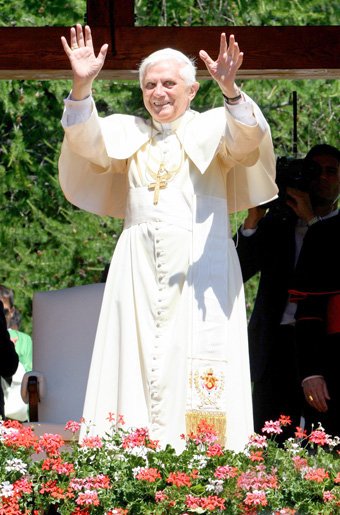
I've got the whole world in my hands!
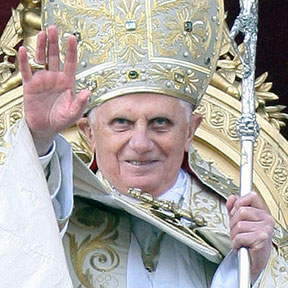
Sieg Heil!
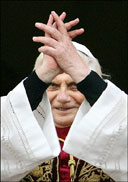
Here is the church; here is the steeple; look inside; see all the defenseless
little people!
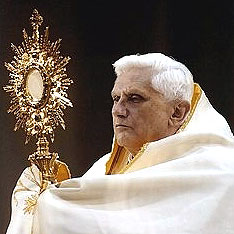
Who cares how many children are starving all over the world, as long as I can
sit on a throne and have billions of dollars in bling?
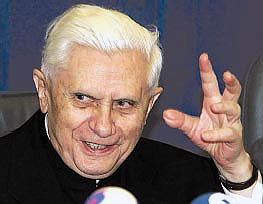
I'll put a spell on you! Show me the money!
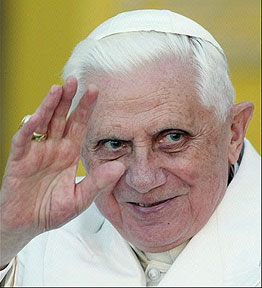
Look deep into my eyes; now show me the money!
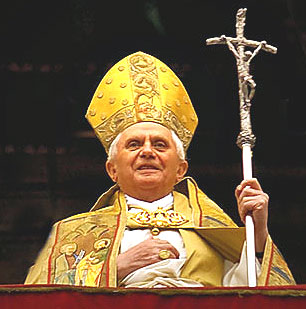
I'm King of the World! Hell, I have Christ on my Scepter!
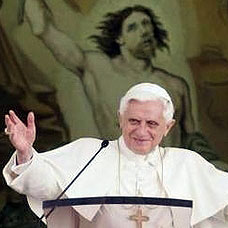
Look who's got my back!
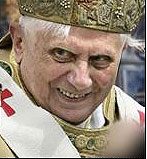
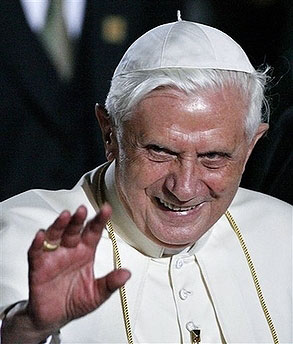
Okay, the pictures are creepy. But what about the evidence? It's even creepier . . .
First, we have a pope who told Africans the use of condoms "increases" the problems posed by AIDS. How can a man with so much influence
speak so rashly and unwisely? A spokesman for the French Foreign Ministry responded,
"these statements endanger public health policies and the
imperative to protect human life." In less diplomatic terms, what
Ratzinger/Benedict said constitutes a death sentence to
people foolish enough to heed him. According to Ratzinger/Benedict, the only
"sure" way to stop the spread of HIV and AIDS is "chastity" and marital
"fidelity." But of course wives can't always depend on their husbands to be
faithful. So if Catholic wives obey the Vicar of Christ, they may well end up
dead. Is this wisdom, or folly? (The question is rhetorical.)
Sarah Palin
is another advocate of chastity. We all know how well that worked for her own
family, don't we? Religious "experts" like Palin and Ratzinger/Benedict live in
a la-la land where "morals" and religious edicts that don't work are more important than
human lives and suffering. In other words, they're dangerous idiots. (When the
pope's words provoked public outrage, the
director of the Vatican press office, Father Federico Lombardi, clarified the Catholic Church's
position, saying it advocates "first, education in personal responsibility in the use of sexuality and
with reaffirmation of the essential role of marriage and the family; second,
with research and implementation of effective treatment of AIDS and making it
available to the greatest number of sick people through many health initiatives
and institutions; third, with human and spiritual assistance for those with AIDS
as for all the suffering, who have always been in the heart of the church." So
the Church seems to be saying that if people don't have sex the way the Church
prefers, rather than using preventive methods, they should seek cures and
plan on suffering. Could anything be more idiotic and dangerous, when a deadly
disease like AIDS can be avoided in most cases via the use of inexpensive
condoms?)
Second, we have a pope who opposes contraceptives, abortion and euthanasia.
It seems he wants human beings to suffer as much as possible, for as long as
possible. According to the "wisdom" of the so-called "Holy Father," we should
only have sex for purposes of procreation, continue to overpopulate the world,
and not allow people who are terminally ill and suffering terribly to end their own
lives on their own terms. Is he the Vicar of Christ, or so out of touch with
reality that no one can take him seriously? (Again, the question is rhetorical.
This is not "wisdom" but madness.)
Obviously most modern human beings have sex primarily for pleasure and only rarely for
purposes of procreation. How can a septuagenarian virgin consider himself
qualified to dispense advice on sex, reproduction and family life to people who
live in the real world, not la-la land? If we have every child that we are
physically capable of bringing into the world, now that we have vanquished the predators
that once helped keep our numbers in check, there won't be a world fit for any
living creature to occupy, in the near future.
Third, we have the all-too-obvious problem with Ratzinger/Benedict's personal involvement in
shocking
cover-ups of pedophilia within the Roman Catholic Church. The evidence is both damning
and overwhelming, as we shall see, shortly. The biggest cover-up, and by far the
most damning and impossible to deny or escape, is the obvious failure of
Catholic bishops, following Ratzinger's lead and example, to report cases of
child abuse to the proper authorities. But even this is only the tip of the
proverbial iceberg, because for almost 2,000 years the Catholic Church has been
damning all the earth's children to an "eternal hell" that was never mentioned
by the God of the Old Testament, or the Hebrew prophets, or the great preachers
of early Christianity: Peter, Stephen, Philip and Paul. How can there be an
"eternal hell" if a place called "hell" was unknown to Adam, Eve, Cain,
Noah, Abraham, Lot, Moses, King David, Solomon, the Hebrew prophets, Peter,
Stephen, Philip and Paul?
Obviously, "hell" was a very late, very clumsy addition to the Bible. Anyone can
use an online Bible search tool like the one at
www.crosswalk.com to verify my claims.
Just search a modern version of the Bible for "hell." A good version to use is
the Holman Christian Standard Bible (HCSB), which was sponsored by the famously
conservative and literal Southern Baptist Convention. According to the HCSB, the
word "hell" does not appear anywhere in the Old Testament, or in any of the
epistles of Paul, or in the book of Acts (ostensibly the self-recorded history
of the early Christian church). Even conservative Bible scholars now freely
admit that the Hebrew word Sheol and the Greek word Hades do not mean "hell" but
"the grave." Everyone went to Sheol-Hades, not just the "wicked." King David
said that if he made his bed in Sheol, God would be there, so he was obviously
not discussing the Christian hell. Job asked to be hidden from suffering in
Sheol, so he was obviously not discussing a place of eternal torment. The sons
of Korah said God would redeem them from Sheol, so they were obviously not discussing a
place that could not be escaped. Ezekiel and Paul agreed that all Israel would
be saved, but Israel (Jacob) himself calmly discussed being reunited with his son Joseph
in Sheol. How can all Israel be saved if Israel himself is in hell?
It is more than obvious that Sheol was not "hell." Anyone who studies Greek
mythology (or just reads the Wikipedia page) can easily see that Hades was not
"hell" either. The Greek hell was Tartarus, not Hades. Tartarus is mentioned in
only one verse in the entire Bible, and that verse discusses fallen angels
awaiting judgment in Tartarus. So according to the Bible, hell is not for human
beings, and it is not eternal.
The only word still translated as "hell" in the HCSB is Gehenna, which appears
in only ten verses in the New Testament. But Gehenna is a physical location in
Israel, and today Gehenna is a lovely park. You can find pictures of it on the
Internet.
So the Catholic Church faces a much bigger problem than the current outrage over
pedophilia and subsequent cover-ups. The single biggest question facing Pope
Benedict is the Bible. If God, the prophets and the great preachers of early
Christianity never discussed a place called "hell," why does the Catholic Church
continue to pretend that it holds the key to "salvation"? And if the Catholic
Church really does hold the key to salvation, how can it be that after 2,000
years it still doesn't know whether a baby who dies without being splashed with
magical water by an even-more-magical priest will go to heaven, hell, purgatory
or limbo? Did God place salvation in the hands of the Catholic Church, yet
completely
forget to explain the most basic things about the process, or did the Catholic
Church make the whole "hell" thing up? (Once again, the question is rhetorical.)
The current problem with pedophilia does create a new theological conundrum: if
someone confesses to an unrepentant pedophile, does it count?
God only knows. But according to the Bible, there is no "hell" and thus nothing
to be "saved" from, after death. The Hebrew prophets spoke of even Sodom being
restored, of the lion lying down with the lamb, and of a heaven without hell. If
they were right, God was to accomplish the miracle without the faith or works of
man. (Or, more correctly, despite the faith and works of man.) If the
prophets
were correct, salvation is entirely the work of God. If they were wrong, the
entire Bible is a hoax because it continually claims there is a God who is able to save.
If God is unable to save, how can he be God?
The Hebrew prophets spoke of the need for chesed (mercy, compassion,
lovingkindness) and social justice in this life, for obvious reasons.
But it seems the Catholic Church has thrown compassion and justice out the
window, where children are concerned. First, it condemns them to "hell" for the
"sin" of being born human. Then it purports to hold the key to
"salvation" without being able to explain clearly what happens to innocent
babies if they die unbaptized. Then if they live and are molested or raped by employees of
the Church, it attempts to defend the criminals at the expense of the victims.
And the ringleader seems to be Ratzinger/Benedict, as we shall now see. I will
say there seems to be some evidence that Ratzinger/Benedict took certain steps,
albeit at a very late date, to combat pedophilia within the Catholic Church,
once he realized the scale of the problem. But what about all the cases that
went unreported to the police for decades, perhaps centuries, as higher-ups in
the Church chose to coddle the perpetrators, cover up their crimes, and shuffle
them around from parish to parish, giving them the opportunity to molest and
rape more innocent victims? How can anyone take a church seriously, that
commands its members to confess and repent, yet refuses to do so itself?
As the German publication Spiegel recently reported: "prosecutors remained relatively powerless
to counter the church's leniency—mainly because they know nothing about the
offenses committed. When there is no plaintiff, there is no judge. As long as
church officials do not file official complaints and succeed in persuading the
victims' families not to report offenses to the authorities, then the Catholic
Church can continue to act within its own realm, and beyond the reach of secular
laws. Up until now, nobody from the outside world has been able to do anything
about it." The Church's biggest sin is not what it did, but what it didn't do.
It didn't report absolutely heinous crimes, the molestation and rape of
children, to the proper authorities.
There are signs the Catholic Church may now understand that change is
imperative. According to Spiegel: "Finally, after much too much hesitation, there is now movement
in the church ... For the first time since the sex
scandal erupted, church officials have indicated that they intend to tackle the
problem seriously. In Bavaria, the Catholic Church now intends to report all
such cases immediately to the authorities. 'We all have to deal with the
consequences of utter evil in the world and in the Church,' says the current
archbishop of Munich, Reinhard Marx. 'This boil must be lanced. Everything must
come out,' his colleague in Bamberg, Ludwig Schick, adds. And the Bishop of
Trier, Stephan Ackermann, who has been engaged by the Bishops' Conference to
handle abuse cases, openly criticizes the institutions of the Church, admitting
that 'there have been cover-ups in a wide range of cases.'" It is good that
Catholic bishops finally admit there have been cover-ups, and understand that
the proper authorities must be contracted when child abuse is suspected, but why
did it take experts on morality centuries to figure this out? And is the
Catholic Church willing to admit that it doesn't have the "absolute truth" on
contraception, abortion, euthanasia, homosexuality, "salvation" and a bizarre
place called "hell," which the God of the Old Testament, the Hebrew prophets and
the great preachers of early Christianity seemed to know nothing about? What,
exactly, has the Catholic Church been peddling for the last two millennia? Child
abuse aside, how many innocent children have been traumatized with visions of
hell, so that Catholic popes, cardinals, bishops and priests can enjoy all the
privileges and perks afforded them by the laity?
Is it possible that a far larger scandal looms ahead, not only for the Catholic
Church, but for every church whose leading lights have told innocent children
that "hell" awaits them, unless they toe religion's absurd lines? Will parents
ever choose to defend their children from the money- and power-hungry ogres of
organized religion? But for now, let's concentrate on the matter immediately at
hand . . .
***
First, to help put things in perspective, here is an article by Terry Sanderson
which delves into a number of the cover-ups orchestrated by
leading figures of the Roman Catholic Church. My comments appear in square brackets:
People are watching the unfolding Catholic abuse scandal with bewilderment—confused as to how priests who committed the most barbaric and depraved acts
against children, often on a huge scale, were just permitted to walk away
unpunished. They want to know how top Vatican officials can simply remain silent
in the face of accusations about conduct that would get anyone else jailed.
[How is it that pedophiles who have molested up to 200 children were not only
allowed to walk around as free men, but were on the payroll of the Catholic
Church and continued to wear priestly vestments, which gave them considerable
authority over children?]
The latest and most damning evidence of the Pope’s personal involvement in
cover-ups comes from the New York Times, which has
uncovered documents that show that when the present Pope was plain old Cardinal
Ratzinger, Inquisitor-in-Chief at the Vatican, he was repeatedly made aware of
the activities of an horrendous serial abuser, Father Lawrence C. Murphy of
Wisconsin, and did nothing to stop him.
[The high office Ratzinger occupied
before he became Pope was actually the re-named, euphemized position of the Grand
Inquisitor!]
Murphy is said to have abused over 200 boys at a school for the deaf. Appeals for help to the Vatican from the
bishop involved were ignored by Ratzinger.
[From all the research I've
done, I'm not sure "ignored" is the right word. Rather, it seems Ratzinger, with
the blessing of John Paul II, assumed authority over all cases pertaining to
pedophilia and what the Catholic Church calls "criminal solicitation" of sex by
priests. But after Ratzinger assumed authority, it seems he consistently failed
to make decisions in a timely manner. Why, it is difficult to say. Some people
with inside information seem to believe there were so many cases, it was taking
up to 18 months for Ratzinger's office to respond to reports of abuses by
priests. Other
people have speculated that there was some sort of paralysis, "disconnect" or
"unholy alliance" involved. I don't pretend to know the reasons for the delays.
But obviously the local police should have been contacted immediately,
and the victims' parents, regardless of who in the Catholic Church was doing
what. In the final analysis, it seems that Ratzinger (the son of a Bavarian
policeman!) and his cohorts acted
criminally themselves, because they failed to report child abuse to the proper authorities
right away. How could an institution that claims to be the ultimate authority on
morality not "know" what to do, when there was only one rational choice?
If the Pope is an obstructer of justice, and an aider and abettor of serial
pedophiles, how can he claim to be an authority on morality?]
And yet still the world seems incapable of holding any of these people to
account. The Vatican has wrapped itself in a cloak of unaccountability that
permits it to shield those responsible—like Cardinal Bernard Law of Boston,
who is wanted by the authorities for questioning on matters related to the cover
up of child abuse. He now resides in the Vatican, having been given sanctuary
and a top job there by the former Pope and enjoys the patronage of the current
Pope, having been asked by him to conduct a funeral mass for the former Pope
[i.e., John Paul II].
[Bernard Law was accused of covering up the facts
about the molestation of thousands of children in the Boston area. When these
facts came to light it was the beginning of the end (hopefully) of the days when
Roman Catholic priests could molest and rape children with virtual impunity.
Under Law's helm, the
Archdiocese of Boston lost millions of dollars in lawsuits and settlements, and
had to close 65 parishes. Law finally resigned as Archbishop of Boston, but
remained a Cardinal in the employ of the Catholic Church and moved to Rome.
According to the Boston Globe, "Three decades of previously secret
correspondence between defrocked priest John J. Geoghan and the two cardinals he
served—Humberto S. Medeiros and Bernard F.
Law—make it clear that Geoghan was treated with unfailing delicacy by his
superiors, whose letters portray him as dogged by unpleasant circumstances
beyond his control. So kindly and solicitous were Law's letters that when
Geoghan twice asked Law to appoint him pastor of St. Julia Parish in Weston—the same parish where he had previously been forced to go on sick leave after
new molestation complaints surfaced—Law twice told Geoghan he would consider
the request and forward his name to personnel officials."]
How was Cardinal Cormac Murphy O’Connor, the former head of the Catholic Church
in England and Wales permitted to walk away from his own cover-up scandal
involving the vile activities of Father Michael Hill, who violated numerous
children, and was moved from diocese to diocese by the Church so that his evil
activities could continue? Newspaper investigations into that case were
peremptorily halted when the Church accused the media of “persecuting” the
Cardinal. Why didn’t the police take up the investigation? Why wasn’t Murphy
O’Connor ever made to answer?
[O'Connor did not report the actions of Hill, who was later convicted of
raping twelve boys, to the police. In an interview with The Daily Telegraph,
O'Connor said that he would have acted differently if Catholic Church guidelines
had been written differently. This illustrates two deep-seated problems in the
Catholic Church: (1) the higher-ups in the Church seem to think the Church is
both above the law and a law unto itself, and (2) with such a strange prevailing
mindset the Church should provide its employees with simple, direct
instructions: "If a crime has been committed, or may have been committed, report
it to the police immediately." But it is hard to fathom how Cardinals and
Archbishops who are supposedly experts on morality seem to be clueless when it
comes to the rights of children not to be exposed to known pedophiles.]
And it seems still those who wish to make the Vatican listen are treated as the
enemy. On Thursday, members of the Survivors Network of those Abused by Priests
(SNAP),
an American advocacy group, held an impromptu news conference in St. Peter’s
Square, holding up pictures of Father Murphy and calling on the Vatican to take
responsibility.
“They’re not holding themselves accountable, and these documents show they were
very involved in the case,” said John Pilmaier, the group’s Wisconsin director.
Twenty minutes into the news conference, the Rome police told the group that it
did not have a proper permit, and brought organizers in for questioning. They
were detained for two and a half hours. “We’ve spent more time in police custody
than most of these pedophile priests have,” Mr. Pilmaier said.
[Catholic priests have been treated with "unfailing delicacy" while
children have been seriously harmed because acts of serial molestation and rape
were not reported to the proper authorities, so why are the church's critics
being vilified? Of course people who make mistakes that harm children should be
criticized. Clearly, the Catholic Church needs to do one of two things: prove
that it reported cases of child abuse to the proper authorities as soon as it
knew about them, or do what it advises more than a billion of its followers to
do: confess its mistakes and repent (i.e., change its ways).]
Now the Vatican is trying to protect itself with its age-old trick of blaming
the messenger. After the New York Times published its evidence, a
senior Vatican official said there was a concerted campaign to damage the
Catholic Church and its supreme leader. “It’s obvious the New York Times has
its mind made up. You have to ask why they didn’t print a story earlier this
month on the conviction of a Jewish rabbi in Brooklyn on eight counts of sex
abuse.” The official also referred to a libel case against Oprah Winfrey that
involved sex abuse allegations that was settled quietly on Wednesday. “But then
why the Front Page for this story? They are targeting the Pope. There’s a blood
lust for attacking the Catholic Church. We have to look at these cases one by
one. There is plenty of embarrassment to go around: district attorneys, school
teachers—take your pick.”
But the Catholic Church, unlike all these others, seeks to tell us relentlessly
that it is the ultimate moral authority, that it cannot be wrong on matters
ethical, and that all other codes are inauthentic or wrong. Yet, as our
Executive Director repeated last week at the UN, the Vatican is in breach of the Convention on the Rights of
the Child. These are the reasons why it deserves special treatment and special
attention. And why its sins—which it so readily condemns so readily in others—are magnified by its own claims to the moral high ground. And despite all this, we still have our Prime Minister saying that the Pope is
welcome here and that his visit will represent a “joyous” event for the country. But it will not be joyous for the thousands of people whose lives have been
deeply scarred by the activities of priests who this Pope, directly or
indirectly, has helped to escape justice. It will feel more like a kick in the
teeth to them.
I believe Sanderson is right. The Catholic Church claims the Pope is able
to speak "infallibly." It claims to be able to guide human beings to
salvation and wisdom. But its leading lights don't seem to understand that
children must be protected from adults who prey on them. Its Pope, Cardinals and
Bishops don't seem to know that crimes must be reported to the police. So the
Church seems like a sad, strange, medieval institution unable to fathom a modern
world where individuals are no longer considered chips in a game of world
domination. Today parents are far more concerned about the welfare of their
children than about the authority and dignity of the Pope and his cohorts. But
it seems the Pope and the Catholic Church just don't get it. To them, a child is
a pawn and a priest is a far more valuable playing piece. But what happens when
the priest turns out to be a Rook?
***
Ratzinger/Benedict was the "top dog" in the Catholic Church in matters
of pedophilia. But how did he use his authority? Did he act responsibly? It
seems not. Take, for instance, the matter of Father Lawrence Murphy, a
Catholic priest accused of molesting around 200 deaf boys, some of them in the
confessional.
Two Wisconsin bishops urged the Congregation for the Doctrine of the Faith (the
Vatican office led by Cardinal Joseph Ratzinger) to allow them to conduct a
church trial against Murphy, but church and Vatican documents reveal that the
Vatican ordered the process halted. Despite the "grave allegations," Ratzinger's
office ruled that Murphy should instead "repent" and be "restricted from
celebrating Mass outside his diocese."
This story was reported by the New York Times, "adding fuel to an
already swirling scandal about the way the Vatican in general, and Benedict in
particular, have handled reports of priests raping children over the years."
The Times obtained the Murphy documents from Jeff Anderson and Mike
Finnegan, attorneys for five men who sued the Milwaukee archdiocese.
"The goal of Cardinal Ratzinger, now Pope Benedict, was to keep this secret,"
said Peter Isely, the Milwaukee-based director of SNAP, the Survivors Network of
Those Abused by Priests. "This is the most incontrovertible case of pedophilia
you could get. We need to know why he (the pope) did not let us know about him
(Murphy) and why he didn't let the police know about him and why he did not
condemn him and why he did not take his collar away from him."
Church and Vatican documents obtained by two lawyers who filed lawsuits against
the Archdiocese of Milwaukee are "remarkable in the repeated desire to keep the
case secret," but they do "suggest an increasingly determined effort by bishops
to heed the despair of the deaf community in bringing a canonical trial against
Murphy." Unfortunately, Ratzinger's office seemed to have little or no
interest in justice for the victims, or protecting possible future victims from
similar fates.
Ratzinger's deputy, Cardinal Tarcisio Bertone, "shut the process down after
Murphy wrote him a letter saying he had repented, was old and ailing, and that
the case's statute of limitations had run out."
In July 1996, Milwaukee Archbishop Rembert G. Weakland sent a letter
seeking advice on how to proceed to Ratzinger.
Weakland received no response from Ratzinger, and in October 1996 convened a
church tribunal to hear the case. In March 1997,
Weakland wrote to the Vatican's Apostolic Signatura (the Vatican high court),
asking its advice. A few weeks later, Bertone (at that time the
Vatican's Secretary of State) told the diocese bishops to begin "secret
disciplinary proceedings" against Murphy according to 1962 norms concerning
soliciting sex in the confessional. (These "norms" include invoking the
"pontifical secret" with the threat of excommunication if anyone
involved were to speak publicly.)
But a year later, Bertone reversed himself, advising the diocese to stop the
process after Murphy wrote to Ratzinger personally, saying he had "repented."
Bertone suggested that Murphy should instead be subject to "pastoral measures
destined to obtain the reparation of scandal and the restoration of justice."
The archbishop handling the case, Bishop Raphael Fliss, objected, saying
in a letter to Bertone that "I have come to the conclusion that scandal cannot
be sufficiently repaired, nor justice sufficiently restored, without a judicial
trial against Fr. Murphy." Fliss and Weakland then
met with Bertone in Rome in May 1988. Weakland informed Bertone that Murphy "had
no sense of remorse and didn't seem to realize the gravity of what he had done,"
according to a Vatican summary of the meeting. But
Bertone insisted that there weren't "sufficient elements to institute a
canonical process" against Murphy because so much time had already passed.
Instead, he said, Murphy must be forbidden from celebrating Mass publicly
outside his home diocese. Weakland, likening Murphy
to a "difficult" child, then reminded Bertone that three psychologists had
determined he was a "typical" pedophile, in that he felt himself a victim.
But Bertone merely suggested Murphy take a "spiritual retreat" to determine if he was
"truly sorry," or otherwise face "possible defrocking."
"Before the meeting ended, Monsignor Weakland reaffirmed the "difficulty he will
have to make the deaf community understand the lightness of these provisions,"
the summary noted."
After Murphy was removed from the school in 1974, he went to northern Wisconsin,
where he spent the rest of his life working in parishes, schools and, according
to one lawsuit, a juvenile detention center.
Weakland resigned as archbishop in 2002 after admitting the archdiocese secretly
paid $450,000 to a man who accused him of sexual abuse.
Catholic Canon 1387 stipulates that a priest who "in confession, or on the
occasion or under the pretext of confession, solicits a penitent to commit a sin
against the sixth commandment of the Decalogue, is to be punished, according to
the gravity of the offence, with suspension, prohibitions and deprivations; in
the more serious cases he is to be dismissed from the clerical state." But
Ratzinger seldom acted to defrock a priest, and when he did, it took him
extraordinary lengths of time to act. In the meantime pedophiles were not only
free to molest more innocent victims, but they were still being subsidized by
salaries paid by the church, and were still allowed to wear the vestments of
priests.
In 1962 Emmett McGloughlin wrote prophetically that "The sexual affairs of
priests in the U.S. are more closely guarded secrets than the classified details
of our national defense." The same year, on March 16, Cardinal Alberto
Ottaviani, the head of the Holy Office, presented Pope John XXIII with
Crimen sollicitationis (Instruction on the Manner of Proceeding in Cases of
Solicitation). This "highly secret" (at least at the time) document contains
instructions for bishops on how to proceed in trying cases of sexual abuse and
homosexuality among clerics. The letter can now be read at this link:
http://rcf.org/pdfs/Criminales.pdf***
Did Ratzinger himself "put a lid" on proceedings against other powerful
Catholics? According to alleged victims of pedophilia, he did. For example, here's
the report of Brian Ross of ABC News, whose hand was slapped away by Pope
Benedict (then Cardinal Ratzinger) when he attempted to discuss the case below:
Priestly Sin, Cover-Up
Powerful Cardinal in Vatican
Accused of Sexual Abuse Cover-Up
By Brian Ross
ABC News
A trusted ally of Pope John Paul II has been accused of
sexually abusing boys a half-century ago at an elite seminary for the Catholic
Church.
The alleged victims say the Vatican knew of the allegations
against Father Marcial Maciel and chose not to pursue them.
In fact, the pope has continued to praise 82-year-old Maciel,
a Mexico native, as an effective leader of Catholic youth, despite detailed
allegations sent to the Vatican four years ago saying the man was also a
long-time pedophile.
Maciel denies the charges and said the men made them up only
after leaving the Legion of Christ.
Maciel is the founder of the little-known but well-connected
and well-financed Legion of Christ which has raised millions of dollars for the
Church. Operating in the United States and 19 other countries, the Legion of
Christ recruits boys as young as 10 years old to leave their families and follow
a rigorous course of study to become priests.
"I think Father Maciel is one of the most powerful men in the Catholic
Church today and also arguably the most mysterious," said Jason Berry, author of
Lead Us Not Into Temptation: Catholic Priests and the Sexual Abuse of
Children.
Hidden Abuse, 50 Years Ago
Maciel is alleged to have molested some of the young men under
his control, some 50 years ago, at the well-manicured seminary and headquarters
of the Legion of Christ, a few miles from the Vatican. It is hidden behind high
walls and a steel gate that warns of a watch dog inside.
"He pushed my hand onto his penis. And I didn't know anything
about masturbation," Juan Vaca, who was first abused when he was 11 years old,
told ABCNEWS. "And he says, 'You don't know how to do it. Let me show you.' And
he gets my penis himself and starts to masturbate me. I was in shock."
Now 65 years old and a psychology professor at Mercy College
in Dobbs Ferry, N.Y., Vaca, the former superior of the Legion of Christ in
Orange, Conn., says he was one of some 30 boys abused by Maciel during his
studies at the Legion in Rome.
Vaca also told ABCNEWS how he was instructed to bring other
boys from their bedrooms to Maciel's room. Vaca said Maciel had different boys
visit his rooms on different nights. "In some instances, two were together with
him—myself and another one," he said.
Vaca said Maciel rewarded him with special privileges, such as
a private meeting with Pope Pius XII, who served as pope from 1939 to 1958.
Maciel always assured Vaca he was doing nothing wrong. When Vaca admitted
concerns of committing a sin, Vaca said Maciel absolved him from his sin "in the
name of the Father and of the Son and of the Holy Spirit."
He told him not to worry and to forget about it. But Vaca said
he could not forget.
Eight Men's Allegations Went Unanswered
Vaca is not alone. He is one of eight former students, now all
in their 60s, who have signed sworn affidavits submitted to the Vatican that
they were abused by Maciel.
When they were members of the Legion, the accusers were devout
followers of Maciel. But for the last eight years, they have been trying to get
the Vatican to listen or even acknowledge their detailed allegations of sexual
abuse at the hands of Father Maciel. They say they have not heard a response
from the Vatican.
In 1997, they went public, telling their story to The Hartford
Courant, a newspaper in Connecticut.
Courant reporters Jerry Renner and Jason Berry, who wrote the
story, repeated the allegations to the Vatican, yet received no response from
the Vatican. However, later that year, the pope took a step that surprised them.
Maciel was appointed to represent the pope at a meeting of
Latin American bishops, which Renner and Berry took as a clear signal the
Vatican had ignored the allegations.
"He's Untouchable"
"I would say he has the pope eating out of his hand. Who is
going to touch him no matter what he does?" said J. Paul Lennon, a member of the
Legion of Christ for 23 years, who has since left and has been helping those
claiming to be victims. "He's untouchable."
Lennon said Maciel is a master of Vatican politics: "He's
worked with several popes, knows the inner workings, knows monsignors, knows
cardinals, knows maybe the men who are really in power, knows that so well, so
well."
Then, four years ago, some of the men tried a last ditch
effort, taking the unusual step of filing a lawsuit in the Vatican's secretive
court, seeking Maciel's excommunication.
Once again they laid out their evidence, but it was another
futile effort—an effort the men say was blocked by one of the most powerful
cardinals in the Vatican.
The accusers say Vatican-based Cardinal Joseph Ratzinger, who
heads the Vatican office to safeguard the faith and the morals of the church,
quietly made the lawsuit go away and shelved it. There was no investigation and
the accusers weren't asked a single question or asked for a statement.
He was appointed by the pope to investigate the entire sex
abuse scandal in the church in recent days. But when approached by ABCNEWS in
Rome last week with questions of allegations against Maciel, Ratzinger became
visibly upset and actually slapped this reporter's hand.
"Come to me when the moment is given," Ratzinger told ABCNEWS,
"not yet."
"Cardinal Ratzinger is sheltering Maciel, protecting him,"
said Berry, who expressed concerns that no response was being given to the
allegations against the man charged with sex abuse. "These men knelt and kissed
the ring of Cardinal Ratzinger when they filed the case in Rome. And a
year-and-a-half later, he takes those accusations and aborts them, just stuffs
them."
Maciel Denies Allegations
As for Father Maciel, he would not agree to speak with ABCNEWS this week in
Rome, although he issued an emphatic, written denial of the allegations, in
which he strongly denied the allegations of what he called "repulsive behavior."
He said the men made up these allegations only after leaving the Legion of
Christ.
"He has many other things to do rather than appear on a news
program," said Father Tom Williams, who said he would serve as Maciel's
spokesman. He called the allegations "patently false."
"I know Father Maciel very well," Williams told ABCNEWS. "I've
lived with him for 10 years." Williams has never asked him about the
allegations, but when the Courant ran the story in 1997, Legion spokesman
released a statement denying the allegations.
Williams said the men making the accusations against Maciel
can't be believed because they didn't raise the sexual abuse charges in the
1950s when Vatican investigators were looking into other matters relating to
Maciel. According to Williams, the Vatican investigated Maciel on counts of
mismanagement of funds, drug and substance abuse and drug trafficking. The
Vatican pronounced Maciel innocent of those charges and reinstated him as
superior general to the Legion.
In addition, Williams noted, a ninth accuser retracted similar
allegations, claiming he was pressured to lie by the other eight accusers. Those
men stand by their story, now an open challenge to both the pope and Ratzinger,
who just this week proclaimed there is no place for pedophiles in the church
during the Vatican meetings with American cardinals.
"It does not inspire much faith," said Berry.***
According to this follow-up article, published on April Fools Day, Ratzinger may
have taken revenge (albeit a rather mild revenge) on Father Maciel, once he was
no longer under the protection of Pope John Paul II. If so, it's a shame that in
the Catholic Church politics, money and power seem to trump compassion and
justice for the victims of child abuse.
New Questions About Pope Benedict's Role In Sex Scandal
By Brian Ross and Anna Schecter
ABC News
April 1, 2010
UNITED STATES -- Investigative Reporter Says Top Vatican
Official Pushed Cardinal Ratzinger Not to Investigate Legion of Christ Founder
Father Maciel; Ratzinger Punished Maciel After Becoming Pope
With growing questions about the role of Pope Benedict in the
Catholic church's sex scandal, there is renewed attention to the Pope's
handling, while still Cardinal Joseph Ratzinger, of a case involving a pedophile
priest who had powerful connections inside the Vatican.
With growing
questions about the role of Pope Benedict in the Catholic church's sex scandal,
there is renewed attention to the Pope's handling, while still Cardinal Joseph
Ratzinger, of a case involving a pedophile priest who had powerful connections
inside the Vatican.
Now investigative journalist Jason Berry says that Cardinal
Ratzinger was pressured not to purse allegations of abuse against Father Marcial
Maciel, considered a favorite of Pope John Paul II, because of pressure from
Vatican Secretary of State Cardinal Angelo Sodano. It was only after Ratzinger
became Pope that he forced Maciel into retirement, although he did not strip him
of his priestly powers.
Maciel, who died in 2008, was the founder of the powerful
worldwide Catholic order known as the Legion of Christ. "Father Maciel was a
revered figure in the Vatican," said Berry. "I think that Father Maciel used
money the way some politicians do, in spreading it liberally to buy support,
both for himself and his religious order."
Berry says that Maciel was known as a man who spread around
generous gifts and cash to top people in the Vatican.
In a statement issued just last week, the Legion of Christ
admitted that Maciel had abused seminarians. Last year, the order issued a
statement admitting that its founder had fathered at least one child.
But when former Legion members brought allegations to the
Vatican in 1998 that they had been abused as teen seminarians by Father Maciel,
nothing happened for six full years.
Juan Vaca, now a college professor in his seventies in New
York, said he was molested by Maciel.
"He pushed my hands into his penis," said Vaca. "And I didn't
know anything about masturbation. And he said, 'You don't know how to do it. Let
me show you.'"
Vaca was one of eight men who sent sworn affidavits to the
Vatican in 1998 alleging that they had been molested by Maciel. The Vatican's
response, said Vaca, was "Absolutely nothing, not a word."
The Vatican official in charge of the investigation was
then-Cardinal Joseph Ratzinger, now Pope Benedict.
Cardinal Ratzinger became upset when I tried to ask him about
the delay in the Maciel case in 2002. "You do not come to me," he said, and
slapped my hand away.
Berry now says Ratzinger was pressured to halt the case by a
well-placed Maciel ally, Vatican secretary of state Cardinal Angelo Sodano.
"And Ratzinger basically got the message do not go after this
man," said Berry.
Berry says Ratzinger finally decided to go ahead with an
investigation on his own in 2004, after Maciel continued to be seen in public
with Pope John Paul II, despite the allegations.
Said Berry, "I think at that point Ratzinger figured he had to
do something on his own. And so he broke ranks with Sodano, broke ranks with the
Pope, and ordered an investigation of Maciel."
Shortly after Cardinal Ratzinger became Pope Benedict, he
forced Maciel into retirement, although he did not defrock him, meaning strip
him of his priestly powers.
Maciel died in 2008, still a priest. Vatican officials say the
Pope will soon decide whether to take further action against the order he
founded and led for more than 60 years, the Legion of Christ.
Berry's documentary film "Vows of Silence" about the Maciel
scandal and the Legion of Christ will air on Irish television next month.
While I am not a fan of Ratzinger/Benedict, by any stretch of the
imagination, as I have studied these matters, I have come to the conclusion that
he may have decided (perhaps sometime after he began to read multitudes of case
histories himself) that the Catholic Church needed to change course. But until
he became Pope he may have been stymied by various powers within the Church. And
he may have been influenced by his personal likes and dislikes for certain
people around him. That would make him very human, but according to the Catholic
Church he is capable of speaking "infallibly" and that assertion sticks in my
craw. Why doesn't he use his magical powers to speak infallibly on the matter of
pedophilia? And while it seems he probably did try to set certain things right,
it doesn't seem to me that he came close to going far enough, and that the
actions he did take were "too little, too late."
***
Here is a series of letters published online by the New York Times.
What is most shocking about this case, to me, is that the priest in question
pled "no contest" to multiple cases of sexual abuse of minors, was convicted and
sentenced to six years of prison time (suspended) and probation, then actually
petitioned the Vatican to be released from the priesthood. But it still
took a decade from the time of his arrest in 1978, until he was finally
defrocked in 1987. If it takes ten years to defrock a priest who petitions the
church to be released from his vows, no wonder there is such a problem with
priests who deliberately use the Church to prey on children. You can find the
New York Times document trail at the following link:
http://documents.nytimes.com/the-document-trail-stephen-kiesle
Here are capsules of the letters, which tell a clear but sordid tale:
April 25, 1981: The Rev. Louis Dabovich, the pastor of a parish where Stephen
Kiesle had worked as a deacon and youth minister, writes Franjo Seper, Cardinal
Prefect of the Congregation of the Doctrine of the Faith, supporting Kiesle's
petition to leave the priesthood. Dabovich mentions Kiesle's "immaturity" and
"lack of responsibility." In the letter published by the New York Times, the
word "lack" seems to be misspelled "lact." Dabovich also mentions that Kiesle
had a domineering mother and that he believed Kiesle's commitment was not to
"the LORD" but to his mother. He also mentions certain "improprieties" related
to children that, according to him, he only learned about later. Cardinal Joseph
Ratzinger replaced Cardinal Seper in February 1982, meaning he inherited the
case. (First letter, page 1)
May 8, 1981: Father Kiesle's pastor, The Rev. George E. Crespin, writes to
Cardinal Seper about Kiesle's case. He too supports Kiesle's petition. According
to Crespin, Kiesle was "highly disorganized," "irresponsible," "highly
undisciplined" and "unmotivated" to fulfill "large areas of priestly ministry."
Crespin seems to be largely in agreement with Dabovich, other than when he says
Kiesle told him that his family opposed his becoming a priest. Perhaps Kiesle
changed his story over time, or perhaps either Dabovich or Crespin drew
incorrect conclusions about Kiesle's reasons for becoming a priest. Crespin
mentions that Kiesle displayed "arrested emotional development" and "adolescent
behavior" and related to most adults only with "great difficulty," while seeming
to be interested only in working with children. When I read those comments, I
thought of Michael Jackson and his problems adjusting to adult life. Crespin
mentions Kiesle having "questionable relationships with children " and says they
occurred while he was on sabbatical. It seems at least slightly curious that
both Dabovich and Crespin happened to be conveniently out of the picture
whenever Kiesle acted inappropriately, but I suppose anything is possible.
Crespin concludes by saying it would be "unwise" for Kiesle to remain a priest
and that it would not be "prudent" for the Church to "allow him to continue in
the ministry." (Second letter, page 3)
June 19, 1981: Bishop John S. Cummins petitions Pope John Paul II to laicize
(defrock) Stephen Kiesle due to multiple sexual offenses with minors and the
priest's stated desire to leave the ministry. Cummins is obviously quite
familiar with Kiesle's case, mentioning that he had been charged with taking
"sexual liberties" with "at least" six boys, ages eleven to thirteen, and had
pleaded "no contest." According to Cummins, Kiesle was not supposed to be left
alone with juveniles, and yet at some point the Church allowed him to once again
work as a youth minister. Just when that happened, I am not certain, but it's
possible that the Church may have participated in violating the terms of
Kiesle's parole. Cummins closes by saying that Kiesle's decision to leave the
priesthood is "irrevocable." (Third letter, page 5)
Nov. 17, 1981: Response to Bishop Cummins From the Congregation for the Doctrine
of the Faith (in Latin). I don’t read Latin, but from what I have read
elsewhere, this was a request for further documentation. But why would any more
information be required? Kiesle had been convicted of multiple cases of sexual
abuse of minors, and he had asked to be released from his vows voluntarily. If
there was ever and open-and-shut case, surely this was it. (Fourth letter, page
7)
Feb. 1, 1982: Bishop Cummins writes to Cardinal Ratzinger,
supplying additional information about Kiesle's case and telling the cardinal
there would be no scandal if the petition was granted, but that "there might be
greater scandal to the community if Father Kiesle were allowed to return to the
active ministry." Words to the wise, no doubt, but they seemed to fall on deaf
ears. (Fifth letter, page 8)
Sept. 24, 1982: The Rev. George E. Mockel of the Diocese of Oakland asks
Cardinal Ratzinger about the status of Kiesle's petition. (Sixth letter, page 9)
Dec. 20, 1983: Father Mockel writes to Bishop John Cummins
about the Vatican's curt reply to his inquiry, saying that Vatican officials
never respond to "mere priests" and suggesting that he write to Ratzinger
himself. (Sixth letter, page 10)
Jan. 17, 1984: Bishop John Cummins of the Oakland Diocese
writes to Thomas J. Herron (a close friend and colleague of Cardinal
Ratzinger's) to inquire on the status of Father Kiesle's case and that of
another priest. Cummins may have believed Herron capable of expediting his
requests, although that's just an "educated guess" on my part. (Seventh letter,
page 11)
Sept. 13, 1985: Bishop Cummins follows up with Cardinal
Ratzinger on the status of Father Kiesle's case, pointing out that multiple
requests had been made, starting in 1981. He does not mention his own letter to
Herron. (Eight letter, page 12)
Sept. 17, 1985: Father Mockel sends an inter-office memorandum
to Bishop Cummins about the continuing lack of response from Cardinal Ratzinger.
(Ninth letter, page 13)
Sept. 27, 1985: Father Mockel asks the apostolic delegate in Washington, D.C.,
Pio Laghi, to forward a letter to Cardinal Ratzinger regarding Father Kiesle's
laicization case. (Tenth letter, page 14)
Nov. 6, 1985: Cardinal Ratzinger finally responds to the
Oakland Diocese's inquiries about Father Kiesle, in a letter written in Latin.
But he has yet to take any appreciable action. (Eleventh letter, page 15)
Here is an English translation of Ratzinger's letter, dated November 6, 1985
letter, to Oakland Bishop John S. Cummins. It was translated for The Associated
Press by Thomas Habinek, chairman of the University of Southern California
Classics Department:
Most Excellent Bishop,
Having received your letter of September 13 of this year,
regarding the matter of the removal from all priestly burdens pertaining to Rev.
Stephen Miller Kiesle in your diocese, it is my duty to share with you the
following: This court, although it regards the arguments presented in favor of
removal in this case to be of grave significance, nevertheless deems it
necessary to consider the good of the Universal Church together with that of the
petitioner, and it is also unable to make light of the detriment that granting
the dispensation can provoke with the community of Christ's faithful,
particularly regarding the young age of the petitioner. It is necessary for this
Congregation to submit incidents of this sort to very careful consideration,
which necessitates a longer period of time. In the meantime your Excellency must
not fail to provide the petitioner with as much paternal care as possible and in
addition to explain to same the rationale of this court, which is accustomed to
proceed keeping the common good especially before its eyes. Let me take this
occasion to convey sentiments of the highest regard always to you.
Your most Reverend Excellency
Joseph Cardinal Ratzinger
Another person who provided a very similar translation wrote: "When I first read
the letter, it struck me as being so remote and bloodless and unconnected to the
actual case, that I thought 'It can’t be anything but a form letter.'" However,
the letter mentions the youth of Kiesle, and recommends the need for "paternal
care" (i.e., fatherly oversight) so it seems Ratzinger was familiar with the
case: familiar enough to know Kiesle's age and circumstances. He needed to be
watched carefully, and overseen. And, yes, the letter seems cold-blooded because
it ignores the extreme youth of the victims (all thirteen or younger at the time
they were molested), while discussing the "youth" of the petitioner, Kiesle, who
was in his late thirties at the time. As we are about to see, the "longer period
of time" may be taken to imply that Kiesle would not be defrocked until he
reached age forty, due to Church policy.
Dec. 12, 1985: Father Mockel writes to Bishop Cummins, saying that his reading
of Cardinal Ratzinger's reply to Kiesle's case is that "they are going to sit on
it until Steve gets quite a bit older." He would prove to be correct, as Kiesle
was not defrocked until 1987, when he turned forty. (Eleventh letter, page 16)
Jan. 13, 1986: Father Mockel writes to Kiesle, telling him
that the Vatican is concerned that granting his request for laicization could
"provoke some scandal among the faithful." (Twelfth letter, page 17)
May 11, 1988: Maurine Behrend, who seems to be associated with the Oakland
Diocese's Youth Ministries Office, writes a letter expressing her anger and deep
frustration that "a convicted child molester is currently the youth ministry
coordinator at St. Joseph's Parish" in Pinole, California. She says the problem
has been pointed out repeatedly for eight months. She demands what most of the
world is now demanding: that convicted child molesters not be allowed to work
with children. (Thirteenth letter, page 18)
Subsequent timeline:
2002: Kiesle is arrested and charged with 13 counts of child molestation; all
but two are thrown out due to the statute of limitations.
2004: Kiesle pleads no contest to felony charge of molesting a
young girl in 1995 at his Truckee vacation home.
2004: Kiesle is sentenced to six years in prison for the 1995
molestation.
2005: Ratzinger is elected pope and adopts the name Pope
Benedict XVI.
2009: Kiesle is released on parole in March; he violates
parole in October and returns to prison.
2010: Kiesle is released in February. He is a registered sex
offender living in Rossmoor, the gated seniors community in Walnut Creek.
Source: Associated Press
***
What
is the Catholic Church up to? According to various sources . . .
Canon lawyer Thomas Doyle wrote with regard to the 1962 Crimen
sollicitations and the 2001 De delictis gravioribus, and the Church's formal
investigation into charges of abuse: "There is no basis to assume that the Holy
See envisioned this process to be a substitute for any secular legal process,
criminal or civil. It is also incorrect to assume, as some have unfortunately
done, that these two Vatican documents are proof of a conspiracy to hide
sexually abusive priests or to prevent the disclosure of sexual crimes committed
by clerics to secular authorities."
However, two years later in 2008 Doyle said of attempts to reform the Catholic
Church that it was like "trudging through what can best be described as a swamp
of toxic waste".
The Church was reluctant to hand over to the civil authorities information about
the Church's own investigations into charges. In the BBC documentary, Rick
Romley, a district attorney who initiated an investigation of the Catholic
Diocese of Phoenix, stated that "the secrecy, the obstruction I saw during my
investigation was unparalleled in my entire career as a DA...it was so difficult
to obtain any information from the Church at all." He reported archives of
documents and incriminating evidence pertaining to sex abuse that were kept from
the authorities, which under the law could not be subpoenaed. "The Church fails
to acknowledge such a serious problem but more than that, it is not a
passiveness but an openly obstructive way of not allowing authorities to try to
stop the abuse within the Church. They fought us every step of the way."
The National Review Board for the Protection of Children and Young People
established by the US Conference of Catholic Bishops has not had an easy time of
determining the extent of the sexual abuse of minors within the American Roman
Catholic Church. Not surprisingly, there has been considerable internal
opposition. This resistance was so bad that long before its work was finished,
its chairman, Frank Keating, was forced to resign after he compared the Church's
actions to the Cosa Nostra, which rather proved his point.
Unfortunately, however, these initial numbers are likely to be
the only official accounting ever done by the Roman Catholic Church. As soon as
the report was published, the UCCB acted swiftly to cut the National Review
Board's feet out from under it. For this was to be the preliminary report; the
audits were to be completed and a larger report issued. Furthermore, the Board
had planned further follow-up reports to follow the implementation of their
proposals.
That will not happen now. And so the Church has squandered its
last, best chance of ever coming clean.
Certainly the fact that the report was reluctantly
commissioned by the bishops who have been responsible for the crisis does not
reflect well on its credibility. Nor does the fact that they only reason they
ever did so was due to the constant and unrelenting pressure since the early
1990s by victims and advocacy groups, and later, the news media — not to mention
the drain on their treasuries from huge settlements and dwindling contributions.
Many dioceses with much to hide did not want to co-operate.
Religious orders, the report acknowledges, were even worse. The results are still
missing from some groups, and the rest are spinning their denials and
minimalizations as fast at their highly paid PR firms can turn. And as it's all
self-reported, there is no guarantee of any kind of completeness nor accuracy.
The focus was criticized as too narrow, being concerned solely
with child sexual abuse. Other situations where clerics have sexually acted out
with adult women and men, nuns and seminarians, have not been looked at; nor the
effect on any offspring they may have sired in the process. For that matter, the
personal cost to victims and their families remains uncounted. How many lives
destroyed through alcohol, drugs, unsafe sex or violence have there been? How
much abuse has been repeated by its victims? How many suicides and ruined
families? How can the total cost ever be calculated?
There has been much complaining by victims, also, that only a
handful were asked to testify, that there was too little time and too many
restrictions. Many, too, point out that not all victims have yet come forward by
any means. Indeed, even if there are no new cases, just the repressed memories
alone of the still-unrecognized victims will guarantee that these numbers will
only increase over the next twenty years.
And nothing has been said about multiple abusers and rings who
swapped victims around like trading cards ...
Nonetheless, A Report on the Crisis in the Catholic Church in
the United States has generated a fog of figures, which cannot obscure the
extent of this massive failure of institutional religion. It is indeed a crisis.
Though this is a step forward, it is not the solution by any means, but a
half-hearted admission that there is a problem.
Here are a few of the highlights.
US clerics (priests, deacons, bishops, etc.) accused of abuse
from 1950-2002: 4,392.
About 4% of the 109,694 serving during those 52 years.
Individuals making accusations: 10,667.
Victims' ages: 5.8% under 7; 16% ages 8-10; 50.9% ages 11-14;
27.3% ages 15-17.
Victims' gender: 81% male, 19% female
Duration of abuse: Among victims, 38.4% said all incidents
occurred within one year; 21.8% said one to two years; 28%, two to four years;
11.8% longer.
Victims per priest: 55.7% with one alleged victim; 26.9% with
two or three; 13.9% with four to nine; 3.5% with 10 or more (these 149 priests
caused 27% of allegations).
Abuse locations: 40.9% at priest's residence; 16.3% in church;
42.8% elsewhere.
Known cost to dioceses and religious orders: $572,507,094
(does not include the $85 million Boston settlement and other expenses after
research was concluded). (Hartford Courant, 2/27/04)
It should be noted that 30% of all accusations included in
these figures were not investigated as they were deemed unsubstantiated (10%) or
because the accused priest was dead or inactive (20%). They do not include
allegations that were "unfounded" or later recanted.
In any case, all these figures are widely suspected to be grossly
underestimated. For example, the late Fr. Tom Economus, former President of the
Linkup, a national survivors' advocacy group, said back in the mid-90s that he
knew of "1,400 insurance claims on the books and that the Church has paid out
over $1 billion in liability with an estimated $500 million pending."
He also said that over 800 priests had been removed from
ministry and that there might be as many as 5,000 with allegations against them,
which is not that far off. He often claimed that by far the most calls he
received from all victims of any kind of clergy abuse were those from males who
suffered abuse in their youth in the Catholic Church. Certainly the numbers,
which show that the highest number of victims were 12 year old boys and that 80%
of the abuse was homosexual in nature, validate that anecdotal evidence, too.
In fact, while the numbers of young children and girls did not vary much, the
report shows an astounding six-fold increase in the abuse of boys aged 11-17
between the 1950s and 70s. And the figures for males stayed high through the
1980s.
Could it be that once the exits were opened by Vatican II, the
good priests who could departed to marry, and the maladjusted ones who remained
were left to their own devices?
In any case, Fr. Tom Doyle, a canon lawyer with more
experience than any in these cases, has raised many questions over the validity
and methodology of the study. He has said that he thought many cases were still
hidden, pointing out the low numbers for the 1950s.
'"It's not over with," Doyle said. "The heart of the matter
is: Why was there this massive betrayal? Why did they move [abusers] around for
years, when they knew what they were doing? Why have they continued to
re-victimize the victims by stonewalling, and why they have never turned in any
of these known pedophiles?"'(Hartford Courant, 2/26/04)
***
According to the following article by Nancy Goldstein, there
may have been an unholy alliance between the new Pope and George W. Bush:
INQUISITION 2005
The Vatican's bold new witch hunt
By Nancy Goldstein | RAW STORY COLUMNIST
In a sign of the rich cultural interchange wrought by our
global economy, this month’s Chutzpah Award goes to…the Catholic Church.
A report from the Philadelphia grand jury released earlier
this month is just the latest of 11 investigations into dioceses in the last
three years. Like those that have come before, it finds that leaders at the
highest levels of the church concealed the sexual abuse of children by Roman
Catholic priests for decades. Rather than expose themselves to expensive
lawsuits or negative publicity, they kept abusive priests active, often moving
them from parish to parish, and hid their crimes from the public, parishioners,
and the police.
In addition to documenting assaults by more than 60 priests,
the Philadelphia report alleges a cover-up by the late Cardinal John Krol, the
former archbishop of Philadelphia, and his successor, Cardinal Anthony Bevilacqu,
who “retired” in 2003.
A series of technicalities makes it impossible for the
perpetrators of these crimes or those who covered up for them to be held liable.
No charges can be brought against a diocese because it is “an unincorporated
association rather than a corporation.” In other cases, statutes of limitations
have lapsed.
But surely these technicalities cannot stand in the way of
justice—certainly not when the chain of command leads to the top of one of the
world’s largest religious institutions. Surely we can count on the Vatican to
make restitution for the damage done to thousands of innocent children and their
trusting parents through a combination of repentance, financial restitution,
punishment where appropriate, and a thorough examination of what went wrong at
the highest levels of the church.
Um…Would you settle for a witch-hunt against gay seminarians
in the US instead?
I hope so, because that’s all you’re going to get. In a move
uncannily reminiscent of a certain American leader who responded to Osama Bin
Laden’s terrorist attack by invading an uninvolved but oil-rich country, the
Vatican has decided to avoid addressing its real problem—pedophile priests and
widespread corruption throughout its leadership—by taking a page from the
Inquisition playbook.
“Better targets,” as Rumsfeld would say.
Who cares that homosexuality is not what motivates men to have
sex with 10-year-old boys any more than heterosexuality is what motivates men to
rape women? So what if the vows of celibacy should, and for many years did,
render moot the question of sexual identity in the church?
The Right Reverend Franics Maniscalco, spokesman for the US
bishops’ conference, sounded like he’d been studying Rove’s play-to-the-base
strategy when he rolled out the Vatican’s new plan last week. “With gay rights,
people have put this forward as a lifestyle that is acceptable," he intoned.
But even the mainstream press isn’t fooled this time. Even
straight people understand the difference between being a pedophile and being
queer.
“The Vatican is presenting this inquiry as ‘a service’ to
American bishops after the recent sex-abuse scandals,” mulls Newsweek. “But the
investigation guidelines say nothing about pedophilia—sex with children—which was the problem at the center of the crisis.” The London Times dismisses
the idea of asking after candidates’ sexuality, noting that “The right question
is: ‘Will the candidate for the priesthood be a potential danger to children or
the young?’”
None of which, of course, is likely to dissuade the Vatican
from its pursuit. And why would it, given the distinguished record of its
current Pope, Benedict XVI, who rose to prominence in the Vatican as Pope John
Paul II’s enforcer?
Highlights of the former Cardinal Joseph Ratzinger’s tenure as
prefect of the Congregation for the Doctrine of the Faith (CDF)—the Vatican’s
office of doctrinal enforcement—included opposing Turkey’s efforts to join the
European Union on the grounds that “Europe should be preserved as a Christian
entity,” and issuing a memo prior to last year's presidential elections
instructing pastors to refuse Communion to pro-choice politicians and their
supporters.
But perhaps the current Pope should best be remembered for his
past role as head of the Vatican office to safeguard the faith and the morals of
the church. His assignment there was to investigate allegations of wrongdoing,
but his primary accomplishment was to prevent any from surfacing.
His defense of his dear friend Father Marcial Maciel—a
leader of Catholic youth charged with molesting dozens of the young men under
his tutelage some years back—is particularly touching in this regard. When
reporter Brian Ross from ABC News approached Ratzinger in Rome with questions
about the allegations against Maciel in 2002, “Cardinal Joseph Ratzinger became
visibly upset and actually slapped Ross' hand.”
When, in the late 90s, some of Maciel’s accusers had filed a
lawsuit in the Vatican’s secret court that sought his excommunication,
Ratzinger, “quietly made the lawsuit go away and shelved it. There was no
investigation and the accusers weren't asked a single question or asked for a
statement.”
Not until December of 2004, when Pope John Paul II was clearly
dying and the race for papal succession had begun did the Vatican open a
full-scale investigation into charges against Maciel. In late May of 2005, a
month after the death of the Pope and Ratzinger’s accession to his mentor’s
post, charges were suddenly dropped. A Vatican spokesman would only say that
there was no longer an investigation—and that none was expected in the future.
But then, that month after Cardinal Ratzinger’s transformation
into Pope Benedict XVI was auspicious in many ways. One of the new pope's first
actions was to have his lawyers ask President Bush to declare him immune from
liability in a civil lawsuit that accused him of conspiring with the Archdiocese
of Galveston-Houston to cover up the molestation of three boys by a seminarian
in Texas during the mid-1990s. (A special thanks to Pam at the House Blend.)
Mere days after the story hit the news earlier this month, the
US government filed papers saying that, “as pope, Benedict enjoys immunity as
the head of a state—the Vatican.” Allowing the lawsuit to proceed would be
"incompatible with the United States' foreign policy interests.’”
O, but it’s good to have Friends in High Places.
Nancy Goldstein can be contacted by email at
goldstein.nancy@gmail.com.
***
In the early days of Vatican II, Ratzinger was something of a liberal reformer,
according to Jay Nelson:
The secret system was inadvertently broken during the Ecumenical Council. Though
it happened as an unintended consequence of trying to protect progressive
theologians, Joseph Ratzinger was undoubtedly largely responsible for this.
Immediately after the Council began, the head of the liberal faction, Cardinal
Josef Frings of Belgium, opposes Ottaviani's proposed plan of discussion.
Ottaviani boycotts the Council for weeks out of pique, giving liberals the
chance to determine their own agenda. Among them is Joseph Ratzinger, one of
Frings' trusted theological advisors. On November 8, 1963, Frings gives a
rousing speech that Ratzinger wrote calling for reform of the Holy Office and
its "medieval ways." It is enthusiastically applauded. Pope Paul VI calls Frings
that evening to tell him that the reform will go through. Heated discussions
over celibacy and the clergy also consume the Council. Finally in the Decree on
the Life and Ministry of Priests, carefully coded language reveals that (1)
priests will no longer be punished for sexual transgressions but treated with
"with fraternal charity and magnanimity" and (2) celibacy is not necessary for
the priesthood but would still be demanded of Latin-rite priests. This sets the
stage for the great clergy exodus. On December 7, 1965, the very last day of the
Council, the reform of the Holy Office is announced. It will henceforth be
called the "Congregation for the Doctrine of the Faith" (CDF). Some secrecy will
be ended, priests would be given certain rights of appeal and representation,
and the Index of Forbidden Books will be discontinued. Ominously, the CDF is
given the power of questioning faith and morals anywhere in the entire Church.
Only the Pope retains more power.***
But after Vatican II there was a major change in course for Ratzinger, according
to a timeline provided by Nelson:
June 14, 1967—Finally bowing to pressure, Pope Paul IV issues an encyclical
that removes the restrictions of the Holy Office on clergy wishing to leave, and
the flight of disgruntled religious begins.
1968—Returning to academic life, Ratzinger is traumatized by anticlerical
student protesters. His doubts about the direction of the Council grow, and he
becomes a reactionary.
Mid-1970s—With few other options available, the Paracletes' Jemez monastery
becomes a major center for treating priests with sexual problems, over the
objections of founder Fitzgerald, who wanted to imprison them on an island for
life. Instead, the order opens up more treatment centers, even halfway houses,
and loans priests in treatment out to local communities without warning anyone.
At some point, they are advised to destroy most of their files by the bishops,
and advised the New Mexico archdiocese to do the same.
1981—Pope John Paul II names Ratzinger as Prefect of the CDF. The former
protestor is now the "Vatican's enforcer." He begins a highly publicized series
of campaigns against liberal causes that have sprung up since the Council—and
many of his former allies, too, such as Hans Kung and Karl Rahner. National
bishops councils established by the Council are also opposed as threats to papal
power.
1983—Canon Law is revised, complete with a statute of limitations for clergy
sex crimes.
1984—The first significant modern scandal begins with the exposure of Gilbert
Gauthe, a serial child molester in Louisiana. His attorney, Ray Mouton, calls
for help. Priests Tom Doyle, then working in the nunciature in Washington, and
Michael Peterson, a psychiatrist who had recently founded a treatment center for
troubled priests, become involved. Together, they write a proposal for American
bishops, The Problem of Sexual Molestation by Roman Catholic Clergy: Meeting
the Problem in a Responsible Manner, most simply known as The Manual.
It calls for a "crisis control team" to fly around the country putting out
hotspots, with little concern for victims.
1985—The Manual is presented to the bishops at their June meeting. It
would even be shown to Pope John Paul II. Nothing happens.
1992—The scandals first receive extensive national media attention when the
notorious James Porter cases surface. His tracks lead to Jemez Springs, which
leads to scandals breaking out in New Mexico. By this time, some 1,200 other
religious had also passed through their programs. American bishops find
themselves again frustrated by Rome, which blocks their proposals.
1993—Archbishop Robert Sanchez of New Mexico becomes the first high-ranking
prelate to fall as his affairs are exposed on CBS' 60 Minutes. At World Youth
Day [how appropriate!] in Denver, Pope John Paul II infamously dismisses the
crisis as a largely North American affair due to a corrupt secular society.
Late 1990s—Despite the pope's wishful thinking, the crisis becomes truly
global. Scandals continue throughout the United States, too many to mention, but
also break out across Canada, Ireland, Australia, Austria, even Poland. The
Servants of the Paraclete scale back their treatment programs in New Mexico.
Meanwhile, two priests, a former client and one of their own, are murdered in
separate events by men claiming they were abused by them.
1997—Ratzinger opens the Inquisition's own secret archives to select scholars,
allowing for the rediscovery of the Inquisition's role in the cover-up.
April 30, 2001—The CDF secretly issues Sacramentorum sanctitatis tutela,
or Safeguarding the Sanctity of the Sacraments under Pope John Paul
II's name. This replaces Crimen sollicitationis with a policy even more
secret and ruthless than before. All priestly sex crimes are to be placed under
the CDF, which usually will authorize the bishops to conduct trials themselves.
However, clerical homosexuality is not even mentioned.
May 18, 2001—Ratzinger quietly adds the cover letter for the new policy,
making cases "subject to the pontifical secret." In other words, absolute
secrecy is imposed on all who know about them under pain of automatic
excommunication that only the pope can forgive.
2002—American bishops issue the so-called "Dallas Charter" calling for audits
and zero tolerance. The scandals reach Boston (again) with John Geoghan and
other cases. Cardinal Bernard Law, exposed as a prime enabler of the cover-up,
resigns and is compensated with a major post in the Vatican.
2003—Crimen sollicitationis is discovered among diocesan legal papers
in Boston.
2004—Pope John Paul II apologizes for the excesses of the Inquisition and asks
for forgiveness. The National Review Board issues a report claiming 10,000 child
sexual abuse victims of nearly 4,000 Catholic priests just in the United States
over the last 50 years, undoubtedly gravely underestimated.
April 19, 2005—Ratzinger ascends the papal throne as Benedict XVI. In June,
the US Conference of Catholic Bishops finally gets a toothless version of the
Charter for the Protection of Children and Young People approved.
2007—David Yallop, in his critical biography of John Paul II, reports that
there are so many referrals for action against priests to the CDF that it takes
18 months just to get a reply.
2008—The Vatican reports that for the third year in a row, the number of new
cases has gone steadily down, despite record high financial settlements. Note:
more money, but fewer cases, and many more priests being reported to Rome. This
is exactly what should be expected if the secret system is once more in place.
And Joseph Ratzinger, who helped accidentally dislodge it, is the one largely
responsible for doing so. One can only shudder at what he may accomplish as
pope.
The Roman Catholic Church, it seems, is quietly once again dispensing its
"justice" privately, unobserved and therefore unchecked and unbalanced. Once
again, it asserts its clerical "privileges"—that is to say, private laws for
the good of the clerical class, not the secular society. And certainly not for
the boys and girls, women and men, who are have been or will be, its victims. Is
this at all tolerable in a modern democratic society that upholds one law for
all people?***
The following comments by Mike Whitney relate to a letter sent by Ratzinger to
bishops, ordering them to maintain strict secrecy in cases of pedophilia:
The U.K. Observer has produced evidence that the new Pope Benedict XVI was
directly involved in obstructing justice in the investigation of pedophile
priests. The article,
“Confidential letter reveals Ratzinger ordered Bishops to keep allegations
secret,” details how Cardinal Joseph Ratzinger “issued an order ensuring the
church’s investigations into sex abuse claims be carried out in secret.”
The order was sent to American bishops in May 2001 and “asserted the
church’s right to hold its inquiries behind closed doors and keep the evidence
confidential for up to 10 years after the victims reached adulthood.” (18 years
old)
What right would that be? The right to protect the Catholic Church from the
lawsuits of psychologically damaged victims?
Or the right to ignore the laws of the host nation in which the pedophile
priests were serving?
The letter was signed by Ratzinger and came directly from his office at the
Congregation for the Doctrine of Faith (aka The Saint Inquisition), which serves
as the papal thought police, bringing errant priests and progressives into line
with Catholic doctrine.
Ratzinger’s edict states unequivocally that the “church can claim jurisdiction
in cases where abuse has been perpetrated with a minor by a cleric.”
Really? Now, what jurisdiction might that be? Certainly nothing in the Federal
penal code allows a cardinal or anyone else to willfully eschew the known laws
of the land and bury the facts related to criminal investigations.
Ratzinger’s letter is such an egregious violation of the law it simply boggles
the mind. But, that’s just the half of it. Ratzinger claimed that the church had
the right to bury these cases for 10 years after the minor has “completed the
18th year of age.”
This goes well beyond simple loyalty to one’s church. These are the calculations
of someone whose moral judgment is so abysmal he shouldn’t be trusted in
anything.
Is that too harsh? How else would you describe someone who cooks up a plan to
obstruct justice and deliberately perpetuate the suffering of innocent children?
Ratzinger’s action can only be described as vile and inexcusable.
It would be interesting to see how Ratzinger would explain his behavior in terms
of his frequently espoused theories on “moral relativism”. In the real world,
there are few moral absolutes, but child abuse certainly rises to that standard.
To show how seriously Ratzinger took the sex abuse scandal, he issued the
[following] warning in his letter:
“Breaching the pontifical secret at any time while the 10 year jurisdiction
order is operating carries penalties, including the threat of excommunication.”
This is terrible. It shows the current Pope acting like a Mafia chieftain,
binding his subjects to silence (“Omerta”) and threatening to throw them out of
the church if they fail. It also shows that his plan to obstruct justice was
neither reflexive nor simply a “moral lapse”; it was a well-thought out
conspiracy designed to intimidate church leaders and force them to shut up and
hide the evidence.
At the same time the Observer was releasing the details of Ratzinger’s letter,
the new Pope was carrying out his first official act: lambasting the Spanish
government for allowing marriage for homosexuals. The Vatican described the new
bill, which will become law in a few months, as “profoundly iniquitous” and said
that Catholic officials should be prepared to “lose their jobs rather than
cooperate with the law.” (BBC)
Unbelievable. How can the marriage of two consenting adults committing
themselves to a life together be “iniquitous”, while the concealing of known sex
predators who have ruined the lives of countless children [is] acceptable?
Ratzinger has established a new benchmark for ecclesiastical duplicity. His
disparaging remarks about women ([a woman] should “follow the roles inscribed by
her biology”) and gays (they are inherently disposed “to intrinsic moral evil”
and their rights can be “legitimately limited”) are already part of the public
record. This new chapter only adds to his (already) dismal legacy.
Ratzinger is the worst thing that could have happened to the Catholic Church.
The world needs a counterbalance to the militaristic chauvinism of Bush. Another
Pope John XXIII would have been nice: a warm, conciliatory pontiff, extending
the hand of friendship and goodwill [to] other religions. Regrettably, Ratzinger
is the polar opposite of the affable architect of Ecumenical Council II [more
commonly known as "Vatican II"]. He’s
already established himself as the pitchman for “traditional values”, discipline
and papal authority. It’s only a matter of time before the hair shirts and
chastity belts are retrieved from the subterranean Vatican vault.
Sidney Blumenthal’s recent article “Holy Warriors” draws some interesting
connections between Bush and the new pope. As Blumenthal notes:
“Bush pleaded with the Vatican to pressure the bishops to step up their activism
against abortion and gay marriage in the states during the campaign season.
About a week later Cardinal Joseph Ratzinger sent a letter to US bishops,
pronouncing that those Catholics who were pro-choice on abortion were committing
a grave sin and must be denied Communion. He pointedly mentioned ‘the case of a
Catholic politician consistently campaigning and voting for permissive abortion
and euthanasia laws.’”
To understand how extraordinary Ratzinger’s letter was, we need to ask ourselves
“when was the last time a pope actively campaigned on the behalf of a
presidential candidate?”
How about never!
Is there any doubt that Ratzinger’s remarks were intended to assist Bush? His
criticism torpedoed the Kerry campaign and handed a larger percentage of the
Catholic vote to Bush. That margin of difference may have been critical in
determining the outcome of the election.
So, why would Ratzinger throw his weight behind Bush and exhibit his disloyalty
to “one of his own”? (Kerry is a Catholic) Was it because of his unshakeable
commitment to principle and moral righteousness? (Certainly, his attempts to
subvert justice disprove that theory.) Or did it have something to do with the
American sex abuse scandal?
Call it a hunch, but I think that Ratzinger’s political maneuverings prior to
the presidential election were a quid pro quo for favors promised by the Bush
administration to overlook legal issues pending in the US. Ratzinger knew he had
the papal election in the bag, because, as Al Jazeera noted,
“Pope John Paul appointed all but two of the men who elected the new pope.”
The fix was in. He knew he had the votes, but he also knew that he had to avoid
being implicated in (covering up) the sex scandal or lose his shot at becoming
pope.
One thing is certain, if justice had been served in Boston, Cardinal Law would
be in leg-irons right now picking up soda cans and candy wrappers on the Mass
Pike and Herr Ratzinger would be staving off extradition to the US on charges of
obstruction of justice.
Instead, he’s the new head honcho of world Catholicism, blowing kisses to the
adoring crowds while, at the same time, condemning the ravages of liberalism.
This is an arrangement that works for Bush, too. With a reactionary ideologue in
the swivel chair at the Vatican, Bush is assured that his Catholic base will
stay put and the carping from Rome about Iraq will be at a minimum.
Pope Benedict XVI elicited his dark vision of humanity during the papal
ceremonies on Sunday. He said:
“We are living in alienation, in the salt waters of suffering and death, in a
sea of darkness without light. The net of the Gospels pulls us out of the water
of death and brings us into the splendor of God’s light, into true life.”
How often have we heard this same ominous Hobbesian vision articulated by
autocrats attempting to ratify their own personal agenda. Ratzinger’s worldview
may be his own bleak projection of reality, but his imposing position in the
church hierarchy suggests that we may all feel its repercussions.***
Whitney's main facts are corroborated in an article by Jamie Doward, religious
affairs correspondent for The Observer, a
U.K. newspaper, dated Sunday 24 April 2005. Doward wrote:
Pope Benedict XVI faced claims last night he had 'obstructed justice' after it
emerged he issued an order ensuring the church's investigations into child sex
abuse claims be carried out in secret. The order was made in a confidential
letter, obtained by The Observer, which was sent to every Catholic
bishop in May 2001.
It asserted the church's right to hold its inquiries behind closed doors and
keep the evidence confidential for up to 10 years after the victims reached
adulthood. The letter was signed by Cardinal Joseph Ratzinger, who was elected
as John Paul II's successor last week.
Lawyers acting for abuse victims claim it was designed to prevent the
allegations from becoming public knowledge or being investigated by the police.
They accuse Ratzinger of committing a 'clear obstruction of justice'.
The letter, 'concerning very grave sins', was sent from the Congregation for the
Doctrine of the Faith, the Vatican office that once presided over the
Inquisition and was overseen by Ratzinger.
It spells out to bishops the church's position on a number of matters ranging
from celebrating the Eucharist with a non-Catholic to sexual abuse by a cleric
'with a minor below the age of 18 years'. Ratzinger's letter states that the
church can claim jurisdiction in cases where abuse has been 'perpetrated with a
minor by a cleric'.
The letter states that the church's jurisdiction 'begins to run from the day
when the minor has completed the 18th year of age' and lasts for 10 years.
It orders that 'preliminary investigations' into any claims of abuse should be
sent to Ratzinger's office, which has the option of referring them back to
private tribunals in which the 'functions of judge, promoter of justice, notary
and legal representative can validly be performed for these cases only by
priests'.
'Cases of this kind are subject to the pontifical secret,' Ratzinger's letter
concludes. Breaching the pontifical secret at any time while the 10-year
jurisdiction order is operating carries penalties, including the threat of
excommunication.
The letter is referred to in documents relating to a lawsuit filed earlier this
year against a church in Texas and Ratzinger on behalf of two alleged abuse
victims. By sending the letter, lawyers acting for the alleged victims claim the
cardinal conspired to obstruct justice.
Daniel Shea, the lawyer for the two alleged victims who discovered the letter,
said: 'It speaks for itself. You have to ask: why do you not start the clock
ticking until the kid turns 18? It's an obstruction of justice.'
Father John Beal, professor of canon law at the Catholic University of America,
gave an oral deposition under oath on 8 April last year in which he admitted to
Shea that the letter extended the church's jurisdiction and control over sexual
assault crimes.
The Ratzinger letter was co-signed by Archbishop Tarcisio Bertone who gave an
interview two years ago in which he hinted at the church's opposition to
allowing outside agencies to investigate abuse claims. 'In my opinion, the
demand that a bishop be obligated to contact the police in order to denounce a
priest who has admitted the offence of paedophilia is unfounded,' Bertone said.
Shea criticised the order that abuse allegations should be investigated only in
secret tribunals. 'They are imposing procedures and secrecy on these cases. If
law enforcement agencies find out about the case, they can deal with it. But you
can't investigate a case if you never find out about it. If you can manage to
keep it secret for 18 years plus 10 the priest will get away with it,' Shea
added.
A spokeswoman in the Vatican press office declined to comment when told about
the contents of the letter. 'This is not a public document, so we would not talk
about it,' she said.
***
The following article, "Child Abuse Was Made Subject to the 'Pontifical Secret,'
by Ruth Gledhill, appeared in
The Times on March 24, 2010:
Laurie Goodstein at the New York Times reports today: 'Top
Vatican officials—including the future Pope Benedict XVI—did not defrock a
priest who molested as many as 200 deaf boys, even though several American
bishops repeatedly warned them that failure to act on the matter could embarrass
the church, according to church files newly unearthed as part of a lawsuit.' The
1962 Vatican norms under which this case was dealt with, Crimen Sollicitationis,
were superseded by Canon Law of 1983 and by new norms on 'delicts' against faith
and morals published in a letter in 2001 from the future Pope, Cardinal Joseph
Ratzinger, head of the Congregation for the Doctrine of the Faith. The Latin is
here. The website Bishop Accountability, which is documenting the abuse crisis
in the US, has the full text in English, reproduced below. Breach of pontifical
secrecy can result in excommunication. A response to the Murphy case has come
out from the Holy See, and can be summarised as, 'Don't blame us, it's not our
fault.' It is produced as a comment below. And in a new development that really
is quite beyond belief, SNAP sex abuse victim protesters at a demo in Rome today
have been arrested, as Richard Owen reports.
Even though the letter has been written about before, it is
being examined again in light of the floods of allegations coming out from
Europe and the US.
The whole affair threatens to cast a shadow over the Pope's
visit here in September. A film about celibacy and the priesthood, Conspiracy of
Silence, will be launched a couple of days before the visit. And this Sunday,
the human rights campaigner Peter Tatchell and the new Protest the Pope group
are organising a demonstration outside Westminster Cathedral.
'In a 2001 edict to Catholic Bishops worldwide, the Pope
ordered a cover-up of child sex abuse by Catholic clergy. He failed to ensure
that priests who raped and sexually abused young people were reported to the
police. This is why he is not welcome in the UK and why we object to him being
honoured with a State Visit in September, especially a State Visit that is being
funded by the taxpayer,' says Tatchell.
The key paragraph in the 2001 letter is the sentence, second
from end: 'Cases of this kind are subject to the pontifical secret.' Lawyers
acting for abuse victims have claimed that this letter was designed to prevent
abuse allegations being made public, or reported to the police. Irish singer
Sinead O'Connor, is among those who believe the Pope's apology to the Irish did
not go far enough and that the threat of excommunication against any who breach
the pontifical secret added to the problems.
CONGREGATION FOR THE DOCTRINE OF THE FAITH LETTER sent from
the Congregation for the Doctrine of the Faith to Bishops of the entire Catholic
Church and other Ordinaries and Hierarchs having an interest REGARDING THE MORE
SERIOUS OFFENSES reserved to the Congregation for the Doctrine of the Faith
[Translation of the text was posted at
http://www.austindiocese.org/epistle/2002/graveoffenses.doc]
In order to fulfill the ecclesiastical law, which states in
Article 52 of the apostolic constitution on the Roman Curia, "[The Congregation
for the Doctrine of the Faith] examines delicts against faith and more grave
delicts both against morals and committed in the celebration of the sacraments
which have been reported to it and, if necessary, proceeds to declare or impose
canonical sanctions according to the norm of common or proper law,"(1) it was
necessary first to define the method of proceeding in delicts against the faith:
This was accomplished through the norms titled Agendi Ratio in Doctrinarum
Examine, ratified and confirmed by the supreme pontiff, Pope John Paul II,
together with Articles 28-29 approved in forma specifica.(2)
At approximately the same time, the Congregation for the
Doctrine of the Faith, through an ad hoc commission established, devoted itself
to a diligent study of the canons on delicts both of the Code of Canon Law and
the Code of Canons of the Eastern Churches in order to determine "more grave
delicts both against morals and in the celebration of the sacraments" and in
order to make special procedural norms "to declare or impose canonical
sanctions," because the instruction Crimen Sollicitationis, issued by the
supreme sacred Congregation of the Holy Office on March 16, 1962,(3) in force
until now, was to be reviewed when the new canonical codes were promulgated.
Having carefully considered opinions and having made the
appropriate consultations, the work of the commission finally was completed. The
fathers of the Congregation for the Doctrine of the Faith examined the
commission's work carefully and submitted to the supreme pontiff conclusions on
the determination of more grave delicts and the manner of proceeding to declare
or impose sanctions, with the exclusive competence in this of the apostolic
tribunal of this congregation remaining firm. All these things, approved by the
supreme pontiff himself, were confirmed and promulgated by the apostolic letter
given motu proprio beginning with the words Sacramentorum sanctitatis tutela.
The more grave delicts both in the celebration of the
sacraments and against morals reserved to the Congregation for the Doctrine of
the Faith are:
-Delicts against the sanctity of the most august eucharistic
sacrifice and the sacraments, namely:
1. Taking or retaining the consecrated species for a
sacrilegious purpose or throwing them away.(4)
2. Attempting the liturgical action of the eucharistic
sacrifice or simulating the same.(5)
3. Forbidden concelebration of the eucharistic sacrifice with
ministers of ecclesial communities which do not have apostolic succession and do
not recognize the sacramental dignity of priestly ordination.(6)
4. Consecrating for a sacrilegious purpose one matter without
the other in the eucharistic celebration or even both outside a eucharistic
celebration.(7)
-Delicts against the sanctity of the sacrament of penance,
namely:
1. Absolution of an accomplice in sin against the Sixth
Commandment of the Decalogue.(8)
2. Solicitation in the act, on the occasion or under the
pretext of confession, to sin against the Sixth Commandment of the Decalogue, if
it is directed to sin with the confessor himself.(9)
3. Direct violation of the sacramental seal.(10)
-A delict against morals, namely: the delict committed by a
cleric against the Sixth Commandment of the Decalogue with a minor below the age
of 18 years.
Only these delicts, which are indicated above with their
definition, are reserved to the apostolic tribunal of the Congregation for the
Doctrine of the Faith.
As often as an ordinary or hierarch has at least probable
knowledge of a reserved delict, after he has carried out the preliminary
investigation he is to indicate it to the Congregation for the Doctrine of the
Faith, which unless it calls the case to itself because of special circumstances
of things, after transmitting appropriate norms, orders the ordinary or hierarch
to proceed ahead through his own tribunal. The right of appealing against a
sentence of the first instance, whether on the part of the party or the party's
legal representative, or on the part of the promoter of justice, solely remains
valid only to the supreme tribunal of this congregation.
It must be noted that the criminal action on delicts reserved
to the Congregation for the Doctrine of the Faith is extinguished by a
prescription of 10 years.(11) The prescription runs according to the universal
and common law;(12) however, in the delict perpetrated with a minor by a cleric,
the prescription begins to run from the day when the minor has completed the
18th year of age.
In tribunals established by ordinaries or hierarchs, the
functions of judge, promoter of justice, notary and legal representative can
validly be performed for these cases only by priests. When the trial in the
tribunal is finished in any fashion, all the acts of the case are to be
transmitted ex officio as soon as possible to the Congregation for the Doctrine
of the Faith.
All tribunals of the Latin church and the Eastern Catholic
churches are bound to observe the canons on delicts and penalties, and also on
the penal process of both codes respectively, together with the special norms
which are transmitted by the Congregation for the Doctrine of the Faith for an
individual case and which are to be executed entirely.
Cases of this kind are subject to the pontifical secret.
Through this letter, sent by mandate of the supreme pontiff to
all the bishops of the Catholic Church, to superiors general of clerical
religious institutes of pontifical right and clerical societies of apostolic
life of pontifical right, and to other interested ordinaries and hierarchs, it
is hoped not only that more grave delicts will be entirely avoided, but
especially that ordinaries and hierarchs have solicitous pastoral care to look
after the holiness of the clergy and the faithful even through necessary
sanctions.
Rome, from the offices of the Congregation for the Doctrine of
the Faith, May 18, 2001.
Cardinal Joseph Ratzinger
Prefect
Archbishop Tarcisio Bertone, SDB
Secretary
[Notes added from the Latin text]
[1] Ioannes Paulus PP. II, Constitutio Apostolica Pastor
bonus, De Romana Curia, 28 iunii 1988, art. 52, in AAS 80 (1988) 874.
[2] Congregatio pro Doctrina Fidei, Agendi ratio in
doctrinarum examine, 29 iunii 1997, in AAS 89 (1997) 830-835.
[3] Suprema Sacra Congregatio Sancti Officii, Instructio
Crimen sollicitationis, Ad omnes Patriarchas, Archiepiscopos, Episcopos aliosque
locorum Ordinarios "etiam Ritus Orientalis": De modo procedendi in causis
sollicitationis, 16 martii 1962, Typis Polyglottis Vaticanis MCMLXII.
[4] Cf. Codex Iuris Canonici, can. 1367; Codex Canonum
Ecclesiarum Orientalium, can. 1442. Cf. et Pontificium Consilium De Legum
Textibus Interpretandis, Responsio ad propositum dubium, 4 iunii 1999.
[5] Cf. Codex Iuris Canonici, can. 1378 § 2 n. 1 et 1379;
Codex Canonum Ecclesiarum Orientalium, can. 1443.
[6] Cf. Codex Iuris Canonici, can. 908 et 1365; Codex Canonum
Ecclesiarum Orientalium, can. 702 et 1440.
[7] Cf. Codex Iuris Canonici, can. 927.
[8] Cf. Codex Iuris Canonici, can. 1378 § 1; Codex Canonum
Ecclesiarum Orientalium, can. 1457.
[9] Cf. Codex Iuris Canonici, can. 1387; Codex Canonum
Ecclesiarum Orientalium, can. 1458.
[10] Cf. Codex Iuris Canonici, can. 1388 § 1; Codex Canonum
Ecclesiarum Orientalium, can. 1456 § 1.
[11] Cf. Codex Iuris Canonici, can. 1362 § 1 n. 1; Codex
Canonum Ecclesiarum Orientalium, can. 1152 § 2 n. 1.
[12] Cf. Codex Iuris Canonici, can. 1362 § 2; Codex Canonum
Ecclesiarum Orientalium, can. 1152 § 3.
***
If it seems that a pattern has been established, that's probably because it has.
Similar reports continue to pour in, linking Ratzinger/Benedict directly to
cover-ups of pedophilia. Here is a disturbing report by Michael Rezendes of the
Boston Globe, dated April 3, 2010:
In 1997, a Catholic tribunal in Tucson formally determined that a local priest
had solicited sex while hearing confession, saying that evidence in the case
against the Rev. Michael Teta showed that his ‘‘insidious ‘rape’ ’’ of his
victims was ‘‘so heinous that the only solution is that he take up some other
occupation.’’
In a sentencing document that runs more than 100 pages, the tribunal recounted
the evidence against Teta, saying at one point that ‘‘there is almost a satanic
quality in his mode of acting toward young men and boys.’’
Despite the urgency of the findings, then-Cardinal Joseph Ratzinger, a top
Vatican official, took more than six years to review the case before Pope John
Paul II affirmed a decision to strip Teta of his status as a priest, or laicize
him.
The leader of the Tucson Diocese, Bishop Gerald Kicanas, said Friday that Teta
was not allowed to wear a clerical collar or represent himself as a priest
during the long proceedings against him, nor did church officials receive
allegations that Teta committed sexually inappropriate acts after the
proceedings against him began.
But attorneys for two of Teta’s victims say that Ratzinger’s lengthy review of
the case, along with the extended consideration of the case of a second Tucson
priest, are evidence that Ratzinger was unreasonably reluctant to discipline
abusive priests.
‘‘Ratzinger’s role in these cases is of someone so concerned with procedural
niceties that he ignores the spiritual and physical safety of his victims,’’
attorney Lynne Cadigan said. ‘‘Local bishops wrote directly to Cardinal
Ratzinger on several occasions begging him to expedite the process and
immediately laicize these priests, who were two of the most notorious serial
sexual abusers within the Diocese of Tucson, but he never responded to those
appeals.’’
Ratzinger, now Pope Benedict XVI, assumed a personal role in the Teta case in
1992, five years before the tribunal’s ruling, when he wrote to Tucson Bishop
Manuel Moreno, informing the bishop that his office would review the results of
the tribunal, along with evidence in the case. In his two-page letter, which has
come to light because of civil lawsuits against the Tucson Diocese, Ratzinger
also admonished the diocese to adhere to a set of procedures designed to ensure
that the proceedings remain secret.
‘‘We would very much appreciate your giving assurance that the judicial process
for Father Teta is being pursued in fact in accordance with this Congregation’s
‘Instructio,’ a copy of which is herewith enclosed,’’ said Ratzinger. At the
time, Ratzinger was in charge of the Vatican’s Congregation for the Doctrine of
the Faith, which had oversight of cases in which priests were accused of abusing
the sacrament of confession.
On Friday—which was Good Friday, a holy day for Catholics—the Globe
was unable to reach Catholic authorities at the Vatican Embassy in Washington
for a response to the documents in the two cases. But in Tucson, Kicanas
released a written statement laying primary responsibility for the length of the
process of laicizing Teta on the procedural requirements of church law.
‘‘Canonical trials in the church, because of the need to respect the right to
due process, can take a long time,’’ Kicanas said. ‘‘In my mind, after a review
of the documentation, it would be inaccurate to suggest that Cardinal
Ratzinger’s office delayed resolution of the Teta case. In fact, the office
sought to expedite the case.’’ [But there seems to be a pattern evolving,
in which it took Ratzinger six years or more to take any definitive
action in cases of pedophilia.]
While the diocese in its written statement said that neither Teta nor the second
Tucson priest, the Rev. Robert Trupia, were allowed to act as priests during the
Vatican review, both continued to be paid the equivalent of about $1,500 a
month.
Regardless of what restrictions were placed on the priests, lawyers for the
victims of Teta and Trupia say formal laicization is significant because this
action, unlike the previous proceedings, is made public, revealing the
identities of abusive priests. [But child abuse and pedophilia are serious
crimes; why were the perpetrators free men? Why were they not behind bars, like
other pedophiles?]
In addition to the Catholic tribunal’s action against Teta, which found he
solicited sex from adult men in the confessional, a civil court later awarded
more than $1.5 million to two men who said Teta sexually abused them when they
were children. The men said they were abused in the late 1970s, after Teta lured
them into the priest’s chamber during confession, according to victims’ lawyers.
One of the victims was 7 at the time, making his first confession. [What a
way to be introduced into Catholicism!]
The Globe documented the allegations against Trupia in 2002, which
included accusations that he was a serial sexual molester who resisted efforts
by Tucson church officials to discipline him, at one point going so far as to
attempt to blackmail his bishop.
The newly aired documents show that Ratzinger’s office became involved in the
Trupia case no later than 2003, two years after Pope John Paul II ordered his
office to assume oversight of all clergy sexual abuse cases. [I assume this
means after Ratzinger sent his letter to all Catholic bishops in May, 2001.] Up
to that time, Trupia had been engaged in an 11-year battle with his supervisors
over the allegations against him and a request by Moreno that Trupia undergo a
psychological evaluation to determine whether he could continue his career as a
priest in good standing.
The documents do not show that Ratzinger personally intervened in the Trupia
case, as he did in the Teta case, but they include notices from his office
regarding Trupia’s status. They also include letters to Ratzinger written by
officials in the Tucson Diocese beseeching him to immediately laicize Trupia.
[Again, there seems to be a pattern of bishops begging Ratzinger to act, and it
taking him many years to do anything substantial, and then still falling far
short of bringing the culprit to justice, or making sure more children were not
victimized.]
On March 28, 2003, for example, Kicanas wrote directly to Ratzinger requesting
‘‘an urgent administrative decision by the Holy See to dismiss [Trupia] from the
clerical state,’’ referring to Trupia as ‘‘a repetitive abuser’’ and noting that
the diocese had settled a multimillion-dollar civil suit based on allegations
that Trupia had molested minors.
It was not until July of the following year, an interval of 16 months, that the
Vatican laicized Trupia and Teta.
Michael Rezendes can be reached at rezendes@globe.com.
***
Who was creating the logjam? Shouldn't all such matters have been immediately
turned over to the local police? The article below illustrates the incompetency
of the Catholic Church to deal with such matters internally. And yet there is no
mention of the urgent need for the police to protect the victims and protect the
perpetrators. All the Catholic Church seems to care about is the "due process"
of its internal investigation. But no other organization on earth would presume
to conduct its own "internal investigation" of a matter under the jurisdiction
of the local police and judiciary system.
The written response of the Most Rev. Gerald f. Kicanas, bishop of the
Roman Catholic Diocese of Tucson, to questions from Arizona Daily Star reporter
Patty Machelor (3/31/10):
Q: The documents I received illustrate late Bishop Moreno's
struggle, and often frustration, to have the cases of Trupia and Teta resolved.
This is new information for the public here. In one impassioned letter, he
pleads with then-Cardinal Joseph Ratzinger to expedite the case and urges him to
consider that the matter has "already gone on for seven years." There are
similar pleadings in the case of Trupia and Moreno's correspondence with the
Congregation for the Clergy. In reviewing the documents and reflecting on Bishop
Moreno's legacy, please provide your own insights as far as this is concerned.
Were Bishop Moreno's frustrations warranted?
A: Michael Teta was put on administrative leave in 1989 and
suspended in 1990 by Bishop Manuel Moreno after reports that he had used the
Confessional to solicit sexual favors from adult males. In 1990 Bishop Moreno
wrote to Pope John Paul II asking for direction on how to proceed in response to
these serious allegations. The Apostolic Nuncio wrote in response that Bishop
Moreno should begin a canonical trial related to these allegations. Between 1990
and 1997 the Diocese of Tucson had responsibility to complete the canonical
trial. During this time there are several letters from the Congregation for the
Doctrine of the Faith (which had competency in this matter because it related to
the Sacrament of Penance) urging Bishop Moreno to expedite the canonical trial.
Bishop Moreno wrote in response that the elongation of the trial was caused by
the slow accumulation of evidence, the time necessary to interview witnesses and
a lack of local canonical expertise. Finally, judgments against Michael Teta
were rendered in that trial in 1997. Immediately afterward, Bishop Moreno wrote
the letter to Cardinal Joseph Ratzinger noting the length of the trial in this
Diocese and asking his help to expedite the case in Rome. The frustration that
you can sense in that letter, when put in the context of the delays experience
in our Diocese, clearly refers to the challenges of getting the case resolved
locally and did not refer to a frustration with the Congregation for the
Doctrine of the Faith. Michael Teta, through his canonical lawyer, appealed the
decision of the court in the trial on the grounds that he was denied his right
to a defense. From 1997 to 2003 that process of review and responding to appeals
by Michael Teta's canonical lawyer took place. It was resolved when the court of
second appeal concluded that Michael Teta was not denied his right of defense
and that the decision to remove him from the clerical state should be upheld. We
received the final degree of laization for publication in 2004.
Three things need to be understood: First Michael Teta was
suspended in 1990 told that he could not perform any ministry, wear a clerical
collar, or present himself as a priest. That suspension remained in effect
throughout this time period. He did no ministry, had no assignments. By canon
law, he was entitled to continue to receive sustenance during the time before a
decision was rendered to remove him from the clerical state. This is not unlike
what would happen if someone were put on administrative leave while an
allegation was being investigated. While frustrating to many people, the need
for sustenance is required by canon law. Secondly, while an allegation against
Michael Teta of sexual misconduct with a minor came forward in 2000 which was
alleged to have occurred in 1978, this allegation was not a part of the case
reviewed by the Congregation for the Doctrine of the Faith. Third, the Diocese
has not received and is not aware of any accusations against Michael Teta after
his suspension in 1990.
In conclusion, it is clear from the record that the
Congregation for the Doctrine of the Faith did not delay the process, but in
fact urged the Diocese on in bringing the canonical trial to a conclusion.
With regard to Robert Trupia, he was suspended by Bishop
Moreno in 1992. From that time on, he was never able to present himself as a
priest, wear a clerical collar or perform any ministry. We are not aware of any
allegations against him that occurred after his suspension. When our Diocese
became aware that he was performing some canonical work for another diocese, we
immediately informed that diocese of his situation. There is a great deal of
correspondence, beginning in 1992 from Bishop Moreno, urging Robert Trupia to go
for an evaluation, but he refused. Robert Trupia wrote to the Congregation for
the Clergy (which had competence at that time in matters of sexual abuse of
minors) in 1993 indicating that his rights were not being respected. Being a
canon lawyer, Robert Trupia used every means possible to delay any action in his
case. Clearly, Bishop Moreno was frustrated by the delays initiated by Robert
Trupia and his lack of cooperation. The delays in this case were substantially
the result of Robert Trupia manipulation of canon law and not a slow response
from the Congregation for the Clergy.
In 2001, Pope John Paul II decided that all cases of sexual
abuse of minors should be dealt with by the Congregation for the Doctrine of the
Faith and no longer with the Congregation for the Clergy. The Pope also approved
an administrative process that could remove a priest from the clerical state
with a canonical trial and without appeal. In 2003, in my ad limina visit along
with Bishop Moreno, I made a visit to the Congregation for the Doctrine of the
Faith, which had only recently received competency in this area, to personally
raise the question of Robert Trupia and to make sure that the matter before the
Congregation for the Clergy was in their hands. The Congregation for the
Doctrine of the Faith responded immediately that I should send them a full
accounting of the allegations against Robert Trupia and that they would proceed
promptly to seek an administrative decision by the Holy Father to remove him
from the clerical state, a decision that could not be appealed. That decision
was rendered in 2004. Clearly, the Congregation for the Doctrine of the Faith
acted expeditiously, understanding that they were dealing with a significant
number of cases from many dioceses.
During the period from 1992 until 2004, Robert Trupia did
receive sustenance as required by canon law.
Neither Robert Trupia nor Michael Teta receive any sustenance
now from the Diocese.
Q: I understand that under canon law, the process of appeals
can drag on for a long time. Would this still be the case today? Please explain.
Do you personally think it took too long for the cases of Trupia and Teta to be
resolved, considering the seriousness of the accusations against them and the
cost to parishioners?
A: Unavoidably, criminal cases in our civil system of justice
and canonical trials in the Church, because of the need to respect the right to
due process, can take a long time. While clearly I would wish these processes
could have progressed more rapidly, especially because people had been harmed
and rightly wanted closure, nevertheless justice requires care and attention to
the rights of all involved.
Q: Do you think then-Cardinal Joseph Ratzinger handled the
cases well as far as the Diocese of Tucson is concerned. Why shouldn't I draw
the conclusion that Ratzinger's office significantly delayed resolution of the
Teta case, considering the documents I have before me?
A: Pope John Paul II's decision to transfer the competency for
dealing with allegations of sexual abuse of minors by clergy to the Congregation
for the Doctrine of the Faith and his granting of an administrative removal of a
priest from the clerical state have been immensely helpful to our Diocese in
resolving these difficult situations. In my mind after a review of the
documentation it would be inaccurate to suggest that Cardinal Ratzinger's office
delayed resolution of the Teta case. In fact, the office sought to expedite the
case.
Finally while this has certainly been a painful and tragic
chapter in the life of the Church, I am confident that action has been taken in
this Diocese to provide safe environments for children and vulnerable adults.
When I met with victims they told me emphatically that even though I could not
change the past and what happened to them, I need to put in place policies and
procedures that would do whatever is possible to assure that children are safe.
Now, we report every allegation of sexual abuse to civil authorities. We screen
all personnel and volunteers. We educate children and parents in child abuse
awareness and prevention and we have enhanced our systems of supervision.
This sounds like so much horse hockey to me. Child abuse and pedophilia are
serious crimes. Why didn't the Catholic Church simply turn the suspected
pedophiles over to the local police? Ratzinger's father was a Bavarian
policeman, so he must understand the need for temporal law enforcement.
Forgiveness may be the province of God and perhaps the church, but protecting
innocent, defenseless children from adult pedophiles is the duty of policemen,
judges and courts.
***
Following are excerpts from an article "Did Archbishop Ratzinger Help Shield Perpetrator from Prosecution?"
that appeared in Spiegel on March 22, 2010. The full article can be
read at this link:
http://www.spiegel.de/international/germany/0,1518,684970,00.html
Did Archbishop Ratzinger Help Shield Perpetrator from Prosecution?
by Dietmar Hipp, Frank Hornig, Conny Neumann, Sven Röbel and
Peter Wensierski
Spiegel
March 22, 2010
GERMANY—After long delays, the Catholic Church finally
appears to be taking responsibility for sexual abuse cases. But it is an
uncomfortable process. The pope even failed to take the problem of child abuse
seriously when he was the archbishop of Munich.
Peter H. simply cannot understand why allegations are being
made against him now—especially after all these years. "Why me of all
people?" the priest asked during a phone conversation with his friend, the mayor
of Garching, a town near his own, Bad Tölz, in Bavaria.

Pope Benedict XVI is pictured here attending a Vatican concert
given by the Regensburger Domspatzen boys choir in 2005 with his brother Georg
Ratzinger. Several choir boys have said that the pope's brother, now in his
eighties and living in a monastery, administered severe and violent punishments
to his charges. Georg Ratzinger has come clean about his transgressions and said
that he stopped slapping choir members when Bavaria banned corporal punishment
in 1980.
Yes, why him of all people? Especially when there are so many
priests who have committed sins against children, and so many who have been
treated leniently by the church. Back in 1980, even Joseph Ratzinger—then the
archbishop of Munich, and now Pope Benedict XVI—had played a role in the
decision to handle Peter H.'s pedophiliac infractions internally. No police, no
state prosecutor, no trial. Therapy and brotherly love would bring this sinner
back to the fold.
Events that linked Ratzinger and Peter H. decades ago are now
causing their paths to cross once again. Last week, one of these two men, Peter
H., was suspended from the priesthood, while the other, Pope Benedict XVI,
signed a pastoral letter on clerical sexual abuse. The pope now wants to clear
up these cases and aid the victims.
Back in 1980, Joseph Ratzinger ... played a role in the decision to handle a case of
pedophiliac infractions committed by a priest internally.
Is this a long-awaited turning point?
Finally, after much too much hesitation, there is now movement
in the church—at the lower level with Peter H. and at the higher level with
the pope and the German Bishops' Conference. For the first time since the sex
scandal erupted, church officials have indicated that they intend to tackle the
problem seriously. In Bavaria, the Catholic Church now intends to report all
such cases immediately to the authorities. "We all have to deal with the
consequences of utter evil in the world and in the Church," says the current
archbishop of Munich, Reinhard Marx. "This boil must be lanced. Everything must
come out," his colleague in Bamberg, Ludwig Schick, adds. And the Bishop of
Trier, Stephan Ackermann, who has been engaged by the Bishops' Conference to
handle abuse cases, openly criticizes the institutions of the Church, admitting
that "there have been cover-ups in a wide range of cases."
Political Reaction May Lead to Official Enquiry
Politicians are also reacting. The German state of Hesse wants
to make it mandatory for public and private schools to report all suspected
cases of abuse and plans to launch a special investigation into all 33 boarding
schools located in the state. Bavaria is calling for preventative therapy to be
offered to any teachers or clergymen with pedophilic tendencies. And the German
federal government has finally reached a decision on who will attend roundtable
talks on the issue and what will be on the agenda. There may even be an
independent commission of enquiry, if the German Justice Ministry has its way.
On Saturday, the head of the Catholic Church, Pope Benedict
XVI, published a pastoral letter in which he addressed the recently revealed
slew of clerical sexual abuse cases in Ireland.
This collective toughening of attitudes is the result of weeks
of mounting pressure. Germany's dioceses have been flooded with complaints and
one of the first church officials entrusted with investigating cases of clerical
misconduct has already resigned because he could not handle the work. Benno
Grimm, from the diocese of Limburg, which covers territory in the states of
Hesse and Rhineland-Palatinate as well as the city of Frankfurt, said that he
could no longer cope with the number of allegations and reports and that the
accounts of abuse were getting under his skin.
Public prosecutors also have their work cut out for them. Up
until now, they have had few opportunities to prosecute because the statute of
limitations has usually expired for the alleged crimes. But investigations are
currently being conducted into at least 14 clergymen on suspicions of sexual
abuse. This figure emerged after a SPIEGEL survey of all 24 public prosecutors
in Germany. Nine refused to comment. In addition, 11 secular teachers and tutors
are being investigated, including three former educators at the prestigious
Odenwald boarding school.
At the same time, many Germans are leaving the Catholic
Church, especially in the Catholic stronghold of Bavaria, where the faithful
have been shocked by scandals surrounding the renowned Regensburger Domspatzen
boys' choir and the monastery school in Ettal as well as the reportedly lenient
treatment of the pedophile priest, Peter H., by the pope's own former
archbishopric in Munich. Officials in the cities of Regensburg and Munich report
that, for the first half of March, the number of people leaving the church is
nearly double when compared to the same period in February. (Editor's note: In
Germany, church taxes are collected by the government and members of the
Catholic and Protestant churches register with the local authorities.)
People are unnerved because, for a long time, no one was able
to credibly assure them that everything possible was being done to ensure that
youth groups and schools were safe from sexual abuse. And their skepticism is
understandable: The case of Peter H. is a prime example of how well the church's
system to protect abusers works.
Young Priest Made 'Indecent Advances'
As a young chaplain in the diocese of Essen in 1979, H. forced
an 11-year-old to engage in oral sex after a camp retreat. He reportedly had the
boy drink alcohol before assaulting him. There were at least three more victims
in Essen but their parents reportedly decided not to press charges to avoid
putting their children through the ordeal. Instead they complained to H.'s
immediate superior, the parish priest of St. Andreas. That priest's handwritten
report to the head of church personnel and the vicar general of the diocese of
Essen states that H. had made "indecent advances" toward the children during his
work in the parish.
Church officials in Essen decided not to press charges and
instead arranged for their brother to enter into therapy in Munich. In the
letter of transfer, written to the Bavarian diocese that Ratzinger then led,
there was a clear admission that the priest had sexually assaulted children in
his former parish. Munich was not left in the dark about what kind of problem
was on its way to them, the diocese of Essen said last week.
The Diocesan Council, chaired by Archbishop Ratzinger, dealt
with the case in Munich on Jan. 15, 1980. According to the minutes of the
meeting, "Point 5d" on the agenda saw the council discussing Peter H., who had
requested "accommodation and support in a Munich parsonage for a while." The
request also stated that "Chaplain H. will undergo psychological therapeutic
treatment."
Ratzinger Knew Police Hadn't Been Informed
A policeman's son, Ratzinger was well aware that no one had
notified the police and that everything had been handled by the Church
internally. Neither he nor his diocese reported the case to the authorities.
Instead, a brief, succinct statement concerning the chaplain's application was
entered into the minutes: "The request is granted."
Barely two weeks later, H. had been assigned to pastoral
duties again. Ratzinger allegedly knew nothing of this. But his office did
receive a note from his vicar-general at the time, Gerhard Gruber, concerning
the chaplain's placement in the Catholic parish of St. Johannes Evangelist in
Munich. Did Ratzinger overlook the memo? Gruber now says that he alone was
responsible.
In the town of Grafing near Munich, H. again sexually abused
several pupils. In 1986, a local court in Ebersberg in Bavaria handed out an
18-month suspended prison sentence and a 4,000 deutsche mark fine to H. He was
also convicted of distributing pornographic materials.
Priest 'Always Kissed Children on the Mouth'
Church officials then simply transferred the pedophile from
Grafing to Garching—but apparently without informing the parish there of his
history. Once again, children at his new place of work complained that their
priest always kissed them on the mouth—a practice they found disgusting.
Mothers complained to the parish council, but nothing happened. In 2008, the
first of his victims in Essen came forward: Wilfried Fesselmann, 41, was 11 at
the time of the alleged abuse. The priest was transferred again, this time to
his current place of residence in the town of Bad Tölz. Once again no warning
was issued to the new parish, where the priest was able to conduct church
services with the young people of the area. And it was not until last week that
H. was finally suspended from priestly service.
And that is precisely the focus of the current discussion.
What responsibility do people with knowledge of what has been done bear? And
what about the perpetrators' superiors? How could they enable pedophile
priests to continue working in the Church? And what has the current pope done
during his career in the Church to combat a sex problem that he is well aware
of?
This debate has long since spread beyond Germany's borders.
Observers in the English-speaking world are taking a particularly critical look
at the role of Pope Benedict XVI. Time even ran a cover story on the pontiff in
its international edition.
And with good reason. It was not only in Munich, but also
later in Rome that Ratzinger missed countless opportunities to vigorously tackle
the issue. For over 23 years—until his election as pope—he headed the
Congregation of the Doctrine of the Faith, meaning that he was also responsible
for dealing with reports of sexual abuse. From 1981, Cardinal Ratzinger
exercised this power from a fortress-like palace in the Vatican, where he passed
through heavy iron-studded gates every morning and every evening. Above the
gates, the walls are still emblazoned with the coat of arms of the Holy Office,
also known as the Inquisition, which held Galileo Galilei under arrest here and
sentenced Giordano Bruno to death as a heretic.
For decades, Ratzinger accepted the fact that little attention
was paid to the problem of sexual abuse. Instead he focused on reprimanding
Latin American church activists who advocated liberation theology, a movement
that defines the teachings of Jesus Christ differently, as well as feuding with
controversial critics of the Catholic Church such as Eugen Drewermann and Hans
Küng. His rare public statements during this period were dedicated to pet topics
like "faith and reason."
A Parallel World of Murky Legality
It wasn't until 2001, after a sexual abuse scandal had rocked
the Catholic Church in the US, that Cardinal Ratzinger took action. He decreed
that the local churches now had to report all such suspected cases to his
offices of the Congregation of the Doctrine of the Faith in Rome—but under
strict secrecy.
Monsignor Charles Scicluna currently serves as the church's
Promoter of Justice, making him, in effect, the Vatican's internal prosecutor.
Between 2001 and 2010, he investigated over 3,000 accusations lodged against
members of the clergy who had allegedly violated their vows of celibacy.
In dealing with such cases, Church officials operate in a
parallel world of murky legality. Clergymen play the roles of judge and
prosecutor, files are kept secret and witnesses are questioned, but never
informed of the purpose of the interrogation.
In 300 cases, the defendants were found guilty and given the
mandatory maximum penalty: dismissal from the clergy. In another 300 cases, the
defendants anticipated that they would be thrown out of the church and preempted
this by asking to be dismissed. This group includes priests who had been caught
with pornographic images of children. And around 1,800 priests only received a
relatively mild punishment due to their advanced age: They were banned from
performing the sacrament.
No Complaint, No Plaintiff, No Judge
All the while, state prosecutors remained relatively powerless
to counter the church's leniency—mainly because they know nothing about the
offenses committed. When there is no plaintiff, there is no judge. As long as
church officials do not file official complaints and succeed in persuading the
victims' families not to report offenses to the authorities, then the Catholic
Church can continue to act within its own realm, and beyond the reach of secular
laws. Up until now, nobody from the outside world has been able to do anything
about it.
So far, there are no known cases in which bishops or vicar
generals have been prosecuted for protecting pedophile subordinates or because
they allowed them to continue to work with young people—as in the case with
the priest Peter H.
Nevertheless, as the policies of the Evangelical Church in
Germany (EKD), the official body of the country's Protestants, clearly
demonstrate, it is actually possible to crack down on sexual offenders in the
clergy. "As soon as initial suspicions arise," says EKD spokesman Reinhard
Mawick, "they are reported to the police so the state prosecutor can
investigate."
The Evangelical Church of Westphalia, for example, has had a
64-page manual on how to deal with sexual assault for a long time. These
guidelines provide detailed information on how to recognize perpetrators and it
also lists possibilities for best supporting victims. The Church has to take
"active and clear steps to prevent sexual assault," it says in the publication.
In response to a request from SPIEGEL, the EKD has checked how
many cases of abuse have come to light. Results have come in from nine of the 22
district churches across Germany. Over the past 10 years, there have been
exactly 11 cases within those churches—and only one had to do with
pedophilia. Any clergymen or deacons involved were removed from the service of
the church.
The HyperTexts