The HyperTexts
R. S. Gwynn
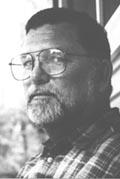
R. S. ("Sam") Gwynn is an American poet who was born in Eden, North Carolina, in 1948. He attended
Davidson College, where he twice won the Vereen Bell Award for
creative writing and played on Davidson’s championship football team in
the General Electric College Bowl. After receiving his B.A. in 1969, he
did graduate work at the Breadloaf School of English, then entered graduate
school at the University of Arkansas, earning his M.A. in 1972 and his M.F.A. in
1973. While a student at Arkansas, he received the John Gould Fletcher
Award for Poetry.
Gwynn began publishing as a college undergraduate, with poetry, fiction,
and translations appearing in the New England Review and the Sewanee
Review. His first collection of poetry, Bearing & Distance,
was published by Cedar Rock Press in 1977 and was followed by The Narcissiad,
a satirical poem, in 1982. His book of poems The Drive-In won the
Breakthrough Award from the University of Missouri Press in 1986. No
Word of Farewell: Poems 1970-2000 was published by Story Line
Press in 2000. His poems appear in a number of anthologies and textbooks,
including The Made Thing: Contemporary Southern Poetry, Sound and Sense,
Western Wind, Rebel
Angels: Twenty-five Poets of the New Formalism, and The Book
of Forms, and he has also been a frequent contributor of reviews to the Sewanee
Review and the Hudson Review.
For five years beginning in 1987 he wrote “The Year in Poetry” for the
Dictionary of Literary Biography Yearbook, and he later edited two
volumes of the DLB on contemporary American poetry. He has also
edited The
Advocates of Poetry: A Reader of American Poet-Critics of the Modernist Era,
New
Expansive Poetry: Theory, Criticism, History, and anthologies of
poetry and fiction for the Penguin Academics/Longman Pocket Anthology
series. Gwynn has lectured and given poetry readings at over one hundred
universities. He has been a faculty member at the Antioch Writers
Conference and the West Chester University Poetry Conference, teaching classes
in poetic meter and form, the sonnet, and the dramatic monologue.
In 1997, Gwynn was named University Professor at Lamar University,
Lamar’s highest academic rank, and he has also been recognized as an
outstanding teacher by Phi Kappa Phi, the national academic honor society, and
as an outstanding scholar by the College of Arts and Sciences.
He lives in Beaumont, Texas, with his wife, Donna. They have three sons and two
grandchildren.
Dana Gioia, in his introduction to No Word of Farewell, says: "By the time I had finished the volume
[Gwynn's The Drive-In] I knew I had come upon one
of the truly talented and original poets of my generation. I
should probably also note two other obvious qualities of Gwynn’s poetry.
First, he is ingeniously funny. Second, he is an effortless master of
verse forms. No American poet of his generation has written better
sonnets, and very few can equal him in the ballade, couplet, rondeau, or
pantoum—not to mention the half dozen new forms he has invented. But,
to be honest, it was neither Gwynn’s considerable formal skill nor his wicked
humor that first attracted me, though those qualities surely added to my
pleasure. Instead, it was his depth of feeling and intense lyricality."
Richard Wilbur says: "R. S. Gwynn's No Word of Farewell is full of a
dark and sardonic view of things, though that mood can modulate into the
elegiac, or into the exquisite poignancy of such a poem as
"Release." Whatever darkness prevails in this book is
continually alleviated by wit, and by a Byronic pleasure in formal play.
His poems are based in the vernacular, yet haunted by the whole tradition of
verse. This is a richly varied, highly accomplished collection from one of
our best."
X. J. Kennedy says: "A wonderful satirist, a master translator, a
keen observer of ironies, Gwynn commands a wide range of forms, some of them
daunting in their difficulty. Moreover, he clearly holds with the ancient wisdom
that a poem ought to bring gladness. That is why, every time I spy one of his
new poems in a magazine, I read it before anything else."
Release
Slow for the sake of flowers as they turn
Toward sunlight, graceful as a line of sail
Coming into the wind. Slow for the mill-
Wheel's heft and plummet, for the chug and churn
Of water as it gathers, for the frail
Half-life of spraylets as they toss and spill.
For all that lags and eases, all that shows
The winding-downward and diminished scale
Of days declining to a twilit chill,
Breathe quietly, release into repose:
Be still.
From No Word of Farewell: Poems 1970-2000, Story Line Press, (c) 2001. Used by permission of the author.
III. Writer-in-Residence
He roared up to the cook-out on his Harley,
Invoking blessings from the Muse of Barley,
Passed round a joint, sliced the brie with his switchblade,
And groped the Chairman’s young wife, all of which made
The pallid tribe disperse with nervous laughter
And grant him tenure very soon thereafter.
On the Threshold
One way out of this endless round of being—
I’ve weighed and proven it with hand and eye.
One quick stroke—and no prison wall is high
Or thick enough to keep my soul from fleeing.
Even before the snoring guard can right
His chair and fumble with the clumsy key,
One quick stroke—and at last my soul is free
And soaring upward in the starlit night.
What keeps these others going—faith, desire,
Or hope—has slowly dwindled, leaving me
Only this shadow play, this senseless revel.
Only, what holds me back? The threshold’s free.
Yet I remain here, held against the fire
In spite of all—by God or by the Devil.
Human Nature
Walking for pleasure, not reward,
He took small profit when he found
The remnants of the fox squirrel’s hoard
Of acorns on the thawing ground;
And by the creek where tongues of fern
Lashed at tardy clumps of snow
He stepped across without concern
Nor need of any gain to show
To those who urged that each new leaf,
Sallow with translucent green,
Bore certain auguries of grief
Which he must serve as go-between.
His taste was not for that at all.
Better to save the yellow flower
Emerging from a tumbled wall
For savoring at a later hour
Than count its petals on his walk
Like one who only understands
The manifesto of a stalk
Stripped naked by his busy hands.
Topping the ridge, he met the line
A winter ice-storm had surveyed;
Trunks lay leveled, oak with pine,
Brown contrast in a greening shade.
Though from both edges branches grew
That by the summer’s close would heal
A breach no longer wide nor new,
It seemed this spoilage might reveal
A frosty parable of waste
Breathing from every broken shaft,
Still lingering like the aftertaste
Of the tempest’s bitter draught—
As if original violence
Had coiled and struck through frozen air
At winter woods whose sole offense
Simply lay in being there.
But if he wondered what it meant
That in this spot no sapling stood,
No witness to the wind’s intent
Came forward from the turning wood.
Ballade of the Yale Younger Poets of Yesteryear
Tell me where, oh, where are they,
Those Younger Poets of Old Yale
Whose laurels flourished for a day
But wither now beyond the pale?
Where are Chubb, Farrar, and Vinal
With fame as fragile as a bubble?
Where is the late Paul Tanaquil,
And where is Lindley Williams Hubbell?
Where’s Banks? Where’s Boyle? Where’s Frances Clai-
Borne Mason? Where is T. H. Ferril?
Dorothy E. Reid or Margaret Ha-
Ley? Simmering in Bad Poets Hell?
J. Ingalls’ Metaphysical
Sword (hacking critics’ weeds to stubble)?
Young Ashbery (that is, “John L.”)?
And where is Lindley Williams Hubbell?
Where’s Alfred Raymond Bellinger
(If you’ll allow me to exhale
Him avec un accent français)?
Where’s Faust (Henri) or Dorothy Belle
Flanagan? Where is Paul Engle
(To rhyme whose surname gave me trouble)?
Hath tolled for all the passing bell?
And where is Lindley Williams Hubbell?
Prince of all poets, hear, I pray,
And raise them from their beds of rubble.
Where’s Younger Carolyn Forché?
And where is Lindley Williams Hubbell?
Before Prostate Surgery
Farewell, thou joy of my right hand, my toy;
My sin was too much use of thee, old boy—
At least the old wives’ tales would have it thus,
And I am too downcast to raise a fuss
Or much of anything, to put it simply.
Now from the ashes of my hot and pimply
Youth and each profligate misspent erection
I bid thee rise to spiritual perfection.
Say, “Here I lie, the truest son of Sam,
Epic intentions shrunk to epigram.”
And pray, that in the deft hand of a lover
From death to life we might thee yet recover.
Train for Ill: A Ballad
. . . train for ill and not for good.
A. E. Housman
The train for Ill is a long train
That takes on passengers in Pain,
Where prayers are offered to complain
To skies of unrelenting rain
And all roads run downhill.
And we who slowly file aboard
Clutch tickets we can scarce afford;
Protesting our unjust reward,
We take the train for Ill.
The platform soon grows loud with those
Who wear dark bands and Sunday clothes,
Whose shared emotion plainly shows
With handkerchiefs near every nose.
They watch the coaches fill,
And as our group departs a few
Shed tears, which others fail to do:
Survivors' benefits accrue
On the train for Ill.
With ashes smeared on every face
The children who appear to chase
The last car seem to run in place
As if inclined to lose the race.
Their cries grow short and shrill
And fall behind as we descend,
Cars swaying lightly in the wind,
A grade that shudders to the end
Of the train for Ill.
Oh, if there were some way we could
Journey instead to distant Good!
We touch old charms and knock on wood
But each mile makes it understood
That we never will.
To our sorrow we must learn
The shining hopes for which we yearn
Are stamped, like tickets, “No return”
On the train for Ill.
How soon it seems the soft light goes—
Then summer’s heat, then corn in rows,
Then on a wall one brilliant rose
Signals a stop as petals close
In the growing chill.
Our faltering voices raise to sing
Remembrances of how the spring
Gathered its green regrets to bring
To the train for Ill.
“Shall we know any good again?”
Some cry. “How many times? And when?”
The warnings on our medicine
Offer no clues what may be in
Each dark and bitter pill.
Beside the tracks two lovers kiss.
We know we have no part in this,
The daily dose we never miss
On the train for Ill.
And at the end what will remain?
An emptiness that can contain
All losses and all hopes of gain,
Even nostalgic thoughts of Pain,
That city on the hill?
With no more failings to confess
We lift our voices up to bless
Each frail design of loveliness,
All sweetness that grows less and less
Aboard the train for Ill.
Coastal Freeze
It will come with warnings published on the air,
So beware
Laying bets on gulf-born breezes harboring
Hopes of spring.
Dwarf azaleas, playing suckers’ odds with doom,
Race to bloom,
But the front’s relentless lashing drains each bud-
Full of blood,
Laying low without distinction as it kills
Daffodils,
Calla lilies, bougainvillea, mustard greens.
For it means
All beginner’s luck runs sour, to be lost
To the frost,
Like a wealth of unconsidered good advice.
Glazed with ice,
Greenness shatters, brittle as an ancient bone,
And our own
Stunned camellia stands, white petals shed below—
Snow on snow.
A Box of Ashes
D.E.G., 1917-1995
A box of ashes, which we scattered on
Your parents’ gravesite where the soil was poor,
Cycles through root and crystal to restore
The cracked red clay that shrank around their stone.
New growth is whispering what you might have known,
Stemming the nothingness you asked us for:
A box of ashes.
If grit and granule, chalky bits of bone,
And your life’s dusty shards weigh little more
Than handfuls sifted in a garden store,
Ponder, Father, why these green blades have grown:
A box of ashes.
At the Center
The pianist is playing Debussy
Beside the lobby cappuccino bar—
Soft smiles and pastels everywhere.You see,
The point’s not to remind you where you are
Or how you are; the point is not to dwell
On thoughts like these. Look at this normal crowd
Such as you’d find in any good hotel.
But why does no one say its name out loud?
Later you pass through elevator doors;
Rising to higher levels, you recall
Rumors you’ve heard of rumors from these floors—
How some guests never leave, how they display
A preference for short hair, or none at all,
How no one asks how long you plan to stay.
Bone Scan
Shadows surround me, building in the air
Like clouds, were I inclined here to compare
My kingly state to portents in the sky.
I could say the expected: I could lie,
Claiming our long-term forecast will be fair.
So, family and friends, do not despair.
Shadows mean nothing. There is nothing there.
Knives will find nothing wrong. Still, I know why
Shadows surround me.
The night my father died, I moved my chair
Close to his bed to touch his meager hair
While shadows gathered in his room that I
Might gather I was not too young to die.
Now, circuits close. A tunnel beckons where
Shadows surround me.
The Dark Place
In the dark place where I had come to piss
I met my maker, and I heard him say:
No man alive deserves a death like this,
But you, for whom the serpent did not hiss
Except in joy, shall have one. For today,
In this dark place where we have come to piss,
The son of man you murder with a kiss
Exacts the toll you shall be made to pay.
I asked, “And I deserve a death like this?”
He answered, No. But nothing can dismiss
The heat that comes by night, the cold by day,
To this dark place where you have come to piss
Over the edge of life and that abyss
Down which no light extends a blessed ray.
“Then who of us deserves a death like this?”
With that, he took my hand, as Beatrice
Sent one to Dante who had lost his way
In this dark place where we have come to piss,
Where none of us deserves a death like this.
The Great Fear
Here where the door stands open, lights are on.
Each object occupies a special place.
Note the half sheet of foolscap by the phone
Where numbers someone labored to erase
Have left impressions. And there's no dial tone.
The tv glows, turned down. Dark figures chase
One who must learn no mercy can be shown
In such an extraordinary case.
An individual was here, but who?
His sheets are cold, the paperback romance
Gapes open, dog-eared, while his hanging pants
And belt await him. There is nothing missing,
Nor any sound except the kettle hissing,
Ready for the next one, whose name is You.
Make Us an Offer
. . . a Shriner . . . she was big in Eastern Star . . .
I round a corner, and the minty voice
Fades like the draperies. On the breakfast bar
Their sad shoes gape: $1 TAKE YOU’RE CHOICE.
Having passed up the tôle paint and veneer,
Framed needlepointed slogans edged with lace
In cheerless rooms the relict tried to cheer
With smiles to which it’s hard to fit a face,
I thumb fresh tracts—as if I sought an answer
To what seems clear enough—promising heaven
Or, failing that, a way to live with cancer.
A textbook dated 1937
Holds formulae which still, perhaps, are so,
The brown spots on its pages whispering, “No.”
III
Jay Swinney did a great Roy Orbison
Impersonation once at Lyn‑Rock Park,
Lip‑synching to "It's Over" in his dark
Glasses beside the jukebox. He was one
Who'd want no better for an epitaph
Than he was good with girls and charmed them by
Opening his billfold to a photograph:
Big brother. The Marine. Who didn't die.
He comes to mind, years from that summer night,
In class for no good reason while I talk
About Thoreau's remark that one injustice
Makes prisoners of us all. The piece of chalk
Splinters and flakes in fragments as I write,
To settle in the tray, where all the dust is.
Two Villanelles:
Optimist
For Ailene Michaelis of Beaumont, Texas, who published, as The Rhyming Optimist, six poems a week 1919-1935 for the
International and King Features syndicates.
Villanelle follows sonnet, day by day,
Like multi-colored bon-bons on a plate.
Fridays bring fishcakes and a triolet.
Your scattered rosebuds falling where they may,
Drifting away like every ripped off date,
Villanelle follows sonnet, day by day.
The stacks of yellow foolscap mount. Can they
Confess the fiery mildness of your fate?
Fridays bring fishcakes and a triolet
While aches and years are gathered in the gray
That spreads from roots to ends: your husband’s late.
Villanelle follows sonnet, day by day,
And soon enough a world has spun away
Like headlines whirling at a heady rate.
Fridays bring fishcakes and a triolet;
Mondays start the round again: you say,
The camphor gaily blooms beside my gate.
Villanelle follows sonnet, day by day.
Fridays bring fishcakes and a triolet.
Ellenalliv for Lew: On His Retirement
In graduate school Lew Turco was the champion of two parlor tricks for which alone
we would never have forgotten him, even if he had written nothing: one was the
trick of being able to recite anything backwards, and to do it instantly; the
second and more impressive was the trick of improvising on the spot a Dylan
Thomas poem, not ever one we could quite remember, though each new Turco-Thomas
poem did sound at least faintly familiar and certainly authentic.
Donald Justice
Retirement into gentle go not do.
Dies he until stops never poet a.
Do to tasks undone many have still you.
Start they what of half finish ever few.
You with compared they’re when away fade they.
Retirement into gentle go not do.
Renown first their on rested have some, true.
Promises early to up live few, hey!
Do to tasks undone many have still you.
Writes who man the to given be must due.
Does he what for reward small too is pay.
Retirement into gentle go not do.
Yield to not and, find to, seek to, strive to.
Truth its holds still saw ancient this that pray.
Do to tasks undone many have still you.
Sleep you before go to miles have you, Lew.
Forth travel you may so, anew breaks day.
Retirement into gentle go not do.
Do to tasks undone many have still you.
Snow White and the Seven Deadly Sins
Good Catholic girl, she didn't mind the cleaning.
All of her household chores, at first, were small
And hardly labors one could find demeaning.
One's duty was one's refuge, after all.
And if she had her doubts at certain moments
And once confessed them to the Father, she
Was instantly referred to texts in Romans
And Peter's First Epistle, chapter III.
Years passed. More sinful every day, the Seven
Breakfasted, grabbed their pitchforks, donned their horns
And sped to contravene the hopes of heaven,
Sowing the neighbors' lawns with tares and thorns.
She set to work. Pride's thousand looking glasses
Ogled her dimly, smeared with prints of lips;
Lust's magazines lay strewn—bare tits and asses
With flyers for "devices"—chains, cuffs, whips.
Gluttony's empties covered half the table,
Mingling with Avarice's cards and chips,
And she'd been told to sew a Bill Blass label
In the green blazer Envy'd bought at Gyp's.
She knelt to the cold master bathroom floor as
If a petitioner before the Pope,
Retrieving several pairs of Sloth's soiled drawers,
A sweat‑sock and a cake of hairy soap.
Then, as she wiped the Windex from the mirror,
She noticed, and the vision made her cry,
How much she'd grayed and paled, and how much clearer
Festered the bruise of Wrath beneath her eye.
"No poisoned apple needed for this Princess,"
She murmured, making X's with her thumb.
A car door slammed, bringing her to her senses:
Ho‑hum. Ho‑hum. It's home from work we come.
And she was out the window in a second,
In time to see a Handsome Prince, of course,
Who, spying her distressed condition, beckoned
For her to mount (What else?) his snow‑white horse.
Impeccably he spoke. His smile was glowing.
So debonair! So charming! And so Male.
She took one step, reversed, and without slowing
Beat it to St. Anne's where she took the veil.
Local Initiative
For years his parents saw that wreaths were placed
Beside the crossroads where their youngest boy
Left lines of rubber from his shattered toy,
An epitaph new concrete has erased.
For years they mailed petitions for a light
Or four-way stop; the city deemed it best
To table them until the time was right.
It took The Mall to honor their request.
You can’t take parents’ sorrows to the bank
But you can always bank on corporate needs.
Now like a docile river traffic flows
By fraying ribbons lost among the weeds,
And slowing to the changing light we thank
Blockbuster, Target, Texaco, and Lowes.
Approaching a Significant Birthday, He Peruses
The Norton Anthology of Poetry
All human things are subject to decay.
Beauty is momentary in the mind.
The curfew tolls the knell of parting day.
If Winter comes, can Spring be far behind?
Forlorn! the very word is like a bell
And somewhat of a sad perplexity.
Here, take my picture, though I bid farewell,
In a dark time the eye begins to see
The woods decay, the woods decay and fall—
Bare ruined choirs where late the sweet birds sang.
What but design of darkness to appall?
An aged man is but a paltry thing.
If I should die, think only this of me:
Crass casualty obstructs the sun and rain
When I have fears that I may cease to be,
To cease upon the midnight with no pain
And hear the spectral singing of the moon
And strictly meditate the thankless muse.
The world is too much with us, late and soon.
It gathers to a greatness, like the ooze.
Do not go gentle into that good night.
Fame is no plant that grows on mortal soil.
Again he raised the jug up to the light:
Old age hath yet his honor and his toil.
Downward to darkness on extended wings,
Break, break, break, on thy cold gray stones, O sea,
And tell sad stories of the death of kings.
I do not think that they will sing to me.
The Ballad of Burton and Bobby and Bill
For Archer Joyce
My best friend and I would often stop by
The store on our way home from school.
What can I say? This was back in a day
When we’d rather be dead than uncool,
When a sneer at one’s shirt was a palpable hurt
That could even occasion some tears,
A juvenile pain that rises again
After so many wardrobes and years.
If you’ll humor me while I discourse upon style
(Oh, I fervently hope that you will!)
I’ll sing you a story that measures the glory
Of Burton and Bobby and Bill.
TOWNE SQUIRE was the name; I recall when it came
To the storefront on Washington Street—
Mill town in the South, pretty down in the mouth
With a well-thumbed carte-de-visite.
Every other men’s store carried Cloth for the Poor
(We were snobs clear down to our jocks),
But the SQUIRE was the first to pour wine for our thirst
For wing-tips and Ivy League socks,
Wembley ties that were narrow and Madras by Arrow
And Weejuns and Gold Cups to fill
The immaculate shelves of our fantasy selves
Dressed by Burton and Bobby and Bill.
Now Bill was stocky and Burton like rock (he
Had played some ball in his prime),
And Bobby was slender with eyes that were tender
And wrinkled with laughter, not time.
I am sure that these guys were not kindly or wise
And they mainly desired that we spend
More than time in perusing the brands of their choosing—
Their smiles were a means to an end.
Still, I can’t help but think that the nod and the wink
As they storewalked from mirror to till
Meant what gleamed in their eyes wasn’t just merchandise
To Burton and Bobby and Bill.
Harris tweeds...Haggar pants...London Fogs...Oxford Gants...
Rep ties...penny loafers from Bass...
They reeked with, we knew, something more than Canoe—
I suppose you could label it Class,
Or at least so it seemed to two youngsters who dreamed
Of someday impressing les femmes
As sophisticates wiser than Playboy’s advisor—
Small wonder we looked up to them!
For to gaze on one’s Dad was to see something sad
As he snored through Bonanza until
He arose with a cough and his pants falling off
(Unlike Burton and Bobby and Bill).
Through a span of lapels and an eon of smells
From those overpriced brands of cologne,
We’ve matured yet have come to be more than the sum
Of all we’ve acquired on our own.
Praise the Lord for the models who showed us which bottles
To test and which knots we should use,
For the older we grow the more clearly we know
What it means to be wearing their shoes.
The lesson they taught—like a blazer you bought,
Wore awhile, and then gave to Goodwill—
Is that goods never last; they belong to the past
Like Burton and Bobby and Bill.
Yes, the years have a way of making us pay
For the rags that we wear on our backs
As we waddle the path to the Vineyards of Wrath
In double-knit Sans-a-Belt slacks.
Good Fellows of Fashion, who leant us a passion
For lint-rollers, orlon, and labels,
Can it be that you’ve gone where it all rests upon
God’s final clearance tables?
The store’s shutting down with the rest of the town
And the Company is closing the mill.
They’ve boarded the door. We’ll bargain no more
With Burton and Bobby and Bill.
West Palm
Arma virumque cano.It should be
That simple, shouldn't it? Sometimes, at night
When Susan and the boys are in their beds
I'll take my Virgil and the dictionary
And work through lines like these until my eyes
Grow heavy, and I know that I can sleep.
I won't take pills, though Susan says I'm stupid
Not doing so. "You are a doctor, Tom.
Write yourself a prescription." But I don't.
The sleeplessness is somehow like the Latin,
Steady and tedious, worth working through.
Arma virumque. Warfare and mankind.
I've known them both and tried to keep my distance.
In '68 I did my residency
At an induction center. Easy work,
Knee‑jerks and assholes, Hunter used to joke
When we'd go out to see the daily crop.
Hunter was something else, a hare‑lipped sergeant
Who'd done the same routine for twenty years.
I can still hear the way he'd holler out:
"Bend oder, gemmun. Gab you cheeks an spead 'em!"
He'd seen it all, the guys who'd drink raw eggs
For weeks on end to register albumin
In urine samples, those who'd swallow speed
To bring on an arrhythmia. We locked them up
There on the holding ward a day or so
Until their signs were normal and they passed.
I sent so many off to war that year
I can't recall a single face. A scar
Or a tattoo, perhaps, but not a face
Except old Hunter's with his twisted lip
And eyes that cut into me like a scalpel.
We worked on daily quotas, for the camps
Could only take so many at a time
And in those days they called up twice the number
They'd ever use. I'd swagger down the lines
And feel those kids' eyes on me, almost begging
For me to find some rare deformity
In feet or knees or crotch to keep them out.
That year, I had the power of life and death.
I can't remember faces, but I know
I sent some that I shouldn't have, a negro
With tracks on either arm, a pool of pus
Between his feet when he pulled back his foreskin
And stood there grinning at us; one fat slob
With H‑A‑T‑E scratched into his knuckles
And teeth like something from a horror movie.
The clean‑cut boys, the ones who answered "Sir"
And seemed to have intelligence as well,
Would get the benefit of every doubt.
Sometimes I'd listen with the stethoscope
Until I half convinced myself I heard
A murmur. Hell, nobody questioned me
As long as every bus to camp was full.
Hunter caught on, I guess, and hated me
For what I did but never said a word.
In '69 I got the job I wanted,
Putting the blasted faces back together
And doing what I could to mask the scars.
For years I read of Mengele. Remember?
The Nazi doctor who stood by the trains
And flipped his riding crop to left or right
To send one to the ovens, one to work.
For years they claimed he hid in Argentina
Or some such place. And I live in West Palm,
Here in a house my old man would have never
Felt better than a servant in—a wife
And two fine boys, a sailboat we could take
Across the ocean if we wanted to,
And a good practice that grows every day.
If Doctor Mengele could see my patients!
Jewish women demanding straighter noses,
Bigger breasts, smaller breasts, a few less wrinkles.
Ponce de Leon discovered Florida
In search of youth. It's right here in my hand.
The fountain's a syringe of collagen.
Mama, god bless her soul, would keep me up
Past midnight with those tables of declensions
Until I had them down. I could still pass,
With practice say a page of Cicero
So silkily you'd think I'd heard the man.
Now, through the years I've found no use for all
That patience but to help me fall asleep.
I'll go up now and look in on the boys,
My blond and flawless sons who'll help me take
The boat out at first light. We'll catch a breeze
And point the bow out where the blue meets blue
And one soon loses sight of everything.
The Easiest Room in Hell
What torments for the genteel sonneteers
Whose praises ran, as streams of syrup flow,
From critics (space reserved somewhere below)
And Gentle Readers lodged in higher spheres?
Prefacing phrase and clause withAh! or O!
They spoke as if the stems and stumps had ears,
Letting the backwash of their idle tears
Leave bathtub rings around the Vale of Woe.
They strove with none, and strummed their tuneless lyres
Until the numbest ears had turned to stone,
But, Lord, deal lightly with them, feed the fires
With many drafts, and make them sweetly moan
Nice sentiments, which echo from their crevice:
Carpe diem!
Ubi sunt?
Ars longa, vita brevis.
In Chalfont St Giles
Satan shops at Marks & Spencer
With a trolley heaped with cake,
Shedding, like a swinging censer,
Whiffs of brimstone in His wake.
Everything there sports one label
(At a fair though upscale price).
Swarthy stockboys shout in Babel,
Keeping picnic things on ice.
Stabbing goodies with His pitchfork—
Capons, capers, casual clothes—
He slows down to ponder which pork
Sausage most excites His nose.
Loosed upon their shops by Milton,
Now, midst sprats and Mozart tinned,
He unveils a putrid Stilton
To remind them how they’ve sinned.
He wolfs down endangered species,
Grills with Amazonian wood,
Chips the poles for ice with ease; He’s
Got a credit line. It’s good.
Satan, consummate consumer,
Thrives in both the boom and bust.
See Him give a housewife room! Her-
self ahead, He swells with lust.
Is He Tory? Is He Labour?
Are His economics planned?
Do thy best to do thy neighbour
In this green and pleasant land.
“Paper? Plastic?” croons the checkout.
Satan smiles and answers, “Both.”
Mrs. Bean now sticks her neck out
From a slow queue bagged by Sloth:
“Sinful Satan,” cries the woman,
“Are Your actions ever Green?”
Satan nods and smirks to someone,
“Let’s recycle . . . Mrs. Bean.”
A Poem: My Agent Says
My agent says Los Angeles will call.
My broker says to sell without delay.
My doctor says the spot is very small.
My lover says get tested right away.
My congressman says yes, he truly cares.
My bottle says he'll see me after five.
My mirror says to pluck a few stray hairs.
My mother says that she is still alive.
My leader says we may have seen the worst.
My mistress says her eyes are like the sun.
My bride says that it's true I'm not the first.
My landlord says he'd think about a gun.
My boss says that I'd better take a chair.
My enemy says turn the other cheek.
My rival says that all in love is fair.
My brother says he's coming for a week.
My teacher says my work is very neat.
My ex-wife says I haven't heard the last.
My usher says the big guy's in my seat.
My captain says to bind him to the mast.
My master says I must be taught my place.
My conscience says my schemes will never fly.
My father says he doesn't like my face.
My lawyer says I shouldn't testify.
My buddy says this time I've got it bad.
My first love says she can't recall my name.
My baby says my singing makes her sad.
My dog says that she loves me all the same.
My pastor says to walk the narrow path.
My coach says someone else will get the ball.
My God says I shall bend beneath his wrath.
My agent says Los Angeles may call.
From No Word of Farewell: Poems 1970-2000, Story Line Press, (c) 2001. Used by permission of the author.
Rhapsode
His agent could not book him
Into big resorts,
And so the years took him
On cruise ships to strange ports,
Where, following smarmy lyrists
Who plucked their single string
For overstuffed tourists,
The rhapsode rose to sing.
Dodging egg and cabbage,
He learned survival's art
By mouthing lines the savage
Ear might take to heart
Yet in each new version
Pruning, with regret,
Subtleties that Persian
And Mede would never get.
Thus he cultivated—
Bloodied, somewhat bowed—
The epic lie he hated
Yet nightly gave the crowd.
At least it was a living,
He heard himself say.
The muse, unforgiving,
Tuned her breath away.
Rosy-fingered mornings
Followed wine-dark nights;
Physicians issued warnings
About his appetites.
One late show as he ended
An endless simile
The Silver Lord descended
And set his song free.
With him died a story
That will not be retold,
How, forsaking glory,
Achilles grows old
While Hector dusts his trophies
Behind high walls—
For in his unsung strophes
Troy never falls.
From No Word of Farewell: Poems 1970-2000, Story Line Press, (c) 2001. Used by permission of the author.
Among Philistines
The night before they meant to pluck his eyes
He caught his tale at six on Action News—
Some blow-dried moron blabbing the bald lies
The public swallowed as "Official Views."
After a word for douche, Delilah made
A live appearance and was interviewed.
Complaining what a pittance she was paid,
She plugged the film she starred in in the nude.
Unbearable, he thought, and flipped the switch,
Lay sleepless on the bed in the bright room
Where every thought brought back the pretty bitch
And all the Orient of her perfume,
Her perfect breasts, her hips and slender waist,
Matchless among the centerfolds of Zion,
Which summoned to his tongue the mingled taste
Of honey oozing from the rotted lion;
For now his every mumble in the sack
(Bugged, of course, and not a whisper missed)
Would be revealed in lurid paperback
"As told to" Sheba Sleaze, the columnist.
Beefcake aside, he was a man of thought
Who heretofore had kept to the strict law:
For all the cheap celebrity it brought
He honestly deplored that ass's jaw,
The glossy covers of their magazines
With taut chains popping on his greasy chest,
The ads for razors with the corny scenes
And captions: Hebrew Hunk Says We Shave Best!
Such were his thoughts; much more severe the dreams
That sped him through his sleep in a wild car:
Vistas of billboards where he lathered cream,
Gulped milk, chugged beer, or smoked a foul cigar,
And this last image, this, mile after mile—
Delilah, naked, sucking on a pair
Of golden shears, winking her lewdest smile
Amid a monumental pile of hair
And blaring type: The Babe Who Buzzed the Yid!
Starring in JUST A LITTLE OFF MY HEAD.
He noted how his locks demurely hid
Those monstrous tits. And how her lips were red,
Red as his eyes when he was roused at seven
To trace back to its source the splendid ray
Of sunlight streaming from the throat of Heaven
Commanding him to kneel and thus to pray:
"Lord God of Hosts, whose name cannot be used
Promotion-wise, whose face shall not adorn
A cornflake box, whose trust I have abused:
Return that strength of which I have been shorn
That we might smite this tasteless shiksa land
With hemorrhoids and rats, with fire and sword.
Forgive my crime. Put forth thy fearsome hand
Against them and their gods, I pray thee, Lord."
So, shorn and strengthless, led through Gaza Mall
Past shoeshop, past boutique, Hallmark, and Sears,
He held his head erect and smiled to all
And did not dignify the scene with tears,
Knowing that God could mercifully ordain,
For punishment, the blessing in disguise.
"Good riddance," he said, whispering to the pain
As searing, the twin picks hissed in his eyes.
From No Word of Farewell: Poems 1970-2000, Story Line Press, (c) 2001. Used by permission of the author.
Cléante to Elmire
Rising, Madame, towards heaven in a bed
That elevates my knees and lifts my head
To sustenance, that is, a plastic tray
Of Jell-O, applesauce, and consommé,
I have become a connoisseur of juice,
Which leaves me liquid, not to mention loose,
And keeps my precious fluids running clear
Until such time as I shall disappear—
Like what descends transparently for pain,
Dripping, ex machina, to tubes that drain.
What has, you may well ask, contributed
To this apostrophe to one long dead
From one so nearly so? You come to me,
As Sting might say, in synchronicity;
Searching just now for bulletins about
This storm called Cara which, I have no doubt,
Shall live up to its namesake, namely you,
And do us in before the day is through,
I
channel-surfed and lit on PBS.
My dear, shall I be coy and make you guess
What stopped me there and brought a hurricane
And you into one focus in my brain?
One line, in Mr. Wilbur's fine translation:
And cultivate a sober moderation ....
Think of it! If we ever needed proof
Of greater patterns, wasn't it Tartuffe
That brought us once and brings us now together—
Molière and two lost souls and raging weather?
Lord, twenty years have passed and still each line
Smacks tartly on the tongue like a good wine
Heady with epigram and foiled seduction.
It was The Coastal Players' great production—
Rhymed verse they said our audience could not
Make much of, let alone digest the plot—
Yet how we triumphed, I the raisonneur
Cléante and you the faithful spouse, the pure
Elmire, the model of a perfect wife.
So much for art. Who says it mirrors life?
Like leaves whirling outside, the years have flown
And taken with them Pernelle and Orgon.
Dorine the maid (Remember? What a bitch!)
Went into real estate and came out rich,
Sweet Marianne had children and grew fat,
And you'd have thought it less than fitting that
The charge against Tartuffe, so like the play's,
Was finally dropped: not only virtue pays.
In spite of the applause I found so sweet
I never found the courage to repeat
Those evenings' glories in another play.
And you? We gathered you were on your way
To greater things. A touring company
(A Chorus Line!) had called, you gushed to me
At the cast party, and our toasts went on
(Fuck "sober moderation"!) until dawn,
When I appeared, bedraggled, in your gown—
My coming out, no small thing in this town—
Battering Blanche against your not-so-manly
Peruked and powdered parody of Stanley
While Matt, your surly boyfriend, hulked and glared.
You laughed at him. I must say I was scared.
After that night our paths diverged. I learned
Your offers never came, heard that you'd turned
To wilder exploits, but, then, I was so
Into my own pursuits I didn't know
How dark your path became. Often our cars
Would pass en route to our respective bars.
We'd honk and wave like drunken teens. Dare I
Hope that one kiss I blew you said good-bye?
Your end came the next summer. Tom, the cop
Who'd played Laurent, came by the flower shop
To tell me what he knew—in rapid order,
Marriage, your panicked calls—quick as the border
Of this new storm front alters. Drugs, of course,
Were much of it, and there was the divorce
Which had turned ugly. Still, the Lord knows what
Led to that final beating and the shot
That tore your face away—before Matt made
The 911 call, sobbing while he played
His own death scene. I only pray it's true
What Tom believed himself: he said that you
Were dead already when the shot was fired.
My own death is the kind that is "acquired,"
Which makes it sound like something one might paste
Into a book, as one "acquires" a taste
For sherry, leather scenes, or the ballet.
All prance around the piper. All must pay.
No more of that. The plot by now is stale.
Let Tony Kushner live to tell the tale
And garner all the money and awards.
May my audition be one aiming towards
A long run somewhere in a stellar cast
In which no bow I take will be my last.
Corny? You know me, Cara, for I am
The same as you, eternally a ham
Who holds out hopes of One who can explain,
A raisonneur of happiness and pain,
Who proves for us that love is possible
And need not climax in so great a fall
As what we've suffered ... and that The Machine
Will lower with a Prince who makes us clean
And whole again, who lends His blessed grace
To salve my wreckage and restore your face—
Who lets the memory of a dead friend's laugh,
In the dark valley, be my rod and staff.
In a world full of such unwelcome guests
As storms, Tartuffe, and sickness, small requests.
It makes a curious dénouement that I,
Too ill for anything except to die,
May be evacuated, which shall save
These sodden relics for a drier grave.
The winds are rising, Cara, your own winds
With the great closing curtain that descends
Upon us as we play our games again
With tracking charts and crayons. CNN
Leads the hour with your great whirling eye.
Live oaks and sweetgums just outside my high
Window gesticulate the agon for us
As fiercely as a Sophoclean chorus.
The living board their windows, and their eyes
Lift past their fragile rooflines to the skies.
What wind is this? they ask themselves.
I say
It is the wind that bears the world away.
From No Word of Farewell: Poems 1970-2000, Story Line Press, (c) 2001. Used by permission of the author.
The HyperTexts