The HyperTexts
The Night the Stars Aligned: Nashville Welcomes His Excellency, Aziz Mekouar, Ambassador of Morocco
to the United States
by Michael R. Burch,
an editor and publisher of Holocaust and Nakba poetry
On the night of Thursday, October 21, 2010, it was my pleasure and honor to meet
His Excellency Aziz Mekouar, the Moroccan Ambassador to the United States. This
was truly a night "the stars aligned" as political celebrities attended the
festivities, along with musicians, poets and peace activists. But the star that
dwarfed the individual lights, the true star of the night, was the Star of Peace
and Tolerance.
The event was aptly named "Friendship from the Start," because Morocco, a Muslim
nation, was the first nation to recognize the fledgling United States of
America, in 1777, and the first nation to sign a friendship treaty with the
United States, in 1786.
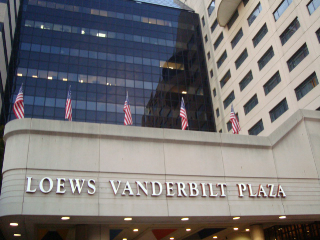
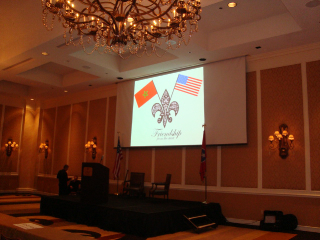
The event took place at Nashville's Vanderbilt Plaza hotel, in the Grand
Ballroom. In the rightmost picture you can see the Moroccan and American flags
side-by-side.

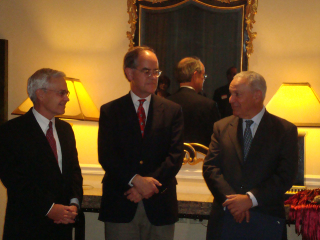
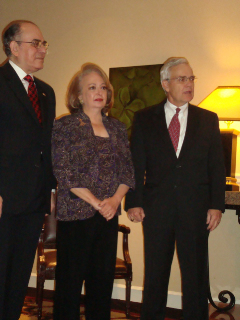
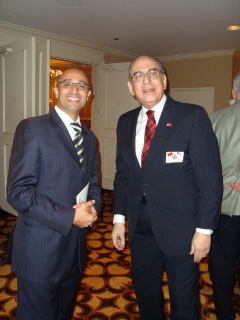
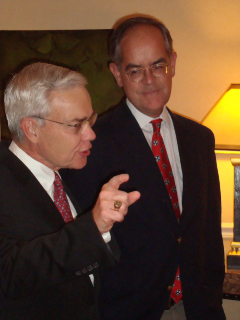
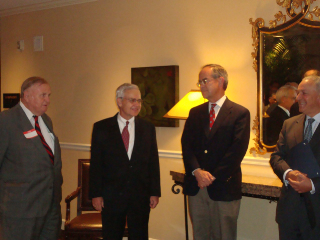
Here are three of the "star" politicians who attended. The two gentlemen on
the left are United States Congressmen Bob Clement and Jim Cooper. The gentleman
on the right is the Moroccan Ambassador to the United States, Aziz Mekouar.
Nashville mayor Karl Dean also attended the event and spoke briefly, but is not
pictured.
The Master of Ceremonies and organizer of the event was Zainab Elberry, an
Egyptian-American peace activist who is also my partner in creating the
Burch-Elberry Peace Initiative, which I presented to Mr.
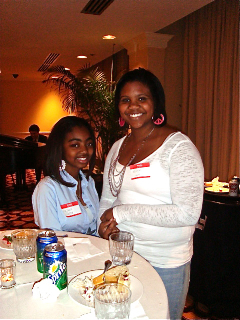
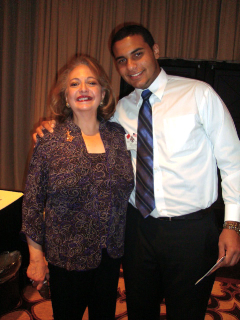
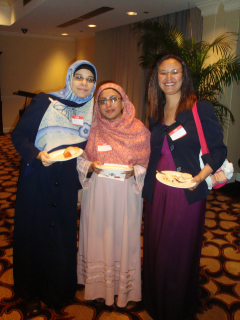
Mekouar toward the end of the evening. That's Zainab in the middle. The woman on
the right is Lynn Grassmeyer, a third-generation Palestinian-American peace
activist who works for human rights for Palestinian children, and all the
children of the world. I'm not sure who the gentleman on the right is.
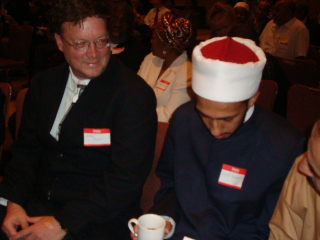
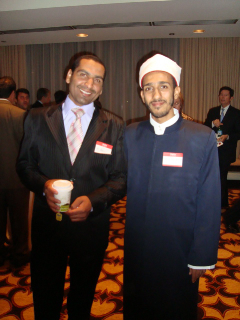
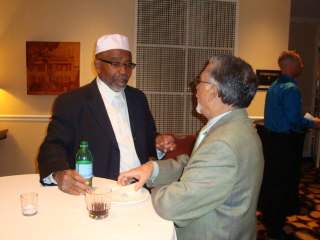
This is me, on the left, smiling
at the Muslim Imam.
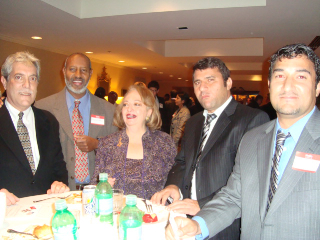
The gentleman to the left is Dr. M. Nour Naciri, the husband of Zainab
Elberry. He was the first Moroccan to live permanently in Nashville, having
moved here more than thirty years ago to get his Ph.D. at Vanderbilt University.
I believe the gentleman to the right is probably someone spectacularly important, but I'm
not good with names and faces, so I'm not sure who he is.
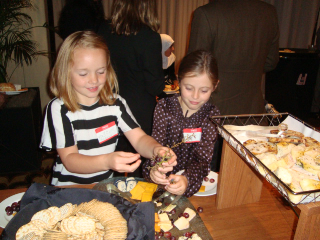
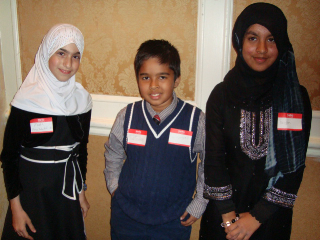
Here are the real stars of the show: the children. Several children presented
Mr. Mekouar with gifts, including a locally-made
confection: the famous Goo-Goo Bar! (I hope they also snuck him a Moon Pie or
three!)
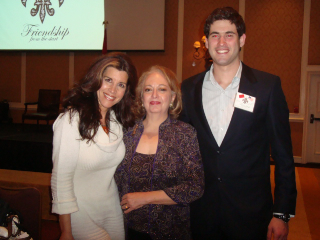
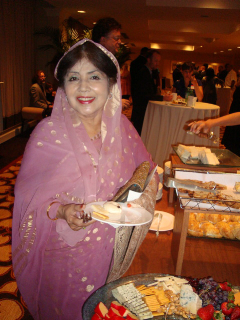
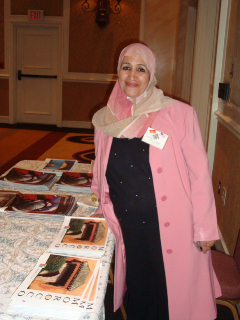
This woman, whose name I don't know, gets my vote for the best-dressed attendee
of the evening.
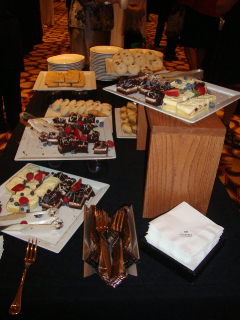
There was lots of wonderful food, presumably of Moroccan origin.
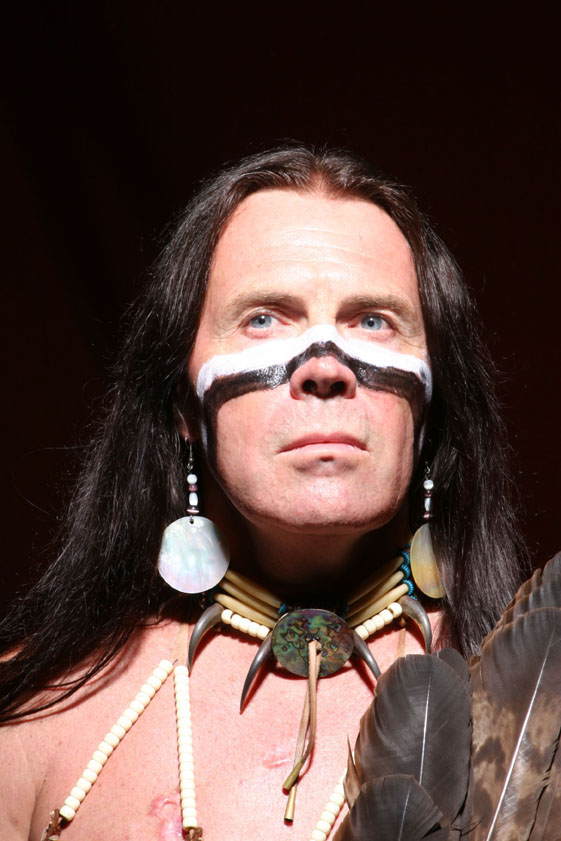
The first performer was Native American flutist
J. J. Kent. You can click on his name to visit his website, which is well
worth your time. His music was wonderfully moving and earned resounding
applause. He was introduced by Alison Shaw, also a native American, who spoke
eloquently of her heritage and the injustices suffered by Native Americans at
the hands of white Americans.
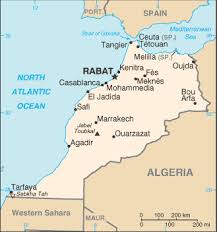
There was a twenty-minute documentary, "Morocco: Portrait of a Nation," followed
by a speech delivered by Mr. Mekouar, who was an eloquent if not "high wattage"
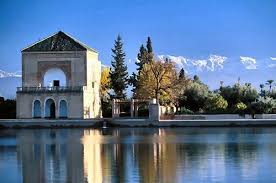
speaker. He certainly made a good impression on me. Morocco lies immediately
south of Spain, as you can see in the map below. Morocco is ethnically and
culturally diverse, with a population of around 32 million people. It has a
constitutional monarchy with a democratically elected parliament, somewhat
similar to Great Britain's, except that the King of Morocco retains vastly more
power than the British royals (something Mr. Mekouar either forgot or chose not
to mention). Morocco was the first nation to publicly recognize the fledgling
United States of America in 1777, and the Moroccan-American Treaty of
Friendship, signed in 1986 by Thomas Jefferson, John Adams and Sultan Muhammad
III, is the U.S.'s oldest unbroken friendship treaty, so our longest-established
formal relationship is with a Muslim nation.
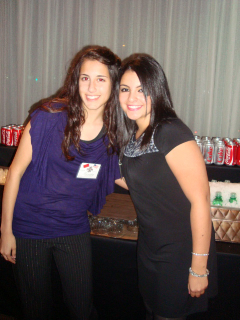
The attendees of the event were also ethically and culturally diverse, but they
all seemed to have one thing in common: beaming smiles.
Two years ago, if you had told me that I would end up submitting a
peace plan to the Moroccan Ambassador to the United States, His Excellency Aziz
Mekouar, I would have looked you straight in the eye and said, “You’re nuts!”
Two years ago, If you had told me that Jewish Holocaust survivors and poets
would accuse me of “turning my back on Israel,” I would have been shocked,
because I’m an editor and publisher of Holocaust poetry and I and my entire
family had always been staunch supporters of Israel.
But these things did happen; here’s why . . .
Ironically, it was my Jewish friends who first informed me,
subliminally, that something was very wrong in Israel. One day, as we discussed
the Israeli-Palestinian conflict, I suddenly realized that what they were
telling me just didn’t “add up.” When I began to ask them probing questions
about Israel’s treatment of the Palestinians, they became defensive, insisting
it was “unfair” to question Israel. Since Americans routinely question our
government’s policies and actions, I found this odd and, quite frankly,
disturbing.
My Jewish friends also seemed to be blaming all Christians
for the Holocaust when American Christians opposed Hitler and helped liberate
the Nazi death camps. Why should my family be accused of complicity in terrible
crimes, when none of us had ever lifted a finger to harm any Jewish person? It
seemed to me that for some unfathomable reason, my Jewish friends were inventing
illogical reasons to keep me from questioning Israel. But why would they do
that?
Puzzled, I decided to investigate the matter myself . . .
Knowing from history and my personal research on the
Holocaust that modern civilization depends on fair laws and courts, and that the
failure of nations to establish fair laws and courts invariably leads to
injustice, which in turn invariably leads to violence, I began my investigation
with the laws and courts of Israel. I had often been informed that Israel was
“the only democracy” in the Middle East, and that Israel and the United States
share “common values,” so I was shocked to discover that Israel has created a
system of Jim Crow laws and kangaroo courts clearly designed to make Jews vastly
superior in rights to Palestinians. For instance, Israel’s laws allow any Jew
anywhere in the world to emigrate to Israel and become a citizen of Israel, even
if their families hadn’t set foot in the region for the better part of two
thousand years. But multitudes of Palestinians are barred from returning to the
places where they actually lived just a few years ago. This was just one
of many racial injustices I found enshrined in the “laws” of Israel. Perhaps the
worst laws are those that make it illegal for non-Jewish citizens of Israel to
marry, live with and raise children with the spouses of their choice. If a
non-Jewish citizen of Israel marries the “wrong” man (according to the whims of
the racist laws of Israel), she can be separated from her husband and even her
own children! I also discovered that Israel routinely demolishes the homes of
Palestinians, without just cause or due process of law, leaving them homeless
and destitute. As I studied Israel’s “laws” and “courts,” which are clearly
travesties of justice, I became sick at heart. I and my Jewish friends had been
saying “Never again!” to such terrible things, but it seemed they had a “special
exemption” in mind for Palestinians, just as Nazis once had a “special
exemption” in mind for Jews. But how could I oppose what Nazis did to the Jews,
yet condone similar things being done by Jews to Palestinians? I felt betrayed,
but of course my discomfort was nothing compared to what completely innocent
Palestinian women and children were enduring at the hands of a government that
my government supplies with financial aid and advanced weapons, to the tune of
hundreds of billions of dollars and “still counting.”
I then studied the so-called “security” walls erected by
the government of Israel. National security walls are, of course, normally built
along borders and lie within the territory of the nation attempting to secure
itself. For example, the wall being erected to protect the United States from
illegal immigrants is being built along the Mexican border, on territory owned
by the United States. But Israel’s “security walls” are not built on its own
land. The border between Israel and the West Bank is roughly two hundred miles
long, but Israel’s “security” walls are over four hundred miles long, more than
double the length of the border. These walls snake through the West Bank, and
are obviously offensive in nature, stealing prime land and water sources from
the Palestinians. These are clearly offensive, dividing, conquering walls. And
they are also killing walls, because they cut Palestinians off from hospitals
and doctors. Innocent women and children are dying in the shadows of those
walls, in ambulances being held up at military checkpoints inside the
West Bank.
Furthermore, Israel has created “Jewish only” roads,
settlements and waterworks inside Occupied Palestine, in direct violation of
international law, the Camp David Accords, and human decency. What does creating
a “Jewish only” road on Palestinian land have to do with anyone’s security?
Clearly, it is an overt act of violence to encamp one’s military on someone
else’s land, then create roads they can’t drive on and settlements where they
can’t live. How would we feel if foreigners started creating roads and
settlements where Americans can’t drive or live, as if our children were not as
good as theirs? What would do? Of course we would
fight until our children’s rights and
freedom were restored.
As I studied the horrors being inflicted on Palestinians by
the government of Israel and its benefactor, the government of the United
States, I suddenly understood the real reason for the 9-11 attacks. So I decided
to do some more research. Sure enough, in the recorded testimonies of Osama bin
Laden and other organizers of the 9-11 attacks, the plight of the Palestinians
was cited as the major motive for the attacks, along with U.S. government
interference in the Middle East. In effect, the men we call “terrorists” are
saying, “If you’re going to cause our women and children to suffer and die, then
we will fight fire with fire, until you cease and desist.” Other Muslim
terrorists have said the same thing — that they are acting to protect Muslims in
the Middle East from U.S. and Israeli terrorism — but it seems most Americans
are deaf to the truth. We are not being attacked because Muslims hate our
“values” or despise our religion. We are being attacked because the governments
of Israel and the U.S. have colluded to cause innocent Muslims to suffer and
die, on their own native soil. When the vice chair of the 9-11 Commission asked
an FBI investigator what motivated the men who planned and executed the attacks,
the agent replied that the men the FBI had been able to interrogate had cited
the plight of the Palestinians and the actions of the U.S. government. But the
agent’s testimony was stricken from the published findings of the committee.
Why? Because many powerful Jews and Christians, like my Jewish friends, consider
it “unfair” to criticize Israel.
While I obviously don’t condone acts of terrorism against
the U.S., I also don’t condone U.S. acts of terrorism against the innocent
civilians of Muslim nations. If I beat another man’s wife and children, I can
expect him to retaliate. If I want peace with other men, I need to respect the
rights of their loved ones. But the governments of Israel and the U.S. chose the
ignore the golden rule, where Muslims are concerned, and 9-11 and the subsequent
wars were the terrible consequences.
Since the day it first dawned on my consciousness and
conscience that my Jewish friends were not saying “Never again!” to all
Holocausts, but were making a “special exemption” of the Palestinians, I have
devoted many hours of study and reflection to what I consider a very good cause:
establishing equal human rights, freedom and justice for Palestinians. In the
course of my studies I noticed something that became the seed of the
Burch-Elberry Peace Initiative: I noticed that the U.N. had repeatedly tried to
pass resolutions that would have helped the Palestinians become a free,
independent nation, but the U.S. had repeatedly used its Security Council veto
to quash such efforts. So I began to consider the idea of a new U.N. resolution
that the U.S. couldn’t veto. What about a veto based on the American Creed of
equal rights, fair laws and fair courts for all human beings, without exception?
How could the U.S. veto the American Creed?
This idea became the “Burch-Elberry Peace Initiative,”
which I presented to the Moroccan Ambassador to the United States, His
Excellency Aziz Mekouar, during his recent visit to Nashville, Tennessee. The
event honoring Mr. Mekouar that night was hosted by Zainab Elberry, my partner
in the initiative. I came up with the idea initially, Zainab thought the idea
had merit, and we decided to try to bring it to the attention of people able to
make it happen. Here’s the idea. If you think it has merit, please feel free to
explain it in your own words, or cut and paste the text from the article, or
direct other people to the web page:
www.thehypertexts.com/peace.htm
by Michael R. Burch
The HyperTexts