The HyperTexts
Nadia Anjuman Herawi (Nadja Anjoman): a Biography and Lyrics of the Poet of Herat
Related page: Hashem Shaabani (another poet and martyr)
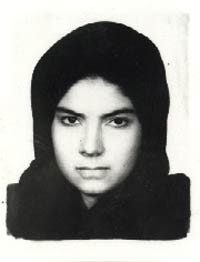 Nadia Anjuman Herawi (Nadja Anjoman) was a talented young Afghani poet who died at age 25 under highly suspicious circumstances. What were her
crimes? To be a woman and dare to be a poet? To speak her unmanacled mind freely? To become an advocate and spokesperson for women
like herself—women who loved literature so much they risked death by reading censored writers right beneath the snoutlike
noses of the Taliban? Ireland may have hurt Yeats into writing poetry, but Ireland didn't kill him for having the talent and audacity to be
published. And while it may not be possible to say Anjuman's position and stature as an acclaimed female Muslim poet directly brought about
her death, the mere fact that such an eventuality seems plausible should give the world pause, as in "Stop and see where the hell
we're heading!" To make matters worse, if such a thing is possible, the same Nadia Anjuman who survived the nightmare reign of the Taliban may
have died by the hand of her own husband, a scholar and writer ...
Nadia Anjuman Herawi (Nadja Anjoman) was a talented young Afghani poet who died at age 25 under highly suspicious circumstances. What were her
crimes? To be a woman and dare to be a poet? To speak her unmanacled mind freely? To become an advocate and spokesperson for women
like herself—women who loved literature so much they risked death by reading censored writers right beneath the snoutlike
noses of the Taliban? Ireland may have hurt Yeats into writing poetry, but Ireland didn't kill him for having the talent and audacity to be
published. And while it may not be possible to say Anjuman's position and stature as an acclaimed female Muslim poet directly brought about
her death, the mere fact that such an eventuality seems plausible should give the world pause, as in "Stop and see where the hell
we're heading!" To make matters worse, if such a thing is possible, the same Nadia Anjuman who survived the nightmare reign of the Taliban may
have died by the hand of her own husband, a scholar and writer ...
Which plunderer’s hand ransacked the pure gold statute of your dreams
In this horrendous storm?
—Nadia Anjuman, "Strands of Steel"
Of all the alarming things that appear herein, what alarms me most is something reported by Christina Lamb, an award-winning journalist/writer and expert
on "things Afghanistani," who wrote a book about the celebrated Sewing Circles of Herat, to which Anjuman belonged. Lamb reports: "Friends say her
family was furious, believing that the publication of poetry by a woman about love and beauty had brought shame on it." Her poems, written in the
Dari language, a dialect of Farsi, were dangerous, simply because a woman had chosen to speak her own mind. When the Taliban had been in power, girls not
only had been limited to studying the Qur'an (Koran), but they had also been denied the right to laugh out loud, or to wear shoes that made any noise. But
when the Taliban was driven from power, Nadia Anjuman and women like her were still not free.
— Intro by Michael R. Burch, editor of The HyperTexts
Do not question love as it is the inspiration of your pen
My loving words had in mind death.
—Nadia Anjuman, "Strands of Steel"
Nadia Anjuman was a poet, silenced by death, whose words may have been her downfall. Her own family, which should have tended and cherished her gift, somehow saw
only shame in the love and beauty she brought to the world. Her first book of published poetry, Gul-e-dodi ("Dark Red Flower" or "Flowers of Smoke" or
"Smokey Flower"), had become popular in Afghanistan, Pakistan and Iran. That may have created a backlash strong enough to cost her her life.
Even though I am the daughter of poem and songs
My poem was novice and broken
My autonomous twig did not recognize the hand of the gardener.
—Nadia Anjuman, "Strands of Steel"
The Fall of a Lark
by
T. S. Kerrigan
"My wings are closed...I cannot fly,"
She wrote before she plummeted,
A creature less of earth than sky,
A lark that bullies killed with stones,
She fell to earth, her music stilled,
A broken heap of shattered bones.
What gift like hers endures for long
Where ignorance flings stones at art,
And bullies put an end to song?
To choose to sing's an act of will;
She had to know instinctively
A singing bird's the first they kill.
Songstress
by Michael R.
Burch
Within its starkwhite ribcage, how the heart
must flutter wildly, O, and always sing
against the pressing darkness: all it knows
until at last it feels the numbing sting
of death. Then life's brief vision swiftly passes,
imposing night on one who clearly saw.
Death held your bright heart tightly, till its maw–
envenomed, fanged–could swallow, whole, your Awe.
And yet it was not death so much as you
who sealed your doom; you could not help but sing
and not be silenced. Here, behold your tomb's
white alabaster cage: pale, wretched thing!
But you'll not be imprisoned here, wise wren!
Your words soar free; rise, sing, fly, live again.
A poet like Nadia Anjuman can be likened to a caged bird, deprived of flight, who somehow finds it within herself to sing of love and beauty. But when the world
finally robs her of both flight and song, what is left for her but to leave the world, thus bereaving the world of herself and her song?
I am caged in this corner
full of melancholy and sorrow ...
my wings are closed and I cannot fly ...
I am an Afghan woman and so must wail.
—Nadia Anjuman
O exiles of the mountain of oblivion!
O the jewels of your names, slumbering in the mire of silence
O your obliterated memories, your light blue memories
In the silty mind of a wave in the sea of forgetting
Where is the clear, flowing stream of your thoughts?
Which thieving hand plundered the pure golden statue of your dreams?
In this storm which gives birth to oppression
Where has your ship, your serene silver mooncraft gone?
—Nadia Anjuman, "Light Blue Memories"
They're coming in from the road, now
Thirsty souls and dusty skirts brought from the desert
Their breath burning, mirage-mingled
Mouths dry and caked with dust
They're coming in from the road, now
Tormented-bodied, girls brought up on pain
Joy departed from their faces
Hearts old and lined with cracks
—Nadia Anjuman, "A Voiceless Cry"
For Nadia Anjuman, there may have been a fate worse than death: not to be free to act, not to be free to speak, not to be free to write poetry.
But for every constraining band of steel meant to cage, bind and ultimately silence her, she has left enduring words of steel. Truly, she has
left her mark.
Do not ask of my blooms great looks
On hands, feet, and tongue strands of steel
on the tablet of time, this will be my mark.
—Nadia Anjuman, "Strands of Steel"
Nadia Anjuman may be gone, but she is not forgotten, as Shahla Zoland paid homage to her and other female Afghani martyrs on the talent show Afghan Star
with her song "Dokhte Afghan" ("Daughter of Afghanistan"). We would like to express our sincere thanks to Thomas Fortenberry for providing
us with translations of several poems by Nadia Anjuman.
Ghazal by Nadia Anjuman
Translated by Khizra Aslam
From this cup of my lips comes a song;
It captures my singing soul, my song.
That in my words is the meaning of ecstasy,
That dies my happiness into grief, my song.
If you see that my eyes say a word,
Then take it as my forgetfulness, my song.
Do not ask of love, O it tells me of you;
My words of love speak of death, my song.
His hope, like flowers, I desire.
No drop of my eyes is enough, my song.
The daughter of this place sings qasida, a ghazal,
But what spoils her strange verses, my song?
O the gardener does not understand my happiness;
O do not ask for many looks of my youth, my song.
From these hands, these feet and words, it looks strange
That my name is written on the slate of this age, my song.
A poem by Nadia Anjoman
Translated by Mahnaz Badihian
No desire to open my mouth
What should I sing of...?
I, who am hated by life.
No difference to sing or not to sing.
Why should I talk of sweetness,
When I feel bitterness?
Oh, the oppressor's feast
Knocked my mouth.
I have no companion in life
Who can I be sweet for?
No difference to speak, to laugh,
To die, to be.
Me and my strained solitude.
With sorrow and sadness.
I was borne for nothingness.
My mouth should be sealed.
Oh my heart, you know it is spring
And time to celebrate.
What should I do with a trapped wing,
Which does not let me fly?
I have been silent too long,
But I never forget the melody,
Since every moment I whisper
The songs from my heart,
Reminding myself of
The day I will break this cage,
Fly from this solitude
And sing like a melancholic.
I am not a weak poplar tree
To be shaken by any wind.
I am an Afghan woman,
It only makes sense to moan
Ghazal by Nadia Anjuman
Translated by Khizra Aslam
There is no desire to speak again; whom to ask, what to say?
I, who was treated ill, what should I not read, what not to say?
What should I tell that honey for me is like poison!
I cry; the fist of the cruel! It teases. Would I not say?
There is no one who knows my affliction, none I trust;
For what should I cry, laugh, die, and live today?
I and this faith; the grief of my failure, and this wishfulness;
I cannot do anything; and the words of affection, if only I could say.
O my heart, there was spring and there was this season of comfort.
But I cannot fly anymore. I want to know to whom should I say ...
Though I am quiet and cannot remember any song,
Yet all the time, something stirs in my heart that I should say.
Ah, remember the good day when this cage was broken;
That loneliness is gone, my delight, I sing the cares away.
I am a frail stick that trembles in air each time;
An Afghan daughter who can say wherever she needs to say.
Ghazal by Nadia Anjuman
Translated by Khizra Aslam
It is night and these words come to me
By the call of my voice words come to me
What fire blazes in me, what water do I get?
From my body, the fragrance of my soul comes to me
I do not know from where these great words come
The fresh breeze takes loneliness away from me
That from the clouds of light comes this light
That there is no other wish that comes to me
The cry of my heart sparkles like a star
And the bird of my flight touches the sky
My madness can be found in his book
O do not say no, my master, O look once at me
It is like the day of judgment
Like doomsday my silence comes at me
I am happy that the giver gives me silk
And all night, all along these verses come to me
Nazm by Nadia Anjuman
Translated by Khizra Aslam
O the one who hides in the mountain of unfamiliarity!
O you that sleep in the quietness of the pearl.
O who remains in the memories!
Bring the memories of transparent water.
In a river like forgetfulness, my mind is full of dust.
The voice that comes from the mountain makes me think
That from the one who destroys, how can you get your golden string?
That the storm of cruelty affects the faith.
How can you get the comfort of a moon from a silver leaf?
There is no death after this!
If the river stops to flow,
And if the clouds open a way to your heart,
And yes, if the daughter of the moon blesses you with her smiles.
If the mountains become soft, greenery grows,
Fruit grows.
And one was kind, from all the unkind.
Will the sun rise?
Will the memories rise with it too?
Those memories that are hidden from our eyes
And while frightened from the flood and the rain of cruelness
Will the light of hope appear?
Memories of light blue by Nadia Anjuman
Translated by David Tayyari
You, exiles of the mountains of oblivion
You, diamonds of your names sleeping in quagmire of silence
You the ones your memories faded, memories of light blue
In the mind of muddy waves of forgotten sea
Where are your clear flowing thoughts?
Where did your peace-marked silver boat moon craft go?
After this death-giving freeze, the sea clams
The clouds, if they clear heart from bitterness
If daughter of moonlight brings kindness, induces smiles
If the mountain softens heart, grows green and
Turns fruitful
One of your names, above the mountain peaks
Will become the sun?
Sunrise of your memories
Memories of light blue
In the eyes of tired-of-flood-water fish and
Scared of rain of darkness
Will it become a sight of hope?
Translator's Note: "An Excerpt from "A NATION CHALLENGED: CULTURE; Afghan Poets Revive a
Literary Tradition" by Amy Waldman, New York Times, December 16, 2001: HERAT, Afghanistan, Dec. 15 ...
[During the reign of the Taliban around 30
women, at the risk of death] studied literature privately at the home of
Muhammad Ali Rahyab, a professor of literary theory and methodology at Herat
University. The sign outside his walled home advertises sewing classes [hence,
the legendary "Sewing Circles of Herat"]. Professor Rahyab has three daughters
— one a budding short story writer, the second an aspiring journalist,
the third a confident 12-year-old — which he said might have
subconsciously motivated him to teach women in secret. He said he believed in
the power of literature, even in a society where most people are illiterate,
because what starts among a small group of readers can easily spread. He added
that Afghans were far more likely to respond to poetry than political analysis:
''If we want to say something or make a statement, we will do it with a poem. A
line of poetry can put an end to a family problem, even trouble in a village.''
So in the name of forging a new literary cadre of women, each week he would
convene his students to discuss the reading they had done at home, whether
Tolstoy, Balzac or Dickens. They would also discuss their own stories and poems,
and he found a deep well of talent among his students. One of those talents,
Nadia Anjoman [more commonly spelled Anjuman], is a neighbor. Swathed in black,
she curled up like a cat in her professor's study, black eyes peering from an
elfin face. She is 20 years old and has written 60 or 70 poems. As the first
person in her family to love words, she has had to fight, like a number of
Professor Rahyab's students, for her family's cooperation. She has fought, too,
to stave off marriage, fearing it will limit her freedom to write. ''I think
I've been quite successful,'' she said. ''Girls are expected to marry at 14 or
15.'' She writes mostly about women's lives, ''because we have suffered a lot.''
She read an excerpt in a high voice:
I was discarded everywhere, the poetic whisper in my soul died.
Do not search for the meaning of joy in me, all the joy in my heart died.
If you are looking for stars in my eyes, that is a tale that does not exist.
—Nadia Anjuman
Flowers of disgrace
by Majlinda Bashllari
… as in a delirium I try to explain
the importance of playing the piano, but
I can’t sit in front of him,
afraid that in my blurred eyes he will see
puddles of overwhelming sadness…
The sounds of the sonata arch over this earth
where a woman’s life can be cut off like a flower,
like the dark flower of hope…
… God, where is all this junk coming from,
this poison like a black-as-death coffee?
Where do these flowers blossom?
Why do they do not become insane?
What tables do they beautify
through endless summers and winters…
Fly, black bird,
Across the bloody sky of the East,
Beyond the fog of November,
Where the smell of disgraced flowers
And the sharp claws of the gardener
Will never reach you…
Hawkgirl
by Thomas Fortenberry
A captured, wild, dark-haired bird,
she restrained the hawk inside
because she liked to kiss
the calloused knuckles of history
falling like rain
upon the rapture
of her upturned face.
Ever the hunter, she chose
her perch, waited, and stared
beyond the immediate
loss, pain, indifference, hatred,
rising like a titan before her
the silhouette of patriarchy
always eclipsed the sun
but never blocked out the full view
of the deepening, cloudless azure sky
or the magnitude of the ever-embracing horizon
which welcomes her return to flight
in the glory of freedom.
Nadia Anjuman was born in Herat, Afghanistan, in 1980. She graduated from Mehboobe-e
Herawi high school and was in her third year at Herat University studying
Literature and Humane Science at the time of her death.
Nadia Anjuman was my next door neighbour back in Afghanistan. Here is what
everybody who knew her says about her, "I have never known anyone as honest,
smart, kind and intelligent as Nadia".—Kalil Jalili
In 2005 Anjuman published her first book of poetry, Gul-e-dodi
("Dark
Red Flower"), and it quickly became popular in Afghanistan and
neighboring Iran.
In the eyes of my book if you read the stars
It is just a tale from my endless dreams
—Nadia Anjuman, "Strands of Steel"
Shortly thereafter, on November 4, 2005,
she was found dead at her home in Herat. Nisar Ahmad Paikar, chief of the Herat
police crime unit, stated that her husband, Farid Ahmad
Majid Mia [or Nia], a literature graduate, lecturer in philology
and administrator on the Herat University faculty, had confessed to slapping her, but not to killing
her, and was claiming that she committed suicide.
Anjuman's husband and perhaps her mother or stepmother have been arrested (the
report of her mother's arrest by major wire services has been refuted by
Kalil Jalili, who knows members of Anjuman's family and has spoken to them; it
seems more likely that her stepmother may have been arrested, and this seems to
be confirmed by Institute for War and Peace Reporting/Afghan Recovery Report accounts to follow). At the time this
article was written it was not clear that any charges had been filed, or would be filed, as the family (presumably the husband's) seemed unwilling to allow an
autopsy.
She was becoming a great Persian poet.—Ahmed Said Haghighi, president of
the Literary Circle of Herat, founded in 1920. It was Haghighi who came up with "the ruse of using sewing classes as a
cover for teaching women ... after the Taliban not only closed all girls'
schools, but also began destroying them and using the sites for mosques."
I’ll never return
by Meena (1956-1987), the martyred founder of
RAWA, the Revolutionary Association of the
Women of Afghanistan
I’m the woman who has awoken
I’ve arisen and become a tempest through the ashes of my
burnt children
I’ve arisen from the rivulets of my brother’s blood
My nation’s wrath has empowered me
My ruined and burnt villages fill me with hatred against the enemy,
I’m the woman who has awoken,
I’ve found my path and will never return.
I’ve opened closed doors of ignorance
I’ve said farewell to all golden bracelets
Oh compatriot, I’m not what I was
I’m the woman who has awoken
I’ve found my path and will never return.
I’ve seen barefoot, wandering and homeless children
I’ve seen henna-handed brides with mourning clothes
I’ve seen giant walls of the prisons swallow freedom in their ravenous stomach
I’ve been reborn amidst epics of resistance and courage
I’ve learned the song of freedom in the last breaths, in the waves of blood and in victory
Oh compatriot, Oh brother, no longer regard me as weak and incapable
With all my strength I’m with you on the path of my land’s liberation.
My voice has mingled with thousands of arisen women
My fists are clenched with the fists of thousands compatriots
Along with you I’ve stepped up to the path of my nation,
To break all these sufferings all these fetters of slavery,
Oh compatriot, Oh brother, I’m not what I was
I’m the woman who has awoken
I’ve found my path and will never return.
Speaking from prison, Anjuman's husband insisted he was not guilty of her murder, "I have not killed
Nadia. How could I kill someone I loved? We had a small argument and I only
slapped her on the face once. She went to another room and when she returned she
told me she had swallowed poison. She said she had forgiven me for slapping her
and pleaded, 'Don't tell anyone I have swallowed poison. Tell them I died from a
heart attack.'" The authorities are skeptical. "One of the reasons we suspect
the husband is that he did not take her to the hospital until four hours after
beating her up," said Maria Bashir, the Herat city prosecutor.
Women are oppressed in the east, in the west, in the south, in the north. Women are
oppressed inside, outside home. Whether a woman is a believer or a non-believer, she is oppressed. Beautiful or ugly, oppressed. Crippled or not, rich
or poor, literate or illiterate, oppressed. Covered or naked, she is oppressed.
Dumb or not, cowardly or courageous, she is always oppressed.
—Taslima Nasreen/Nasrin
Hafizullah Gardesh and Salima Ghafari in Herat (Afghan
Recovery Report No. 196, 29-Nov-2005):
"The exact circumstances of her death may never be known. Conflicting testimony,
along with her family's refusal to sanction an autopsy, means that the secret of
Nadia's end may remain permanently entombed with her body. According to Dr.
Barakatullah Mohammadi, head of emergency services at the Herat hospital,
Nadia's body was brought to the hospital at 12:30 am on November 5. An
examination revealed some bruising around her right eye, but no other signs of
an injury that could have caused her death. 'The blow alone would not have
killed her,' said Mohammadi. 'We told Nadia's family that we would have to
[perform an autopsy] to find out the reason for her death, but they would not
give their permission. So the reason for her death is not clear to us, either.'"
She was a great poet and intellectual but, like so many Afghan women, she
had to follow orders from her husband. — Nahid Baqi, Anjuman's best friend
at Herat University
It seems that somehow, incomprehensibly, Anjuman was a disgrace to her family because of her poetry.
Christina Lamb says, as reported in The Sunday Times, The Australian, and
elsewhere: " Friends say her family was
furious, believing that the publication of poetry by a woman about love and
beauty had brought shame on it."
Students everywhere are
so upset over this. She was such a prominent poet in Afghanistan. — Homayan
Ludin, a student at Kabul University
Anjuman's poetry speaks eloquently of the
oppression of Afghan woman in these lines from one of her ghazals
(lyric poems):
I am caged in this corner
full of melancholy and sorrow ...
my
wings are closed and I cannot fly ...
I am an Afghan woman and must wail.
These are among the all-too-few lines of hers translated into English that I have been able
to find. If any reader knows where further English translations of her poetry
can be found, please let me (Mike Burch) know by e-mailing me at
mikerburch@gmail.com.
Nadia Anjuman was a wonderful poetess and God's gain has been our greatest
loss. — Shahab Khan
The United Nations condemned her apparent murder. UN spokesperson Adrian Edwards said,
"This is a tragic loss for Afghanistan ...
Violence against women remains dramatic in Afghanistan—in its intensity and
its pervasiveness ... Domestic violence is a concern. This case illustrates how bad
this problem is here and how it manifests itself. Women face exceptional
challenges." In this case, he might have said, "Exceptional women face exceptional
challenges." For was she not a hero as well as a poet? Judge for yourself. During the
years the Taliban was in power in Afghanistan, years in which women were
not only banned from working and studying, but from so much as laughing out loud, one of
the few things women were allowed to do was to sew. And so Anjuman and other female writers of the
"Sewing Circles of Herat" met three times a week at the
"Golden Needle Sewing School." There instead of sewing
dresses, they studied banned writers such as
Shakespeare, Joyce, Nabokov, Tolstoy, Dickens, Balzac and Dostoevsky. In doing this, they risked
execution: for under the Taliban it was a capital crime to teach even one's own daughter to read.
Just how bad were those years for literate women and women who dreamed of
literacy? According to Leyla, a member of the Sewing Circles of Herat, "Life for women
under the Taliban was no more than being cows in sheds."
Once inside the Golden Needle Sewing School, the women would "pull off
their burqas, sit on cushions around a blackboard and listen intently as
Mohammed Nasir Rahiyab, a 47-year-old literature professor from Herat
University, taught forbidden subjects such as literary criticism, aesthetics and
poetry."
These were not isolated activities, as Unicef recently reported that 29,000
girls and women in Herat province alone received some form of secret education
while the area was under Taliban control. Herat is a city rightly proud of its
literary heritage and reputation. In her book The Sewing Circles of Herat,
Christina Lamb writes: "First settled five thousand years ago, Herat has always
been regarded as the cradle of Afghan civilisation, so renowned as a centre of
culture and learning that one of its leading patrons of arts in the fifteenth
century, Au Sher Nawa'i, claimed, 'here in Herat one cannot stretch out a leg
without poking a poet in the ass'. Babur, the first Moghul Emperor, descended
from Tamerlane on his father's side (and Genghis Khan on his mother's), visited
his cousins in Herat in 1506, only a year before it fell to the Uzbeks. In his
memoir The Baburnama, a sort of personal odyssey which tells of what he calls
his 'throneless years' wandering Central Asia in search of a kingdom, having
lost his own tiny Ferghana, he wrote of the city being 'filled with learned and
matchless men.'" Today Herat is also home to "learned and matchless women," some
of whom we are about to meet ...
I believe [Nadia Anjuman's] death to be a great cultural loss to Afghanistan. It is
also a wake-up call to the world. Nadia Anjuman represented the rise of the new
generation of Afghan and Islamic women standing tall, making their own
decisions, speaking with their own voices, exercising their own power, and
discovering their own self-importance. –
Thomas Fortenberry [Thomas
Fortenberry is an American poet, author, editor and reviewer. To read two poems
he has written in Nadia Anjuman's honor, click his hyperlinked name, then select
the Poetry category.]
Hafizullah Gardesh and Salima Ghafari in Herat (Afghan Recovery Report No. 196,
29-Nov-2005): " One thing is clear —
Nadia's death stems from the conflict and violence which are an integral part
of many Afghan women's life. Farid Ahmad Majid Nia, 27, Nadia's husband of 15
months, has been arrested and charged with the murder. A lecturer in philology
at Herat University, he vehemently proclaims his innocence. Nadia committed
suicide, he insists. 'I loved Nadia. Life makes no sense to me without her,' a
weeping Farid told IWPR [Institute for War and Peace Reporting] during an interview in his jail cell. He does not deny
that he hit her. According to Farid, he arrived home late on the evening of
November 4, which was the third day of the Islamic festival of Eid. During Eid,
it is customary for Afghans to visit friends and relatives, to celebrate the end
of the Ramadan fast. 'Nadia was all dressed up to go visiting. I told her it was
late, so we would only go to her sister's. She became angry, and cursed me,
calling me names like ass and son of a bitch. I slapped her,' he
said. A few hours later, according to Farid, Nadia came to him and told him she
had taken poison, 'She asked me to take care of our six-month-old son. She died
before we could get to the hospital.' But Nadia's family and friends do not
believe her husband. 'Farid called me and told me that Nadia had taken poison,'
said Nadia's mother, who did not want her name used. 'But when I got to the
hospital, I saw that Nadia's face and neck were all bruised. I am 80 per cent
sure that she died because of a blow by her husband.' She blames Farid's mother
— who has also been arrested — for her daughter's death.
Following Nadia's death, Farid's mother fled from the house. Nadia's mother
categorically dismisses any possibility of suicide. 'Nadia was very hopeful
about her life. She never thought of suicide,' she said, weeping. A close friend
of the poet, Nahid Baqi, also rejects Farid's claim that Nadia took poison.
'Nadia was very religious and she strongly condemned those who committed
suicide. She said it was against Islam,' said Nahid. Nahid said it was
impossible to believe she would have taken her own life and abandoned her
six-month-old son, 'Nadia loved her child so much. She brought in his photo
every month to show us how he had grown. She would suffer anything for him.'
According to Nahid, Farid was caught between his wife and his mother. It was his
weakness that caused the problems, she said. She does not believe the murder was
intentional. “Farid's mother wanted him to marry someone else,” said Nahid.
“When he insisted on Nadia, she began to hate her.” Nadia's mother-in-law was
always cursing and criticising her and trying to turn Farid against her. 'In my
opinion, Farid is guilty because he could not create a balance between his wife
and his mother,' she said. Farid himself corroborates this. 'I had no problem
with Nadia,' he said. 'But she and my mother were always fighting. I was two
years old when my father died. My mother brought me up, and faced a lot of
problems. I also had problems trying to marry Nadia. I did not want to make
either of them unhappy.' According to Afghan tradition, a wife becomes a member
of her husband's household. So Nadia had little choice but to live with Farid's
mother, no matter how strained the relations between them. 'I had a house, a
wife, and a child,' said Farid, while tears coursed down his cheeks. 'I was so
happy. I did not want to lose them. If Nadia really did die because I slapped
her with this small hand, then kill me, or cut off my arms,' said Farid, and
then fainted. Following his arrest, Farid attempted suicide by injecting himself
with kerosene from the heater in his jail cell. He was rushed to the hospital,
and soon recovered. He is now back in custody. Farid's mother has been arrested
for complicity in Nadia's death, but she refused to speak with IWPR."
Despite the black clouds of the Taliban, fundamentalism and various atrocities, Herat has a glorious,
mysterious, poetic past that might in great part account for its history of
producing of poets like Nadia Anjuman. Christina Lamb again: "Herat's golden era was under Queen Gowhar Shad, wife of Tamerlane's youngest son, Shah Rukh.
The name of Herat's most important queen is almost unknown in the West but she
used her power as wife of a ruler whose empire stretched from Turkey to China to
find and promote the best architects to carry out such grand projects as the
ruined musalla. She also sponsored painters, calligraphers and poets, usually in
the romantic language of Persian even though the Timurids themselves were
Turkish-speaking. One of her protégés was Abdur Rahman Jami, widely considered
the greatest-ever Persian poet with his prolific outpouring of ghazals and
Couplets."
What did the people of Afghanistan think of Nadia Anjuman? Thousands of people attended Anjuman's burial in Herat.
It appears that she was loved, respected and mourned.
I wish we had more lines of Anjuman's own poetry to share. Because we don't, at
least at this moment, let's close with lines by another Muslim woman poet:
Even a mangy cur of the house barks now and then,
but over the mouths of women cheaply had,
there's a lock, a golden lock.
—Taslima Nasreen/Nasrin
Although my article on Nadia Anjuman ends here, there are other
amazing, heroic tales to be told of the poets and intellectuals of Herat ...
Zena Karamzade was 23 years old and in her second term as a medical student when the Taliban ended
female education. She was on the verge of suicide when a friend introduced her
to the clandestine classes of the Sewing Circles of Herat. "We didn't live under
the Taliban," she explains. "We just stayed in our rooms like cows. If we did go
out, we had to be accompanied and wear a burqa, which is like being imprisoned
in a closed space. With the carbon dioxide you breathe out and not enough oxygen
coming in, after a while your lungs feel like exploding. The only time we felt
human was in the sewing classes." Today she is trying to organize a mass lifting of burqas, even though her father will
not let her out of the house without one. She says, "The Taliban have gone, but
they have altered this city and people won't change their habits overnight."
Leyla Razeghi by her early twenties had several stories
published in the Literary Circle's journal. She wrote under male pseudonyms with
one theme: the harsh life for women under the Taliban. Her stories used
metaphors to criticize the regime. "The head of censorship was too stupid to
realise what I was doing," Leyla tells us.
Herat's leading poet, Naser Khafash, "would sit every afternoon
in his upstairs room on Camel Stable Road, writing anti-Taliban poems in the
fading light. These would then be Xeroxed or painstakingly copied by hand and
circulated. The most popular was about the Amar bil Marouf, the hated moral
police who went round herding people into mosques and beating men for not having
beards. Its second verse — 'You, moral policeman in the middle of the
bazaar, are like a long-tailed donkey in a trough' — became an
anti-Taliban anthem that small children would chant in Persian behind the backs
of the Pashtu-speaking police — then run away. Khafash, as he is known,
was jailed seven times by the Taliban, including one seven-month stretch during
which he was beaten and whipped. He was never actually caught with any of the
poems ... One of his most daring feats was to commission four comical busts of
Mullah Omar, the one-eyed Taliban leader, which were placed at strategic points
around the city one night. Inscribed on each was a line of a poem he had written
after Mullah Omar took the Cloak of Prophet Mohammed from its shrine in Kandahar
and had himself crowned Amir-ul Momineem, or Supreme Prince of Islam.
'Congratulations, for cloaking a pile of dung with an ass's skin,' it reads.
That night, all Herat's poets were arrested. Khafash, who denied writing the
offending lines, was kept under house arrest for five months. 'Only now can I
sleep at night,' he said. 'Before, every time I heard a car, I thought it was
Taliban coming to get me.'"
Ahmed Said Haghighi, president of the Literary Circle of Herat, speaking to
Christina Lamb, recounts how the Literary Circle came to be, and something of
the assaults it has endured throughout its first century of existence: "It was
founded in 1920 by the poets of the city to make known the rich culture and
heritage of Herat. We used to have literary evenings when people would come and
read their works but we've always been opposed by governments. Many times the
doors of this place have been shut down. The Communists locked up many
intellectuals and when the Russians came in 1980 they wanted to turn this into
an institute of propaganda so many of our members fled to Iran. But the Taliban
was the worst time. First they tried to turn us into a propaganda voice, then
they came and padlocked the door and publicly whipped our members so we were
forced to become an underground movement, meeting in members' houses to secretly
read stories and poems." [Reading this, I am reminded of the article I did on
Karol Wojtyla, better known as
Pope John Paul II, and the underground arts movement he embraced during the
black, horrific years the Nazis overran and controlled Poland.] "In other cities, where there had been fighting between factions and lots of
crime and insecurity, when the Taliban came they were greeted with relief. But
we had not had those problems. So to us they were simply a bunch of illiterate
religious fanatics who did not speak our language and had come to make life
difficult for us. Barbarians who hung people from electricity poles and
crossroads. One day I counted eighteen people hanging. Can you imagine seeing
that?"
Truly men and women like Ahmed Said Haghighi, Naser Khafash, Mohammed Nasir Rahiyab, Leyla Razeghi, Zena
Karamzade and Nadia Anjuman are heroes in ways that we hope never to have
to be. For me, the story of Herat, the Sewing Circles, and martyred poets like
Nadia Anjuman comes together in this passage from The Sewing Circles of Herat,
as recounted by Christina Lamb: "Mr. Haghighi
banged on the door [of the Golden Needle] and it was opened by a small boy who showed us into a long
windowless room with cushions on the floor, a board at one end, an oil painting
of a man at a desk, and some glass wall-cases containing a few books including a
Persian-English dictionary, some volumes of Persian poetry, and a book in
English on Poisoning. Professor Rahiyab came and sat down with us beneath his
own portrait, and a flask of green tea and a dish of pistachios were brought
even though it was Ramadan. 'I don't go to the mosque,' he explained with a
shrug. He was a shy soft-spoken man who only became passionate when talking
about his beloved Russian writers and he showed me his bust of Pushkin, which he
used to keep hidden, only taking it out for the classes. While lessons
were underway his children would be sent to play in the alleyway outside. If a
Talib or any stranger approached, one of the children would slip in to warn him
and he would then escape into his study with his books while his place running
the class was quickly taken by his wife holding up a half-finished garment which
they always kept ready. Only
once were they almost exposed when the professor's daughter was ill in bed and
his son had run to buy bread so there was no one to raise the alarm when a
black-turbaned Talib rapped at the door. 'Suddenly he was in the courtyard
outside. I just got out of the room in time and my wife ran in and the girls hid
their books under the cushions. I realised that I had not cleaned the board or
hidden Pushkin. I sat in the other room, drinking tea, my hand shaking so much
my cup was rattling. Fortunately the Taliban were such ignorant people they did
not know what they were seeing.' In a society where even teaching one's own
daughter to read was a crime, the Sewing Circle was a venture that could easily
have ended in more bodies swinging above Gul Crossroads and I asked the
professor why he had taken such a risk. 'If the authorities had known that we
were not only teaching women but teaching them high levels of literature we
would have been killed,' he replied. 'But a lot of fighters sacrificed their
lives over the years for the freedom of this city. Shouldn't a person of letters
make that sacrifice too? 'We were poor in everyday life,' he added. 'Why should
we be poor in culture too? If we had not done what we did to keep up the
literary spirit of the city, the depth of our tragedy would have been even
greater.' ... 'A society needs poets and storytellers to reflect its pain – and
joy,' said Professor Rahiyab as we got up to leave. 'A society without
literature is a society that is not rich and does not have a strong core. If
there wasn't so much illiteracy and lack of culture in Afghanistan then
terrorism would never have found its cradle here.'"
Even the merchants of Herat speak like poets. Christina Lamb again: "The
card for Sultan Hamidy's famous glass factory described it as 'Handicrafts &
Historical Things Shop' and carried a small blue diagram which pictured it on
the corner of 'North St. of the Big Mosque'.
It was not hard to find. Big Mosque was a literal but accurate description of
the Masjid-i-Juma or Friday Mosque where for eight centuries the people of Herat
had gathered for prayers and important events in the city such as declaring a
new ruler or motivating soldiers before they went off for war. Every inch of the
walls was covered with stunning blue tiles decorated with golden arabesques and
white-petalled flowers; the entrance was through an impressive archway with
three tiers of pointed arched windows. We left our shoes with the old man
sitting with his pile of sandals and tin of coins outside and stepped into a
vast courtyard open to the sky with a marble floor which was icy cold underfoot
even through thermal socks. Only the rich wear socks in Afghanistan, and I
grimaced to see the worshippers walking barefeet. Near the entrance in a plastic
case was a bronze cauldron at least three feet tall and wide, engraved with
black markings, that had been commissioned by Tamerlane, and just off to the
left a room which contained the tomb of Ghiyas-ad-Din, king of the Ghorids, who
founded the mosque in 1200. A small marble shelf ran all the way along the west
wall at about knee height and on it, in one of the prayer niches, a man had
taken off his prosthetic leg and laid it by his side with his Kalashnikov while
he prostrated himself. It seemed an odd place of worship where men leave their
shoes at the entrance but not their guns. It was too cold to linger long in the
mosque so I scurried across the road to find sanctuary in Sultan Hamidy's shop.
From the outside the windows were so encrusted with dust that it was hard to see
what it sold. I supposed it was a long time since a foreign tourist passed this
way. But inside, once one adjusted to the dim light, was an Aladdin's cave. Old
British muskets hung from the ceiling along with wooden lute-like instruments
called tamburs inlaid with ivory, as well as long Uzbek coats and antique silk
scarves in bright pinks and emeralds. Glass cabinets contained a jumble of
Bactrian lion heads, small limestone tablets covered with squiggly writing, flat
squarish coins that looked like they dated from Greek or Roman times,
Buddhist-style walnuts covered with ivory fashioned into dragon designs,
Kandahari whistle-flutes, Persian seals and miniatures, and Russian pocket
watches in silver cases carved with bears or trains. It was an inventory of
Afghanistan's invaders. By the windows was a series of cardboard boxes piled
with candle sticks, vases, dishes, water cups for birdcages and goblets twisted
and sculpted into the strangest shapes and sorted into colours – bright mermaid
blue, deep cobalt and jade green. I tried to pick out a set of six glasses but
no two were even remotely alike, all different heights and shapes and
thicknesses with strange bumps and bulges. They were layered with dust and when
I took them to the doorway and wiped them with my sleeve they glittered in the
sun as if tiny particles of dust were trapped inside the glass. I was holding up
one that I particularly admired when a papery voice behind me whispered, 'Do you
know the secret of glass?' I turned around to see an old man in white shaiwar
kamiz with a short waistcoast and a long white beard. His face was smooth and
unlined yet his milky green eyes told of times long past. This was Sultan
Hamidy, the owner of the shop. 'The secret of glass?'
— 'We once made glass for all over Afghanistan. All over Persia too. Kings and queens drank
from Hamidy's glasses. We were the biggest glass factory in all Oxiana and
Transoxiana. Look.' On the wall were framed yellowing certificates of awards won
for his glassware in exhibitions in Tehran, Istanbul and Karachi.
'What happened?' — 'War. Killing. Who is there to make glass when the
men are all fighting? And who will buy glass when they don't even have a roof
over their heads or bread to feed their children?' The old man shook his head
and turned in from the doorway as if the light was burning his eyes. 'Mine is a
country where all the beauty has died. Look around you. This was a beautiful
city of poetry and painting and pine trees famous as far away as your country.
Foreigners loved this place. It was green and lush, the stalls were all piled
high with pomegranates, figs and peaches bigger than your fist. Now it is brown
and dry, a dead place.' He walked back towards the depths of his shop and I
feared he would disappear. Instead he picked up something wrapped in yellowing
newspaper from inside a drawer and handed it to me. It was a wooden pencil box
varnished in lapis blue with the Herat citadel delicately painted in the centre
surrounded by a border of tiny star-shaped red roses and gold edging in the
style of the old miniatures. The price he quoted was the equivalent of six
months' salary in Afghanistan and, I knew, far too much, but it was little to me
and it seemed wrong to bargain over something so exquisite, so I took the box
along with half a dozen of the turquoise blue glasses which he wrapped in straw
in a box as if they were tiny kittens in a bed. 'You mentioned a secret,' I said
after counting out several large bricks of tattered afghanis, considerably
lightening the load in my rucksack. 'Each glass is individually made. We used to
say a line of poetry for each one so that it would have its own soul. You see
them there in the grains of sand trapped in the glass. Then when my first son
Rahim was killed by the dushman [Russians] in 1979 I whispered his name into the
glass as I blew it over the flame; Then we did the same every time a son or
brother or neighbour was made shaheed but we could not keep up – you see how
many glass pieces we have made but there were hundreds, thousands of dead. First
we had no more customers. Then after a while we no longer had the workers or the
materials. Our colours were from crushed jewels, you see the tiny splinters. Now
the glasses just sit there, waiting to be found. This is the secret of Sultan
Hamidy's glass.'"
Zare Hussaini, Herat's white-bearded librarian, recounts that
"a line of trucks roared up to the door bearing the Governor
of Herat, the head of censorship, and 25 Taliban soldiers. 'They said all books
"contrary to the tastes and beliefs of Sunni" must be confiscated, as well as
those with pictures and political books, and they began packing them all up.' It
is estimated that 25,000 books were removed and burnt in an enormous pyre
outside the city. Pakistani Korans and religious volumes were brought in to take
their place. 'Nobody reads them,' said Mr Hussaini. 'They are in Arabic, which
no one here speaks, and they are far too theoretical.' [Shades of our highly
evolved Western
Theology!] The only non-religious
books saved by the library were a few boxes that members of the Literary Circle
had managed to remove earlier and bury under the ruins of an old theatre in the
next-door garden, as well as in the lavatories of a youth centre. Last week,
these books, including Moby Dick, were ceremoniously returned to the
library's shelves, which are still mostly empty. That same day, the Herat
Literary Circle held its first open meeting of men and women for seven years,
over lamb meatballs and rice. Inside the restaurant, men and women chattered
together excitedly. Yet before leaving, the women without exception disappeared
inside burqas."
This article was stitched together by
Michael R. Burch,
a fan of Nadia Anjuman and
editor of The
HyperTexts.
Footnotes and Observations:
Khalida Khursand, a Herat writer and journalist, has pointed out that
Anjuman's killing demonstrates violence against women is near-universal in
Afghanistan, even occurring in intellectual families.
Christina Lamb, author of The Sewing Circles of Herat, has observed
that "Herat, in particular, has seen a number of women burn themselves to death
rather than succumb to forced marriages."
Al-Qaradawi, "the foremost scholar in Sunni Islam,"
condoned wife-beating in an interview with the Guardian, stating that
the beating of a wife by her husband is "necessitated by certain circumstances."
Wahidullah Amani in Kabul (Afghan Recovery Report No. 196, 29-Nov-05):
The well-publicised case of a magazine editor jailed for blasphemy could soon take a
more ominous turn, with a state prosecutor threatening to press for the death
penalty. Mohaqeq Nasab, editor of Huquq-e-Zan, Women's Rights, was found guilty
of blasphemy on October 22, and sentenced to two years at hard labour. Nasab's
offence included publishing articles that, among other things, questioned the
Islamic precept that a women's testimony in court carries only half as much
weight as a man's, and the harsh punishments meted out for adultery, theft and
heresy. His theoretical musings were deemed an insult to Islam, and he was duly
arrested, charged and sentenced. Now Zmarai Amiri, the capital's chief
prosecutor, is asking a court of appeal to impose a harsher punishment. "The
decision made by the lower court on Muhaqeq Nasab will in no way satisfy the
public prosecutor's office. The court has given him two years imprisonment.
Nasab must be punished more severely, up to and including execution,” Amiri told
IWPR [Institute for War and Peace Reporting].
Bill Weinberg reports: "Ironically, Herat province had just witnessed the election of Fauzia Gailani,
a women's rights campaigner and professional fitness instructor, to
Afghanistan's parliament in an upset victory. Gailani, whose campaign posters
'sold in a hormonally-charged secondary market,' topped the ballot with nearly
17,000 votes and eclipsed powerful allies of the province's former ruler,
warlord Ismail Khan ... (India Daily, Oct. 24) Gailani pledges to form Afghanistan's first women's party.
'Women are not
seen as human beings in Afghanistan, but like objects that people can sell,
trade or buy,' she says. 'There are not enough rights for women in this country:
they cannot study, they cannot work.' She is particularly opposed to child
marriage, which is common in Afghanistan. 'I can talk about it: I was married at
12, I had my first child at 13, and I hated that,' she says. (Sify, Nov. 5)"
Sources:
Institute for War and Peace Reporting
Afghan
Recovery Report
Arts.Telegraph
Wikipedia
CBC Arts
The Australian
Philobiblion
Sunday Times
Christina Lamb
A NATION CHALLENGED: CULTURE; Afghan Poets Revive a Literary Tradition
By AMY WALDMAN, New York Times, December 16, 2001
HERAT, Afghanistan, Dec. 15
Were this a novel, the slumbering dog and locked door at the Herat Literary
Association might be metaphors for the fate of Afghanistan's culture of words
after more than 20 years of civil war.
But this is life, so a little after 9 a.m., Ahmadzia Siamak wheeled up his
bicycle, woke up the dog and unlocked the door. Within half an hour the squat
building was full of the association's members. They gathered — as they do most
days, being unemployed — to discuss Persian poetry and Afghan literature and
politics.
Their ranks include Mr. Siamak, a 32-year-old satirist; Massoud Ahssanzedeh, 23,
a political cartoonist and poet; and Khaled Hosrat, a 20-year-old poet and
critic. They are mostly self-taught. They are inspired, if that is the right
word, by experience: poverty, drought, foreign intervention, ethnic
discrimination.
''I've never been interested in war,'' Mr. Hosrat said. ''I write about the
things that caused the war.''
With guns seemingly more common than books, and education typically ending in
grade school, it is easy to forget that Afghanistan is home to more than
warriors and their victims. The country has a rich literary tradition, albeit
one that has been distorted by war and revolution, in whose service writing has
often been drafted.
This literary culture has been husbanded by a small, admittedly elite, band who
prefer writing to fighting. Their allies have been ordinary Afghans, who often
know and recite the works of the great Persian — or, as they call them here,
Afghan — poets, even if they cannot read their works.
Like many residents of Herat, its writers are breathing a bit easier these days.
The fundamentalist Islamic Taliban, who fled this western city in mid-November,
were no fans of the written word, particularly when it came in Persian, as is
favored here, rather than their own Pashto. Women, meanwhile, were barred from
association activities. Their membership cards were restored this week at a
ceremony — where copies of ''Little House on the Prairie,'' by Laura Ingalls
Wilder, translated into Persian, were also given out.
But it would be wrong to say that the Taliban clamped down on all creative
expression. It was, in fact, the administration of Ismail Khan, the former
governor who has returned to power here, who closed the association, deeming it
overly liberal. And it was a Taliban official who gave the writers permission to
resume their association two years ago and to create a literary journal as well.
The Eighth Throne, as the journal is called, was shut down for two months after
the writers refused to publish a letter from the Taliban's spiritual leader,
Mullah Muhammad Omar. But it was allowed to resume, on the writers' terms: the
letter was never published, and they were promised freedom from government
interference.
To produce a first issue, the association collected money from its 300 members,
and inveigled more from doctors, engineers and the rich. They sold 700 copies —
no easy feat in such a destitute place — and were on their way.
The journal gives much space to discussion of the work of Abdolrahman Jami, a
beloved 15th-century Persian poet who lived in Herat, which was a center of
Persian civilization, and is buried here. The journal's name is a play on one of
his books, ''The Seventh Throne.''
But there is contemporary work, too, some subtly subversive, like a column that
uses a roundabout, historical discussion of a Persian proverb, ''A river gets
muddy from its source,'' to comment on corruption in the government.
One writer, Eshaq Jawad, 21, said that his fellow writers took advantage of
poetry's ability to contain multiple meanings, directing the Taliban to one
interpretation, while hoping their readers would take away another.
The Eighth Throne could not publish the political cartoons of Mr. Ahssanzedeh,
because the Taliban did not allow any depictions of a human figure. But it did
publish satire. This week, Mr. Siamak read a sample of his work, in this case
mocking the tendency of Iranian radio, which can be heard here, to completely
contradict itself without missing a beat:
''First broadcast: Mullah Omar is dead."
''Second broadcast: Mullah Omar has issued an appeal for new recruits.''
Next door to the literary society, the library was open for business. The
two-room library, 63 years old, is like a walk through Afghan history, with its
English-language books — including ''Moby-Dick,'' Langston Hughes's ''Famous
American Negroes,'' and a 1962 Encyclopaedia Britannica — Russian volumes and
of course, Persian ones. And there are also many recently published religious
books from Pakistan, imported by the Taliban.
The religious texts took the place of tens of thousands of books confiscated by
the Taliban. The librarian, Zareh Hosseini, 60, managed to hide some of the more
valuable ones before they could be removed.
The Taliban also banished women from the library, but now they are free to
return. Mr. Hosseini bought new coat racks on which women can hang their burkas
and then read in comfort.
Reading, and writing, became a lifeline for educated women during their years of
confinement. Sina Karamzadeh, 22, who had planned to study medicine, said she
had written two novels in the last five years. ''I am not a novelist,'' she
said. ''I just did it out of boredom.''
She and about 30 other women also studied literature privately at the home of
Muhammad Ali Rahyab, a professor of literary theory and methodology at Herat
University. The sign outside his walled home advertises sewing classes.
Professor Rahyab has three daughters — one a budding short story writer, the
second an aspiring journalist, the third a confident 12-year-old — which he
said might have subconsciously motivated him to teach women in secret.
He said he believed in the power of literature, even in a society where most
people are illiterate, because what starts among a small group of readers can
easily spread. He added that Afghans were far more likely to respond to poetry
than political analysis: ''If we want to say something or make a statement, we
will do it with a poem. A line of poetry can put an end to a family problem,
even trouble in a village.''
So in the name of forging a new literary cadre of women, each week he would
convene his students to discuss the reading they had done at home, whether
Tolstoy, Balzac or Dickens. They would also discuss their own stories and poems,
and he found a deep well of talent among his students.
One of those talents, Nadia Anjoman, is a neighbor. Swathed in black, she curled
up like a cat in her professor's study, black eyes peering from an elfin face.
She is 20 years old and has written 60 or 70 poems.
As the first person in her family to love words, she has had to fight, like a
number of Professor Rahyab's students, for her family's cooperation. She has
fought, too, to stave off marriage, fearing it will limit her freedom to write.
''I think I've been quite successful,'' she said. ''Girls are expected to marry
at 14 or 15.''
She writes mostly about women's lives, ''because we have suffered a lot.''
She read an excerpt in a high voice:
I was discarded everywhere, the poetic whisper in my soul died.
Do not search for the meaning of joy in me, all the joy in my heart died.
If you are looking for stars in my eyes, that is a tale that does not exist.
Related page:
Hashem Shaabani
(another poet-martyr)
The HyperTexts