The HyperTexts
Mahmoud Darwish: The Palestinian Poet of Exile
Modern
English Translations of Mahmoud Darwish Poems, Quotes, Epigrams and Bio
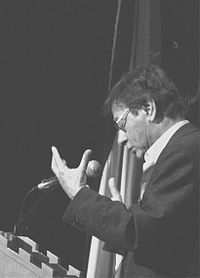
Mahmoud Darwish is the essential breath of the Palestinian people, the
eloquent witness of exile and belonging ... his is an utterly necessary voice,
unforgettable once discovered.—Naomi Shihab Nye
Mahmoud Darwish (1941-2008), the Poet Laureate of the Palestinians, was the preeminent Arab poet of his day.
Darwish was
a Palestinian Arab born in the
Galilean village of Barweh, which was razed to the ground
by Israelis during the Nakba ("Catastrophe") of 1948, along
with hundreds of other Palestinian villages. Like hundreds
of thousands of Palestinians, Darwish became an exile, along with his
family, because his ancestral village had been destroyed. The title of his
first book, Wingless Sparrows, speaks volumes. It was published when he
was nineteen. And yet Darwish rejected anti-Semitism, saying:
The accusation is that I hate Jews. It's not comfortable that they show me
as a devil and an enemy of Israel. I am not a lover of Israel, of course. I have
no reason to be. But I don't hate Jews.
As a young man, Darwish faced house
arrest and imprisonment because of his political activism. He left Palestine in 1971 to study
briefly at the University of Moscow, after which he worked for a newspaper in Cairo,
then in
Beirut as an editor of Palestinian Issues. When he joined the PLO in
1973, he was banned from reentering Palestine. Still, he recognized the humanity
of the Jews; some were his oppressors, others his lovers:
I will continue to humanise even the enemy ... The first teacher who
taught me Hebrew was a Jew. The first love affair in my life was with a Jewish
girl. The first judge who sent me to prison was a Jewish woman. So from the
beginning, I didn't see Jews as devils or angels, but as human beings.
For explanations of how he translates and why he calls his results "loose
translations" and "interpretations" please click here:
Michael R. Burch Translation
Methods and Credits to Other Translators
Palestine
by Mahmoud Darwish
loose translation/interpretation by
Michael R. Burch
This land gives us
all
that makes life worthwhile:
April's blushing advances;
the aroma of bread baking at dawn;
a woman haranguing men;
the poetry of Aeschylus;
love's trembling beginnings,
a kiss on a moss-covered boulder;
mothers who dance to the flute's sighs;
and the invaders' fear of memories.
This land gives us
all that makes life worthwhile:
September's rustling end;
a woman leaving forty behind, still full of grace,
still blossoming;
sunlight illuminating prison cells;
clouds taking on the shapes of unusual creatures;
the people's applause for those who smile at their erasure,
mocking their assassins;
and the tyrant's fear of songs.
This land gives us
all that makes life worthwhile:
Lady Earth, mother of all beginnings and endings!
In the past she was called Palestine
and tomorrow she will still be called Palestine.
My Lady, because you are my Lady, I deserve life!
Identity Card
by Mahmoud Darwish
loose translation/interpretation by Michael R. Burch
Record!
I am an Arab!
And my identity card is number fifty thousand.
I have eight children;
the ninth arrives this autumn.
Will you be furious?
Record!
I am an Arab!
Employed at the quarry,
I have eight children.
I provide them with bread,
clothes and books
from the bare rocks.
I do not supplicate charity at your gates,
nor do I demean myself at your chambers' doors.
Will you be furious?
Record!
I am an Arab!
I have a name without a title.
I am
patient in a country
where people are easily enraged.
My roots
were established long before the onset of time,
before the unfolding of the flora and fauna,
before the pines and the olive trees,
before the first grass grew.
My father descended from plowmen,
not from the privileged classes.
My grandfather was a lowly farmer
neither well-bred, nor well-born!
Still, they taught me the pride of the sun
before teaching me how to read;
now my house is a watchman's hut
made of branches and cane.
Are you satisfied with my status?
I have a name, but no title!
Record!
I am an Arab!
You have stolen my ancestors' orchards
and the land I cultivated
along with my children.
You left us nothing
but these bare rocks.
Now will the State claim them also
as it has been declared?
Therefore!
Record on the first page:
I do not hate people
nor do I encroach,
but if I become hungry
I will feast on the usurper's flesh!
Beware!
Beware my hunger
and my anger!
NOTE: Darwish was married twice, but had no children. In the poem above, he is
apparently speaking for his people, not for himself personally.
Excerpt from “Speech of the Red Indian”
by Mahmoud Darwish
loose translation/interpretation by Michael R. Burch
Let's give the earth sufficient time to recite
the whole truth ...
The whole truth about us.
The whole truth about you.
In tombs you build
the dead lie sleeping.
Over bridges you erect
file
the newly slain.
There are spirits who light up the night like fireflies.
There are spirits who come at dawn to sip tea with you,
as peaceful as the day your
guns mowed them down.
O, you who are guests in our land,
please
leave a few chairs empty
for your hosts to sit and ponder
the conditions for peace
in your treaty with the dead.
Passport
by Mahmoud Darwish
loose translation/interpretation by
Michael R. Burch
They left me unrecognizable in the shadows
that bled all colors from this passport.
To them, my wounds were novelties—
curious photos for tourists to collect.
They failed to recognize me. No, don't leave
the palm of my hand bereft of sun
when all the trees recognize me
and every song of the rain honors me.
Don't set a wan moon over me!
All the birds that flocked to my welcoming wave
as far as the distant airport gates,
all the wheatfields,
all the prisons,
all the albescent tombstones,
all the barbwired boundaries,
all the fluttering handkerchiefs,
all the eyes—
they all accompanied me.
But they were stricken from my passport
shredding my identity!
How was I stripped of my name and identity
on soil I tended with my own hands?
Today, Job's lamentations
re-filled the heavens:
Don't make an example of me, not again!
Prophets! Gentlemen!—
Don't require the trees to name themselves!
Don't ask the valleys who mothered them!
My forehead glistens with lancing light.
From my hand the riverwater springs.
My identity can be found in my people's hearts,
so invalidate this passport!
My Mother
by Mahmoud Darwish
loose translation/interpretation by
Michael R. Burch
How I long for my mother’s fresh-baked bread,
for a steaming cup of her
coffee,
but mostly ...
for the merest brush of her breath.
Childhood memories well within me...
Day after day,
I must be worthy of my life
and her memory.
And so I must cherish life
because otherwise
my mother's tears would
disown me.
Will the hour of my death
be worthy of her tears?
And if I return one day,
take me for your eyelashes’ shawl,
cover my
bones with the grass blessed by your immaculate footsteps,
entwine us
together with a lock of your hair,
fasten us together with a thread from
the hem of your dress.
Make us secure, never again to be parted.
And if I become immortal,
become a God,
it is only to touch your
heart’s innermost depths.
If I return
use me as kindling to feed your fire,
as the clothesline
strung across your patio,
for without your blessing
I am too weak to
stand.
I grow old ...
Return my childhood star guides
so that I, along with the vagabond
swallows,
can chart the path
back to your welcoming nest.
Excerpts from "The Dice Player"
by Mahmoud Darwish
loose translation/interpretation by
Michael R. Burch
Who am I to say
the things I say to you?
I am not a stone
burnished to illumination by water ...
Nor am I a reed
riddled by the wind
into a flute ...
No, I'm a dice player:
I win sometimes
and I lose sometimes,
just like you ...
or perhaps a bit less.
I was born beside the water well with the three lonely trees like nuns:
born without any hoopla or a midwife.
I was given my unplanned name by chance,
assigned to my family by chance,
and by chance inherited their features, attributes, habits and illnesses.
First, arterial plaque and hypertension;
second, shyness when addressing my elders;
third, the hope of curing the flu with cups of hot chamomile;
fourth, laziness in describing gazelles and larks;
fifth, lethargy dark winter nights;
sixth, the lack of a singing voice.
I had no hand in my own being;
it was mere coincidence that I popped out male;
mere coincidence that I saw the pale lemon-like moon illuminating sleepless
girls
and did not unleash the mole hidden in my private parts.
I might not have existed
had my father not married my mother
by chance.
Or I might have been like my sister
who screamed then died,
only alive an hour
and never knowing who gave her birth.
Or like the doves’ eggs
smashed before her chicks hatched.
Was it mere coincidence
that I was the one left alive in a traffic accident
because I didn’t board the bus ...
because I’d forgotten about life and its routines
while
reading the night before
a love story in which I became first the author,
then the lover, then the beloved and love’s martyr ...
then overslept and avoided the accident!
I also played no role in surviving the sea,
because I was a reckless boy,
allured by the magnetic water
calling: Come to me!
No, I only survived the sea
because a human gull rescued me
when he saw the waves pulling me under and paralyzing my hands!
Who am I to say
the things I say to you
outside the church door?
I'm nothing but a dice throw,
a toss between predator and prey.
In my moonlit awareness
I witnessed the massacre
and survived by sheer chance:
I was too small for the enemy to target,
barely bigger than the bee
flitting among the fence’s flowers.
Then I feared for my father and family;
I feared for our time as fragile as glass;
I feared for my pet cat and rabbit;
I feared for a magical moon looming high over the mosque’s minarets;
I feared for our vines’ grapes
dangling like a dog’s udders ...
Then fear walked beside me and I walked with it,
barefoot, forgetting my fragile dreams of what I had wanted for tomorrow
because there was no time for tomorrow.
I was lucky the wolves
departed by chance,
or else escaped from the army.
I also played no role in my own life,
except when Life taught me her recitations.
Are there any more?, I wondered,
then lit my lamps and tried to amend them ...
I might not have been a swallow
had the wind ordained it otherwise ...
The wind is the traveler's fate: his fortune or misfortune.
I flew north, east, west ...
but the south was too harsh, too rebellious for me
because the south is my country.
I became a swallow’s metaphor,
hovering over my life’s debris
from spring to autumn,
baptizing my feathers in the cloud-like lake
then offering my salaams to the undying Nazarene:
undying because God’s spirit lives within him
and God is the prophet’s luck ...
While it is my good fortune to be the Godhead’s neighbor ...
Just as it is my bad fortune the cross
remains our future’s eternal ladder!
Who am I to say
the things I say to you?
Who am I?
I might have not been inspired
because inspiration is the lonely soul’s compensation
and the poem is his dice throw
on an unlit board
that may or may not glow ...
Words fall ...
as feathers fall to earth:
I did not plan this poem.
I only obeyed its rhythm’s demands.
Who am I to say
the things I say to you?
It might not have been me.
I might not have been here to write it.
My plane might have crashed one morning
while I slept till noon
then arrived at the airport too late
to visit Damascus and Cairo,
the Louvre, and other enchanting cities.
Had I been a slow walker, a rifle might have severed my shadow from its
cedar.
Had I been a fast walker, I might have disintegrated and vanished like a
fleeting whim.
Had I dreamt too much, I might have lost my memories of reality.
I am fortunate to sleep alone
listening to my body's complaints
with my talent for detecting pain,
so that I call the physician ten minutes before death:
dodging death by a mere ten minutes,
continuing life by chance,
disappointing the Void.
But who am I to disappoint the Void?
Who am I?
Who?
***
For Yael Lerer, Darwish is "like a mirror showing Israelis the painful reality
[of the occupation]." Lerer said, "We wanted Mahmoud Darwish to be the nice Arab
guy, but he reminds us that he is a Palestinian — one who has a well and a fig
tree and the house of his grandfather. And as much as Israel would have liked to
eliminate his legacy, he cannot be erased from memory. He is an Israeli citizen
by virtue of birth — hence the deep-rooted symbolism. He confronts us with the
Palestinians, Palestinian nationality and the Nakba in a way that cannot be
ignored. For us Israelis, it is intolerable."
***
Mahmoud Darwish was only six years old when Barweh/Berwah, the Palestinian
village of his nativity, was completely obliterated, destroyed by an encroaching
Israeli army, and he was forced to flee with his mother to a refugee camp in
Lebanon. Later, they returned illegally to the
village of Dayr-al-Asad.
***
Asked for something in celebration of the second anniversary of the State of
Israel, an eight-year old Darwish wrote: "You can play in the sun as you please,
and have your toys, but I cannot. You have a house, while I have none. You have
celebrations, while I have none. Why can't we play together?" The following day,
Darwish was summoned by the Israeli military governor who ridiculed his Arabic
language and threatened both him and his family. The young Darwish left his
office shaken, unable to understand why a poem had so upset the military
governor. In ensuing years, he was imprisoned several times and frequently
harassed by the Israeli apparatus, always for the same crime: reading poetry or
traveling in his own country without a permit.
***
Darwish lived in exile for more than twenty years, primarily in Beirut and Paris, until
he was allowed to settle in Ramallah in 1996. But even then he spoke as if his
exile continued, since he did not consider the West Bank his personal
"homeland."
A central theme in Darwish's poetry is watan, or homeland.
His poetry earned international acclamation and has been translated into 35
languages. He also founded the prestigious literary
review Al Karmel. In 1998 he published Sareer el
Ghariba (Bed of the Stranger), his first collection of love poems. In 2000 he
published Jidariyya (Mural) a book-length poem about his near-death
experience of 1997. By speaking eloquently for himself and his fellow
Palestinians, Darwish made it impossible for history to ignore them:
We have triumphed over the plan to expel us from history.
Darwish's influences include the Arab poets Abd al-Wahhab al-Bayati and Badr
Shakir al-Sayyab, along with Rimbaud and Ginsberg. He also admired the Hebrew poet Yehuda
Amichai, but described his poetry as a "challenge to me, because we write about
the same place. He wants to use the landscape and history for his own benefit,
based on my destroyed identity. So we have a competition: who is the owner of
the language of this land? Who loves it more? Who writes it better?" Darwish
became a voice of compassion and reason, speaking for young men driven to
martyrdom by despair:
We should not justify suicide bombers. We are against the suicide bombers,
but we must understand what drives these young people to such actions. They want
to liberate themselves from such a dark life. It is not ideological, it is
despair ...
We have to understand—not justify—what gives rise to this
tragedy. It's not because they're looking for beautiful virgins in heaven, as Orientalists portray it. Palestinian people are in love with life. If we give
them hope—a political solution—they'll stop killing themselves.
In March 2000, Israeli education minister Yossi Sarid proposed that two of
Darwish's poems be taught in Israeli high schools. Prime Minister Ehud Barak
rejected the proposal on the grounds that Israel was "not ready." This
sounds suspiciously like white supremacists saying their children are "not
ready" for the words of Dr. Martin Luther King Jr., or Langston Hughes. No doubt the incident had more to do with Israeli politics
and racism than
poetry. With the death of Darwish the debate about including his poetry in the
Israeli school curriculum has been re-opened.
Mahmoud Darwish Quotations and Epigrams
If the olive trees knew the hands that planted them, their oil would become
tears.—Mahmoud Darwish
My love, I fear the silence of your hands.―Mahmoud Darwish
The days have taught you not to trust happiness because it hurts when it
deceives.— Mahmoud Darwish
Be worthy of the aroma of bread and summer flowers, for your mother’s clay oven
is still lit, each loaf a warm greeting.—Mahmoud Darwish
I have learned and dismantled all the words in order to construct a single word:
Home.—Mahmoud Darwish
Be strong as a bull when you're angry,
weak as an almond blossom when you love.—Mahmoud Darwish
Sunset is here, tormenting the stranger with its beauty.—Mahmoud Darwish
Slow down, O horse saddled with seasons!—Mahmoud Darwish
Besiege your siege … there is no other way.—Mahmoud Darwish
We Palestinians suffer from an incurable disease called "hope." Hope for
liberation and independence. Hope for a normal life where we shall be neither
heroes nor victims. Hope to see our children go to school without danger. Hope
for a pregnant woman to give birth to a living baby, in a hospital, and not to a
dead child in front of a military control post. Hope that our poets will see the
beauty of the colour red in roses, rather than in blood. Hope that this land
will recover its original name: "land of hope and peace." Thank you for carrying
with us this banner of hope.—Mahmoud Darwish
A moral is like a bullet in its poet's heart,
a deadly wisdom.
Be strong as a bull when you’re angry,
weak as an almond blossom
when you love, and nothing, nothing
when you serenade yourself in a closed room ...
Don't think, when you melt in sorrow
like candle tears, of who will see you
or follow your intuition's light.
Think of yourself: is this all of myself?
The poem is always incomplete; the butterflies make it whole.
No advice in love. It's experience.
No advice in poetry. It's talent.
And last but not least, Salaam.
On the Bridge
On the bridge, near your life, I lived as a guitar player lived near his star.
Sing for me, she said, a hundred of your love songs and you will enter my life!
So he sang ninety-nine songs about love, then killed himself.
A Traveller
This road takes me; a horse guiding a horseman
A traveler like me cannot look back
I have walked far enough to know
where autumn begins:
there, behind the river,
the last pomegranates ripen
in an additional summer
and a beauty mark grows
in the seed of the apple
The road and I will sleep like partners
behind the river, beneath our shadows,
then rise at dawn and carry each other.
I will ask it: Why so fast?
Slow down, O horse saddled with seasons!
No matter how few our dreams
we will cross the desert and valleys
to reach the end at the beginning.
The beginning is behind us;
Before us, clouds bringing winter's tidings.
I have walked far enough to know
where winter starts:
there, over the hill
a gazelle looks for a fawn under the clouds.
A hunter points his rifle;
I will howl like a wolf
so the white gazelle can flee the fire
and the hunter is scared.
The road and I will sleep
there, next to a cave, over the hill,
then rise at dawn and carry each other
asking: What next? Where are you taking me?
I see the fog, but I don't see the road,
nor does it see me.
Have I arrived?
Or have I been separated from the road?
I asked myself, then said:
Now, from this distance,
a traveler like me
can look back!
Translated from the Arabic by Sinan Antoon.
The Prison Cell
It is possible…
It is possible at least sometimes…
It is possible especially now
To ride a horse
Inside a prison cell
And run away…
It is possible for prison walls
To disappear,
For the cell to become a distant land
Without frontiers:
What did you do with the walls?
I gave them back to the rocks.
And what did you do with the ceiling?
I turned it into a saddle.
And your chain?
I turned it into a pencil.
The prison guard got angry.
He put an end to my dialogue.
He said he didn’t care for poetry,
And bolted the door of my cell.
He came back to see me
In the morning,
He shouted at me:
Where did all this water come from?
I brought it from the Nile.
And the trees?
From the orchards of Damascus.
And the music?
From my heartbeat.
The prison guard got mad;
He put an end to my dialogue.
He said he didn't like my poetry,
And bolted the door of my cell.
But he returned in the evening:
Where did this moon come from?
From the nights of Baghdad.
And the wine?
From the vineyards of Algiers.
And this freedom?
From the chain you tied me with last night.
The prison guard grew so sad …
He begged me to give him back
His freedom.
Translated by Ben Bennani
Words
When my words were wheat
I was the earth.
When my words thundered
I was the storm.
When my words wore down rock
I was the river.
But when my words became honey
Flies devoured my lips.
Think of Others
As you prepare your breakfast – think of others.
Don't forget to feed the pigeons.
As you conduct your wars – think of others.
Don't forget those who want peace.
As you pay your water bill – think of others.
Think of those who only have clouds to drink from.
As you go home, your own home – think of others – don't forget those who live in
tents.
As you sleep and count the planets, think of others – there are people who have
no place to sleep.
As you liberate yourself with metaphors think of others – those who have lost
their right to speak.
And as you think of distant others – think of yourself and say, "I wish I
were a candle in the darkness."
NOTE: Eleanor Roosevelt said, "It is better to light a candle than to curse the
darkness."
I Have a Seat in the Abandoned Theater
I have a seat in the abandoned theater
in Beirut. I might forget, and I might recall
the final act without longing … not because of anything
other than that the play was not written
skillfully …
Chaos
as in the war days of those in despair, and an autobiography
of the spectators’ impulse. The actors were tearing up their scripts
and searching for the author among us, we the witnesses
sitting in our seats
I tell my neighbor the artist: Don’t draw your weapon,
and wait, unless you’re the author!
—No
Then he asks me: And you are you the author?
—No
So we sit scared. I say: Be a neutral
hero to escape from an obvious fate
He says: No hero dies revered in the second
scene. I will wait for the rest. Maybe I would
revise one of the acts. And maybe I would mend
what the iron has done to my brothers
So I say: It is you then?
He responds: You and I are two masked authors and two masked
witnesses
I say: How is this my concern? I’m a spectator
He says: No spectators at chasm’s door … and no
one is neutral here. And you must choose
your part in the end
So I say: I’m missing the beginning, what’s the beginning?”
Passport
They did not recognize me in the shadows
That suck away my color in this Passport
And to them my wound was an exhibit
For a tourist
Who loves to collect photographs
They did not recognize me,
Ah ... Don't leave
The palm of my hand without the sun
Because the trees recognize me
Don't leave me pale like the moon!
All the birds that followed my palm
To the door of the distant airport
All the wheatfields
All the prisons
All the white tombstones
All the barbed boundaries
All the waving handkerchiefs
All the eyes were with me,
But they dropped them from my passport
Stripped of my name and identity?
On soil I nourished with my own hands?
Today Job cried out
Filling the sky:
Don't make an example of me again!
Oh, gentlemen,
Prophets,
Don't ask the trees for their names
Don't ask the valleys who their mother is
From my forehead bursts the sward of light
And from my hand springs the water of the river
All the hearts of the people are my identity
So take away my passport!
Excerpts from "Under Siege"
translated by Marjolijn De Jager
Here on the slopes of hills, facing the dusk and the
cannon of time
Close to the gardens of broken shadows,
We do what prisoners do,
And what the jobless do:
We cultivate hope.
A country preparing for dawn. We grow less intelligent
For we closely watch the hour of victory:
No night in our night lit up by the shelling
Our enemies are watchful and light the light for us
In the darkness of cellars.
Here there is no "I".
Here Adam remembers the dust of his clay.
You who stand in the doorway, come in,
Drink Arabic coffee with us
And you will sense that you are men like us
You who stand in the doorways of houses
Come out of our morningtimes,
We shall feel reassured to be
Men like you!
When the planes disappear, the white, white doves
Fly off and wash the cheeks of heaven
With unbound wings taking radiance back again, taking
possession
Of the ether and of play. Higher, higher still, the
white, white doves
Fly off. Ah, if only the sky
Were real [a man passing between two bombs said to me].
Cypresses behind the soldiers, minarets protecting
The sky from collapse. Behind the hedge of steel
Soldiers piss—under the watchful eye of a tank—
And the autumnal day ends its golden wandering in
A street as wide as a church after Sunday mass . . .
[To a killer] If you had contemplated the victim’s face
And thought it through, you would have remembered your
mother in the
Gas chamber, you would have been freed from the reason
for the rifle
And you would have changed your mind: this is not the
way
to find one’s identity again.
The siege is a waiting period
Waiting on the tilted ladder in the middle of the storm.
Alone, we are alone as far down as the sediment
Were it not for the visits of the rainbows.
We have brothers behind this expanse.
Excellent brothers. They love us. They watch us and
weep.
Then, in secret, they tell each other:
"Ah! if this siege had been declared ... " They do not
finish their sentence:
"Don’t abandon us, don’t leave us."
Our losses: between two and eight martyrs each day.
And ten wounded.
And twenty homes.
And fifty olive trees ...
Added to this the structural flaw that
Will arrive at the poem, the play, and the unfinished
canvas.
Oh watchmen! Are you not weary
Of lying in wait for the light in our salt
And of the incandescence of the rose in our wound
Are you not weary, oh watchmen?
A little of this absolute and blue infinity
Would be enough
To lighten the burden of these times
And to cleanse the mire of this place.
In the state of siege, time becomes space
Transfixed in its eternity
In the state of siege, space becomes time
That has missed its yesterday and its tomorrow.
The martyr encircles me every time I live a new day
And questions me: Where were you? Take every word
You have given me back to the dictionaries
And relieve the sleepers from the echo’s buzz.
The martyr enlightens me: beyond the expanse
I did not look
For the virgins of immortality for I love life
On earth, amid fig trees and pines,
But I cannot reach it, and then, too, I took aim at it
With my last possession: the blood in the body of azure.
The siege will last in order to convince us we must
choose an enslavement that does no harm, in fullest liberty!
Resisting means assuring oneself of the heart’s health,
The health of the testicles and of your tenacious
disease:
The disease of hope.
Greetings to the one who shares with me an attention to
The drunkenness of light, the light of the butterfly, in
the
Blackness of this tunnel!
Greetings to the one who shares my glass with me
In the denseness of a night outflanking the two spaces:
Greetings to my apparition.
My friends are always preparing a farewell feast for me,
A soothing grave in the shade of oak trees
A marble epitaph of time
And always I anticipate them at the funeral:
Who then has died ... who?
Ahmad Al-Za’tar:
translated by Tania Nasir
For two hands, of stone and of thyme
I dedicate this song. For Ahmad, forgotten between two
butterflies
The clouds are gone and have left me homeless, and
The mountains have flung their mantles and concealed me
From the oozing old wound to the contours of the land
I descend, and
The year marked the separation of the sea from the
cities of ash, and
I was alone
Again alone
O alone? And Ahmad
Between two bullets was the exile of the sea
A camp grows and gives birth to fighters and to thyme
And an arm becomes strong in forgetfulness
Memory comes from trains that have left and
Platforms that are empty of welcome and of jasmine
In cars, in the landscape of the sea, in the intimate
nights of prison cells
In quick liaisons and in the search for truth was
The discovery of self
In every thing, Ahmad found his opposite
For twenty years he was asking
For twenty years he was wandering
For twenty years, and for moments only, his mother gave
him birth
In a vessel of banana leaves
And departed
He seeks an identity and is struck by the volcano
The clouds are gone and have left me homeless, and
The mountains have flung their mantles and concealed me
I am Ahmad the Arab, he said
I am the bullets, the oranges and the memory
Related Pages:
English Translations of Arabic/Palestinian Poets by Michael R. Burch
The HyperTexts