The HyperTexts
Leo Yankevich
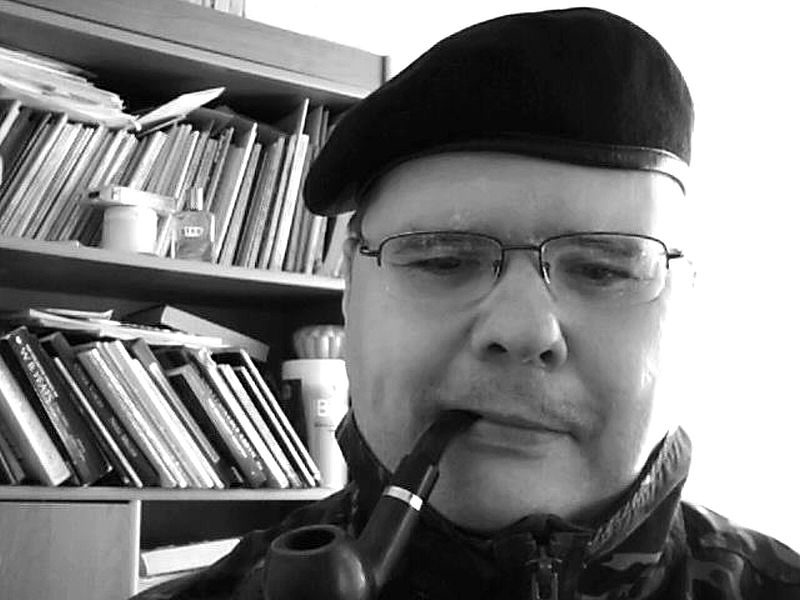
Leo Yankevich (1961-2018) was born in Sharon, Pennsylvania and also lived in
Gliwice, Poland. His poems
and translations appeared on both sides of the Atlantic in scores of
journals and anthologies.
To Love This Flesh
To love this flesh,
its rivers and valleys,
its fruits,
ripe or rotting.
To be conscious,
to understand a toad’s agony
or delight.
To finger the pricks of a bush,
lick the blood of the world
with a warm tongue,
and comprehend a crow’s hunger.
To breathe the spring air
full of laughing and weeping,
like a sow thistle
or lazy lizard.
To endure
without any sense of time—
to wake, sleep, live and die
under the same sun, moon and stars,
eternal as a weed.
To love the rhythm of this being,
like sperm swimming upstream
in one you love,
never questioning
or doubting the gods.
Originally published in the
Windsor Review, Spring 1997
Swallows
It was once thought that swallows
wintered on the moon,
or morphed into field mice
beneath the autumn swoon
of clouds, or slept beneath
wavelets on the floor
of shadowy ponds and lakes
until the sudden lure
of springtime roused them from
the kingdom of the dead.
Early Christians believed
they swirled around the head
of Jesus, giving comfort
as he bore his heavy cross,
or they were harbingers
of heaven after loss.
Today I look above
the eaves as autumn blooms
in the deep well of the sky,
my house’s empty rooms
echoing only wind,
the memory of their song.
They have flown south for winter,
which here is dark and long.
Originally published in The London Magazine
Cracow at Dawn
1.
Beneath the clouds
in the corner of my faithless eyes
seven magpies have stolen away
the morning star.
Glory, glory! The rising sun
crowns the cathedral
in this town stopped still
in awe of blazing malachite.
Reborn are the winged shades
in the rookeries
to haunt dear heaven
with their pained pterodactyl cries.
Reborn are the grey pigeons
on the old market square
quarrelling with their enemies,
the dirty sparrows.
2.
Sancho, my old friend,
is it time to embrace more love,
to sit with the ageing harlots
mid the pews of Saint Anne,
though the heft on our backs
is heavier than the rood,
than the silent sermons
of characters stained in glass?
I’ve two coins in my pocket
as poisonous as lead,
enough for a flask of rum
or Hungarian wine.
Let’s park our gaunt donkey
beneath the Baroque clouds,
then limp back to the inn
for as long as there is time...
From The Unfinished Crusade, 2000
Don Quixote
Suddenly, I am astride a donkey
with Sancho Panza. As usual, my head
is in the clouds. And I am stubborn, stupid
as always. Please forgive my making so
much noise when I send dreams to tap against
your window-pane. I’ve come prepared this time.
When you say that you never loved me,
I kiss your feet. When you say that you fear me,
I kiss your knees, your pale and precious knees.
By this time you expect me to have brought
a single rose, reflecting northern skies.
But no, I’ve brought the best Swiss Chocolate,
rife with exotic fruit and hazelnuts.
You turn your face away, embarrassed to
have been acquainted with my person. So
I settle for the shadow of your neck.
Then I move down and kiss your noble arms,
which tower like two queens above a servant.
I kiss your belly, and I kiss your hips.
Then, mercifully, you bend your high brow,
allowing me to taste your angry lips.
And before I understand that this is dream,
I kneel to do what only I do best
in the valley where undying love was born.
Grey Oak
I turn the stony corner
where the graveyard begins.
Today I am a mourner.
Crows circle garbage bins
beyond the iron gate;
two magpies poach hairpins;
a sparrow comes too late,
then flees the treasure chest.
I move on, and I wait.
It is here she will rest
beneath the silt and sand,
her headstone facing west.
And still, I can’t withstand
the power of my grief.
A tree can’t understand
the falling of its leaf.
Originally published in The Chimaera, Autumn 2007
Visiting my Dead Grandmother’s Cottage
Lithuania, 1966
Visiting her cottage I remember ripe ears of corn,
drawers full of bent knives, mouldy crusts of pumpernickel bread,
high shelves of hoary berry jams, curtains threadbare and torn,
and an axe brighter than the cracks in the wall near a bed
bereft of her broken body for three months and one week.
Through a veranda window I recall a thistled yard,
and still hear portents issuing from a fat raven’s beak.
A bucket of stagnant water mirrors the cloudy lard
she must have fried eggs and coffee grinds in every morning.
And by a potato patch I see a wild war-like pig,
with its head full of demons, palavering and snorting.
And I shout something and ineptly cast a birch’s twig
while my father speaks to an old peasant in a strange tongue
about pagan deities carved on trees when he was young.
Originally published in
Cedar Hill Review, Summer 1998
An Autumn Evening
The brown village. A darkness often treads
Along the walls that stand in autumn. Mock-
Shapes: man as well as woman, dead now, walk
In the cold parlours to prepare their beds.
Here young boys play. A heavy shadow spreads
Over brown dung. Servant women walk
Through the moist blue, and sometimes their eyes mock
It, longing, as bells toll above their heads.
An inn leans for the down and lonely there.
Patiently it waits beneath dark arches,
Moved by clouds of gold tobacco smoke,
Yet always black and near. A stranger soaked
In booze stands in the shade of older arches
After the wild birds take to the air.
After the German of Georg Trakl (1887-1914)
Originally published in The Grodek Review
Manichaeans
Indistinguishable from the dark, a rat
crawls through debris. Above, aloof and pale,
the moon shines on all the heavens and hells
of the city, shines on the good and bad
alike, more intimately than the sun.
Two pounds of dung sit in our bodies' bowels,
waiting to be released. The sweat on our brows,
the warm saliva on our twisted tongues
shall be purified in estuaries,
merge with the thoughts of seals and otters.
Our sperm and eggs become sons and daughters,
but what of the husks of all our worries,
of our falling lungs and aching gallstones,
of the scabs from our wounds, of our bad blood?
We prefer abstractions, words like: love
and redemption; hate the meat on our bones,
gag at the worms that cleanse us, yield to blight.
We are purists at heart. But, if only
it would stop pounding, if only we could be
fleshless, if only we could be like light.
Published in The Tennessee Quarterly and American Jones
Sarajevo Sonnet
Within the four walls of this sonnet's form
(while outside spring rain gathers in a pail),
there is at least one happy story to tell,
something lovely brought on by a storm.
Fresh thrifts have sprouted, and a fat worm
lazily crawls out of someone's cracked bell,
crawls out of the centre of someone's hell,
out of a skull atop a uniform,
while not too far away, in someone's rib cage,
in a sunlit temple without a steeple,
two tiny beetles in the place of people,
(their love too pure to ever turn into rage,
too tried and true to ever fail or falter),—
take their vows before a priestless altar.
The Idiot
Whenever I sit with the village idiot,
it's always with genuine reverence and a bit
of suspicion. Usually we just stare at the rooks,
and he sips my beer without asking, then looks
deranged as if to say he's sorry. He knows enough
about me to know I like diamonds in the rough.
And, strangely, he and I always notice the same things:
hieroglyphs in the snow, tiny holes in our fillings.
When he's not around, my wife says he's a blackguard
and a parasite, a charlatan, and a drunkard;
and I try to explain that he's just the village idiot,
and that once in a while it's necessary to sit
with him and share a pint. Later, when she falls asleep,
out of pity and out of love, I allow him to sneak
into her bed and fondle her thin white thighs,
and, if she doesn't protest, to spend the night.
Published in Blue Unicorn, The Windsor Review, Staple, American Jones
and Edge City Review
The Bridge
Petalled with rust beneath a sky of slag,
the bridge expands into infinite haze.
Below it, the meaning of all my days:
thistled lots, brambled voids where time lags
oblivious to the maimed and forgotten.
My eyes sink in their vision: flocks of crows,
torrents of black water, flapping shadows
over tawny fields in endless autumn...
On the bridge, wasting bad time, I'd shed tears,
but have no regrets, only old ironies,
black insect prayers that cannot break my fall.
I'd appeal my sentence, seek solace from seers,
but the child in me knows: beyond destinies
light is everywhere, and redeems us all.
Published in The Eclectic Muse and The Susquehanna
Quarterly
Philosopher
for Czeslaw Milosz
For a moment as brief and long as eternity
he sees what the blind man sees in the blink of an eye:
a sun that never sets, forms wrought from gold, purity
before it falls or is restored to grace, the grey sky
beheld from the far side of dawn. As if in a dream,
he walks amid universals, essences of names,
and marvels at the beauty of birds, the snowflakes teem-
ing through the ethereal windows of souls, and the flames
of dear dead Heraclitus—now at last understood.
For as long as a moment is he sees the Father
embrace the Son—forever since the onset of time.
He has climbed out of the phantasmical cave for good,
martyred by what rills in the blood, no longer bothered
by those in fetters—yet part of the natural crime.
Published in The New Formalist
The HyperTexts