The HyperTexts
Harvey Stanbrough
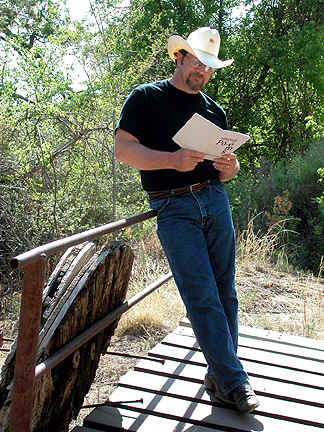
Harvey Stanbrough is an American poet who was "born in New Mexico, seasoned in
Texas, and baked in Arizona." He spent 21 years in the US Marine Corps before attending college. He is
a past editor of The Raintown Review, and a poet,
writer and freelance editor who frequently teaches at writers' conferences around the nation. His works have been nominated for the
National Book Award, the Pulitzer Prize, the Frankfurt Award, the Foreword
Magazine Engraver's Award, the Pushcart Prize, and the BEA Book of the Year
Award. His books include Punctuation for
Writers (Central Ave Press, 2003) and Writing Realistic Dialogue
(Central Ave Press, 2004). His poetry
collections include On Love & War &
Other Fallacies (1998), Residua (1999), Partners in Rhyme (with Bill Middleton, 2000), Lessons for a Barren
Population (2001), Intimations of the Shapes of Things (2003) and Beyond the Masks
(2005).
On Compassion Under Fire
Three feet away, I saw the death mask settle
on his face — on what was left — and my
shoulders slumped, my head jerked right, a lump
the size of god settling in my throat
and chest, my gaze frantic, racing, racing
across the paddy to the taller grass,
to the tree line, to the million trees
and leaves from which the shot had come. Nothing.
I glanced again, rose slowly, slowly, looking
at the field and at the mask and back
and moved, the lump still resident but choking
less, across the intervening yard
to settle, like the mask, around my friend,
to cradle him and whisper It’s all right
and try to keep him calm and help him die
quietly: Please don’t give me away.
From Beyond the Masks (Central Ave Press, 2005)
God?
If you are there, bequeath a gentle snow
to blanket grass and hills and trees and us,
the weary ones who really need to know
if you are there. Bequeath a gentle snow,
and let it drift to comfort us below
these endless marble rows, victorious.
If you are there, bequeath a gentle snow
to blanket grass and hills and trees and us.
From Beyond the Masks (Central Ave Press, 2005)
On a Clear Night, the Moon
turns a lighted face to earth and smiles,
slipping quietly across the night,
snuffing stars and twinkling others on,
content to momentarily eclipse
those distant, greater lights, as if it paused
and tipped a hat, then moved along again,
to the urgent business of the night,
lighting the evening for the lovers below
and mysteries on mysteries reveal
themselves beneath the glowing face: a girl
sighs yes, a boy fumbles his way to bliss;
two others, holding hands, vow forever,
certain the odds were meant for lesser hearts;
two others speak in halting tones, dividing
children, things, amazed at the relief.
We spin, the stars adjust, the moon goes down.
Lullaby
This will kiss you softly on the cheek,
caress your hair, as if a gentle breeze
had lightly brushed its lips across your own.
This will practice sighing as it longs
to hold you near its core, to calm your fear
and push away the darkness. This will bring
water, soothe that tickle in your throat,
calm the thunderstorms that rage outside,
smoothe the sheets and let you rest awhile.
This will lullaby you tenderly,
wake you with a gentle song, and hush
the morning sun to quiet overtones.
This will practice smiling on your lips
and in your eyes, will slip a perfect day
into your calendar. This will rise
to stretch with you each morning, lead you in
to dreams then draw you back to face the world;
yes, this will touch you softly on the cheek.
Beyond the Masks
from and for Gerald Whitefoot St. Clair, just a man
"There used to be gods in everything
and now they've gone...."
— Howard Nemerov in "The Companions"
I
Before we lost the gods or sight of them
and let them fade away beyond the masks
that separate their world (the world) and us,
we knew there was a line between the sea
and the coral resting there; between
the stream and the rocks that line its bed;
between the liquid and the bowl; between
the fruit and the seed; between the void
and the atmosphere; and between
the music and the flute. We heard the gods
in creaking branches, in the touch of rain,
and consequential gatherings of birds,
their flappings tuned perfection to the ear
their song an invocation in the trees,
whence they would rise as one to form a sign
then turn this way and that, as if on signal,
before they settled to the trees again
to talk excitedly among themselves
about the gods they'd called, whether those gods
would visit them and us ever again.
II
I walk with you to look beyond the masks,
to see us as we were before The Fall,
before we lost the ears to hear the gods
in everything, before we lost the eyes
to see the gods, the sense to know their worth.
I walk with you to taste the sweet mesquite,
the silence layering the land, the music
trickling down the Rio Penasco;
I walk with you to smell the dusty sage
just before it rains, the joyful sage
just afterward, and to know a god
made the difference; and I walk with you
to learn to count the threads in mescal,
listen for a blessing on the wind,
and watch a single grain of dust settle
gently on a yellowed blade of grass.
III
Before we slipped beyond the masks, the gods
guided us, beheld our gangly stride,
our awkward gait as if we hadn't grown
into our feet. They watched us flail about,
feigning all the while a certain status,
lifting ourselves even over them
until we couldn't hear them when they spoke
and so they fell silent. But now I walk
with you to hear them creak in juniper,
see them hunched beside the craggy rocks,
and know that we and they are of one heart,
the rhythmic heartbeat of the Law of One
as if they'd never gone, as if we'd never
turned our backs on them in our headlong
rush to leave ourselves behind, our rush
to be who we are not. But now we know:
We listen to the earth and to the gods.
We hear them and we see them peeking at us.
They slip across the window pane at night,
they whisper softly just outside the door,
and sometimes, when I've been well behaved,
they rustle dust in moonbeams on my desk.
From Beyond the Masks (Central Ave Press, 2005)
Resembling Uranium
Resembling uranium, she glows,
enticing in her natural element
but dangerous as well. She'll melt your eyes
and leave you quivering in a foolish stance,
for you had thought your body fit for hers.
Wisdom comes to some, who realize
some radiant things are better left observed.
They learn too late, their hands and senses burned,
that, like uranium, she was never meant
to be discovered, captured, or confined.
From Beyond the Masks (Central Ave Press, 2005)
Doctorow as Mentor
for Lynn
We could begin as Doctorow began,
when writing Ragtime: write the walls and write
the ceiling and the floor of that one room
then write the daisies—write how Lynn never
stenciled them onto the orange floor
for fear the bastard landlord might evict
them both—then we could skew the pen and write
the piles of dirty dishes write the laundry
write the kitchen and the smoky vent
and books and records shoring up our stern
voyage as we wrote with our heads high
the sixties’ world of parties wine and grass
the closets and the bathroom and the stench
that crept along the hall. We could expand
into the hallway write the other tenants’
hairy bellies unshaved faces eyes
no longer dreaming yesterdays or love
and we could write the city, write the cops’
fists batons and gas and protest signs
could write the streets the burning of LA
could write a kid like us there on those streets
in uniform a Guardsman with a gun
and how his gun would tremble if he tried
to shoot and how his pen would tremble too
if he should feel a need to write the truth.
Then we could write the state and write the nation
forests valleys mountains rivers trees
and write the congress write the president
and we could write our friends away from home
not write to them but write them as they were
the jungle canopy the mud the rain
the stench of fear the bugs the blood and we
could write the oceans of the world could write
the continents the moon the solar system
the universe we know the universe
we’ve never seen but know it must be there—
as if our writing ever made a difference
or saved the smallest part of anything.
We could begin as Doctorow began
O, we could write, and in than, say the world.
The Leading Man Thinks to Strike
She melts into his waiting arms;
He smoothes her silken hair.
He hungers for her tender charms:
The serpent’s in its lair.
His breath is soft upon her ear,
His hands upon her skin.
She knows, she knows, there’s naught to fear:
The serpent’s creeping in.
His tongue is quick and soft and sure,
Romance a practiced art.
He whispers she is Love writ pure:
The serpent nears the heart.
Her lips are warm and soft and wet;
She yields as she will do
And drained, he sleeps; she bares her fangs:
The serpent hungers too.
Denoumént
“Not knowing where to begin, that was the beginning.”
Howard Nemerov in Journal of the Fictive Life
Not knowing where to start is the beginning;
not knowing where to go, continuance;
the end, a figment of imagination,
a product of the finite mind, a fluke
deduced by the reader, who sinisterly suspects
all things must end despite the lack of proof.
Consent?
“What use to learn the lessons taught by time
if a star at any time might tell us: Now.”
Howard Nemerov in “The Consent”
If a star at anytime might tell us Now
as stars have done the leaves and have done you,
a great among the century’s great bards,
what use indeed have we to learn the lessons
taught by time—except that we have learned,
from Yeats and Frost and You, of Poetry,
at once a valued lesson learned and guarded
well against the stars and their morés.
Nothing has been for nothing, Laureate:
your students cannot wander in a meadow
without wond‘ring after amateurs;
cannot view a man and dog walking
without a sense of partnership; a mud
turtle without the bending grass; a jet
descending over the Lady in the Harbor
without a sense of you there in her torch.
We try today, as you had done, to notice
the awesome things that matter least to some
and most to poets, and record the cycles
of those stars in their reversed abyss;
and we wonder at the easy pace
with which we all step out toward that Now,
and hope, in some perversion of the truth,
they have no certain target specified.
Moon Over Arlington
As silv’ry rays intrude on silent lanes
at Arlington, the stones define the cold
and endless rows of those who died in vain.
Here lie the bold, in death with nothing gained,
a shrouded consequence of all we sold
as silv’ry rays intrude on silent lanes.
Here lie the gentle ones, those whom the strain
of war so quickly turned from young to old
and endless rows of those who died in vain.
Here lie the ones who fled, their souls in twain,
their nerves in knots, afraid and uncontrolled
as silv’ry rays intrude on silent lanes.
Here lie the strong, the ones who fought the pain
in silence, family values to uphold
and endless rows of those who died in vain.
Eternally together lie the slain,
our sons and daughters, colorless and cold,
as silv’ry rays intrude on silent lanes
and endless rows of those who died in vain.
From Beyond the Masks (Central Ave Press, 2005)
To a War Protester
for J. Lynn Cutts
How odd that she should ask me for a poem
that might explain there were no enemies,
no heroes, and no villains in that war,
that underneath the uniforms were humans,
and no one on our side or on the other
knew hatred, spite, or righteousness — just fear.
And how should I begin? Should I say Faith
in god, country, and corps were stripped away
when Digger’s face exploded next to mine?
Should I describe the hot, incessant rain,
the mud that splattered up from falling men,
the M-16s that jammed with every round?
Can I, in adequate terms, hope to describe
the agony of pleading, bulging eyes
that knew my lies were nothing more? Can I
relate the sound of arms, legs, stomachs,
ripping off or open, and the feel
of hot, moist bits stinging my face?
Can I communicate the stench of fear,
the silence that precedes a concrete hell,
(one you can touch and one that touches you,
not the one the preacher talks about)
the taste of sweat that runs into your mouth,
the pus that coats your blistered, rotting feet?
I think not, but the hardest to convey
is that ride home, that flight out of Japan:
the leggy flight attendants (their sad eyes),
the absence of all fear, and then relief,
the tires screeching down, a jolt or two,
a hurried reluctance in mouthing last goodbyes.
The eyes negate the need for words, and then
the ramp! — America! — the scent of home,
the dream, the picket fence, the house, the job,
the girl, the kids, the moms, the dads, the dogs,
the cats, the bikes, the cars, and hair — but no:
someone throws blood and calls me Murderer.
How odd that she should ask me for a poem
that might explain there were no enemies,
no heroes, and no villains in that place,
that underneath the uniforms were humans,
just like those who carried protest signs.
How odd she didn’t know that on her own.
From Beyond the Masks (Central Ave Press, 2005)
The HyperTexts