The HyperTexts
Greg Alan Brownderville
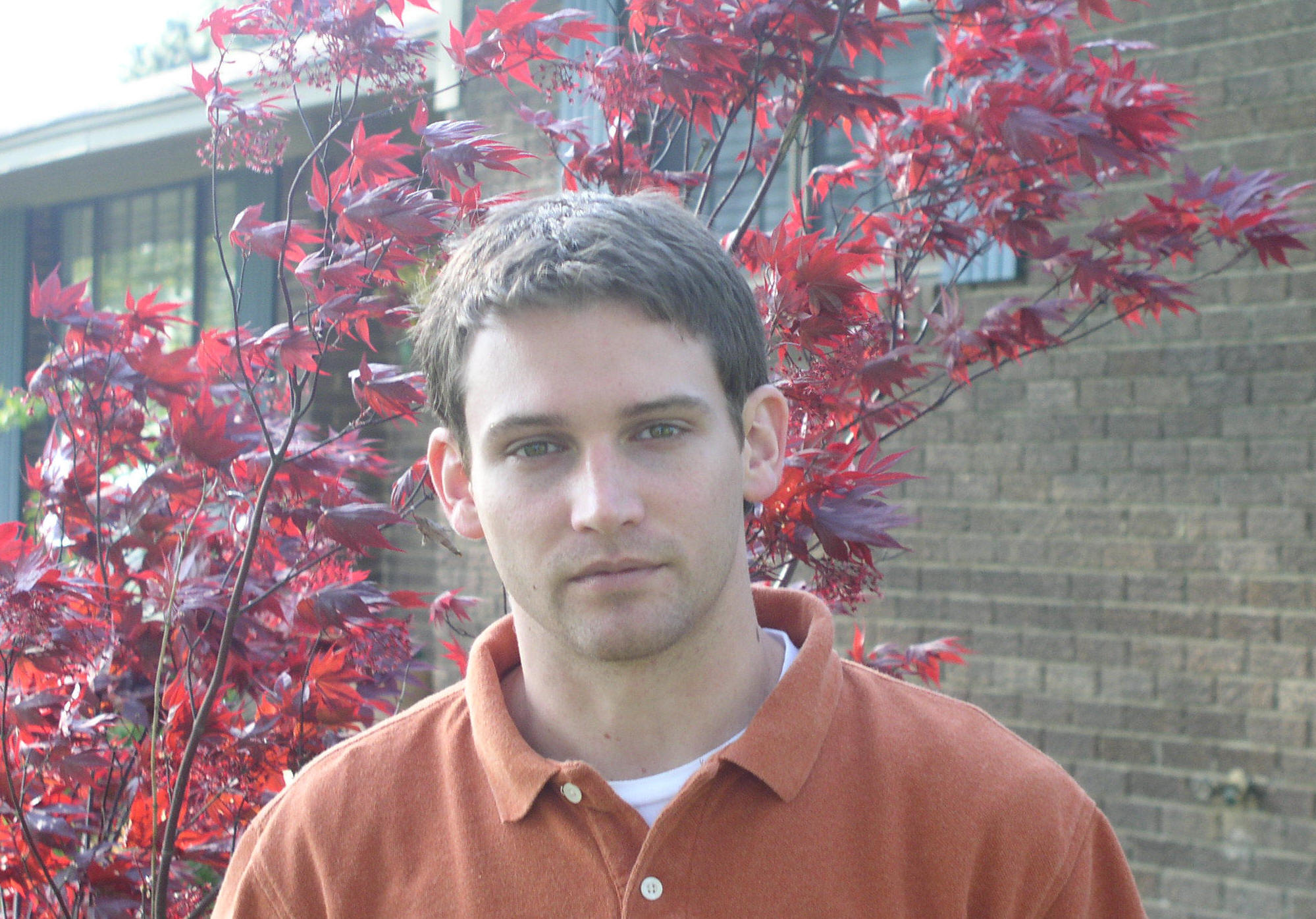
Greg Alan Brownderville is an American poet. A native of Pumpkin Bend, Arkansas,
he teaches Creative Writing at Lincoln University in Jefferson City, Missouri. His
poems have appeared, or are forthcoming, in the Oxford American, Prairie Schooner,
Poetry Daily, Measure, and several other journals and magazines. He
was chosen for the 2007 Porter Prize by past winners, including Lewis Nordan, Donald Harington, and Leon Stokesbury, and is the youngest person
ever to receive the award, given annually to a writer with an Arkansas connection. He was nominated on the strength of his book Deep Down
in the Delta, a collection of his original poems interspersed with folktales he gathered in Arkansas. In 2008 Brownderville completed an
MFA at the University of Mississippi. Copies of his book can be purchased at his website,
www.gregbrownderville.com.
Honey Behind the Sun
In glimmering coils, tuba-serpents beg,
gaping their massive mouths
to gulp the lunar egg.
Trombonists blow their melodies cheek-tight
and let them loose like fat
balloons, yellowy bright.
In streaming sound-confetti, the dead arrive
to claim this bead-strung city
as their afterlife.
Baby’s in the kingcake
God and the Devil one
Deep down in New Orleans
Honey behind the sun
Originally published in Oxford American
Muddy Baptizin
Dirt-stopped, eary mussel shells were strewn
across alluvium jigsawed by the sun.
Barefoot, I witnessed Brother Langston dunk
a young girl and proclaim her borned again.
Cypress knees like headstones on the bank,
I chawed my nails as the line shrank.
The words of “Jesus on the Mainline” rang
inside my head. (Sister Birdie had sung
a couple rounds to start the ceremony.)
Call him up, rolling off a country tongue,
sounded like call them up, reminding me
of Uncle Paul, of all I couldn’t be
now that I was Langston’s kind of Christian.
Tangly red hair like dodder in the sun,
Paul taught me how to call them up. He stole
his mama’s antique hand-crank telephone—
a little generator, powerful
enough to be our magic fishing reel.
With rubber seats and boots, we’d float the Cache,
cathedral-quiet if not for chirp or splash.
Mirrored dimly in the river’s brown,
tupelos towered, cypress, gum, and ash.
We’d hook two twelve-gauge wires up to the phone
and drop them in the water twelve feet down.
I dreamed he’d let me man the reel someday.
It finally happened on my thirteenth birthday.
The fish lived through the shock but couldn’t swim
for minutes, only float. I cranked away.
As Paul picked up the dip-net, here they came,
flathead, bluecat, buffalo, and bream ...
I tried to get my mind off Uncle Paul,
beer-killing, woman-thrilling, red outlaw.
Langston covered my nose and mouth with white,
then braced my back and said, Surrender all.
In a wet rush I felt my blood ignite
and shivered as I rose electrified.
Originally published in Measure
Waking Up in Baghdad
He ties the boat to a tree that he can trust
where the wild sugarhaws of Arkansas
rain red berries after a killing frost,
rare fruits his brother Bobby helps him haul
away with cracklewood steps. In the boat,
working his shoestrings free of cockleburs,
he breathes the bayou mud-funk as they float
past cypress hips. After their mother stirs
that appley pink translucence, Bobby grins
and licks the wooden spoon, smearing his chin.
Then he holds a jar up, hot and bright,
to see its coral color in the light.
Too soon those pops, the sealing of the lids,
mutate to muffled blasts. Ten more dead. Kids.
Originally published in Oxford American
Nothing in Cotton Plant Arkansas Except
The start of a bottletree
Empty RC
On a knuckly branch
Like a slide about to jam
On the highline wires
Outside the home
Of Mudcat Myers
Inside pet rats
Named Racecar Bess and Mable
Scurry over the couch and table
Numbers scrawled on the wall
Above a dead telephone
Jug of corn whiskey
And the party’s on
Tangle of kinky black wires
Round the hole he poked
In a Gorilla amplifier
To give his French harp
Raunchy tone
Woman shake that meat
On her strong bones
While he sing her a song
In his Arkansas drawl
Come on baby
Bigleg mama
We gon’ have a natural ball
Originally published in Arkansas Review
A Welder's New Year's Eve
Another ice storm, someone else is dead.
She’s on a ditch bank in the car she crashed.
Sixteen years old. The lone eyewitness said
she tried to round McDaniel’s Curve too fast.
It’s a small town, I’ve fixed this car before.
That time, the accident made a widower
of my old coach. And now I’ll exorcise
a ghost with auburn curls and a smashed skull,
scour the bloodstains, take this twisted steel
and make it gleam again so that fresh eyes
might look on it with innocence. Perhaps
a year from now someone will buy it for
a son or daughter’s sweet sixteen. One hopes.
And I’ll be damned if there’s a trace of her
perfume to haunt the senses when I’m done.
December’s dying, 5, 4, 3, 2, 1.
A momentary welder in the weather
bears down on the cold, silver pavement, arcs
and melts the new year and the old together—
lightning on ice, a blinding spray of sparks.
Bonding the now and then I’m paid to sever,
I live in paradox. For all my fireworks,
all my skill, the Old Acquaintance reappears.
These hands can do some good. One hopes. One fears.
Originally published in Kritya
Never
And there he stood, undressing Sherry Anne.
It seemed immensely strange to him (despite
His lonely line of work) that, of all men,
He found himself alone with her this night.
Remembering her body grape-skin tight,
He channeled Eden through his hands to give
Her flesh an afterglow of primal Eve.
Night blacked his eyes, and slowly transferred ten
Years from her face to his. At five, he shook
The spring and refill from a ball-point pen.
Sawing the barrel with his knife, he took
An inch out, painted it flesh-toned, and stuck
It in a lump of clay he hoped would answer
For the left side of her nose, lost to cancer.
While nothing could restore her radiance,
Her husband and the kids would be impressed
To see the change wrought in her countenance.
The artist thought, "Whoever would have guessed?
A nose-hole made from an ink pen." He pressed
The clay around it till the shape was set,
And cried as he performed her last toilette.
At sunup, as he headed home—the black
Road in the mirror slithering loosely away,
Writing an S in the grass like a snake—
He thought about the past, about a day
When Sherry Anne was in his Chevrolet
At Christmastime. He didn't know back then,
But life would never be that good again.
Flesh to Marble, Marble to Flesh
Flesh to Marble, Marble to Flesh
The flesh, we’re told, is at war with the Spirit.
Whose flesh? It galls me every time I hear it.
We eat the flesh of Christ and say it’s good.
And why did Krishna charm the sacred wood
at Vrindavan, fluting a melody
that lured the cowherd girls from chilly pillows
to dance with him among the bird-bright willows?
The answer, yes, is to enjoy freely
but beautifully? The senses need not bind
the soul or why does Jesus heal the blind?
You say he never heals? I’ve shared a pew
with passionate, persuasive country folks
who thought a good, full-throated prayer unchokes
the source at some invisible Siloam.
They found that flesh is worth the praying through.
I had a dream last night that might come true.
A poet, blind from birth and lost in Rome,
had somehow stumbled into St. Teresa
in Ecstasy. His fingers on her face,
the marble turned to flesh and stood, dismissing
his fear with one soft touch. While they were kissing,
like lightning before dawn, sight flickered twice
and he was healed. Imagine paradise
awaiting—faces, paintings, gleaming day;
and yet he closed his eyes to kiss and pray.
The Poem of Poems
A boy passes ghost-like through a curtain of weeping willow.
In rainbow-stained apparel, birds are singing a cappella.
Suddenly I sense it, in the birds and in the child:
The world is a poem growing wild.
A dewdrop on a blade of grass soon slips from where it clung
Like a perfect word that gathers on the tip of a poet's tongue.
And men are merely characters to love and be defiled.
God is a poem growing wild.
Hurt with Hunger
The cosmic goddess put this day on paper.
Now we must live the tragedy: skyscraper
Volcanoes vomit, Samson's hair is shorn.
Colder to Hamlet's prayer than William Shakespeare,
She sings the darkness down, and I will mourn,
Waking to find the world battered and torn;
Yet will make meat of rubbish, drink the rain,
If that is what it takes to wake again.
Though every blessed thing should go asunder,
There is raw life to live for, deep in pain.
How could I hate my fate? I hurt with hunger
For the snake-tongue whip wielded by the thunder.
Confused word-slingers have repudiated
The joy of song as if it were outdated.
They grope for a new way to mope or, what
Is worse, rehash the Twenties with a jaded
Laziness. Some are satisfied to dot
The i and cross the t in Eliot.
I am a songbird in the city, blest
With ruthless wonder. In my holy nest,
Rude, foreign scraps are woven into shape.
Cruel Life, too enchanting to resist,
Savage me, and you'll leave without a scrape.
I am impossible for you to rape.
Some Kind of a Good-By
What I was really hanging around for, I was trying to feel some kind of a
good-by. I mean I've left schools and places I didn't even know I was leaving
them. I hate that. I don't care if it's a sad good-by or a bad good-by, but when
I leave a place I like to know I'm leaving it. If you don't, you feel even
worse. — From The Catcher in the Rye, by J.D. Salinger
... los ultimos versos que yo le escribo.
—From Puedo Escribir, by Pablo Neruda
We waded into a sea of lespedeza
And made a careless pallet of our clothes.
Like two pasts melting into one amnesia,
We merged and mixed the colors of our souls.
She bit my lip, she loved me violently.
Her nails dug in
And slashed my back, graphing her ecstasy
On my skin.
I was breathing her inebriating air
For the last time right then and there.
I talk to you about you now as if you were another
Because I cannot find her in your eyes, the you who were my lover.
Sweetheart, I cherished every wound
You left on my back, blood-cocooned.
Aided by the burning in the shower and the itching
Where torn skin fibers were re-stitching,
I pretended your fierce hands were on me still,
And tried to feel
Some kind of a good-by.
The deepest cut stayed with me quite a while,
The mark as well as a faint feeling,
Before it made a mockery of healing.
In the end a slight discoloration,
Pinkish and thin,
One morning in the mirror it was gone.
Had I watched it all night long,
I would have witnessed the evaporation,
The very whitening of the skin.
But the final vanishing of the beloved
Never happens when you're thinking of it.
Like a rare, dwindling patch of Southern snow
That disappears with no one there to see,
It left me secretly,
The last trace of your touch my flesh will ever know.
The HyperTexts