
BRIAN COLEMAN—FRIEND OF HOLOCAUST VICTIMS AND SURVIVORS

It all started in the 7th grade. We were going to perform “The
Diary of Anne Frank.” It wasn’t going to be anything spectacular, only in front
of our class. My teacher was describing the events that led up to this teenage
girl writing in her diary. I was curious. Of course, I had heard of WWII, but
what exactly was the Holocaust? I remembered seeing the year before in my
history book that the population of
Israel
increased after the Holocaust, but that is the only part I know. As my teacher
was going on about the diary, I wanted to know more. “Mrs. Ulrich, is this girl Anne
Frank still alive?” I had no idea. If only I had known the velocity of the war! “Well, Brian, I don’t exactly want
to tell about the book.” But before she was done she was shaking her head, “No.”
“No.” “No she is not.” They began assigning parts to the
students. I was nervous…Would I get one? I don’t do well in front of classes,
not even my class, who had gone to elementary school with me. I was given the
part of Otto Frank. We started the play. Over the course of the next four weeks,
we performed just in front of our 4th hour English class. However,
our class was taking too long, so after a few weeks and being nowhere close to
the end, we skipped a few sections to the end. The play was over. What next? We
were told to pick groups and each group was to do a posterboard presentation
speech in front of the class.
I already knew I wanted:
“Holocaust Survivors.” However, when we got into groups, I was outvoted and the
topic was the total opposite: “Nazi Leaders.” We made a few trips to the school
library during our English class. During one of those visits, I found the book
“Tell Him We Remember.” I was going through the book to see if it had the info I
was seeking. I noticed it had stories of different people on the sides of the
pages. I flipped from page to page reading about each person. Twenty in all.
Some only a year or two older than me, some younger. I remember reading each
story and thinking “I hope they all lived.” However, the reality of how bad this
hell was sank in when I read “gassed in Auschwitz”
or “Treblinka.” How could this happen sixty years ago? How! At that time my
dad’s parents would have been 13 and 14!! Would they have survived? And my mom’s
parents weren’t born until '42 and '43. They surely would have never come back. I wondered if the people in the
book who had survived were still alive. Wouldn’t it be something to be able to
speak to them? One was only a few months older than my grandma. Surely she would
still be alive. But how would I find her now? I decided to look on Google. I
searched Google, but the only thing that came up over and over again was about a
woman who had won awards for books, who by chance was also born in I decided to give up. Besides, even if I found someone,
would I really have the courage to contact them? Probably not. So I began to
read more on the subject. “Night” was also among my favorites. However, “Tell
Them We Remember” was my favorite as it had sparked my interest. I kept checking
it out of the library. My aunt eventually said, “They should just give you the
book after checking it out so many times.” So 7th grade ended and
8th grade started and ended and 9th grade started and
ended. Not much had gone on during those two years except me getting books on
the Holocaust for birthday and Christmas gifts. During the summer after my
freshman year of high school, I was at the store. I was looking through the
movie sections and, by a mere chance, found “Escape from Sobibor.” What were the
odds? I had known about the death camps, but was there really a successful
escape from the Germans? I bought the movie for a dollar and watched it over and
over and over again. This story was incredible. Not only did fifty people
survive the war, but one was a Dutch woman who didn’t even speak Polish!! At the end of the movie there was
a list of the survivors alive in 1987, when the movie was made. The movie was
older than I. How many would be alive 17 years later? How old would they be by
now? The youngest one must be 80 and the oldest one? 90? 95? How in the world
would I be able to find one? Google. So I printed off the list of known
survivors and began to Google. A lot of results came up for “Esther
Terner-Raab.” How active she was! I finally saw something that may help. It must be her, I thought. Ok, so
now I have an address for one. I knew if I wanted to ask questions, writing a
letter would be the only way. What do I write in the letter?
What if she doesn’t write me back? Or worse, what happens if I write the wrong
person? How embarrassing!! But my mind came to reality. I knew at age 15, if I
did not write the letter now, I would not have a chance in ten years. So I
decided to write the letter. I will confess, it was not written very well. Dear Mrs. Raab, After watching the
movie “Escape from Sobibor,” I was
wondering if I could ask you a few questions. In the meantime, I began to go
through my books and look to see if I could write to anyone else. I found a few
people in the books I had and began to write to them. I was really scared no one
would write me back. I figured, “I will just go until school starts, then I will
quit writing.” I was hoping for at least one response. It finally came: a letter
from Selma Engel. I opened it carefully. I read it
and thought something was strange. It said, “Thank you for your letter…Selma &
Chaim.” I was confused. I knew her husband
had passed away. How could they both have signed the letter? I realized the letter was copied
and disappointment began to set in…However, I had a letter from a Holocaust
survivor!! I was on cloud nine for a long time. I showed it to everyone. Well
almost. Everyone in my family. No one else knew. Not long after, two more
responses and a returned letter!? How could that be, weren’t the phone
directories always accurate? Now how would I find this person?
School started for my sophomore year. However, I was not wanting to give
up the letter writing. I figured I would go on for a little longer. I used to
sit in my math class and watch the clock anxiously waiting for the dismissal
bell, every day after school wanting to go home as soon as possible to check the
mail. I was always wondering, trying to guess who I would hear from. I knew not
everyone would write back. I received another returned letter that had been
mailed back in a manila envelope. I used that envelope to store all my responses
in. Eventually they would no longer fit and I decided a shoe box would work. I
had 19 responses, so a shoe box was more than big enough.
Brian with Yala Korwin
Brian with the poet Israel Halpern
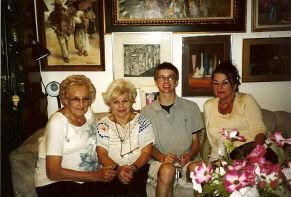
Brian with Holocaust Survivors
Brian with an unidentified Rabbi and friend
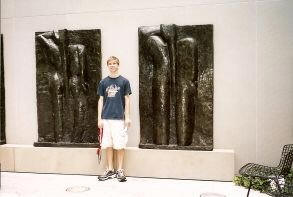
Brian at the Museum of Modern Art (MOMA) standing by Matisse sculptures
A letter from Audrey Friedman Marcus:
I didn’t know Brian Coleman. Yet—somehow—I felt that I did.
About a year ago, I heard of the letters Brian was writing
to Holocaust survivors. I wrote to him immediately to tell him how significant I
felt his efforts were in defeating the lies of Holocaust deniers and giving hope
to survivors that their stories would live on. Because my late husband was a
survivor, these matters are of vital interest to me. Brian and I became friends
via the internet and wrote back and forth frequently.
I decided to bring Brian to
Brian never got to take this trip. Nor did he see the
schedule for his visit, which I emailed to him around the first of February,
unaware of his death on January 29th. When I learned of this tragic occurrence,
I had to read the letter three times before the message sank in. Brian was gone,
his valuable work unfinished and promising life cut off. A pervasive sadness has
stayed with me night and day ever since.
This 19-year-old boy influenced and changed many lives.
Mine is one of those lives, even though we never met. Brian Coleman’s legacy
will live on in the hearts of the many people whose lives he touched. And in my
heart as well.
Audrey Friedman Marcus
Denver, Colorado
A letter from Gail Schwartz:
I first met Brian when he came to Washington, DC last year. I am a volunteer in the Oral
History Department at the United States Holocaust Memorial Museum and Johanna
and Eddie Willner, a survivor and his wife who had known Brian thought I would
be interested in meeting him. I began corresponding with him and when he came
to Washington soon after, we spent the day together at the Museum. I'll always
remember seeing him for the first time with his backpack filled to the brim with
letters. We had a long talk over lunch where he spoke of how he got involved in
his meaningful project as well as his future college plans. We talked about how
each survivor's story is unique and needs to be told. I could tell how precious
those letters were to him and how he treasured his personal relationships with
survivors. I'm sure the feelings were mutual. Every staff member he met that day
was fascinated by his letter project, and when the survivors who were in the
building that day found their letters in his collection they were so touched.
We continued to correspond after that—he wrote about the courses he was
taking at college, his hopes that the letters would be archived in a museum. I
could tell by the wonderful smile on his face in numerous photographs how much
he enjoyed visiting with survivors in their homes, sightseeing with them, and
helping them to form new relationships among each other, which was truly a gift.
It is through Brian that I was able to get in contact again with Yala
Korwin, a poet and artist, whom I had met some years before, a survivor who has
also enriched my life. Brian and I frequently spoke of her.
Brian will be missed so very much, not only by his family, but so many
others whose lives he had touched. He was such a warm, caring and sensitive
young man, mature beyond his years. It was a privilege to know him and I will
always be grateful for that.
May his memory always be for a blessing.
Gail Schwartz
A letter from Evelyn and Leonard Rubin:
Brian Coleman was one of the most unusual teenagers we have
ever met. As we hosted him for a week, in our home in
Evelyn and Leonard Rubin
A photo and letter from
Isaac Nehama:
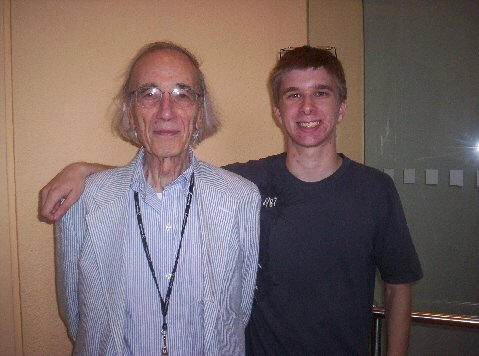
I was shocked to learn of Brian's untimely death ... Brian first contacted
me in January 2005. After the first exchange, we continued our
correspondence over the years. We finally met at the Holocaust Museum in
Washington during his visit there in August 2007. [The photo above.] I echo
the sentiments of his many friends, mostly his openness and genuineness. I
will miss him.
Best Regards,
Isaac Nehama
Isaac Nehama was born in
A letter from Simon & Cecile Jeruchim:
My wife and I were shocked and terribly saddened to read the news that
Brian Coleman had recently died.
We are "Hidden Children", survivors of the Holocaust and Brian had
contacted us a few years ago after reading our stories in a book titled
"Hidden to Survive" by Maxine Rosenberg. Ever since we had been in
contact with him and finally had the great pleasure of meeting Brian
last summer when he came to New York.
Brian was an extraordinary, one of a kind teenager, who would have been
destined to achieve great things in his life. Even though he died too
soon, he had already accomplished a great deal in his short life.
Beyond Brian's interest in the lives of Holocaust survivors, through our
frequent emails with him, we discovered that Brian was unusually mature
for his age, sensitive and also quite humorous. For instance, he had a
love and hate relationship with his old car, which kept breaking down,
and Brian regaled us with funny stories about it that kept us in
stitches. He also enjoyed practicing writing in French to us, since
French is our native language, and we appreciated the fact that he
wanted to please us. As an author myself, I recognized that Brian was
already a gifted writer and I encouraged him to take advantage of his
talent.
My wife, Cecile and I will miss him very much.
Sincerely,
Simon & Cecile Jeruchim
How it all started, in Brian Coleman's own words:
This is the school paper which explains how Brian's interest
in the Holocaust started. As he says, "It all started in the 7th grade."
The full essay appears below the image of Brian's untitled essay.
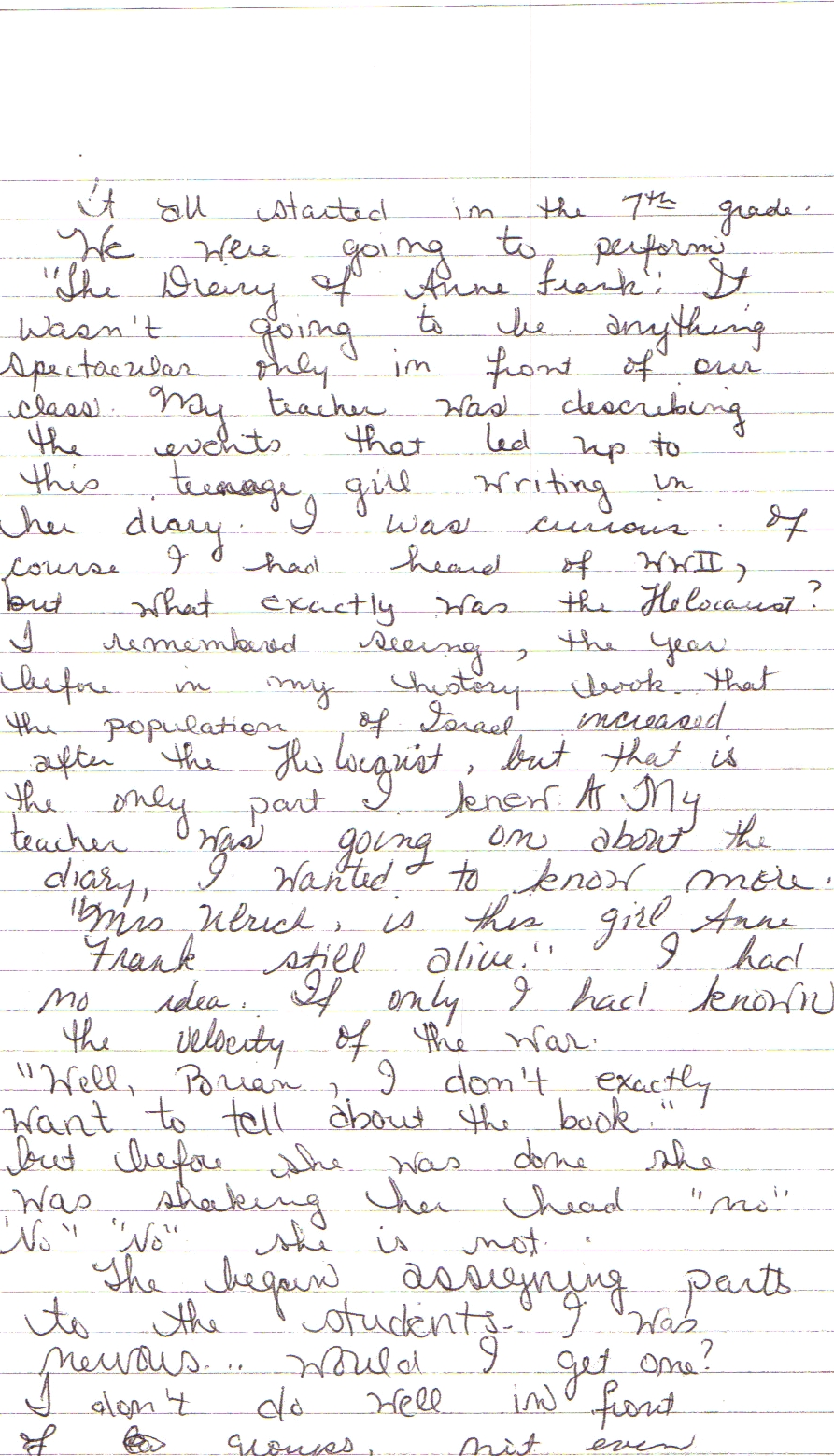
An Untitled Essay by Brian Coleman
I mailed it
One day I received a letter
that stated the person would rather talk on the phone than respond to a letter—I
couldn’t believe it. I was more nervous than anything!! I finally called on
Labor Day, my day off from school. She said she would call back the next day
after I got back from school. I told her at
[The essay appears above as I received it, except for a few minor changes in
punctuation and corrections of what seemed to be typographic errors.—Mike
Burch.]
An essay by Brian Coleman on what he learned about the Holocaust:
Survivors of the Holocaust in
America
by Brian Coleman
11/22/2005
When
war-torn Europe was finally liberated by the
Russians, British, and the Americans, three million Jewish people had been
displaced. After six years of surviving the Nazis, the survivors of the
Holocaust would struggle with the scars for the rest of their lives. Rebuilding
their lives was not easy and some 92,000 chose to do so in
Irene
Frank, who had survived a ghetto and two concentration camps, eventually
immigrated to America
and recalls, "I only had five dollars in my pocket" (Landau 41).
Mrs. Frank
was not alone, as many people had almost nothing when they came to
Rebuilding their lives in a foreign country was not easy for any of the
survivors and many had called on relatives who had fled to
When
the survivors arrived in
America, they soon realized many people,
including their relatives, wanted to hear nothing of the Holocaust. The
survivors stuck together when they arrived in the land of opportunity, thus many
sections of New York became largely Jewish, and as Helen Epstein writes in
"Children of the Holocaust", "Some, like the survivors who swelled the
populations of Williamsburg, Crown Heights, Flatbush, and Boro Park in Brooklyn,
New York, formed strong survivor communities where several of their children
grew up thinking that 'everyone's parents had been in concentration camps'"
(97). Not only was
Many
started their own businesses, which soon prospered. Fred and Tamara Wildauer had
a successful clothing store in Minneapolis, after
working long hours six days a week, in a grocery store in
Eventually life became good for the survivors in
Even
while raising their families, the emotional scars were too much for some to
handle. Many survivors that were tattooed in Auschwitz,
were asked, "Why did you write your telephone number on your arm?" Some chose to
simply get the number that had been branded on them in Auschwitz removed, as did
Frida Herskovits, who settled in Brooklyn after arriving in
As a
result of the Holocaust many survivors were very fearful. Esther Peterseil
described to David Adler, "Since Auschwitz, I have never taken a shower, only
baths."
Sam
Goldstein refuses to stand in lines as it reminds him too much of his days spent
in the camps. Judy Schoenfeld Schabes was reminded of her time in
As the
years passed and the survivors grew older, many still did not talk much about
their war experiences. Some might make a quick reference to their families, who
were murdered in the Holocaust, time they spent in a concentration camp, or
something that occurred after the war. Telling their stories was simply too hard
for many and they were never planning to talk about it. It was not until
recently, when Holocaust deniers were becoming very outspoken claiming that six
million Jewish people were never murdered and that there were never any gas
chambers. This was simply too much for some survivors to hear and they were now
determined to tell the world that it did happen and that they were the
witnesses. This was the case for Bella Tovey, who not only wants to tell that it
happened, but also wants to preserve the memory of her parents and siblings who
were murdered in Auschwitz.
Most
survivors are now retired and they are enjoying the remaining years of their
lives doing volunteer work in their communities and many, such as Carol Lipson,
have left the colder climates, for places like Florida. They are spending time with their
now grown children and playing with their grandchildren and even great
grandchildren.
Watching their children succeed has been the best thing that has happened
for them. Lilly Salcman's daughter now works for the New York Times, Simon and
Cecile Jeruchim's daughter is now a successful business woman, and Alex
Lebenstein's son is a successful realtor in
New York. Not only have their children become
successful, but also their grandchildren, such as Ben Kamm's grandson, who is in
the musical group The Calling. The descendants of the survivors continue to grow
and expand and continue to make the survivors proud of their achievements.
As the
number of survivors begins to rapidly decrease, their children feel that they
need to help tell the stories, not only of their parents, but also of the family
members that they never knew. Their children push them to write their memoirs,
record an audiotape of their experience and give interviews or presentations at
high schools and universities. The survivors, such as Frida Herskovits, have
spoken numerous times to audiences that numbered well over two hundred people.
Some survivors have even given testimony to Steven Spielberg's Shoah foundation,
The United States Holocaust Museum, and some are filling out forms for their
murdered relatives at the Yad Vashem museum in Israel.
As the
aging survivors continue to tell their stories, they are racing against time to
get their messages across. They are growing frailer and illness and Alzheimer's
is becoming more frequent. They tell their stories for remembrance of their
relatives, not so one will feel pity for them. Each time a survivor remembers
the events of sixty years ago, it takes them back to a time when they had their
families, what they would give up anything today to have. Remembering these
events brings tears to their eyes, even the survivors who have seemed to cope
the most. While the number of survivors gradually gets smaller and smaller, they
want only one thing, for the world to remember.
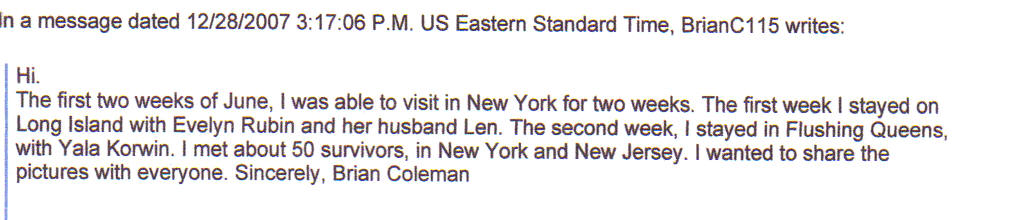
Brian Coleman kept in touch with his friends among the Holocaust
survivors, and during the first two weeks of June 2007, managed to meet around
50 survivors in New York and New Jersey:
Excerpts from a letter by Frank P. Moses:
Brian was truly a very wonderful person and now I am sorry
that I did not keep more in touch with him. On his trip to
South Florida, I had the pleasure in meeting his grandfather who
came with him. He too was a great person.
Friendliest
regards,
Frank P. Moses
A letter from Debora Biron:
I can not begin to describe the sorrow and shock I felt when I learned about the
untimely death of Brian. The first time I heard from Brian was in December 2006.
Brian wrote me that he read the book "Hidden to Survive" by Maxine Rosenberg .
My name is in the book. Brian
wanted to come to New York
and organize a lunch for as many people in the book that could attend. I was
happy to help him do that.
Brian worked very hard to make it happen . The lunch on June
8th 2007 was a great success, very emotional as everyone there met for the first
time and had their stories to tell. Brian was the STAR.
My husband and I spend another day with Brian in Manhattan; he
loved New York.
Brian was amazing; his interest in the holocaust survivors was
beyond belief. Brian was a young man with integrity, sensitivity, a sense of
humor and a great big heart. Brian will certainly leave a great void in my life
and in anyone that has ever met him. We will miss him.
With deep sadness,
Debora Biron
A series of letters between Brian Coleman and Henny M. Simon:
Hi Mrs. Simon,
I know it has been some time since we last corresponded. I wrote you a
letter maybe a little over a year ago and we talked on the phone. I wanted
to tell you that I was in New York last month and was at the Heritage Museum
and was I surprised to see the ring and your name by it! I was thinking
"wow, i have been in touch with Mrs. Simon."
I hope you are well. Yours, Brian
The South Bronx in 1950 was the home of a large and thriving community,
predominantly Jewish. In the 1950s the Bronx offered synagogues, mikvas,
kosher bakeries, and kosher butchers—all the comforts one would expect
from an observant Orthodox Jewish community.
The baby boom of the postwar years happily resulted in many new young
parents. As a matter of course, the South Bronx had its own baby equipment
store, Sickser's. Sickser's was located on the corner of Westchester and
Fox, and specialized in "everything for the baby" as its slogan ran.
The inventory began with cribs, baby carriages, playpens, high chairs,
changing tables, and toys. It went way beyond these to everything a baby
could want or need. Mr. Sickser, assisted by his son-in-law Lou Kirshner,
ran a profitable business out of the needs of the rapidly expanding child
population.
The language of the store was primarily Yiddish, but Sickser's was a place
where not only Jewish families but also many non-Jewish ones could acquire
the necessary for their newly arrived bundles of joy.
Business was particularly busy one spring day, so much so that Mr. Sickser
and his son-in-law could not handle the unexpected throng of customers.
Desperate for help, Mr. Sickser ran out of the store and stopped the first
youth he spotted on the street. "Young man," he panted, "how would you like
to make a little extra money? I need some help in the store. You want to
work a little?"
The tall, lanky black boy flashed a toothy smile back. "Yes, sir, I'd like
some work."
"Well then, let's get started."
The boy followed his new employer into the store. Mr. Sickser was
immediately impressed with the boy's good manners and demeanor.
As the days went by and he came again and again to lend his help, Mr.
Sickser and Lou both became increasingly impressed with the youth's
diligence, punctuality, and readiness to learn. Eventually Mr. Sickser made him a
regular employee at the store. It was gratifying to find an employee with an
almost soldier-like willingness to perform even the most menial of tasks,
and to perform them well.
From the age of thirteen until his sophomore year in college, this young man
put in from twelve to fifteen hours a week, at 50 to 75 cents
an hour. Mostly, he performed general labor: assembling merchandise,
unloading trucks and preparing items for shipments. He seemed, in his quiet
way, to appreciate not only the steady employment but also the friendly
atmosphere Mr. Sickser's store offered.
Mr. Sickser and Lou learned in time about their helper's Jamaican origins,
and he in turn picked up a good deal of Yiddish.
In time the young man was able to converse fairly well with his employers,
and more importantly, with a number of the Jewish customers whose English
was not fluent. At the age of seventeen, the young man, while still working
part-time at Sickser's, began his first semester at City College of New
York. He fit in just fine with his, for the most part Jewish classmates,
hardly surprising, considering that he already knew their ways and their
language.
But the heavy studying in the engineering and later geology courses he chose
proved quite challenging.
The young man would later recall that Sickser's offered the one stable point
in his life those days.
In 1993, in his position as the Chairman of the Joint Chiefs of Staff—two
years after he guided the American victory over Iraq in the Gulf War,
General Colin Powell visited the Holy Land. Upon meeting Israel's Prime
Minister Yitzhak Shamir in Jerusalem, he greeted the Israeli with the word
"Men kent reden Yiddish" (We can speak Yiddish).
As Shamir, stunned, tried to pull himself together, the current Secretary of
State continued chatting in his second-favorite language. Colin Powell never
forgot his early days working at Sickser's.
Have a wonderful day.
Brian
Hi Brian,
I liked the article about Collin Powell. Thank you. On May 31, I also was
in New York at the Museum of Jewish Heritage. I went with the Colchester
Middle School class where I had just spoken a week before the trip. It was
the first time that I got to that museum. Too bad we did not meet there.
Keep up your interest in the Holocaust because we survivors will not be
around too many years anymore.
I am glad I was still home when your email came because tomorrow I am
leaving for a 2 week vacation to Alaska.
Have a wonderful summer.
yours
Henny M. Simon
Hello Brian,
You are a remarkable young man. Nice pictures. [There are a
number of pictures of Brian with Holocaust survivors toward the bottom
of this page.] How do you know all
those survivors? It is good to know that there is somebody who is going
to carry on our stories. We won't be around many more years. Thank
you.
Henny M. Simon
If you love yiddish and sephardic songs, this site is special. Please make sure your speakers are on.
Hope you enjoy. (Especially sixteen tons in yiddish.)
SHALOMANIA!
www.shalomania.com
Brian's letter of January 28, 2007, to Yala Korwin
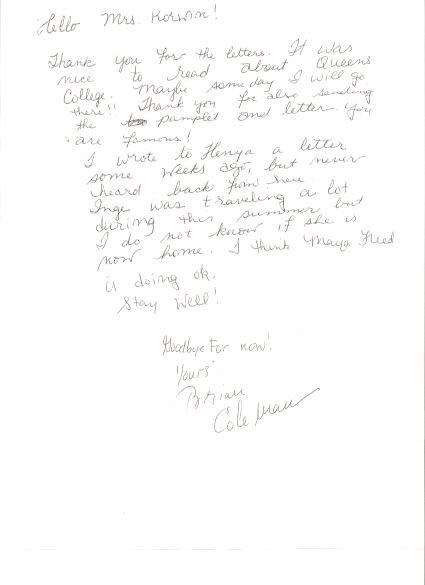
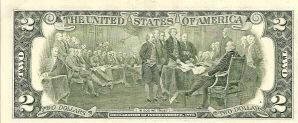
Rare two dollar bill (recto) given to Yala Korwin by
Brian

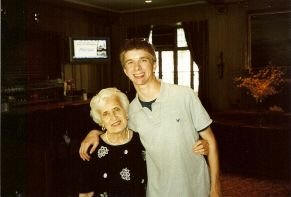
Rare two dollar bill (verso) given to Yala Korwin
by Brian
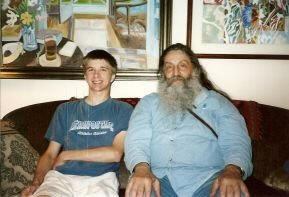
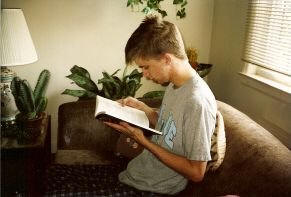
Brian reading a book at Yala Korwin's residence
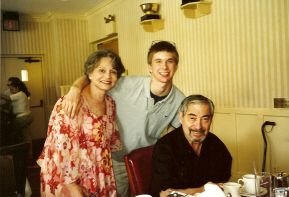
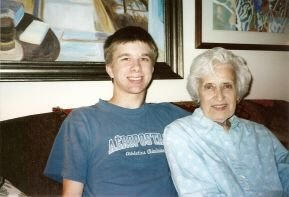
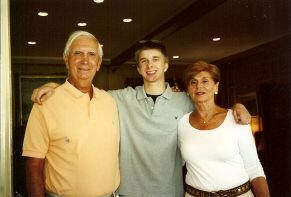
Brian sitting with Yala Korwin at her residence: two Angels of Light!
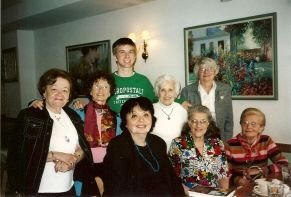
Brian at a reunion of Holocaust child-survivors
Brian with Bella Rubin (center), her sister (right) and friend
(left)
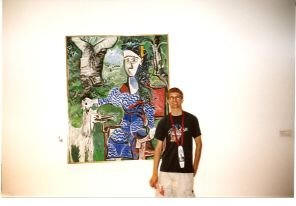
Brian at the Museum of Modern Art (MOMA) standing by a Picasso
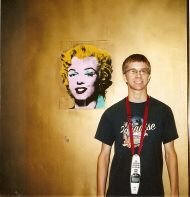
Brian at the Museum of Modern Art (MOMA) standing by a Warhol
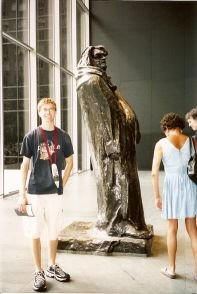
Brian thinking by a Rodin sculpture of Balzac
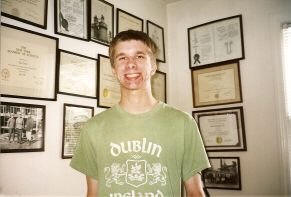
Brian at the office of Yala Korwin's late husband
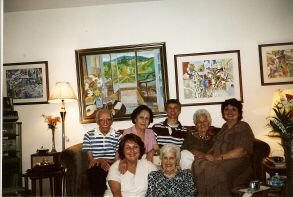
Back: Frank
Stiffel, a survivor of
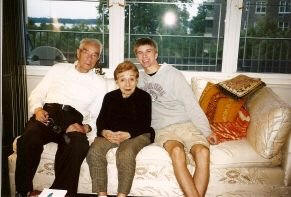
Brian viewing Manhattan

Brian with Yala Korwin's friends Gary and Rosalie
Brian with a Holocaust Survivor
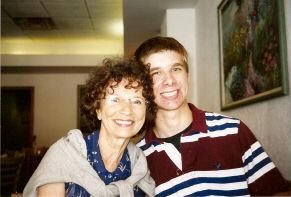
The following is an email from Brian to Yala Korwin:
I met Inge Auerbacher when I was in New York this past June.
Brian
Passing It On: Holocaust survivor shares story at school
by Kassia Micek, Courier staff,
11/07/2007
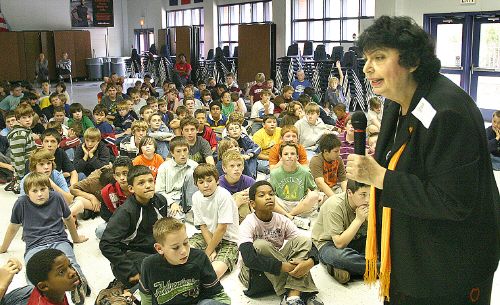

Scientist, author and Holocaust survivor Inge Auerbacher
describes her experiences as a child in Nazi concentration
camp to sixth-grade students Tuesday at Montgomery Middle
School. Staff photo by Brad Meyer.
MONTGOMERY—The yellow star Inge Auerbacher wore as a Jewish child in
Nazi Germany is now a symbol of what she has overcome.
As one of the 13 survivors from the 1,200 men, women and children in her
transport taken to Terezin concentration camp in Czechoslovakia,
Auerbacher now tells her story across America, Canada and Germany.
Auerbacher shared her story Tuesday with Montgomery Middle School
students as exclusive pictures were displayed behind her.
"I feel I have a mission to keep the memory alive of those who were
killed," said Auerbacher, now of Jamica Queens, N.Y. "My hope, my wish
and my prayer is for every child to grow up in peace without hunger or
prejudice."
Born in Nazi Germany on Dec. 31, 1934 in a small village in southwest
Germany, Auerbacher vividly remembers the "Night of Broken Glass," when
the Holocaust began.
"I was 4 years old, but I remember it clearly," she told the students.
"Glass was all over the floor."
All the windows in her family's home were broken out and her
grandfather, who had gone to the synagogue for morning prayer, was
arrested and taken to Dachau concentration camp, as was her father,
Auerbacher said.
"It didn't matter he was wounded from World War I and a proud German,"
she said about her father receiving the Iron Cross.
After the men were released, the family narrowly escaped a transport to
the concentration camp in 1940, but in August 1942 weren't as lucky.
Auerbacher already had her yellow star that branded her to "show
everyone you're a Jew," she said.
The youngest in a transport of 1,200, Auerbacher received her number—13-408. The group was herded on trains to Terezin concentration camp in
Czechoslovakia, she said.
In the disabled/veteran section with her parents, Auerbacher lived in
the camp for three years before the Soviet Army liberated it on May 8,
1945.
"I never prayed so hard for God to save me," she said about that day.
Of the 1,200 Jews taken to Terezin, 13 survived, including Auerbacher
and her parents, representing only 1 percent of all the people
transported.
"A miracle—a mother, father and child, a family intact," she said
about her family.
To demonstrate this reality, two of the 200 students gathered for
Auerbacher's speech stood up. The others gasped, realizing how lucky
Auerbacher was.
"I felt bad for the Jews who were in the Holocaust, because many of them
died," said sixth-grader Adam Anderson, 11.
The one item that survived those "years of terror" was Auerbacher's
doll, Marlene, which she donated to the U.S. Holocaust Memorial Museum.
The estimated number of Jewish deaths during the Holocaust is usually
given between 5.1 and 6 million victims, according to the U.S. Holocaust
Memorial Museum.
Auerbacher tells her story in three books, including "I am a Star—Child of the Holocaust."
To learn more about Auerbacher, visit
www.ingeauerbacher.com.
In Closing:
Sometimes there are people who
appear like shooting stars, as if to give the world hope – Einstein, Gandhi,
Martin Luther King Jr., Elvis Presley, Princess Diana, Marilyn Monroe. I have
comforted myself with the thought that Brian was such an angel – a messenger of
hope. Even his name is interesting. “Brian” means “Strong.” “Kyle“ means “Omen“
or “Belief.“ “Coleman” is
Germanic for “Dove” or “Dark like a Dove.” Although Brian was fair-skinned on
the outside, it seems his heart strongly believed in those who
fell like dark doves beneath
the bootheels of the Nazis. Was Brian an angel? I am quite sure he was: if not a Heavenly Angel, then surely a Human Angel.
Brian set a stellar example for the world, and now it's up to us to
follow his lead and see our work bear the fruit of his spirit: love,
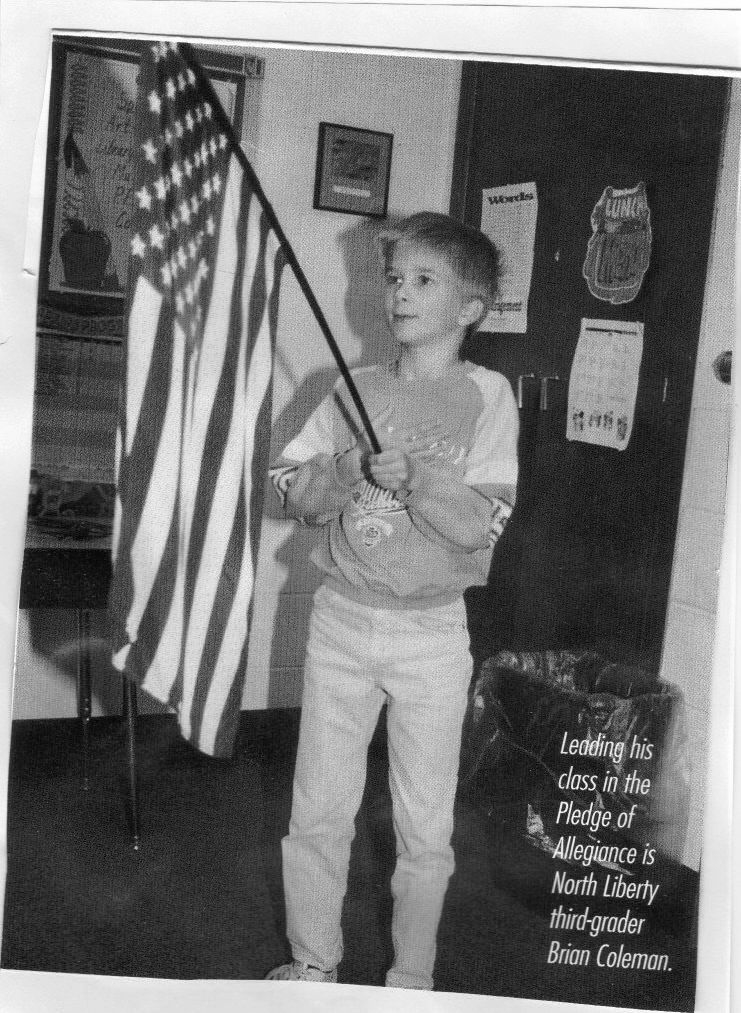
compassion, peace and tolerance. As the picture below attests, Brian was
a leader from a young age. He led his class in a pledge, with his eyes
on the stars and a hand held over his heart.—Michael R. Burch, Editor,
The HyperTexts
A series of emails between Brian Coleman and Judith Bihaly regarding their meeting in June 2007:
From: Judith Bihaly
Date: April 20, 2007 4:22:01 PM EDT
Dear Brian, I guarantee you will be safely back in Long Island
before dark, unless of course you change your mind and want to stay for some
I am excited to finally meet you.
Fondly, Judith Bihaly
On Apr 20, 2007, at 10:21 AM, brianc115@aol.com wrote:
I think that that may be able to work. How late in the summer
does NY have daylight? In Indiana
in the summer it is still light at 9:30 and 10. If it stays light out longer
there too that would help. I am uncertain if I would want to be out in the dark.
I think that that day may work.
-----Original Message-----
Sent: Thu, 19 Apr 2007 7:28 PM
Subject:
How is Tuesday, June 5?
On Apr 19, 2007, at 12:11 PM, brianc115@aol.com wrote:
Hi Mrs. Bihaly,
That sounds great! Yes, let's pick a date as soon as we can
because I think the longer we wait it will be very tricky to plan something.
Maybe one of the days during the first week?? June 1-June7. I don't think June
1,2, or 7 are good but I think that the others will work! I hope we can get
something arranged!! looking Forward!!
Brian
-----Original Message-----
From: Judith Bihaly
To: brianc115@aol.com
Sent: Thu, 19 Apr 2007 12:11 AM
Subject:
Dear Brian,
At last! It will be a thrill to meet you. I know you will want
to see quite a number of your friends in this area, and my time is flexible
during much of your visit. It is still off in the future, but are you already
scheduling your meetings? If you wish, let me know and we can pick a date and
time. Otherwise, there is plenty time. While here, you may want to take in some
of the sights in Manhattan, and I would love to
show you around
Take care.
Fondly,
Judith Bihaly
On Apr 18, 2007, at 10:30 AM, brianc115@aol.com wrote:
Mrs. Bihaly,
How are you doing? I hope that all is well. I wanted to tell
you I will be visiting NY this June (1-15). The first week in Jericho Long
Island and the second in Flushing Queens. I was
hoping that if you are not busy we will be able to plan a time and be able to
meet.
Yours,
Brian
From: Judith Bihaly
Date: April 22, 2007 8:36:18 PM EDT
To: BrianC115@aol.com
Subject:
Dear Brian,
The 6th could work, but it would help to know which very soon,
as I will need to reserve the rehearsal date. Here is how it works: Supporters
of the New York City Ballet have the privilege to attend a number of rehearsals
and to bring one guest. We have to request in advance the dates -- Tuesdays
through Fridays -- on which we want to come. Then, on the morning of the
rehearsal, we find out which two-hour segment between 12 and 4 PM is set aside
for us for that day. I certainly don't want to cause any trouble for Mrs. Rubin,
and if she can't pin down the date I could ask the office at the NYC Ballet
Guild to be flexible. By the way, Thursday the 7th and Friday the 8th are also
open for me, if they are still open (for sure) for you. I am looking forward to
meeting you and sharing with you some of my world in
Manhattan, but not to cause any awkwardness. So, feel
free to choose.
Fondly,
Judith Bihaly
On Apr 22, 2007, at 7:25 PM, BrianC115@aol.com wrote:
Mrs. Bihaly,
If the 5th is not a good day would the 6th be ok? Mrs. Rubin
(whom I am staying with on LI) is going to plan a meeting with her French group
on one of those two days. She is not sure which one will work out. Although I do
not know at what time so Tuesday may still work out.
Yours,
Brian
From: Judith Bihaly
Date: April 24, 2007 8:11:07 PM EDT
To: brianc115@aol.com
Subject:
Great news, Brian! Thanks. Judith Bihaly
On Apr 23, 2007, at 10:48 AM, brianc115@aol.com wrote:
Mrs. Bihaly,
Yes Tuesday would be a great day, luckily everything has
worked out so far. So I look forward to seeing you there.
Yours,
Brian
From: Judith Bihaly
Date: May 9, 2007 7:56:34 PM EDT
To: brianc115@aol.com
Subject:
Dear Brian, Please send me a link to the train schedules. I
don't know where Fair Haven is, but if I can find it on Google Map and get a
link to the train schedule, I will be able to suggest a meeting place --
probably one of the following: Grand Central Station, Penn Station, Port
Authority, or even
From: Judith Bihaly
Date: May 13, 2007 5:41:09 PM EDT
To: BrianC115@aol.com
Subject: Meeting plans
Good!
On May 12, 2007, at 10:13 PM, BrianC115@aol.com wrote:
Hi Mrs. Bihaly,
Thank you for your detailed letter. I think I will try and
meet you early in Hoboken
if that is still ok. I will work it out with Mrs. Feldman in Fair Haven, who I
think could provide transportation to the station. I can pack very lightly and
will probably just have a backpack with one pair of clothes in them. Then we
will be able to spend the day together and then when the day ends I can ride the
train back to Jericho.
I look forward!!
Yours,
Brian
From: Judith Bihaly
Date: May 13, 2007 5:43:04 PM EDT
To: BrianC115@aol.com
Subject: Meeting plans
Good! At the End of the day I will get you to Penn Station
for your train to Jericho. Do
you have a Long Island Railroad link to its schedule?
On May 12, 2007, at 10:16 PM, BrianC115@aol.com wrote:
Hi Mrs. Bihaly,
I just wrote to Mrs. Feldman and asked about taking the 8:38
train from Red Bank to Hoboken
so that we will be able to meet there.
Sincerely,
Brian
From: Judith Bihaly
Date: May 18, 2007 12:19:13 AM EDT
To: BrianC115@aol.com
Subject: Meeting plans
Dear Brian, Sorry for not replying sooner. Thank you for the
details of your first week's plans. I had been concerned that you were
overextended, and you indeed are, but your plans seem under control. Your hosts
have planned well to take good care of your transportation and lodging needs,
and they have also planned an exciting schedule.
As for June 5, I keep my fingers crossed for good weather and
hope the rehearsal begins later rather than earlier in the afternoon, to give us
time to roam the
At the end of our day I will accompany you to Penn Station for
your return trip to Jericho
(I hope you'll have a schedule for the Port Jefferson Branch of the LIRR.).
According to the LIRR map, the closest station to
Fondly,
Judith Bihaly
On May 13, 2007, at 11:32 PM, BrianC115@aol.com wrote:
Mrs. Bihaly,
I reread your email and once again want to thank you. I think
I have not yet answered all of your questions and will try to.
On June 1, I will fly into LaGuardia, Mr and Mrs Rubin are
going to pick me up and then I will spend the day with them and visit and get to
know them
June 2, I am going to services with the Rubins and Mrs. Rubin
is going to interview me in front of her congregation. Then after that a lady
who is Polish Catholic is going to take me to Pt Washington
to the
June 3-The Rubin's are going to take me into the city and
afterwards we are having dinner in Woodbury or
June 4-Taking the train to Red Bank and seeing the
June 5- Taking the 8:38 train from Red Bank to
June 6- I am meeting Mrs. Rubin's French Group that will meet
at her house. Then in the evening there will be a professor who wants to meet
me.
I do not have the plans for the second week complete yet. They
are so tricky right now and I wish I had about four more days in NY! I hope it
will work out in the end!
Yours,
Brian
From: BrianC115@aol.com
Date: May 23, 2007 3:37:25 PM EDT
To: Judith Bihaly
Subject: Re: Meeting plans
PS My cell is [ ].
Sorry so short but I am on my way to work.
Yours,
BC
From: Judith Bihaly
Date: May 24, 2007 7:12:16 PM EDT
To: BrianC115@aol.com
Subject: Changes in Plans
Dear Brian,
I see that your plans are still evolving, and hope it's all
good. I will not be able to meet you Monday evening, but if you spend Monday
night in Long Island I can still meet you
Tuesday morning at Penn Station -- all I need is the time of your arrival. I
look forward to our time together. Thanks for your cell number.
Fondly,
Judith Bihaly
On May 23, 2007, at 3:36 PM, BrianC115@aol.com wrote:
Mrs. Bihaly,
On Monday, I will not go to Red Bank like I had planned,, but
rather spend the day in the city meeting some people. Maybe we could meet
somewhere Monday evening in NYC or in NJ, instead of the next morning?
Yours,
Brian
From: Judith Bihaly
Date: May 28, 2007 2:31:56 PM EDT
To: BrianC115@aol.com
Subject:
Dear Brian,
I see that your plans are still evolving, and hope it's all
good. If you spend Monday night in Long Island,
I can meet you Tuesday morning at Penn Station -- all I need is the time of your
arrival. And I can help you get back to
By the way, all the commencements around here have reminded me
that you are a high school graduate! CONGRATULATIONS! I have your junior prom
picture. Is there a senior prom picture? What is your summer job? What college
are you headed for?
I look forward to our time together.
Fondly,
Judith Bihaly
On May 27, 2007, at 9:37 PM, BrianC115@aol.com wrote:
Mrs. Bihaly,
Since there was a change in plans where would you want to meet
Tuesday morning? Some where in NYC maybe?? Yours, Brian
From: Judith Bihaly
Date: May 29, 2007 1:01:44 AM EDT
To: BrianC115@aol.com
Subject:
Dear Brian, If you have trouble finding a place to stay in the
city Monday night, you're welcome to stay at my place. When your daytime plans
are over, I can pick you up (really a short trip except during rush hour), and
bring you to my apartment. I have a comfortable couch in the living room, and
the view is great unless the river is fogged in. I may leave for an hour to
attend a Council meeting, but you're a big boy.
Fondly, JB
On May 28, 2007, at 2:43 PM, BrianC115@aol.com wrote:
Hi Mrs. Bihaly,
I am going to try to spend Monday night in the city, I just
have to find a place, then we could meet anywhere in the city. If I do not find
somewhere, then I will go back to
I did not go to senior prom, this year. I work at a
grocery store that is local, not a corporation one and have worked there for
almost two years. I am going to a local college for the first year and then
after that I am not sure. I will call you when I get to
Yours, Brian
The HyperTexts